



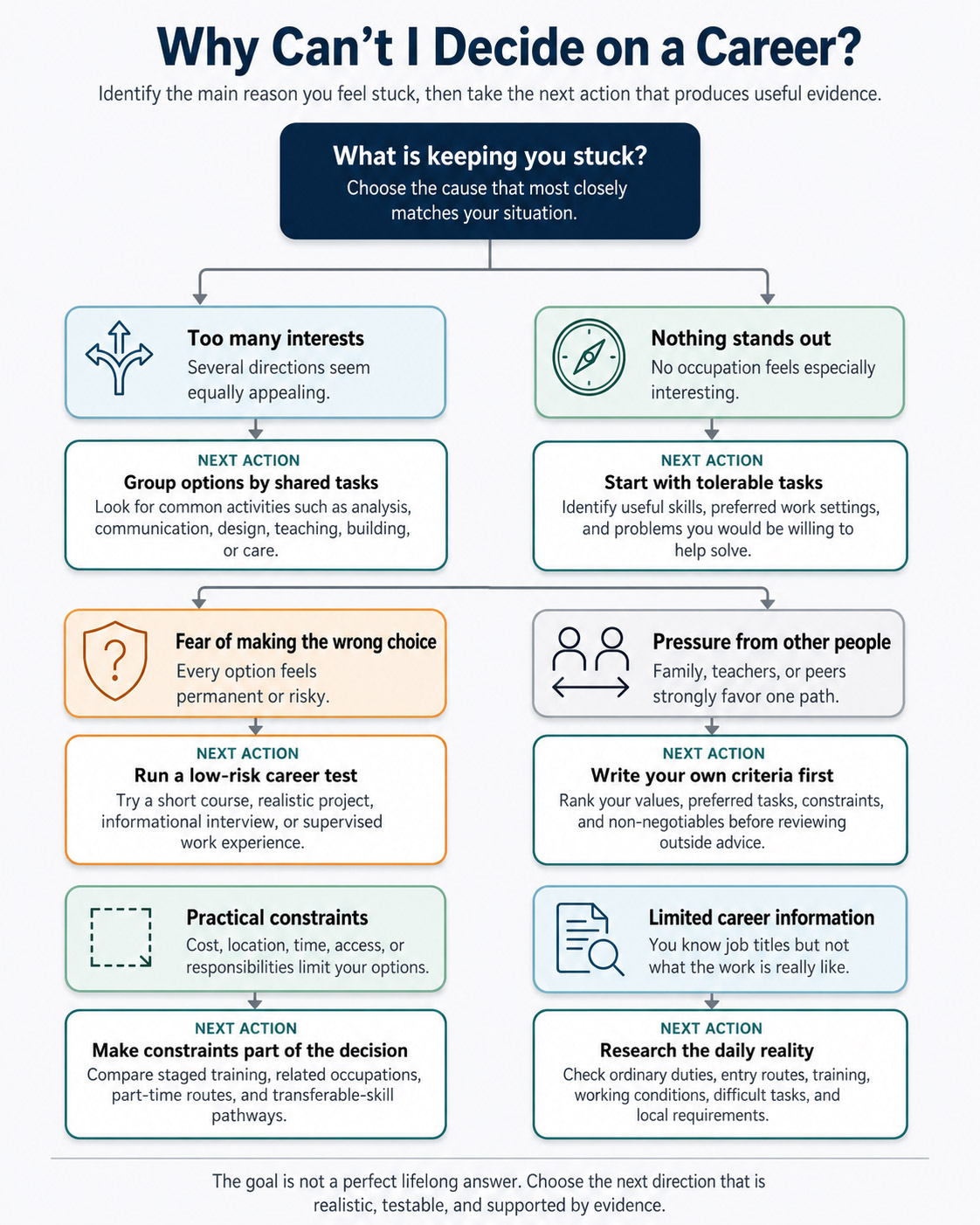
Career indecision means having difficulty choosing or committing to an educational or occupational direction. It may involve limited information, unclear priorities, too many options, practical barriers, outside pressure, or fear of making the wrong choice. This article uses the term descriptively, not as a mental-health diagnosis.
A 2023 systematic review of career indecision examined 118 articles indexed in Scopus. It grouped commonly studied influences into career-related decision difficulties, individual and situational decision-making profiles, readiness for career choice, and other personal or contextual factors.
You do not need to identify one permanent occupation before taking action. A more practical goal is to narrow your options, investigate what the work involves, test the strongest possibilities, and choose a reasonable next step based on the evidence available now.
Salary, employment demand, education requirements, and professional licensing vary by occupation and location. Verify these details through official sources for the country or region where you expect to study or work.
Answer Summary: When you cannot decide on a career, identify why you are stuck, define what you need from work, shortlist a few realistic directions, research their duties and entry requirements, and test the leading options through small experiences. Then make a provisional choice, record your next action, and review the decision after gaining relevant experience.
Table of Content
- Use a Six-Stage Career Decision Process
- Clarify What You Are Choosing
- Identify Why You Cannot Decide
- Define Your Career Criteria
- Use Career Assessments as Clues
- Create a Shortlist of Two to Four Directions
- Research the Daily Reality of Each Direction
- Test Careers Before Making a Major Commitment
- Compare Your Remaining Options
- Make a Provisional Career Decision
- Review the Decision After Gaining Experience
- Seek Career Support When Needed
- Follow a 14-Day Career Exploration Plan
- Avoid Common Career-Decision Mistakes
- Choose the Next Evidence-Based Action
Key Takeaways:
-
Match your next action to the cause of your indecision.
-
Separate interests, skills, values, and practical constraints.
-
Use assessments to generate possibilities, not final answers.
-
Research ordinary duties rather than relying on job titles.
-
Test leading directions before making a costly commitment.
-
Treat comparison tools as decision aids, not predictions.
-
Choose a provisional direction and schedule a review.
Use a Six-Stage Career Decision Process
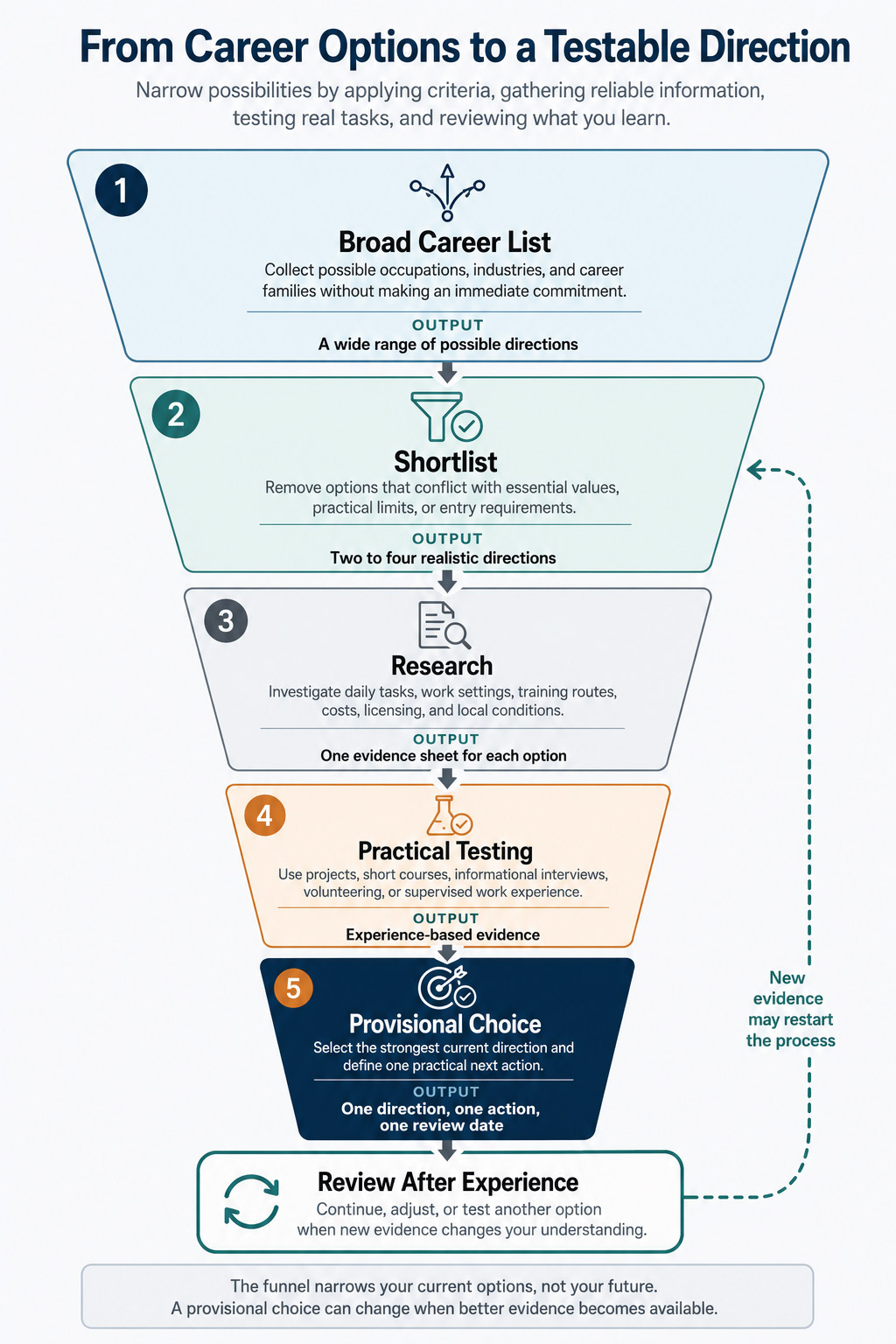
A defined process prevents career exploration from becoming an endless search. This article uses six stages:
Diagnose → Define → Shortlist → Research → Test → Decide
This is an editorial framework for organizing your actions. It is not a formally validated diagnostic instrument.
It broadly reflects Yale University’s career decision-making process, which includes self-assessment, researching options, evaluating priorities, taking action, and reviewing the result. Yale describes career decision-making as an ongoing process that may be repeated as a person’s circumstances and career develop.
| Stage | Main task | Intended output |
|---|---|---|
| Diagnose | Identify the main reason you are stuck | One primary cause of indecision |
| Define | Rank your activities, values, needs, and constraints | A short list of career requirements |
| Shortlist | Remove options that fail essential criteria | Two to four directions to investigate |
| Research | Examine duties, conditions, training, and entry routes | One evidence sheet per direction |
| Test | Gather experience-based information | A small test for each leading option |
| Decide | Compare the evidence and choose the next action | One provisional direction and review point |
The number of options and the time spent at each stage can be adjusted. These are practical limits for this guide rather than universal career-development rules.
Clarify What You Are Choosing
A career, occupation, job, employer, and industry are related concepts, but they are not interchangeable. Separating them can prevent one disappointing experience from being treated as proof that an entire field is unsuitable.
| Term | Meaning in this guide |
|---|---|
| Career | The longer pattern of work, learning, and role changes over time |
| Occupation | A recognized type of work, such as teaching or accounting |
| Job | A specific paid position with defined duties |
| Employer | The organization or person providing the job |
| Industry | The sector in which an organization operates |
| Degree | A formal academic qualification awarded by an authorized institution |
| Skill | An ability developed through learning or experience |
| Interest | An activity or subject that attracts your attention |
| Work value | A condition or outcome you consider important in work |
A person may enjoy an occupation but dislike one employer’s management, schedule, or working conditions. Someone may also enjoy an academic subject without enjoying every related occupation.
Skills developed in one role may transfer to other roles or industries. A career should therefore be viewed as a developing sequence of work and learning rather than one unchangeable job title.
Identify Why You Cannot Decide
The first useful step is to identify the main cause of your indecision. Different causes require different responses.
| Main cause | What it may look like | Suitable next action |
|---|---|---|
| Too many interests | Several directions appear equally appealing | Group options by shared tasks or career families |
| No strong interest | No occupation stands out | Begin with tolerable tasks, useful skills, and preferred conditions |
| Fear of regret | Every choice feels permanent | Separate low-risk tests from major commitments |
| Outside pressure | Other people strongly favor one direction | Define your own criteria before evaluating their advice |
| Practical constraints | Cost, location, time, or responsibilities restrict access | Treat constraints as formal decision criteria |
| Limited information | You recognize job titles but not the daily work | Research tasks, conditions, entry routes, and difficult duties |
When You Have Too Many Interests
Look for shared activities beneath the occupations that interest you. Journalism, policy, teaching, and marketing may all involve research, explanation, writing, or persuasion.
Possible career families include:
-
data and analysis;
-
design and communication;
-
education and training;
-
health and care;
-
science and research;
-
skilled trades;
-
business operations;
-
public and community services.
The purpose is not to decide immediately. It is to turn a long list of job titles into a smaller number of directions that can be investigated properly.
Readers facing this specific problem can also use Collegenp’s guide to choosing a career when you have many interests. The page is directly aligned with this reader need.
When Nothing Stands Out
Begin with tasks you can tolerate and abilities you are willing to develop. Ask:
-
Which activities feel manageable?
-
Which work settings drain me less?
-
Which problems seem worth addressing?
-
Which skills am I willing to practise?
-
Which tasks do I strongly want to avoid?
Interest does not always appear before experience. It may become clearer after you encounter the real tasks, learning demands, and work setting.
When You Fear Regret
Separate low-risk exploration from high-commitment decisions.
Reading an occupational profile, speaking with a worker, completing a sample task, or taking an introductory class usually involves less commitment than leaving a job or enrolling in a long and expensive program.
Use the smaller action to gather information needed for the larger decision.
When Other People Are Pressuring You
Write your career criteria before discussing the choice with family members, teachers, friends, or colleagues.
Outside advice may reveal opportunities, costs, or barriers you have overlooked. However, advice based mainly on status, tradition, or another person’s preferences should not replace your own evaluation.
When Practical Constraints Limit Your Choices
Include cost, time, location, accessibility, family responsibilities, language, and entry requirements at the beginning of the process.
A staged training route, related occupation, part-time program, or transferable-skills pathway may be more feasible than an immediate large commitment.
Define Your Career Criteria
Career criteria describe what a direction should provide, require, or permit before you consider it seriously. Defining them early reduces the risk of changing the rules whenever a new option appears.
Preferred Activities
Focus on tasks you would be willing to perform regularly, not only subjects you enjoy reading or learning about.
Possible activity categories include:
-
analyzing information;
-
creating written or visual material;
-
explaining concepts;
-
organizing people or resources;
-
building or repairing;
-
caring for others;
-
persuading or negotiating;
-
investigating problems;
-
working with numbers;
-
managing projects.
Enjoying an academic subject does not automatically mean that every related occupation will suit you. Daily duties, schedules, training requirements, and workplace conditions also matter.
Skills and Willingness to Learn
Separate your current ability from your willingness to improve.
List:
-
skills you already use confidently;
-
skills you can demonstrate through projects or experience;
-
skills you are willing to develop;
-
tasks you would not want to perform frequently.
A career may still be worth investigating when you lack some entry skills, provided the learning requirement is realistic and acceptable to you.
Work Values
Work values are features of work that matter to you, such as independence, security, recognition, supportive relationships, achievement, or suitable working conditions.
CareerOneStop’s Work Values Matcher organizes work values into six categories: achievement, independence, recognition, relationships, support, and working conditions. CareerOneStop is a US resource, so its occupational and labor-market information should be interpreted within that context.
Define each value in observable terms. Flexibility, for example, could mean:
-
control over working hours;
-
the ability to work from different locations;
-
freedom to change employers;
-
time for study or family responsibilities.
Constraints and Non-Negotiables
Record the conditions that affect what is currently feasible:
-
available education budget;
-
acceptable training duration;
-
geographic access;
-
family or care responsibilities;
-
schedule needs;
-
minimum income requirements;
-
language or accessibility needs;
-
professional registration requirements.
Rank a small number of requirements and identify only the conditions that genuinely cannot be compromised. Treating every preference as non-negotiable may remove all options before meaningful research begins.
Adjust the Process to Your Current Stage
The same framework can be used at different stages, but the next action should reflect your circumstances.
| Reader stage | Suitable starting action | Main evidence needed |
|---|---|---|
| School or university student | Compare subjects, programs, projects, clubs, and work experience | Whether the activities and learning demands fit |
| Recent graduate | Compare entry-level duties, transferable skills, and employer requirements | Whether the occupation fits beyond academic study |
| Career changer | Map existing skills to adjacent roles and test a field before leaving work | Whether the transition is practical and improves important work conditions |
Readers moving from college into employment can use Collegenp’s career planning tips for fresh graduates alongside this framework.
Use Career Assessments as Clues
Career assessments can help identify patterns in your interests, skills, or values. They should generate research questions rather than prescribe one career.
The O*NET Interest Profiler is a vocational-interest inventory developed for educational planning, career exploration, and career guidance. Its scales use six interest areas: Realistic, Investigative, Artistic, Social, Enterprising, and Conventional.
| An assessment may help you | An assessment cannot establish |
|---|---|
| Name broad interest or value patterns | That one occupation will remain suitable throughout life |
| Suggest occupations for investigation | That a particular workplace will suit you |
| Identify topics for discussion with an adviser | That suitable jobs or training are available locally |
| Organize a long list of possibilities | That you meet qualification or licensing requirements |
| Compare current preferences | That those preferences will never change |
Before using a commercial assessment, check:
-
who developed it;
-
what it measures;
-
whether its method is explained;
-
whether payment is required;
-
how personal information is handled.
Use the results as leads. Compare them with your criteria, local requirements, occupational research, and direct experience.
Create a Shortlist of Two to Four Directions
For this framework, a shortlist of two to four directions offers enough variety for comparison without allowing the research task to expand continuously.
This range is a practical recommendation, not a scientifically established optimum.
Begin with broad career families. Remove an option when it clearly fails an essential condition or when reliable research shows that the route is not currently feasible.
Use a stopping rule:
Do not add another career direction until you have completed the planned research on your current shortlist.
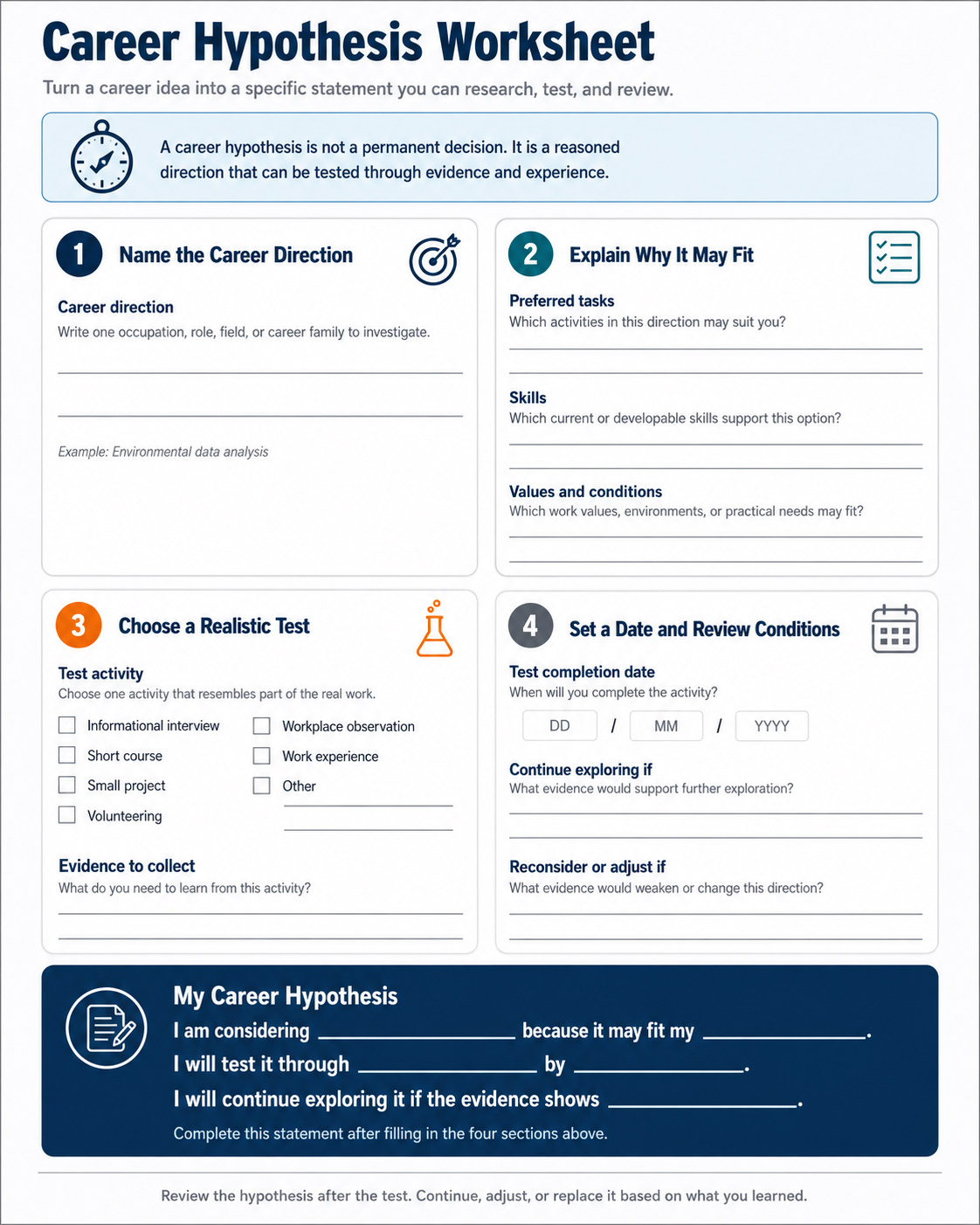
Write a Career Hypothesis
Turn each direction into a statement that can be investigated:
I am considering [career direction] because it may fit my [preferred tasks, skills, values, and constraints]. I will test it through [specific activity] before [date]. I will continue exploring it if the evidence shows [decision criteria].
For example:
I am considering user-experience research because it may involve interviewing, analysis, and written explanation. I will test those activities through a small research project before deciding whether to pursue formal training.
This is a simplified illustration, not a recommendation of that occupation.
Research the Daily Reality of Each Direction
Research should examine ordinary duties, working conditions, entry routes, and less visible parts of the work. A job title or promotional description is not enough evidence for a major decision.
Complete one evidence sheet for each shortlisted direction.
| Research area | Questions to answer |
|---|---|
| Daily tasks | What takes up most of an ordinary working week? |
| Entry-level work | What duties are normally given to new workers? |
| Work setting | Is the work independent, public-facing, physical, remote, scheduled, or team-based? |
| Education and training | Which qualifications are required, preferred, or optional locally? |
| Assessment and licensing | Is registration, examination, supervised practice, or renewal required? |
| Skill demands | Which technical and transferable skills are used frequently? |
| Difficult duties | Which tasks are repetitive, stressful, physically demanding, or less visible? |
| Entry routes | Are several routes into the occupation available? |
| Progression | What additional experience, training, or evidence is needed for later roles? |
| Local conditions | What do official sources say about access, pay, and demand in your location? |
Verify Local Information
Use sources that match the occupation and jurisdiction:
-
government occupational-information services;
-
professional regulators;
-
official education and training providers;
-
recognized licensing bodies;
-
current job descriptions from several employers;
-
official admissions or funding information.
Do not apply salary, demand, licensing, or qualification information from one country to another without checking the relevant local authority.
Conduct Informational Interviews
An informational interview is a conversation used to learn about a career, organization, or professional’s experience. It is not primarily a request for employment.
Useful questions include:
-
What does an ordinary week involve?
-
Which duties take more time than outsiders expect?
-
What do new workers often misunderstand?
-
Which entry routes are realistic?
-
Which skills matter most during the first year?
-
What conditions cause people to leave the field?
-
What would you test before paying for training?
Where possible, speak with more than one person. One person’s experience may reflect a particular employer, location, or career stage rather than the occupation as a whole.
Set an Evidence Threshold
Before making a costly or difficult-to-reverse commitment, decide what evidence you require.
A practical starting checklist is:
-
one official or authoritative occupational profile;
-
one official training or regulatory source where qualifications matter;
-
conversations with people familiar with the field;
-
one small experience resembling the work;
-
one written comparison against your criteria.
This checklist is an editorial decision aid, not a validated professional standard. Increase the amount of research when a decision involves substantial cost, relocation, long training, or regulated practice.
Test Careers Before Making a Major Commitment
A small career test gives you experience-based information before you commit extensive time or money.
Possible tests include:
-
an introductory course;
-
a small project based on realistic tasks;
-
volunteering;
-
workplace observation where permission and safety requirements allow;
-
a part-time or temporary role;
-
a student organization;
-
a professional event;
-
a supervised work-experience placement;
-
an informational interview followed by a sample task.
Choose Tests That Match Your Stage
Students may test a direction through a subject project, club role, short course, volunteering activity, or supervised work experience.
Graduates may create a work sample, speak with people in entry-level roles, attend a professional event, or seek temporary experience involving relevant tasks.
Career changers may take on an internal project, volunteer in a related role, complete a small portfolio task, or study an introductory module before leaving current employment.
Record What the Test Shows
After each experience, record:
-
which tasks held your attention;
-
which tasks you avoided;
-
whether the work setting suited you;
-
whether you want to develop the required skills;
-
which assumption was supported;
-
which assumption changed;
-
what evidence remains missing.
Discomfort caused by being inexperienced is not automatically evidence that the career is unsuitable. A second test may help when the first experience was too brief, unrepresentative, or poorly supervised.
Compare Your Remaining Options
Use the same criteria for every direction. A weighted matrix can make priorities and trade-offs more visible, but it cannot calculate an objectively correct career.
The weights below are examples. Change them to match your circumstances.
| Criterion | Weight | Career A | Career B | Career C |
|---|---|---|---|---|
| Interest in daily tasks | 5 | |||
| Fit with work values | 5 | |||
| Willingness to develop skills | 4 | |||
| Education cost and time | 4 | |||
| Work-setting fit | 4 | |||
| Geographic feasibility | 3 | |||
| Income sufficiency | 4 | |||
| Stability | 3 | |||
| Transferable future options | 3 | |||
| Evidence from practical tests | 5 |
Use one scoring scale, such as 1 to 5. Multiply each score by its weight, then review both the result and the evidence behind it.
A high score based mainly on assumptions should not outweigh reliable information from official sources, conversations, and direct experience. Mark uncertain scores instead of treating them as established facts.
Make a Provisional Career Decision
A provisional decision identifies the strongest current direction and commits you to the next useful action. It does not claim that the direction will remain suitable throughout your working life.
Set a decision date before starting another research cycle. On that date:
-
Remove directions that clearly fail a non-negotiable.
-
Compare the remaining evidence using the same criteria.
-
Select the direction with the strongest overall support.
-
When two options remain close, choose one additional test that can distinguish them.
-
Record the next action and review point.
The next action may involve:
-
applying for a suitable program;
-
completing a foundation module;
-
creating a portfolio project;
-
seeking relevant work experience;
-
developing a transferable skill;
-
investigating a regulated entry route.
Collegenp’s steps of a career development plan can help turn the provisional choice into goals, actions, and review points.
Review the Decision After Gaining Experience
Review the direction after a meaningful milestone, such as completing a project, course module, placement, academic term, or initial period in a role.
Ask:
-
Do the central tasks suit me?
-
Are the difficult duties manageable?
-
Do I want to improve the required skills?
-
Does the working environment fit my values?
-
Are the cost and access conditions still realistic?
-
Has new evidence changed the comparison?
-
Should I continue, adjust the route, or test another direction?
Changing direction after gathering evidence is not the same as choosing carelessly. It means the decision has been updated using information that was not previously available.
Seek Career Support When Needed
Career support may help when self-guided research has not produced a workable direction or when the choice involves substantial educational, personal, or financial consequences.
Support may be useful when:
-
family conflict prevents an independent comparison;
-
assessment results are difficult to interpret;
-
disability, access, care duties, or finances significantly restrict the routes;
-
you need help identifying transferable skills;
-
several options remain tied after research;
-
indecision is causing persistent distress or interfering with everyday activities.
The National Career Development Association’s guidance on finding career help distinguishes career counselors from other career-service providers, including coaches, advisers, and consultants. Their education, credentials, experience, services, and fees may differ.
Before paying for support, check:
-
relevant qualifications and credentials;
-
experience with people in your situation;
-
the scope and method of the service;
-
fees and cancellation terms;
-
privacy practices;
-
whether the provider promises guaranteed or immediate results.
Students may begin with a school, college, or university career service where one is available. Collegenp’s article on why career counselling matters provides additional decision frameworks and questions to consider.
Career indecision alone should not be treated as proof of a mental-health condition. When distress is significant or everyday functioning is affected, consider speaking with an appropriately qualified health professional or trusted school support service.
Follow a 14-Day Career Exploration Plan
This 14-day schedule is an optional pacing tool. It is not a researched minimum period or a guarantee that you will reach a decision within two weeks.
Days 1–2: Diagnose
Write the main reason you are stuck. Record any secondary factor affecting the decision.
Output: One primary cause of indecision.
Days 3–4: Define
Rank your preferred activities, skills, work values, working conditions, and constraints. Identify a small number of requirements and genuine non-negotiables.
Output: A ranked criteria list.
Days 5–6: Shortlist
Choose two to four career directions and write one hypothesis for each. Pause the search for additional options.
Output: A limited shortlist.
Days 7–9: Research
Complete an evidence sheet for each direction. Check local education, training, and licensing information where relevant. Arrange informational conversations.
Output: Comparable evidence sheets.
Days 10–12: Test
Complete one accessible activity that resembles part of the work. Record what the experience supported, challenged, or left unanswered.
Output: Experience-based evidence.
Days 13–14: Decide
Compare the options using the same criteria. Select a provisional direction or define one additional test needed to resolve a close comparison.
Output: One next action and a review date.
You may need more than 14 days when access to workers, courses, official documents, or practical experiences is limited.
Avoid Common Career-Decision Mistakes
Expanding the Option List Continuously
Adding new careers without researching the existing shortlist creates more comparison work. Use a stopping rule.
Researching Titles Instead of Tasks
An appealing job title may hide duties, schedules, or working conditions that do not fit. Investigate ordinary tasks and entry-level responsibilities.
Letting One Assessment Decide
An assessment measures selected patterns. It cannot account for every workplace, practical constraint, local labor market, or future change.
Treating a Degree as a Job Outcome
A degree is an educational qualification, not a guaranteed employment result. Employment outcomes also depend on role requirements, demonstrated skills, experience, location, employer practices, and labor-market conditions.
Ignoring Cost and Access Until Late
Financial, geographic, accessibility, and licensing barriers should be examined before you commit to a direction.
Waiting for Complete Certainty
Career decisions usually involve incomplete information. Use a defined evidence threshold, choose a provisional action, and review the outcome after gaining experience.
Choose the Next Evidence-Based Action
Career uncertainty becomes easier to manage when an undefined life decision is converted into a series of smaller tasks.
Use the same six stages throughout the process:
Diagnose → Define → Shortlist → Research → Test → Decide
The aim is not to prove that one occupation will remain suitable forever. It is to select the most defensible next direction based on current evidence, take an appropriate action, and review the choice after learning more.







Comments 0
No comments yet. Be the first to start the conversation.