




The honest answer is that neither a degree nor skills are always more important. A degree matters most when a career requires formal eligibility, credibility, licensing, or structured academic knowledge. Skills matter most when employers or clients need proof that you can actually perform the work.
For most people, the strongest career path is not degree or skills alone. It is a degree supported by practical, visible, job-ready skills.
This question matters because students, parents, graduates, job seekers, freelancers, and career switchers are making real decisions about time, money, and career direction. A degree can open doors, but skills often decide whether a person can perform, grow, and adapt after entering the workplace.
Table of Content
- Quick Answer: Degree vs Skills
- What Is a Degree?
- What Are Skills?
- Degree vs Skills: Main Differences
- When Is a Degree More Important?
- When Are Skills More Important?
- What Do Employers Actually Want?
- Which Is Better by Career Type?
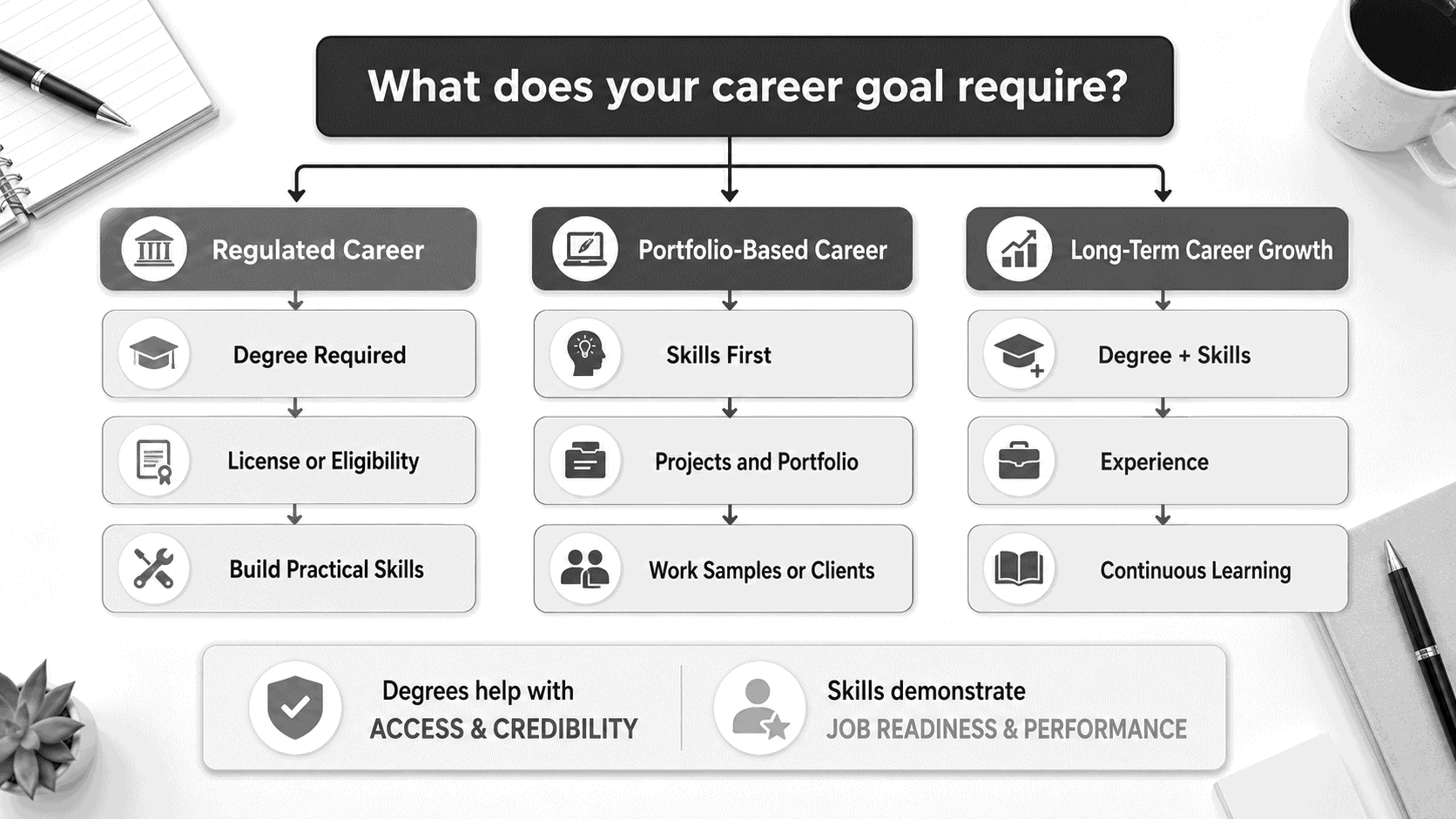
- Degree-First, Skill-First, or Both: Decision Framework
- Best Strategy for Students
- Best Strategy for Job Seekers Without a Degree
- Best Strategy for Degree Holders Without Skills
- Best Skills to Build While Studying
- Common Mistakes to Avoid
- Final Verdict: Degree or Skills?
Quick Answer: Degree vs Skills
A degree is more important when the career has formal entry rules, licensing requirements, or strong academic expectations. Skills are more important when performance can be proven through projects, portfolios, work samples, internships, technical tests, or client results.
The safest answer is this: choose a degree-first path for regulated careers, a skill-first path for portfolio-based careers, and a combined path for long-term career growth.
| Factor | Degree | Skills |
|---|---|---|
| Main value | Formal qualification and credibility | Practical ability and performance |
| Best for | Regulated, academic, government, and structured careers | Tech, design, digital work, freelancing, sales, trades, entrepreneurship |
| Proof | Certificate, transcript, institution, license | Portfolio, projects, internship, case studies, work samples |
| Time required | Usually longer | Can be built continuously |
| Job impact | Helps with eligibility and screening | Helps with performance and shortlisting |
| Main weakness | May not prove practical ability | May be ignored if there is no visible proof |
| Best outcome | Degree plus practical skills | Skills plus credible proof |
What Is a Degree?
A degree is a formal academic qualification awarded by a college, university, or recognized institution after completing a structured program of study. It usually includes theory, assignments, examinations, projects, research, and sometimes internships or fieldwork.
The value of a degree is not only the certificate. A good degree can provide:
-
Structured subject knowledge
-
Academic discipline
-
Professional credibility
-
Eligibility for further study
-
Access to regulated careers
-
Networking opportunities
-
A recognized signal of commitment
However, a degree alone does not prove that someone is job-ready. A graduate may understand theories but still lack communication, problem-solving, digital tools, teamwork, writing, data handling, or technical execution. This is where many degree holders face difficulty in the job market.
What Are Skills?
Skills are the abilities that help a person perform a task well. They may be technical, practical, creative, analytical, interpersonal, or job-specific.
Skills usually fall into two broad groups.
Technical skills include coding, accounting, data analysis, graphic design, digital marketing, writing, research, laboratory work, video editing, project management, and the use of industry tools.
Soft skills include communication, teamwork, critical thinking, leadership, adaptability, time management, negotiation, emotional control, and problem-solving.
Skills become more valuable when they are visible. Saying “I know programming” is weaker than showing a working app, website, GitHub profile, or solved technical challenge. Saying “I know digital marketing” is weaker than showing an SEO audit, campaign report, analytics dashboard, or content strategy.
Degree vs Skills: Main Differences
The main difference between degree and skills is access versus performance.
A degree often helps a person enter a system. Skills help the person perform inside that system.
| Comparison Point | Degree | Skills |
|---|---|---|
| Purpose | Shows formal education and subject exposure | Shows ability to perform real work |
| Recognition | Recognized by institutions, employers, and regulators | Recognized through results, portfolio, tests, and experience |
| Cost | Often expensive and time-consuming | Can be low-cost or high-cost depending on the path |
| Flexibility | Usually follows a fixed curriculum | Can be updated quickly |
| Employer use | Screening, eligibility, credibility | Hiring tests, job performance, promotion, client trust |
| Long-term value | Useful for credibility, further study, and formal careers | Essential for adaptability and career growth |
| Risk | Degree without skills can be weak | Skills without proof can be ignored |
When Is a Degree More Important?
A degree is more important when the profession has formal rules or when employers need a trusted qualification before allowing someone to perform the work.
Regulated Professions
Fields such as medicine, nursing, law, teaching, engineering, accounting, and some government or public-sector roles may require recognized qualifications, licensing exams, registration, or professional approval. The exact requirement depends on the country, employer, and professional body.
In these fields, skills are essential, but skills alone may not be enough. A self-taught person cannot legally or professionally enter many regulated roles without meeting formal education, examination, or licensing requirements.
Academic and Research Careers
Formal qualifications usually matter strongly in university teaching, research, academic publishing, and postgraduate study. Degrees help prove that a person has studied a discipline systematically and can continue into advanced academic work.
Government and Formal Recruitment
Many government jobs and structured recruitment systems use degrees as eligibility criteria. Even if the actual work requires practical skills, the application may not move forward unless the candidate meets the education requirement.
Early-Career Credibility
For fresh graduates, a degree can reduce uncertainty for employers. It shows that the person completed a formal learning path. This signal becomes much stronger when the graduate also has internships, projects, volunteering experience, certificates, and communication skills.
When Are Skills More Important?
Skills become more important when performance can be tested or inspected directly.
Technology and Digital Careers
In software development, web development, data, cybersecurity, content, and digital product roles, practical ability can often be tested through assignments, portfolios, code samples, technical interviews, and projects.
A degree can help, but it is not enough if the candidate cannot solve real problems.
Design, Media, and Creative Work
Graphic design, video editing, photography, animation, UX design, writing, and content creation are strongly portfolio-based. Employers and clients want to see what the person can produce.
In these fields, a strong portfolio may speak louder than a weak academic record.
Sales, Marketing, and Business Roles
In sales, digital marketing, customer support, business development, operations, and entrepreneurship, practical execution matters strongly. Communication, persuasion, reporting, negotiation, customer handling, and problem-solving often matter as much as formal education.
Freelancing and Entrepreneurship
Freelancers and entrepreneurs are judged mainly by results. Clients usually care whether the person can deliver the service, solve the problem, meet deadlines, and communicate clearly.
A degree can support credibility, but portfolio, testimonials, work samples, and client outcomes often carry more immediate value.
What Do Employers Actually Want?
Employers rarely want only a degree or only skills. They want lower hiring risk.
A degree reduces risk by showing that a person completed formal education. Skills reduce risk by showing that the person can perform the actual work. Experience reduces risk further by proving that the person has already handled real tasks, deadlines, teams, or clients.
This is why the degree vs skill debate is often too simple. In real hiring, employers may look at:
-
Minimum education requirement
-
Relevant technical skills
-
Communication ability
-
Internship or work experience
-
Portfolio or project evidence
-
Problem-solving ability
-
Professional attitude
-
Fit for the role and organization
Skills-based hiring is growing as a discussion in the job market, but it should not be exaggerated. Some employers are reducing degree requirements for certain roles, but many still use degrees as screening tools, especially when there are many applicants or when the role has formal requirements.
A practical way to understand employer behavior is:
-
A degree may get your resume noticed.
-
Skills may get you shortlisted.
-
Proof of work may get you interviewed.
-
Communication and reliability may get you hired.
-
Continuous learning may help you grow.
Which Is Better by Career Type?
| Career Type | What Matters More? | Practical Verdict |
|---|---|---|
| Medicine and nursing | Degree and license first | Skills are essential, but formal qualification is usually non-negotiable |
| Law | Degree and professional qualification first | Legal practice usually requires recognized education, exams, or licensing |
| Teaching | Degree, training, and license | Classroom skill matters, but eligibility rules often apply |
| Engineering | Degree and technical competence | Formal qualification may be required; projects and practical skills improve employability |
| Government jobs | Degree and eligibility first | Skills help after entry, but formal criteria often decide application eligibility |
| Software development | Skills and portfolio strongly matter | Degree helps, but coding ability, projects, and technical tests are critical |
| Graphic design and creative media | Portfolio first | Degree can help, but visible work is often more persuasive |
| Digital marketing | Skills and measurable work | Campaigns, analytics, content, SEO, ads, and reporting matter strongly |
| Business and management | Both | Degree gives foundation; internships, communication, data, and execution prove readiness |
| Trades and vocational work | Skills and certification | Practical competence, safety, and recognized training matter |
| Freelancing | Skills and trust proof | Portfolio, reviews, samples, delivery record, and communication matter most |
Degree-First, Skill-First, or Both: Decision Framework
| Situation | Better Path |
|---|---|
| Your target career requires a license or formal qualification | Degree first, then skills |
| You want medicine, law, teaching, nursing, engineering, or government jobs | Degree and eligibility first |
| You want software, design, content, digital marketing, or freelancing | Skills and portfolio are critical; degree can support credibility |
| You are still in high school and unsure | Choose a broad degree path while building transferable skills |
| You cannot afford a degree immediately | Start with skills, portfolio, and work experience; consider formal study later if needed |
| You already have a degree but no job | Build job-specific skills and practical proof |
| You already have skills but no credibility | Add certificates, client work, testimonials, or formal qualifications where useful |
| You want long-term career mobility | Combine degree, skills, experience, and continuous learning |
Best Strategy for Students
Students should not wait until graduation to build skills. A degree without practical evidence is weak in a competitive job market.
The best strategy is to build a simple career file from the first year of study. This file may include projects, certificates, writing samples, internship records, presentation slides, research work, case studies, volunteering experience, competition participation, and technical work.
Students should focus on four layers.
First, complete the degree properly. Do not ignore academic performance, especially if the field is regulated, competitive, or linked with further study.
Second, learn practical tools. These may include spreadsheets, writing tools, design tools, coding platforms, accounting software, data tools, research tools, or field-specific equipment.
Third, create proof. Build a portfolio, publish work, complete projects, join internships, contribute to clubs, or solve real problems.
Fourth, improve communication. Many capable students lose opportunities because they cannot explain their work clearly. Writing, speaking, email etiquette, teamwork, and interview confidence matter in almost every field.
Best Strategy for Job Seekers Without a Degree
It is possible to build a career without a degree in some fields, but it is not equally easy in all fields. The realistic question is not “Can I succeed without a degree?” The better question is: “Can I prove enough value that an employer or client trusts me without a degree?”
A job seeker without a degree should focus on proof, not slogans.
Useful proof includes:
-
A portfolio website or professional profile
-
Project samples
-
GitHub or technical repository for coding roles
-
Case studies
-
Freelance work
-
Internship or apprenticeship experience
-
Client testimonials
-
Short, credible certifications
-
Work samples matched to the target job
-
Strong interview preparation
This path works better in fields where output can be inspected directly, such as coding, design, writing, digital marketing, video editing, sales, customer support, and some skilled trades. It is much harder in careers where a degree or license is legally required.
Best Strategy for Degree Holders Without Skills
A degree holder without skills should not assume the degree has no value. The problem is not always the degree. The problem is often the missing bridge between education and work.
The fastest improvement is to identify the exact skills required for target jobs. Read job descriptions carefully. List repeated requirements. Then build evidence around those requirements.
For example:
-
A business graduate can learn Excel, financial analysis, reporting, CRM tools, sales communication, and presentation.
-
An IT graduate can build projects, improve coding, learn databases, contribute to open-source work, and prepare for technical interviews.
-
An education graduate can prepare lesson plans, classroom activities, assessment methods, and teaching demonstrations.
-
A management graduate can complete internships, case studies, market research, and operations projects.
-
A media student can build a writing, video, design, or social media portfolio.
The goal is to convert formal education into employability. That happens when knowledge becomes visible work.
Best Skills to Build While Studying
Students should not chase random courses. The best skills are those that support their career goal.
Some widely useful skills include:
-
Communication
-
Writing
-
Digital literacy
-
Data basics
-
Problem-solving
-
Presentation
-
Teamwork
-
Research
-
Time management
-
Critical thinking
-
Basic financial literacy
-
Field-specific technical tools
For technical careers, add coding, data analysis, cybersecurity basics, cloud tools, engineering software, laboratory skills, or machine operation depending on the field.
For business careers, add Excel, accounting basics, market research, sales communication, CRM tools, reporting, analytics, and negotiation.
For creative careers, add portfolio development, design tools, storytelling, editing, branding basics, and client communication.
Common Mistakes to Avoid
Thinking a Degree Guarantees a Job
A degree can improve access, but it does not guarantee employment. Employers still look for ability, communication, attitude, adaptability, and proof of work.
Saying Degrees Are Useless
This claim is misleading. Degrees remain important in many careers, especially regulated, academic, public-sector, and structured professional fields.
Collecting Certificates Without Real Skill
Short courses and certificates are useful only when they build real ability. A certificate without practice, projects, feedback, or understanding has limited value.
Ignoring Soft Skills
Many candidates focus only on technical skills and ignore writing, speaking, teamwork, punctuality, and professional behavior. These skills affect hiring, promotion, and client trust.
Claiming Skills Without Proof
Skills must be visible. A claim on a resume is weaker than a project, sample, demo, case study, internship, or portfolio.
Final Verdict: Degree or Skills?
Skills are more important for performance. A degree is more important for access, credibility, and careers with formal requirements. For long-term career success, the stronger answer is usually both.
Choose a degree-first path if your career requires eligibility, licensing, formal recognition, or academic progression.
Choose a skill-first path if your target field rewards visible output, practical tests, portfolios, freelance work, or direct performance.
Choose a combined path if you want the strongest and safest career profile. A degree tells people you studied the field. Skills show that you can work in it. Experience and proof show that others can trust you.
The job market is changing, but the basic rule remains clear: formal education opens some doors; practical ability keeps them open.







Comments 0
No comments yet. Be the first to start the conversation.