




The choice between becoming a generalist and becoming a specialist is often framed as a permanent career decision. That framing creates an unnecessary problem. Most careers involve some combination of broad capabilities and deeper expertise, and the balance can change as the work changes.
A student choosing a field, an early-career worker trying to become more employable, a specialist considering management, and an experienced professional changing direction are not making the same decision. One may need deeper technical competence. Another may need broader business or communication skills. A third may already have the required abilities but lack a clear way to demonstrate them.
Research on human capital, occupational specificity, skill transferability, and career mobility supports a more useful question: what mix of depth and breadth does the work you want next require?
That question shifts attention away from career labels and toward the skills, qualifications, tasks, and evidence of competence that matter in a real role.
Answer Summary: A generalist career is not automatically safer or more flexible, and a specialist career is not automatically better paid or more secure. Evidence suggests that broad and specific skills often complement one another. Greater occupational specificity can increase returns while reducing mobility in some settings, while transferable skills can preserve more options. The practical choice depends on the target work, required depth, transferability of existing skills, and the cost of changing direction.
Table of Content
- What Do Generalist and Specialist Mean in Practice?
- Why Breadth and Depth Are Not Opposites
- What Does Research Say About Specialization and Career Mobility?
- When Should Deeper Specialization Take Priority?
- When Does Broader Capability Become More Useful?
- Is a T-Shaped Career the Answer?
- How Can You Decide What You Need Next?
- How Can You Change Direction Without Discarding Your Experience?
- Which Career Claims Deserve Caution?
- Illustrative Situations Where the Answer Changes
- A Practical Generalist-vs-Specialist Decision Table
- A Better Way to Make the Decision
- References
Key Takeaways:
-
Generalist and specialist describe different patterns of work and expertise, not permanent personality types.
-
Broad foundational skills and advanced specific skills can exist together.
-
Specialization can bring stronger returns in some settings while reducing occupational mobility.
-
Transferable skills matter most when they overlap with the tasks required in the next role.
-
A career problem may come from insufficient depth, insufficient breadth, or weak proof of competence.
-
Regulated and qualification-gated careers require formal requirements to take priority over general career advice.
-
The most useful decision is often the next skill investment, not a permanent generalist-or-specialist identity.
What Do Generalist and Specialist Mean in Practice?
A generalist usually works across a wider set of tasks, functions, or problems. A specialist develops greater depth in a narrower area. Those definitions are useful only if you also ask what is broad, what is specific, and where the skills can be reused.
Someone may have a broad job and still possess deep expertise. A specialist may depend on communication, analysis, problem solving, teamwork, or other capabilities that transfer across many roles.
This is why definitions such as “a generalist knows a bit about many subjects” and “a specialist knows one subject deeply” are too crude for career decisions.
A stronger way to examine the difference is through four questions:
-
How wide is the person's work scope?
-
How deep is their knowledge or proficiency in a particular domain?
-
How reusable are their skills across jobs or sectors?
-
How specific are their training and qualifications to a particular occupation?
These dimensions do not always move together.
The European Commission's European Skills, Competences, Qualifications and Occupations framework, or ESCO, separates skills by reusability. Its categories include transversal, cross-sectoral, sector-specific, and occupation-specific skills. A transversal skill has wide application; an occupation-specific skill has much narrower use.
That distinction is more useful than asking whether someone “is” a generalist. It directs attention to what their abilities allow them to do in other settings.
If the deeper problem is uncertainty about the career itself, it makes sense to first choose a career based on skills, values and lifestyle. Breadth-versus-depth decisions become clearer once there is a realistic target.
Why Breadth and Depth Are Not Opposites
Advanced specialization can be built on broad foundational abilities rather than replacing them.
A 2025 study in Nature Human Behaviour examined U.S. occupational skill data and more than 70 million job transitions. The researchers identified a nested structure in which more specific skills often depend on broader foundational skills. In the occupational system they studied, jobs requiring specialized capabilities commonly also required more general capabilities underneath them.
That finding corrects a common misunderstanding. Developing deep expertise does not necessarily mean giving up broad skills. A person may need both.
Consider an illustrative example. Someone working deeply in data analysis may need technical knowledge of statistical methods and software, but that work can also depend on writing, interpretation, problem framing, and communication. The specific capability does not make the broader abilities irrelevant.
The same logic works in the other direction. Broad skills alone do not prove competence in work that requires substantial technical depth. Strong communication does not substitute for accounting knowledge in accounting work, clinical competence in health practice, or engineering competence in engineering work.
The useful question is not whether breadth or depth is superior. It is whether your broad capabilities support the deeper work you want to perform, and whether your deeper expertise is sufficient for the standard that work requires.
Readers who need a narrower distinction between technical and interpersonal abilities can also compare hard skills and soft skills. That comparison is related, but it is not identical to generalist versus specialist: both hard and soft skills can vary in depth and transferability.
What Does Research Say About Specialization and Career Mobility?
Research suggests a genuine trade-off in some settings: greater specificity can increase the value of staying in a field while reducing flexibility to move elsewhere.
A 2018 Labour Economics study examined Swiss vocational education and training curricula. The researchers developed a measure of occupational specificity based on the skills taught in training programs and how widely those skill combinations were used in the labor market. They found higher returns for more specific training and greater occupational mobility for less specific training.
The finding matters, but its limits matter equally. It comes from the Swiss vocational education system. It does not prove that every specialist earns more, that every generalist changes careers more easily, or that the same trade-off has the same size in another country.
A second study, published in the European Economic Review in 2020, examined the specificity of U.S. college majors. The most specific majors in the researchers' measure had an early-career earnings premium of about 5–6% over average-specificity majors and about 15–20% over the most general majors. Graduates from the most specific majors were also the least likely to hold managerial positions, while those from majors of average specificity were the most likely.
Those numbers should not be translated into “specialists earn 15–20% more.” The study measured college-major specificity, not whether individual workers had generalist or specialist careers. Field of study, occupational choice, worker characteristics, and other factors are part of the context.
The defensible lesson is narrower: specificity can have economic value, but that value comes with conditions and does not create a universal career rule.

When Should Deeper Specialization Take Priority?
Deeper specialization deserves priority when the target work has a clear competence threshold that broad familiarity cannot meet.
That situation is clearest in regulated or qualification-gated occupations. Where a profession requires a particular qualification, license, accredited training route, supervised practice, or other formal condition, those rules come before general career strategy. Requirements vary by country and profession, so they should be checked with the responsible authority.
A similar issue exists outside regulated work. A role may have no legal entry requirement but still demand substantial practical depth. If the core work requires technical judgment that you cannot yet perform reliably, learning additional unrelated skills does not solve that gap.
Specialization may deserve priority when:
-
the role consistently requires a specific body of knowledge;
-
performance depends on techniques that need sustained practice;
-
employers or clients need credible evidence of domain competence;
-
the work carries consequences that make superficial knowledge inadequate;
-
your current limitation is inability to perform the central task rather than inability to understand the wider context.
There is also a difference between developing depth in a durable area and tying yourself to one narrow tool.
Knowledge of a domain, method, or recurring type of problem may transfer across employers. Expertise that depends entirely on one proprietary system or one organization's internal process may have narrower value. The distinction is worth examining before committing substantial time to specialized learning.
When Does Broader Capability Become More Useful?
Broader capability becomes more useful when the work crosses functions, requires coordination, or when your specialist knowledge is already strong enough and the next limitation lies outside it.
Imagine an experienced technical employee who can perform the specialist work well but struggles when responsibilities expand to budgeting, project prioritization, stakeholder communication, or team coordination. More technical depth may not address the new problem. Complementary breadth may.
A different reader may face the opposite situation. Someone has worked across research, projects, communication, administration, and client support but cannot explain what they are distinctly capable of doing. That person may not need more breadth. They may need a clearer anchor: one area where their accumulated experience forms credible, demonstrable depth.
Broader learning can also be useful while comparing plausible directions, especially when the cost of an early narrow commitment is high. That does not mean remaining broad indefinitely. Some careers impose early training requirements, while others allow more room to test different functions before choosing a deeper focus.
Breadth has more value when the skills connect to one another. Accumulating unrelated courses and surface-level knowledge can create activity without creating a coherent professional capability.
Is a T-Shaped Career the Answer?
The T-shaped model is a useful metaphor, not a proven universal career design.
In the model, the horizontal part represents breadth and the vertical part represents depth. It helps people picture a career that combines a wider set of capabilities with stronger expertise in one area.
The problem begins when the metaphor becomes a rule. The evidence reviewed here does not establish that every worker should have exactly one deep specialty, that a T-shaped profile produces stronger outcomes in every profession, or that one shape fits every career stage.
Some people develop depth in several related areas. Some professions demand substantial depth before broader responsibility becomes relevant. Others place greater value on integrating work across functions.
The more reliable principle is to build enough breadth to work effectively in the relevant environment and enough depth to meet the real competence standard of the work you want.
How Can You Decide What You Need Next?
The strongest decision process starts with the target work and works backward to the missing capability.
1. Name the Work You Are Moving Toward
Choose a specific role, responsibility, problem area, or professional direction.
“Become more specialized” is too vague to guide learning. “Become capable of handling financial analysis for this type of role” or “move from technical execution into project leadership” gives you something concrete to investigate.
If several directions are still plausible, compare a small number rather than trying to evaluate every possible career.
2. Find the Competency Gates
Identify requirements you cannot bypass through general experience.
These may include formal qualifications, licenses, technical skills, language ability, portfolios, examinations, or recurring experience requirements. Some are legal or professional requirements; others are hiring expectations.
Separate genuine gates from preferences. A job advertisement may contain a long wish list, while the core role may depend on a smaller group of abilities.
3. Map What Already Transfers
List the tasks you have performed repeatedly rather than relying only on job titles.
Ask:
-
What problems have I solved?
-
What decisions have I made?
-
What tools or methods have I used?
-
What kinds of people have I worked with?
-
What knowledge do I already have?
-
Which of these appear in the target role?
This task-based comparison is supported by research from Christina Gathmann and Uta Schönberg. Their study found that workers tended to move into occupations with similar task requirements and that labor-market skills were more portable across occupations than a rigid general-versus-specific distinction would suggest.
Transfer is partial, not automatic. Similar tasks can preserve part of prior experience, but a new profession can still require substantial additional learning.
4. Diagnose the Missing Piece
A useful career diagnosis separates three different problems.
A depth problem exists when you cannot yet perform the central specialist work to the required level.
A breadth problem exists when you can perform the specialist work but struggle with the surrounding functions needed for wider responsibility.
A signaling problem exists when you have relevant capability but other people cannot see clear evidence of it.
These problems call for different responses.
Someone with a depth problem may need focused training and practice. Someone with a breadth problem may need complementary exposure to adjacent functions. Someone with a signaling problem may gain more from stronger work samples, project evidence, clearer positioning, or a recognized qualification where one has genuine value.
Adding another course to all three situations treats different problems as though they were the same.
5. Compare the Cost of Narrowing With the Cost of Staying Broad
Specializing has an opportunity cost. So does refusing to specialize.
When considering deeper specialization, ask:
-
How many roles use this capability?
-
Does it transfer across employers?
-
Does it depend on one tool or on a wider body of knowledge?
-
Which adjacent roles remain open?
-
Would changing direction later require formal retraining?
When considering a broader path, ask:
-
Does the target work have a depth threshold I am avoiding?
-
Can I show credible competence in a particular area?
-
Do I repeatedly move to new subjects before reaching usable proficiency?
-
Can an employer or client understand what problem I am prepared to solve?
This is where the decision becomes personal without becoming arbitrary. The value of flexibility depends on what alternatives you are preserving, while the value of specialization depends on what deeper capability allows you to do.
6. Test the Direction Through Real Work Where Possible
Large education or career decisions are easier to judge when you have evidence from the work itself.
Depending on your situation, that may mean completing a relevant project, taking responsibility for a narrower task, joining work that crosses functions, creating a portfolio sample, or speaking with people who understand the target role.
The purpose is to test your assumptions about the work. A career can sound attractive in description while its daily tasks feel unsuitable. A specialty can seem too narrow until you see how many related problems it connects to.
7. Choose the Next Investment Rather Than a Permanent Label
You do not need to decide whether you are “a generalist” or “a specialist” for the rest of your working life.
A broad professional can deepen. A specialist can broaden. A technical employee can move into wider responsibility while keeping domain expertise. A career changer can carry transferable experience into an adjacent field and build the missing component.
The more manageable question is: what capability would make the next realistic move more credible?
Readers deciding whether that means deeper learning in the current direction or preparation for a different one can compare upskilling or reskilling.
How Can You Change Direction Without Discarding Your Experience?
A career change does not automatically erase the value of earlier work. What matters is how much of the underlying task experience carries into the new role.
The Gathmann and Schönberg research found that occupational moves frequently occur between jobs with similar task requirements. That supports a practical way to assess a transition: compare tasks rather than titles.
Suppose a person wants to leave one industry for another. Instead of asking whether the old title matches the new title, they can compare activities such as research, analysis, client communication, process improvement, project coordination, writing, negotiation, or technical problem solving.
Some of those capabilities may transfer directly. Others may need adaptation to a new context. Still others may have little relevance.
Then identify what does not transfer.
That gap may be a qualification, new domain knowledge, a different technical method, or experience that must be built through new work. The size of the gap helps determine whether the move is an adjacent transition or a substantial professional retraining decision.
This approach avoids two errors. The first is assuming that changing careers means returning to zero. The second is assuming that transferable skills alone qualify someone for work with a genuine expertise threshold.
For a more focused transition process, see how to switch careers without starting from zero.

Which Career Claims Deserve Caution?
Several claims about generalists and specialists are repeated more confidently than the available evidence permits.
“Specialists earn more.”
Some research finds stronger returns to more specific training or fields of study in particular settings. That is not a global salary rule. Occupation, country, experience, demand, education, industry, and role level can change the result.
“Generalists have stronger job security.”
Transferable capabilities may provide more possible directions, but mobility and job security are not the same outcome. The evidence reviewed does not support a universal claim that generalists are more secure.
“Specialists cannot become managers.”
The evidence does not support that conclusion. The study of U.S. college-major specificity found differences in managerial outcomes, but a specific college major is not the same as a specialist career, and the result does not define what an individual worker can become.
“Generalists make better entrepreneurs.”
The entrepreneurship evidence is mixed. Olmo Silva's panel-data study found that acquiring expertise across more subjects did not increase the probability of becoming an entrepreneur after accounting for unobserved individual characteristics. Other research has continued to test relationships between balanced skill sets and entrepreneurship. That literature does not justify a rule that generalists make stronger founders.
“Once you specialize, you are stuck.”
Specialization can make distant moves more costly, but related tasks and knowledge can transfer across occupations. The amount that transfers depends on the relationship between the old work and the new work.
“A T-shaped profile is the ideal career model.”
T-shaped skills are a useful way to picture breadth plus depth. They are not an empirically established optimum for every profession, labor market, or career stage.
Illustrative Situations Where the Answer Changes
The following situations are examples for decision-making, not documented case studies.
A Graduate With Several Interests but No Clear Target
The immediate problem may not be choosing breadth or depth. It may be identifying which work is worth testing. Premature specialization can be costly if the person has little evidence about the work, while indefinite exploration can prevent the development of credible competence.
A sensible next move is to narrow the possible directions, inspect the real work involved, and then identify which capabilities deserve deeper investment.
A Broad Professional Whose Experience Is Hard to Explain
Someone may have experience across projects, research, communication, operations, and client work but struggle to describe a clear professional anchor.
More breadth may make the problem worse.
The better move may be to identify where those experiences overlap and develop deeper evidence in that area. The goal is not to erase broad experience but to make its value easier to understand.
A Deep Specialist Moving Toward Wider Responsibility
A technically capable specialist may find that the new bottleneck is no longer technical knowledge.
If the next role involves planning, budgeting, communication, prioritization, or coordination, broader capability may now create more value than further narrowing. The person can add those abilities without abandoning the technical foundation.
A Worker Moving Into an Adjacent Career
A person changing fields may already possess useful task experience. Mapping those overlaps can reduce unnecessary retraining, while a careful gap analysis prevents overestimating what transfers.
Someone Entering a Regulated Profession
General career frameworks have limited authority here. Formal qualification, licensing, registration, supervised practice, and scope-of-practice requirements may determine the necessary route.
The first step is to verify the current rules in the relevant jurisdiction.
A Practical Generalist-vs-Specialist Decision Table
| Situation | Emphasis to Consider | Important Limitation |
|---|---|---|
| Regulated or expertise-gated role | Required depth first | Verify current professional requirements |
| Broad role with no clear anchor | Build one demonstrable area of depth | Keep transferable breadth that supports the work |
| Deep specialist moving into wider responsibility | Add complementary breadth | Retain relevant domain credibility |
| Career changer | Map task overlap and target-specific gaps | Transferability is partial, not automatic |
| Small-team or founder setting | Ensure the needed functions are covered | Breadth can exist across a team, not only in one person |
The table is not a scoring system. Its purpose is to identify the type of problem you are solving before choosing more education, another credential, or a different role.
Career priorities can also change as responsibilities, constraints, and goals change. Readers thinking over a longer horizon may find career planning at different stages useful.
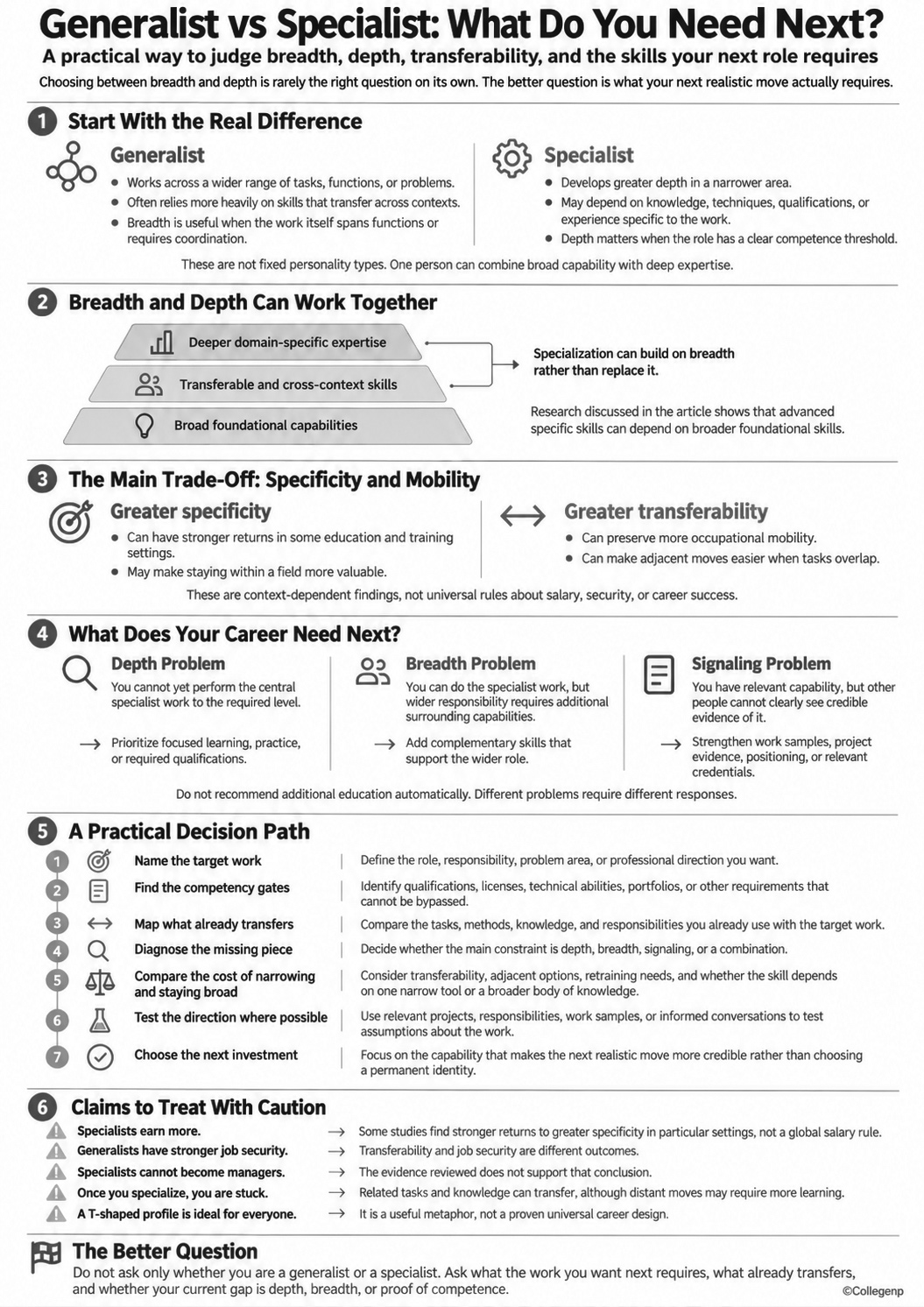
A Better Way to Make the Decision
The generalist-versus-specialist question becomes easier when it stops being a choice between two identities.
Start with the work you want next. Find the genuine competence and qualification requirements. Separate what you already know from what the work still demands. Then decide whether the limiting factor is missing depth, missing breadth, weak evidence of competence, or some combination of the three.
Research provides useful boundaries for that decision. Broad and specific skills can complement each other. Greater specificity can have stronger returns in some settings while reducing mobility. Related career moves can preserve part of accumulated experience. None of those findings establishes one career design for every person.
The practical aim is to build a skill profile that fits the work while keeping the consequences of that investment visible. That may mean specializing now, broadening now, or developing depth in one area while retaining capabilities that transfer elsewhere.
The label matters less than whether the combination prepares you for work you can credibly perform.
References
-
Hosseinioun, M., Neffke, F., Zhang, L., et al. (2025). “Skill dependencies uncover nested human capital.” Nature Human Behaviour, 9, 673–687.
-
Eggenberger, C., Rinawi, M., & Backes-Gellner, U. (2018). “Occupational specificity: A new measurement based on training curricula and its effect on labor market outcomes.” Labour Economics, 51, 97–107.
-
Leighton, M., & Speer, J. D. (2020). “Labor market returns to college major specificity.” European Economic Review, 128, 103489.
-
Gathmann, C., & Schönberg, U. (2010). “How General Is Human Capital? A Task-Based Approach.” Journal of Labor Economics, 28(1), 1–49.
-
European Commission. “Skill reusability level.” European Skills, Competences, Qualifications and Occupations.
-
Silva, O. (2006; published in Economics Letters, 2007). “The Jack-of-All-Trades Entrepreneur: Innate Talent or Acquired Skill?” IZA Discussion Paper No. 2264.
-
Syme, L., & Mueller, E. (2022). “Does skill balancing prepare for entrepreneurship? Testing the underlying assumption of the jack-of-all-trades view.” Applied Economics, 54(10), 1145–1161.







Comments 0
No comments yet. Be the first to start the conversation.