




Graduation can make career preparation feel urgent, especially if you do not have an internship, a polished portfolio, or a clear job target. The useful question is not whether you have collected enough skills to look impressive. It is whether you understand the work you may enter, can identify the abilities that matter there, and can show credible evidence of what you have practiced.
Students often face opposite problems: they have useful experience but cannot explain what it demonstrates, or they keep learning tools without checking whether those skills appear in the roles they want.
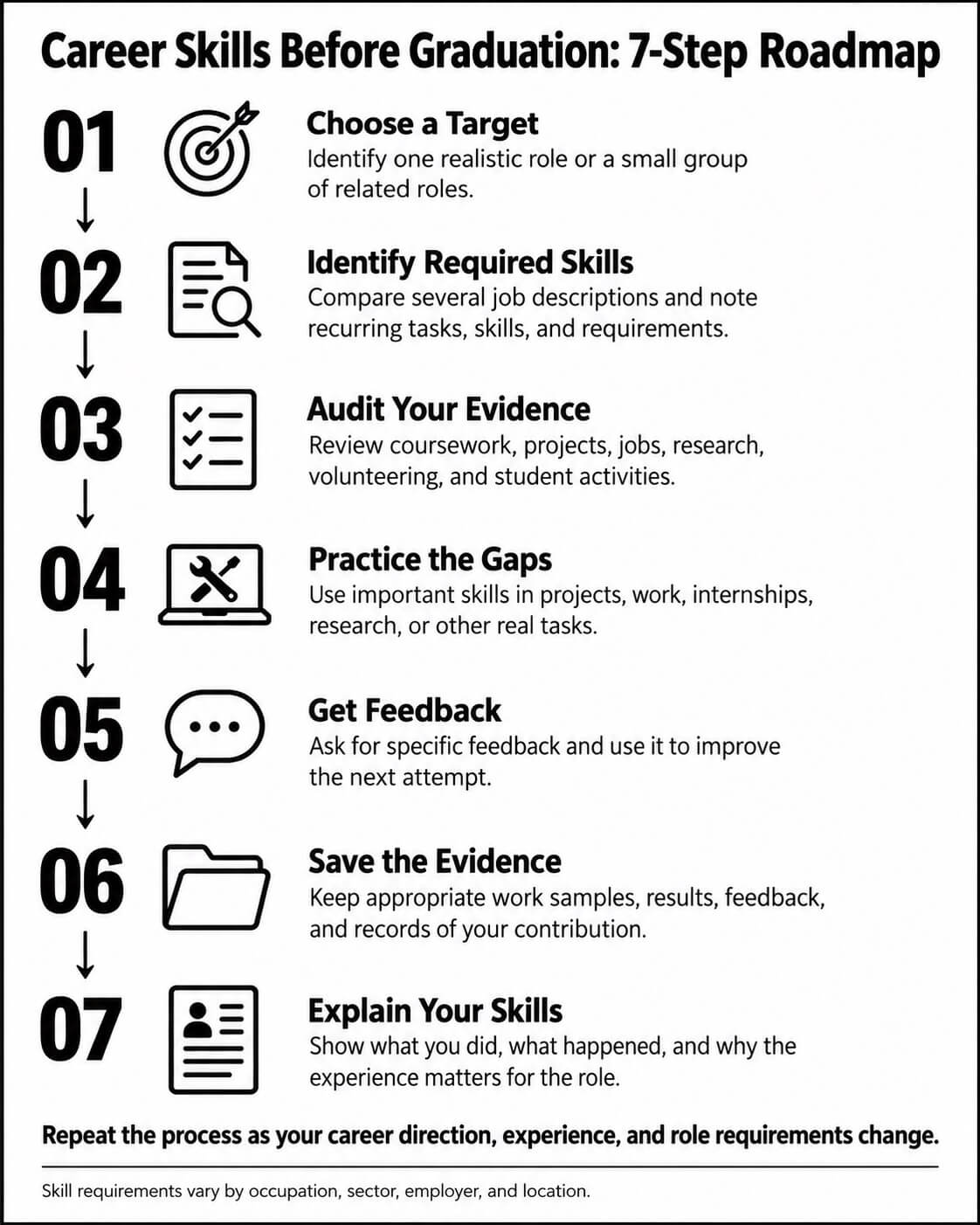
A stronger approach is to treat career development as a cycle: choose a provisional target, identify the requirements, audit your evidence, practice important gaps, get feedback, save evidence, explain it clearly, and repeat. This avoids the assumption that one list of career skills fits every occupation. ESCO, the European Commission's classification of skills and occupations, distinguishes broadly reusable or transversal skills from more occupation-specific skills. NACE, a U.S. association focused on the college-to-career transition, uses a framework of broad career-readiness competencies while also recognizing job-specific skills.
Answer Summary: Build career skills before graduation by starting with a realistic role or role family rather than a generic skills list. Compare several job descriptions, identify recurring transferable and technical requirements, and check what you can already demonstrate. Practice the most important gaps through coursework, projects, paid work, internships, research, volunteering, or student activities. Ask for specific feedback, keep evidence of your contribution, and learn to connect that evidence to the role in applications and interviews.
Table of Content
- What Career Skills Include
- Choose a Provisional Target Before You Choose More Training
- Audit What You Can Demonstrate
- Practice Skills in Settings That Require Real Performance
- What Makes an Internship Useful
- What If You Cannot Get an Internship?
- Use Feedback to Decide What to Practice Next
- Keep a Skill Evidence Bank
- Learn to Explain a Skill Without Overclaiming It
- Use Career Conversations as Research
- Build Technology Skills Around the Work
- What to Prioritize Based on Time Remaining
- Mistakes That Weaken Career Preparation
- A Career-Skill Self-Check Before Graduation
- What to Do Next
- References
Key Takeaways:
-
Build for a role or role family, not for an abstract skills list.
-
Compare several job descriptions before deciding what to learn.
-
Separate learning a skill from practicing it and proving it.
-
Treat internships as one valuable practice setting among several.
-
Ask for feedback that identifies what to improve next.
-
Save work samples, results, and examples of your own contribution.
-
Check licensing or credential rules separately for regulated professions.
What Career Skills Include
Career skills include broadly reusable abilities, role-specific abilities, and the skills needed to manage your own career decisions. Keeping these categories separate prevents you from treating communication, a software package, and job-search technique as if they were the same type of skill.
Transferable or transversal skills
Transferable skills apply across many occupations. ESCO defines transversal knowledge, skills, and competences as relevant across a broad range of occupations and sectors. Its examples include communication, teamwork, negotiation, and office software.
NACE offers a related U.S. framework. Its eight career-readiness competencies include career and self-development, communication, critical thinking, equity and inclusion, leadership, professionalism, teamwork, and technology. NACE notes that its equity and inclusion competency is under review and that the framework is flexible rather than a requirement to use all eight competencies.
For a global reader, the point is not to copy either framework as a universal checklist. It is to recognize that many roles depend on abilities that transfer across settings. Collegenp's Hard Skills vs Soft Skills provides a separate comparison of commonly used skill categories.
Job-specific or technical skills
Job-specific skills are tied more closely to tasks, tools, methods, standards, languages, or domains. The requirements for a laboratory assistant, junior accountant, software developer, designer, teacher, or logistics coordinator can differ sharply.
A general career article cannot identify these requirements for you with enough precision. You need evidence from the roles you are considering.
Career-management skills
Career-management skills help you decide what to build and communicate what you can do. They include researching roles, recognizing skill gaps, seeking feedback, building professional relationships, preparing work samples where appropriate, and explaining the relevance of your experience.
This category matters because having experience and presenting its relevance are separate problems.
Choose a Provisional Target Before You Choose More Training
You do not need to decide on one career for life. You need enough direction to decide what to practice next.
Start with one plausible role or a small family of related roles. If you are uncertain between several paths, compare two or three. An economics student, for example, might compare entry-level research, policy, data, and business-analysis roles to see which requirements overlap.
Collect several recent job or internship descriptions from the country or region where you may work. Look for recurring patterns:
-
tasks performed in the role;
-
technical tools, methods, or subject knowledge;
-
communication, analysis, teamwork, planning, or other transferable requirements;
-
evidence requested, such as a portfolio, writing sample, project record, or prior experience;
-
formal requirements, such as a qualification, registration, license, language level, or supervised practice.
One vacancy is weak evidence. It may reflect an unusual organization or an inflated wish list. Repeated requirements across several employers are more useful.
NACE's Job Outlook 2026 survey offers one U.S. snapshot. Among 183 employer respondents, 70% reported using skills-based hiring, and more than 80% said they highlight key skills in job descriptions. Those figures describe that survey sample, not employers worldwide. The practical lesson is narrower: job descriptions can help you identify what a specific group of employers expects candidates to demonstrate.
If you are entering a regulated or credential-dependent profession, check the responsible professional or regulatory body in the country where you intend to work. A portfolio or skill demonstration does not replace a legally required qualification, registration, examination, license, or supervised practice requirement.
Audit What You Can Demonstrate
A useful skill audit asks for evidence rather than a confidence score. Rating "communication" as 8 out of 10 tells you less than examining a real task.
For each skill you plan to claim, ask:
-
What was the task or problem?
-
What did I personally do?
-
What constraint, standard, or audience shaped the work?
-
What output, result, or feedback exists?
-
What did I learn or change afterward?
-
Why is this evidence relevant to the role I want?
This often reveals experience that students dismiss. University of Sydney career guidance points students to coursework, projects, presentations, internships, clubs, volunteering, casual work, paid work, research, and assignments as places where employability skills may be developed and documented. It also recommends keeping records of skills, responsibilities, achievements, outcomes, and feedback.
Keep the claim proportional to the experience. A class project can show that you applied a method in an academic setting. A club title does not prove leadership on its own. A part-time job may provide strong evidence of reliability or customer communication even when it is unrelated to your degree.
Practice Skills in Settings That Require Real Performance
Career skill development becomes more meaningful when you have to use the skill to complete a task, meet a standard, or solve a problem. Course completion can build knowledge, but it does not by itself show how you apply that knowledge.
Suppose you want to improve data analysis. A course can teach concepts and software functions. The next stage is to work with a dataset, make decisions about cleaning or exclusions, choose a suitable method, document assumptions, explain the result, and respond to critique. The same principle applies to writing, design, programming, laboratory work, research, planning, public speaking, or project coordination.
Useful practice settings include:
-
assessed coursework with a substantial output;
-
research assistance or independent research;
-
internships and co-operative placements;
-
paid part-time or campus work;
-
volunteering and community work;
-
student organizations with defined responsibilities;
-
discipline-relevant competitions or project challenges;
-
self-directed projects with a clear user, purpose, or standard.
University of Sydney guidance similarly identifies academic, extracurricular, work, internship, and volunteering settings as places where students can develop and document employability skills. Students looking for non-employment options can also use Collegenp's guide to extracurricular activities and skill development.
Before choosing an activity, ask whether you will perform the skill, receive evaluation, get feedback, retain evidence, and use the skill in a context relevant to your target. If most answers are no, the activity may not address the gap you are trying to close.
What Makes an Internship Useful
An internship is useful when it combines meaningful work with a clear learning structure. The title "intern" does not tell you whether the experience will build relevant skills.
NACE's internship guidance describes features such as a defined beginning and end, clear responsibilities, learning objectives, direct supervision by someone with relevant expertise, productive feedback, and opportunities to apply classroom knowledge in a professional setting.
Before accepting or evaluating an internship, ask:
-
What work will I be responsible for?
-
What am I expected to learn or improve?
-
Who will supervise the work?
-
How will feedback happen?
-
Will the tasks expose me to the work I am considering?
-
Can I later describe my contribution without disclosing confidential material?
An internship can provide experience with organizational constraints, shared responsibilities, supervision, and workplace processes. A self-directed project may develop similar underlying skills but does not automatically provide the same form of workplace exposure.
What If You Cannot Get an Internship?
You can still build relevant skill evidence without an internship, but you should be precise about what the alternative experience demonstrates.
Internship access can be limited by availability, location, pay, course schedules, disability access, caregiving, work authorization, or other constraints. Identify what you hoped the internship would help you practice, then find the strongest feasible setting for that goal.
If you need analysis experience, a research or data project may help. If you need customer or client communication, a campus job, volunteer role, student organization, or community project may provide real interactions. If you need a technical work sample, a well-scoped project can show how you apply methods and make decisions.
Seek outside feedback where possible. A project reviewed by an instructor, supervisor, user, client, professional, or structured peer group gives you more information about your performance than self-evaluation alone.
Do not claim that alternatives carry the same hiring signal as an internship. A project may demonstrate technical ability while offering little evidence about working inside an organization. A service job may show reliability and communication while providing no specialist exposure. Ask what the experience lets you demonstrate rather than whether it "counts" in the abstract.
Use Feedback to Decide What to Practice Next
Feedback helps identify the difference between your current performance and the standard you are trying to meet. NACE's career and self-development competency includes identifying areas for growth and applying feedback, while its internship guidance includes productive feedback as part of supervision.
Ask narrow questions:
-
Which part of this explanation was unclear?
-
Where did my analysis rely on a weak assumption?
-
What would make this design easier to use?
-
Which part of my contribution helped the team?
-
Where did I create extra work for others?
-
What would you expect me to handle independently next time?
Use the answer to make the next attempt more demanding: a less familiar problem, a tighter constraint, a different audience, a larger responsibility, or a stricter quality standard.
Keep a Skill Evidence Bank
A skill evidence bank is a private record of experiences that may later support a resume, application, interview, portfolio, or career conversation. It prevents useful details from being forgotten.
| Skill target | Evidence you can keep | Next improvement |
|---|---|---|
| Communication | Presentation, report, customer interaction, feedback | Explain the same idea to a different audience |
| Problem solving | Problem statement, analysis, decision rationale | Compare alternatives and document assumptions |
| Teamwork | Defined contribution, coordination example, shared output | Take responsibility for a larger shared task |
| Technical skill | Code, model, design, analysis, lab output | Use it on a harder problem and explain your choices |
| Reliability | Deliverable completed to standard, schedule responsibility | Improve planning, checking, or documentation |
For each entry, record the context, your contribution, the result or output, the feedback, and what you would change next time. For team work, separate the group's outcome from your individual actions.
Protect confidential and private information. Do not publish employer data, client information, classmates' personal information, proprietary code, internal documents, restricted research, or work you do not have permission to share. If a public sample is not allowed, describe the task at a safe level or create a separate demonstration with non-confidential material.
Learn to Explain a Skill Without Overclaiming It
Skill development and skill signaling are different. You may have learned something useful but still lack a strong example, or you may have a strong example but describe it too vaguely for another person to understand your contribution.
NACE's 2026 employer research reports that respondents wanted candidates to provide examples rather than merely list skills. UT Austin's career-readiness guidance also teaches students to prepare competency-based stories and suggests structures such as STAR or PARL.
A useful evidence story contains four elements:
-
the situation or problem;
-
your individual action;
-
the result, feedback, or learning;
-
the connection to the target role.
The individual-action part matters in team projects. "We built a website" does not show what you did. Identify the component you owned, the decisions you made, the constraint you faced, and what followed.
Treat certificates with the same care. A certificate can show that you completed a provider's learning or assessment process. It does not establish workplace proficiency by itself. Ask what task you can now perform, what evidence supports that claim, and whether the capability matters for the role.
When you are ready to present this evidence in applications, Collegenp's resume strategies for college students provides more focused guidance on the application document itself.
Use Career Conversations as Research
Career conversations are useful when they reduce uncertainty about the work. Treat them as a way to understand tasks, standards, beginner expectations, and entry routes rather than as a request for someone to find you a job.
Useful questions include:
-
Which tasks take most of your time?
-
Which skills are hardest for new entrants to learn?
-
What does competent beginner-level work look like?
-
Which tools or standards matter in daily work?
-
What do applicants often misunderstand about the role?
-
What experience helps a beginner become credible?
Career services, alumni, faculty members, supervisors, professional associations, events, and project contacts can provide context where those options exist. Collegenp's article on career networking covers the broader relationship-building side.
Build Technology Skills Around the Work
Technology needs vary by occupation, so build technical skills around the work you are targeting rather than around a temporary tool list.
The World Economic Forum's Future of Jobs Report 2025 surveyed 1,043 companies across 55 economies and reported a mix of analytical, technological, creative, interpersonal, leadership, and learning-related priorities. Its dataset represents more than 14.1 million employees, but its methodology focuses on larger or significant employers and does not represent small enterprises or the informal sector.
If a technology appears repeatedly in your target roles, learn what it is used for, when it is appropriate, how to check its output, and how to explain the decisions you make while using it. Role relevance matters more than visibility in current discussion.
What to Prioritize Based on Time Remaining
The less time you have before graduation, the more selective your plan needs to be.
More than 12 months
Compare a few plausible role families, build recurring foundations, seek sustained practice, and start an evidence bank early. Use feedback to decide what deserves deeper work.
Three to 12 months
Narrow the target. Identify a small number of recurring gaps, strengthen one or two substantial projects or work experiences, prepare relevant work samples, and convert your strongest experiences into application and interview examples.
Less than three months
Inventory coursework, work, volunteering, research, clubs, and projects. Select examples relevant to the roles you are applying for. Improve one or two gaps that can be addressed credibly, and make a post-graduation plan for skills that require more time.
Graduation ends an academic program, not skill development.
Mistakes That Weaken Career Preparation
Collecting courses without applying the learning
A course can build knowledge. Follow it with a task that requires you to use the learning and make decisions.
Copying a generic skills list
A list of communication, teamwork, leadership, and technology is not a personal skill plan. Check which abilities recur in the work you are considering.
Waiting for one perfect internship
Keep pursuing appropriate workplace experience, but do not stop practicing while you wait. Use the strongest feasible setting for the skill you need to build.
Treating one project as proof of mastery
One project shows one experience. Describe your level accurately and keep increasing difficulty, independence, and range.
Chasing every new tool
A tool matters when it is relevant to the work and you can use it responsibly. Visibility is not a substitute for role relevance.
Treating professionalism as appearance
Professional expectations vary across cultures, industries, organizations, and accessibility needs. Focus on observable work behaviors such as preparation, integrity, accountability, reliability, meeting commitments, and attention to quality. This framing is consistent with the behavior-based way NACE describes professionalism.
Ignoring formal professional requirements
A strong portfolio or project record does not replace a legally required qualification, license, registration, examination, or supervised practice requirement.
Publishing confidential work
A portfolio is not worth exposing private or restricted information. Use material you have permission to share or create a safe alternative.
A Career-Skill Self-Check Before Graduation
Use these questions to identify your next action rather than to produce a score:
-
Can I name one or two realistic roles I am preparing for?
-
Do I know the recurring transferable and technical requirements?
-
Can I show at least one concrete example for the important skills I claim?
-
Have I received feedback from someone other than myself?
-
Do I have a work sample or a safe description of meaningful work where relevant?
-
Can I explain what I personally contributed to team projects?
-
Do I know which formal requirements apply to my field and location?
-
Do I know which gaps still need work after graduation?
If several answers are no, start with the gap that matters most for your target role. Choose a practice setting, arrange feedback, and decide what evidence you want to have afterward.
What to Do Next
Career skill building before graduation is not a race to collect the longest list of abilities. It is a process for deciding what to learn and building evidence that supports what you say you can do.
Choose a provisional role. Compare the requirements. Audit your evidence. Practice the important gaps in settings that demand real performance. Ask for feedback. Keep a record of the work. Then explain your contribution in terms that matter to the role.
No project, course, internship, certificate, club role, or portfolio can promise an employment outcome. The more realistic outcome is clearer direction, stronger evidence, and a repeatable way to decide what to build next.
References
-
European Commission. (n.d.). Skill reusability level. ESCO.
-
National Association of Colleges and Employers. (n.d.). What is career readiness?
-
National Association of Colleges and Employers. (2026, April 10). How new grad job seekers can stand out with potential employers.
-
National Association of Colleges and Employers. (2026, May 28). Employers give new college grads a passing grade on job readiness.
-
National Association of Colleges and Employers. (n.d.). Internship meaning and definition: A NACE guide.
-
World Economic Forum. (2025). The Future of Jobs Report 2025.
-
University of Sydney Careers Centre. (n.d.). Employability skills.
-
The University of Texas at Austin Career Success. (n.d.). Career readiness.







Comments 0
No comments yet. Be the first to start the conversation.