




A skills training course is worth considering when it teaches abilities you need, gives you meaningful opportunities to practise them, and provides credible evidence of what you have learned. An attractive course title, a recognised provider, or a completion certificate does not establish those conditions on its own.
Before enrolling, you need to determine whether the course matches your current skill level, covers the tasks you want to perform, and uses appropriate teaching and assessment methods. You also need to understand what any qualification means, whether it meets your intended requirements, and what participation will cost in money and time.
These questions apply to short professional courses, technical and vocational training, online programmes, and workplace skill development. However, the importance of each factor changes with your purpose. Someone learning a skill for personal use may prioritise instruction and practice, while a learner entering a regulated occupation must also verify formal qualification requirements.
The Australian Skills Quality Authority (ASQA) and the US Federal Trade Commission (FTC) both recommend examining course suitability, training arrangements, recognition, provider information, and enrolment conditions before committing.
Answer Summary: To evaluate a skills training course before enrolling, check five areas: relevance to your learning goal, curriculum and practical training, assessment of competence, recognition of any required credential, and the full enrolment commitment. Request a detailed syllabus, assessment information, trainer details, and written terms. Compare these against your actual needs. When an essential requirement cannot be verified, seek clarification before paying.
Key Takeaways:
-
Define the exact skills and level of competence you need.
-
Check whether the syllabus connects learning outcomes with practical activities and assessments.
-
Examine instructor qualifications, feedback arrangements, and access to training resources.
-
Verify formal credentials with the appropriate authority when recognition is necessary.
-
Separate course completion, demonstrated competence, and employment outcomes.
-
Confirm the total workload, required expenses, and contractual conditions.
-
Compare documented evidence rather than relying on course descriptions or ratings alone.
1. Start With the Skills You Need to Develop
The first step in evaluating a training course is identifying what you want to become capable of doing. Without a specific learning goal, it is difficult to determine whether a course is relevant, too basic, unnecessarily advanced, or unsuitable for your intended purpose.
Define the task, not merely the subject
A subject describes an area of learning. A skill describes something you can perform.
For example, the subject of spreadsheet training may include formulas, calculations, information management, and reporting. Those topics do not establish whether a particular course teaches the level of spreadsheet work you need.
Identify:
-
The tasks you want to perform after training.
-
Your current knowledge and practical ability.
-
The level of independence or accuracy required.
-
How you intend to demonstrate competence.
Evidence of competence may include assessed practical work, a completed project, a portfolio, or a qualification accepted for a particular purpose.
The FTC advises prospective vocational students to review actual job requirements and ask relevant employers what training and experience would be useful. This helps establish whether a proposed programme addresses the requirements of the intended work.
Decide whether you need training or a recognised qualification
Learning a skill and obtaining a formal qualification are different objectives.
If your goal is personal development or improvement in an existing role, a short course with relevant practice and feedback may meet your needs without awarding a regulated qualification.
If you need to satisfy an employer's requirement, enter another academic programme, or qualify for a regulated occupation, the precise credential may be essential.
Before comparing providers, establish whether your goal requires:
-
Demonstrated practical ability.
-
A particular certificate or professional certification.
-
Academic credit or an accepted qualification.
-
A supervised workplace training component.
-
A licence or another form of occupational authorisation.
Do not assume that completing a course automatically satisfies professional entry requirements.
2. Examine the Syllabus and Learning Outcomes
A syllabus should help you understand what the course teaches, what learners are expected to accomplish, and how the learning content is organised.
An extensive list of modules does not necessarily indicate appropriate depth. A shorter, focused course can be more suitable when its content directly addresses the learner's intended tasks.
Check the level, prerequisites, and curriculum
Obtain a detailed syllabus rather than relying exclusively on the course advertisement.
Examine the entry requirements and how the modules build on previous knowledge. A beginner course should not assume substantial experience without explaining that requirement.
An advanced programme should identify the foundational abilities learners need to follow the instruction and complete the assessments.
Review the syllabus for:
-
Clearly stated entry requirements.
-
Learning outcomes for relevant modules.
-
Logical development from foundational to more demanding tasks.
-
Appropriate practical activities.
-
Required software, equipment, or learning materials.
-
Relevant technical or occupational standards, where applicable.
The International Telecommunication Union (ITU) Academy's instructor-led training quality checklist identifies measurable learning objectives, relevant instruction, learner participation, practical application, and feedback as important course-design criteria.
Distinguish topics covered from skills demonstrated
A syllabus that states a course covers project planning tells you the subject.
A learning outcome that requires learners to prepare a project schedule, identify dependencies, and review their decisions describes observable performance.
This distinction matters because attendance at lessons does not establish that learners have acquired the ability to perform the tasks discussed.
Look for outcomes describing what learners will produce, perform, analyse, or demonstrate.
If the outcomes use broad wording such as developing knowledge or gaining familiarity, ask the provider to explain what practical achievement is expected.
Check whether the content is relevant to current requirements
Technical content should match the tools, standards, and methods relevant to the learner's intended use.
Check the versions of software, equipment, or procedures specified in the syllabus where these details affect the skill.
For regulated training, compare the course description with the requirements published by the appropriate awarding or regulatory body.
A recent publication date does not independently establish curriculum quality. What matters is whether the material remains accurate and appropriate for the intended learning outcome.
3. Evaluate Practical Training and Assessment
Practical training deserves close examination when a course claims to develop abilities that learners must demonstrate through actual performance.
The central question is whether learners will perform the relevant tasks themselves, receive feedback, and have opportunities to correct their work.
Find out what learners will practise
Ask the provider to describe the practical activities included in the programme.
Distinguish instructor demonstrations from activities learners complete independently or under supervision.
Relevant questions include:
-
What practical tasks will learners perform?
-
How much access will they have to necessary equipment?
-
Will practice occur individually, in groups, or through observation?
-
Who supervises activities that require specialist guidance?
-
How will learners identify and correct mistakes?
For equipment-based training, examine whether the facilities allow learners to complete the tasks required by the course.
When training involves hazardous machinery, regulated procedures, or other safety-sensitive work, confirm that suitable supervision, facilities, and safety arrangements are provided.
The ITU Academy identifies applied exercises, realistic work-related tasks, and opportunities to practise knowledge and skills as elements of its training quality framework.
Understand how competence will be assessed
A course assessment should match the ability the course claims to develop.
A written test may assess knowledge of concepts or procedures. It does not necessarily demonstrate practical competence in performing a task.
Depending on the subject, assessments may include practical demonstrations, reviewed assignments, projects, workplace observations, or examinations.
Ask for the assessment plan and, where available, a sample rubric. A rubric explains the criteria used to judge performance.
Establish:
-
What learners must demonstrate to pass.
-
Whether assessment includes practical performance.
-
Who evaluates the completed work.
-
What feedback learners receive.
-
Whether reassessment is available and whether additional charges apply.
The US Centers for Disease Control and Prevention (CDC) recommends that e-learning assessments match the course's learning objectives and use meaningful feedback to support learning. Its guidance also emphasises suitable learning activities and clear system requirements.
A useful way to examine the course is to trace the connection between its promises and the actual learning process:
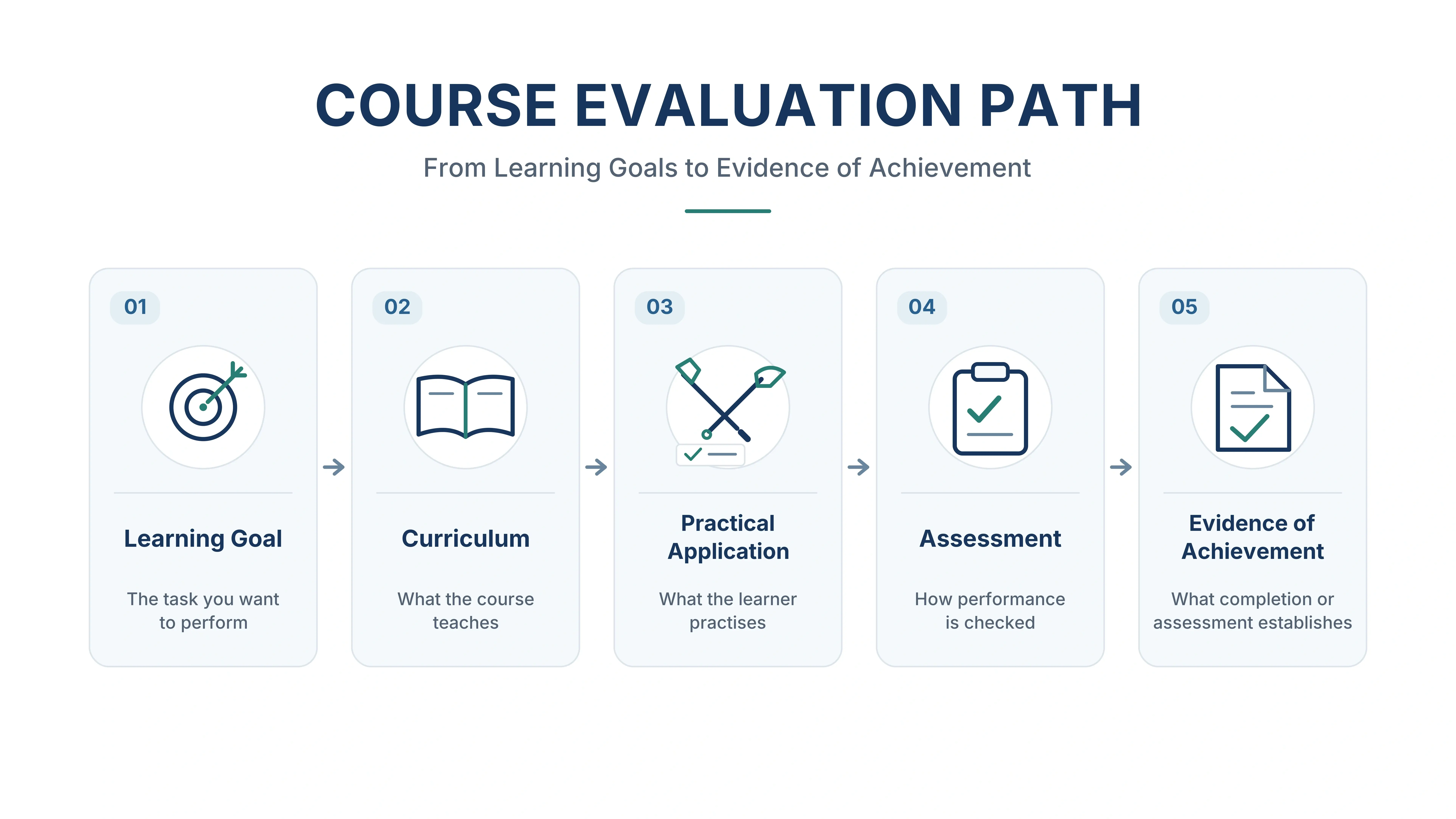
COURSE EVALUATION PATH
Learning goal
The task you want to perform
Curriculum
What the course teaches
Practical application
What the learner practises
Assessment
How performance is checked
Evidence of achievement
What completion or assessment establishes
If a course advertises a skill but cannot explain how learners practise and demonstrate it, important evidence of course suitability is missing.
4. Check Instructors, Support, and Delivery Methods
The teaching arrangements should match both the subject and the learner's circumstances.
An institution's reputation is not a substitute for information about the person delivering a particular course or the support learners will receive.
Examine instructor qualifications and feedback
Ask who will teach the course and what relevant qualifications, teaching experience, or professional experience they have.
For programmes requiring authorised instructors or assessors, verify the applicable qualification requirements.
Also investigate how instructors interact with learners.
Relevant information includes opportunities to ask questions, review work, receive corrections, and obtain assistance with difficult material.
Where practical activities are supervised, check the arrangements for equipment sharing, instructor access, and feedback.
An instructor's professional profile provides background information. It does not independently establish the quality of the instruction learners will receive.
Choose a delivery format that supports the skill
Online, in-person, and blended courses have different practical characteristics.
|
Delivery format |
Potential advantages |
What to verify |
|---|---|---|
|
In-person |
Direct access to facilities, instructors, and supervised activities |
Location, timetable, equipment availability, and individual practice |
|
Live online |
Scheduled teaching and interaction without regular classroom attendance |
Connectivity, instructor access, time zones, and practical assessment |
|
Self-paced online |
Flexible scheduling and opportunities to revisit materials |
Feedback, deadlines, content access, assessment, and required devices |
|
Blended |
Combines remote learning with scheduled practical activities |
Attendance requirements, practical-session locations, and assessment arrangements |
No format is universally suitable.
A self-paced online course may serve a learner who needs flexible study hours. However, a skill requiring supervised use of specialist equipment needs appropriate arrangements for that practical component.
Before joining an online programme, check accessibility features, device requirements, platform compatibility, learning-material access periods, and support availability.
Where offered, a sample lesson can help you assess how information is presented. It cannot establish the quality of an entire programme or its final assessments.
5. Verify Credentials and Qualification Recognition
A certificate has value according to what it records and whether the relevant organisation accepts it for the intended purpose.
The terms certificate, certification, qualification, and licence should not be treated as interchangeable.
Understand what the awarded credential represents
A certificate of attendance or completion records participation or fulfilment of conditions defined by the course provider. Those conditions do not necessarily include independent assessment of practical competence.
An assessed training certificate may indicate that the learner met specified learning and assessment requirements.
Professional certification generally involves an organisation evaluating whether an individual satisfies defined professional or technical standards.
A micro-credential commonly records achievement in a focused area of learning. UNESCO-UNEVOC's terminology describes micro-credentials through assessed learning outcomes, defined standards, and relevant quality assurance.
A licence is a separate form of authorisation governed by the applicable occupational or legal requirements.
For readers considering a broader educational pathway, the differences between a certificate and a degree also deserve attention.
Verify the precise qualification, not merely the provider
A provider may hold some form of registration or recognition without every course it offers leading to the same type of award.
Before enrolling, obtain the exact qualification title, course code where applicable, awarding organisation, and stated recognition.
Then verify the relevant details with the responsible authority.
For example, the UK government's Register of Regulated Qualifications allows users to check regulated qualifications and awarding organisations in England and Northern Ireland. Separate qualification systems apply in Scotland and Wales.
For other countries, identify the responsible national, regional, professional, or educational authority.
If your intended employer, university, or licensing organisation has a specific acceptance requirement, obtain confirmation from that receiving organisation.
A genuine qualification may be recognised for one purpose without satisfying another country's requirements.
Lack of a formally regulated award does not automatically mean that a course provides poor instruction. The significance of formal recognition depends on why you are taking the course.
6. Assess Course Outcomes, Reviews, and Employment Claims
Course outcomes and learner reviews provide additional information, but they should be interpreted alongside evidence of teaching, assessment, and credential recognition.
Separate completion from employment
Providers may publish figures or claims concerning graduation, assessment success, job placement, or career advancement.
These outcomes describe different events.
Completing a course means meeting its stated completion requirements. Passing an assessment indicates achievement against particular criteria. Demonstrated practical competence requires evidence of performing the relevant skill.
Employment is influenced by additional factors, including job requirements, location, experience, and recruitment decisions.
If a provider advertises an employment rate, ask:
-
Which group of learners was measured?
-
What reporting period does the figure cover?
-
Does it include all enrolled learners or a selected group of graduates?
-
Does employment mean work related to the training?
-
How was the information collected and verified?
Without these details, it is difficult to interpret the claim or compare it with results from another programme.
The FTC advises prospective vocational students to investigate completion, employment, and cost information rather than treating recruitment claims as established outcomes.
Job-search assistance should also be distinguished from an employment guarantee.
Read reviews critically
Learner feedback may reveal concerns about practical sessions, instructor availability, scheduling, learning materials, or refunds.
Look for reviews discussing the exact course rather than the general reputation of the provider.
Compare information from different sources and pay attention to relevant details.
The FTC has warned that businesses may create, purchase, or encourage deceptive reviews. It recommends examining review independence, sponsorship, recency, and unusual patterns.
A high rating is not proof of effective instruction. Similarly, a negative review requires context.
When important claims remain unsupported, treat them as unconfirmed rather than assuming they are either accurate or fraudulent.
7. Understand the Full Cost and Enrolment Conditions
A course may fit your learning goal but remain unsuitable because of its schedule, required expenses, or contractual obligations.
Assess the complete commitment before registration.
Calculate the time and resources required
The advertised duration may describe scheduled instruction without fully explaining independent study, assignments, or practical work.
Request a realistic breakdown of the expected workload.
Also identify compulsory expenses beyond the advertised tuition fee. Depending on the programme, these may include:
-
Registration or administrative charges.
-
Required textbooks, materials, software, or equipment.
-
Practical-session and examination expenses.
-
Reassessment or certification charges.
-
Travel and workplace-placement expenses.
Check which expenses are included and which are paid separately.
For learners balancing study with employment or family responsibilities, the timetable should be assessed against the actual required attendance and workload.
If a programme offers flexible attendance, recordings, deferral, or recognition of prior learning, confirm the conditions in writing. These arrangements are not available under identical terms across providers.
Review the agreement, refunds, and cancellation conditions
Read the enrolment agreement before paying.
Confirm the services included, payment schedule, attendance obligations, cancellation procedure, and relevant complaint process.
If workplace placement forms part of the programme, establish who arranges it, what supervision is provided, and whether additional requirements or expenses apply.
Consumer rights vary by jurisdiction.
For example, British Columbia's Private Training Institutions Regulatory Unit distinguishes institutional certification from programme approval and specifies enrolment-contract and refund requirements for institutions under its regulatory system. These provisions should not be treated as worldwide rules.
Keep copies of written programme descriptions, agreements, payment receipts, and communications.
If the provider changes a material course arrangement, these records can help establish what was originally represented and what terms apply.
8. Compare Courses Before Making Your Decision
A useful course comparison begins by separating essential requirements from optional preferences.
This prevents convenience, price, or promotional features from outweighing a requirement that the programme cannot satisfy.
Identify your non-negotiable requirements
A mandatory requirement is a condition the course must meet to serve your intended purpose.
It may include a particular accepted qualification, suitable entry level, necessary practical facilities, accessible instruction, or affordable contractual commitment.
Preferences are features you would value but can assess flexibly, such as a particular timetable, supplementary learning materials, or delivery format.
The distinction depends on your situation.
A flexible schedule may be optional for one learner and essential for another.
If a course fails an essential requirement, strong performance on unrelated features does not resolve that mismatch.
Use a two-course evidence comparison
The following worksheet can help you compare shortlisted courses using documented information.
For each criterion, record the evidence available and whether it meets your requirement, remains unconfirmed, or does not meet it.
|
Evaluation criterion |
Course A evidence |
Course B evidence |
|---|---|---|
|
Learning outcomes and entry level |
To verify |
To verify |
|
Practical activities and resources |
To verify |
To verify |
|
Assessment criteria and feedback |
To verify |
To verify |
|
Instructor and learner support |
To verify |
To verify |
|
Required credential recognition |
To verify |
To verify |
|
Total costs and time commitment |
To verify |
To verify |
|
Contract, refund, and cancellation terms |
To verify |
To verify |
This comparison is a decision aid rather than a scientifically validated course-quality score.
Avoid assigning arbitrary numerical ratings when the supporting evidence is missing or the criteria have different importance for your goal.
Questions to ask before paying
Use this checklist when contacting a course provider:
-
Can you provide the complete syllabus, learning outcomes, and entry requirements?
-
Which practical activities will I complete, and what facilities or equipment will I use?
-
How will my work be assessed, and can I review the assessment criteria?
-
Who will deliver the training, and how will I receive feedback?
-
What credential will I receive, who issues it, and how can its recognition be verified?
-
What is the total cost, including compulsory materials, assessments, and additional charges?
-
What workload, attendance, and placement requirements apply?
-
What happens if I withdraw, defer, miss required sessions, or the provider changes the course?
Request written clarification where an answer affects your decision.
A provider's incomplete initial response does not necessarily indicate poor quality. However, missing evidence about an essential requirement is a reasonable basis for delaying commitment.
A course that meets your necessary conditions can be considered alongside other suitable options. If it does not, an alternative programme, supervised workplace learning, or another recognised training route may fit your goal more closely.
Conclusion
Evaluating a skills training course means checking whether its stated outcomes, instruction, practical activities, assessments, and enrolment conditions match what you need.
Start with the skills you intend to develop. Trace those skills through the syllabus, learning activities, and assessment requirements. Verify formal recognition when it is necessary, and examine the full cost and written agreement before committing.
The aim is not to identify one course that suits every learner. It is to make a decision supported by reliable information, realistic expectations, and a clear understanding of what the training can and cannot establish.
Sources and Further Reading
1. Australian Skills Quality Authority. Choose a Course & Provider. Official guidance for prospective learners in Australia's vocational education and training system.
2. US Federal Trade Commission. Choosing a Vocational School or Certificate Program. Consumer guidance, May 2021.
3. International Telecommunication Union Academy. Instructor-Led Training Quality Assurance Checklist. Updated February 2026.
4. US Centers for Disease Control and Prevention. Develop Training: Quality E-Learning Checklist. October 2024.
5. UK Government. Find a Regulated Qualification. Official qualification-verification service for England and Northern Ireland.
6. UNESCO-UNEVOC. TVETipedia Glossary: Micro-Credential. Terminology based on recognised educational and policy sources.
7. US Federal Trade Commission. FTC Warns Businesses About Fake Reviews. December 2025.
8. British Columbia Private Training Institutions Regulatory Unit. Be an Informed Student. Official programme, enrolment-contract, and student-protection guidance.






Comments 0
No comments yet. Be the first to start the conversation.