




Table of Content
- How to Stay Motivated While Learning a New Skill: Practical Guidance on Goals, Practice, and Consistency
- Why Does Motivation Decline When Learning a New Skill?
- Understand Motivation as a System, Not Just Enthusiasm
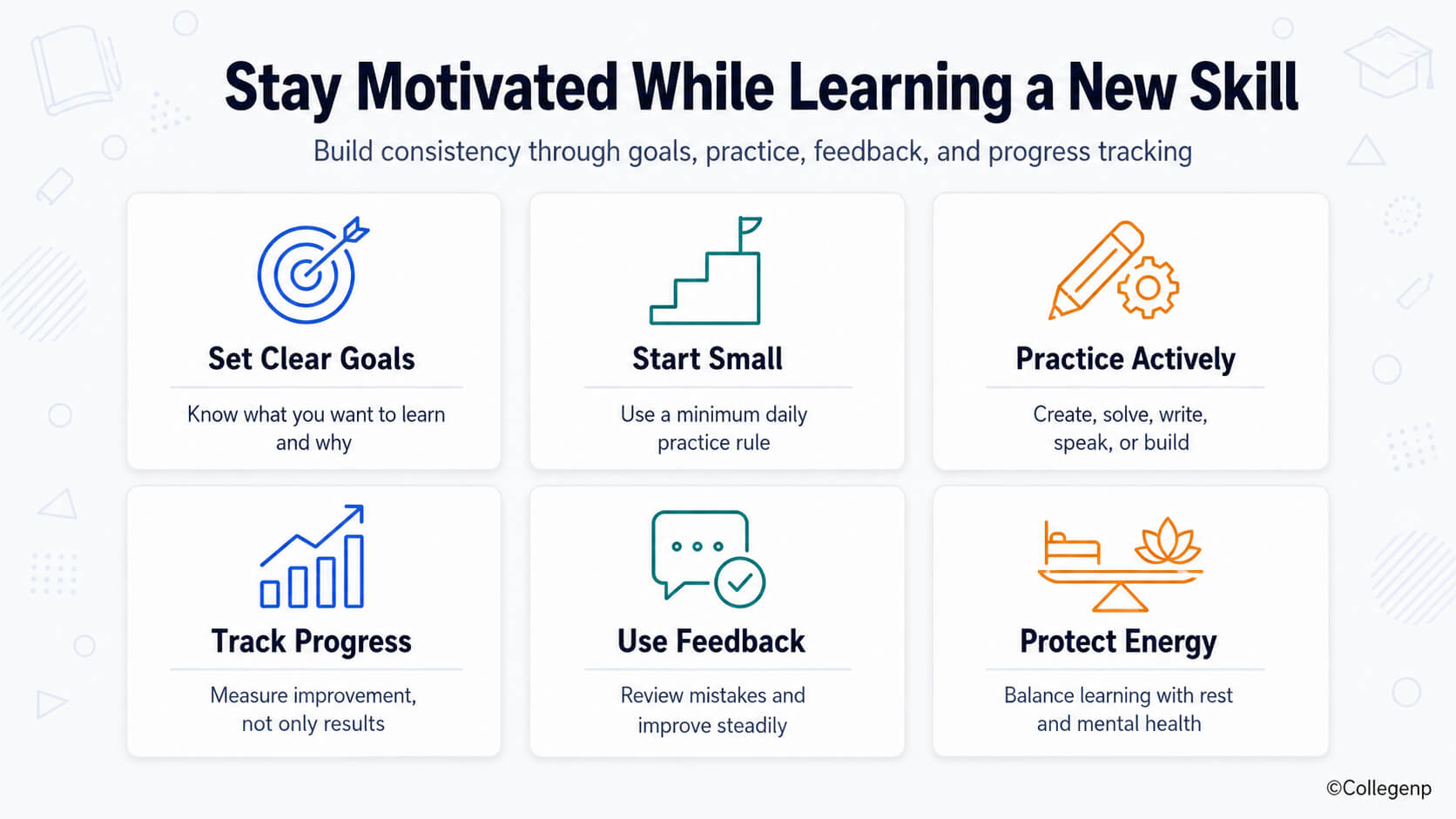
- Set Clear and Measurable Goals
- “How” Does Not Last Without a Clear “Why”
- Start Small: Create a Minimum Practice Rule
- Put Practice in Your Schedule, Not in Free Time
- Do Active Practice, Not Just Content Consumption
- Measure Progress, Not Just Results
- Treat Mistakes as Information, Not Failure
- Reduce Comparison and Understand Context
- Connect Learning With Real Life
- Choose the Right Source and Do Not Get Lost in Resource Overload
- Take Feedback, but Do Not Stop Learning Out of Fear of Criticism
- Do Not Ignore Fatigue and Stress
- Build a Learning Community
- What to Do When Motivation Declines
- Common Misunderstandings
- Different Perspectives for Students, Professionals, and Parents
- 12 Practical Ways for Long-Term Motivation
- Why Is Continuous Learning Important for the Future?
- Conclusion
How to Stay Motivated While Learning a New Skill: Practical Guidance on Goals, Practice, and Consistency
Learning a new skill is not just a process of adding knowledge. It is a long-term practice of improving one’s thinking, working style, time management, and self-discipline. Whether learning a language, improving writing, coding, digital marketing, artificial intelligence, financial literacy, public speaking, design, music, research, or any professional skill, it is natural for enthusiasm to decline midway.
There is a lot of energy in the beginning. But as practice deepens, difficulties, delays, comparison, lack of time, and the absence of visible results can weaken motivation.
In today’s world, skill learning is becoming necessary not only for students but also for workers, parents, entrepreneurs, writers, teachers, professionals, and anyone who wants to change careers. The World Economic Forum’s Future of Jobs Report 2025 emphasizes major changes in jobs and skills from 2025 to 2030, showing the importance of lifelong learning.
But motivation is not merely a “mood” or enthusiasm. It is a process built through goals, meaning, practice systems, feedback, environment, and mental energy. This article clearly covers practical ways to stay motivated while learning a new skill, common mistakes, challenges, self-discipline, mental health precautions, and long-term learning strategies.
Why Does Motivation Decline When Learning a New Skill?
Many people expect quick results when they start learning a new skill. Basic concepts may seem easy at first, but complexity increases after some time. At that point, many people start thinking they are weak. In reality, entering the difficult stage of learning can itself be a sign of progress.
Some common reasons for declining motivation are:
-
Unclear goals
-
Trying to learn too many things at once
-
Irregular practice
-
Not seeing immediate results
-
Comparing too much with others
-
Collecting too many courses, videos, or resources while practicing less
-
Fatigue, stress, or time management problems
-
Not receiving feedback or not seeing a path for improvement
In skill learning, it is more useful to begin not with the conclusion “I do not have the ability,” but with the question, “How effective is my learning system?”
Understand Motivation as a System, Not Just Enthusiasm
Motivation does not remain at the same level permanently. Sometimes energy is high, and sometimes it is low. Therefore, a good learning system helps maintain small practice even on days when motivation is low.
According to Self-Determination Theory, three aspects are considered important in human motivation: autonomy, a sense of competence, and a feeling of connection. Autonomy means feeling that one has some control over learning. A sense of competence means seeing improvement through practice. A feeling of connection means linking learning with a meaningful environment, friends, teachers, community, or purpose.
This means these three questions are useful while learning a new skill:
-
Why am I learning this skill?
-
How can I see small improvements step by step?
-
Which person, community, work, or future purpose can I connect this learning with?
When learning is driven only by external pressure, fear, or certificates, long-term motivation may become weak. When learning is connected with personal meaning, use, and gradual progress, practice is more likely to become sustainable.
Set Clear and Measurable Goals
Goals such as “I will learn coding,” “I will become a good writer,” or “I will improve my English” may sound motivating, but they are not clear enough for practice. When goals are small, measurable, and time-bound, it becomes easier to begin.
For example:
-
“I will learn the basic syntax, functions, and file handling of Python in three months.”
-
“I will do 30 minutes of English reading and 15 minutes of speaking practice daily.”
-
“I will write and edit one short article every week.”
-
“I will practice basic Excel formulas and data cleaning in six weeks.”
Goals can be divided into three levels:
1. Long-Term Goal
This is the larger purpose. Examples include career change, better writing, exam preparation, freelancing, professional efficiency, or personal development.
2. Medium-Term Goal
This is a practical goal for one to three months. Examples include completing a course, building a portfolio, completing 10 practice projects, or earning a basic certificate.
3. Daily Practice Goal
This is the most important part. Examples include 30 minutes of daily practice, 10 new words, solving one problem, writing one paragraph, or revising one concept.
A big goal gives direction, but daily practice creates results.
“How” Does Not Last Without a Clear “Why”
In learning a new skill, “Why should I learn?” must be clear before “How should I learn?” If the reason is weak, practice stops as soon as challenges appear.
Write down your “why.” For example:
-
“I am learning data skills to make my work faster and more organized.”
-
“I am improving English communication for better opportunities in the future.”
-
“I am learning editing and SEO to make my writing professional.”
-
“I want to increase digital literacy to work online safely and effectively.”
The reason must be realistic. Expectations such as “becoming an expert in one month” are risky. A good reason gives long-term direction to practice, while unrealistic expectations can increase frustration.
Start Small: Create a Minimum Practice Rule
Many people make a big plan when they feel motivated, but they cannot continue it on busy or tiring days. That is why a minimum practice rule is effective.
Examples:
-
Read for 10 minutes even on a tiring day
-
Revise at least five words in a day
-
Review one concept even if you cannot solve a coding problem
-
Write 100 words even if you cannot write a complete article
-
Revise for five minutes even if you cannot complete a full lesson
This does two things. First, the rhythm of learning does not break. Second, there is a psychological sense of achievement: “I did something today too.”
Consistency does not always come from a lot of time. Many times, it begins with small but regular work.
Put Practice in Your Schedule, Not in Free Time
The plan “I will learn when I have free time” is usually weak. Free time does not come on its own; it has to be created. A schedule is necessary for learning a new skill.
Practical ways:
-
Set aside a fixed time in the morning, evening, or afternoon.
-
Keep the practice period short and regular.
-
Turn off mobile phones, social media, and unnecessary notifications.
-
Keep one day a week for review.
-
Prioritize stable short sessions over excessively long sessions.
Spaced repetition and active recall can support long-term memory. Retrieval practice, which means recalling what has been learned, is also considered useful. The Australian Education Research Organisation describes spaced retrieval practice as a strategy that can help strengthen long-term memory.
In practical terms, this means it is better to practice repeatedly over several days or weeks than to study for many hours in one day and then stop.
Do Active Practice, Not Just Content Consumption
When learning a new skill, many people watch videos, read notes, or collect courses. These may be useful, but active practice is necessary for skill development.
Active practice means:
-
Writing yourself
-
Solving problems
-
Creating projects
-
Explaining as if teaching someone else
-
Receiving feedback
-
Correcting mistakes and practicing again
-
Recalling and writing or speaking about previous learning
For example, when learning a language, watching grammar videos alone is not enough; speaking, writing, and listening practice are needed. When learning coding, tutorials alone are not enough; you must write code yourself. When learning writing, reading articles alone is not enough; regular writing and editing are necessary.
The core idea of deliberate practice is the same: practice must be purposeful, focused, feedback-based, and improvement-oriented. Simply spending a lot of time is not enough; how practice is done matters.
Measure Progress, Not Just Results
One major reason motivation declines is not seeing progress. But in many skills, progress appears slowly. Therefore, a measurement system is needed.
Some ways to measure progress are:
-
Marking practice days on a calendar
-
Writing a weekly review
-
Comparing earlier and current work
-
Creating a mistake log
-
Completing mini projects
-
Testing knowledge through tests or quizzes
-
Noting improvement points based on feedback
For example, if you are learning writing, compare an old article with a current one. If you are learning coding, see whether you can now solve a problem you previously could not. If you are learning a language, compare old and new voice recordings.
Once progress becomes visible, motivation naturally becomes stronger.
Treat Mistakes as Information, Not Failure
Mistakes are unavoidable when learning a new skill. But many students or professionals see mistakes as proof that they lack ability. Such thinking can stop learning.
A mistake shows three things:
-
Which concept is still unclear
-
Which practice needs repetition
-
Where feedback is needed
A “mistake review” is useful for learning from errors. After every mistake, ask these questions:
-
Where did I make the mistake?
-
Is this due to lack of knowledge or lack of practice?
-
What should I repeat now?
-
What should I do differently next time?
When mistakes become a subject of analysis rather than an emotional reaction, learning becomes faster and more stable.
Reduce Comparison and Understand Context
Social media, online courses, and public portfolios make other people’s progress easy to see. But visible progress is not always the whole story. Someone may have practiced for years, found a good teacher, spent a lot of time, or not shown failed attempts.
Comparison creates two risks:
-
Thinking of oneself as unnecessarily weak
-
Frequently changing one’s plan after looking at others
Healthy comparison means learning from others, not discouraging oneself. It is more useful to compare your progress with your own previous stage.
Connect Learning With Real Life
To make a new skill sustainable, its use must be visible. Motivation does not last long through theoretical knowledge alone. Use what you learn in small tasks.
Examples:
-
If you are learning English, write a short daily journal.
-
If you are learning digital marketing, create a sample campaign plan.
-
If you are learning data skills, clean a simple dataset and create a chart.
-
If you are learning writing, prepare a blog draft.
-
If you are learning design, create a poster or infographic.
-
If you are learning public speaking, make a two-minute recording.
When a skill is used in real work, the brain considers it meaningful. Motivation lasts longer in meaningful learning.
Choose the Right Source and Do Not Get Lost in Resource Overload
Many materials are available for learning today. But too many options sometimes increase decision fatigue. Starting one course, switching to another midway, then another resource, then a new method can make direction unclear.
Use these criteria when choosing resources:
-
Whether the beginner, intermediate, or advanced level is clear
-
Whether practice and projects are included
-
The credibility of the teacher or writer
-
Whether the content is updated
-
Whether it matches your goal
-
Whether feedback or community is available
-
Whether the language and style are easy for you to understand
In skill learning, the most important factor is not “the largest number of resources,” but “the right source plus regular practice.”
Take Feedback, but Do Not Stop Learning Out of Fear of Criticism
Feedback is an important part of learning. But receiving feedback can also be emotionally tiring. Therefore, it should be clear that the purpose of feedback is improvement, not self-judgment.
Sources for feedback can include:
-
Teacher or mentor
-
Colleague
-
Online community
-
Practice group
-
Portfolio review
-
Peer review
-
Self-review checklist
When asking for feedback, it is better to ask a specific question rather than a general one.
For example:
-
Instead of “How is my article?” ask, “How are the structure and clarity of this article?”
-
Instead of “Is my code okay?” ask, “Is this code readable and error-free?”
-
Instead of “Is my speaking good?” ask, “Which areas need improvement in pronunciation and fluency?”
Specific feedback makes the path of improvement clear.
Do Not Ignore Fatigue and Stress
Consistency is necessary when learning a new skill, but excessive pressure can weaken learning instead. A small amount of stress may bring activity to work, but excessive stress can affect mental and physical health. The World Health Organization has stated that stress can affect both the mind and body, and stress management can support overall health.
Practical precautions:
-
Get enough rest.
-
Take short breaks after long practice sessions.
-
Maintain balance between learning and sleep.
-
Stay away from unhealthy comparison and self-blame.
-
If excessive frustration, stress, or inability to function continues for a long time, consult a qualified health worker or counselor.
Damaging one’s own health in the name of increasing motivation is not the right strategy. A healthy body and stable mind are foundations of learning.
Build a Learning Community
It is possible to learn alone, but a community can make consistency easier. A community can provide answers, feedback, practice opportunities, motivation, and accountability.
A community does not always have to be a large group. Two friends, a mentor, a study partner, an online forum, a professional group, or a small practice circle can also be enough.
To benefit from a learning community:
-
State your goal clearly.
-
Share progress regularly.
-
Help others.
-
Focus on cooperation, not comparison.
-
Check reliable sources to avoid spreading incorrect information.
A community increases motivation, but a crowd that does not match your goal can also distract you. Therefore, careful selection is necessary.
What to Do When Motivation Declines
Do not make a major decision on a day when motivation is low. Many people conclude, “I do not feel like doing this today, so this skill is not for me.” This decision may come from fatigue, stress, or temporary frustration.
In such situations, these steps can be followed:
1. Read Your Goal Again
Why did you start? What difference can this skill make in your life, work, or thinking?
2. Reduce the Size of Practice
If you cannot do one hour, do 10 minutes. If you cannot complete a full chapter, study one concept.
3. Look at Previous Progress
See whether you can now do something you could not do before. Progress is often visible when looking back.
4. Separate the Difficulty
Is the problem caused by the subject being difficult, or by the resource not fitting you? Is it due to lack of time, or a weak practice method?
5. Complete a Small Achievement
Completing a mini task can help restore rhythm.
Common Misunderstandings
“I Should Practice Only After I Feel Motivated”
In reality, practice also creates motivation. Once a small task begins, the brain can catch rhythm.
“If Results Do Not Come Quickly, I Am Not Capable”
In skill learning, delayed results are normal. Improvement often happens subtly.
“Everything Must Be Learned Alone”
Self-learning is useful, but feedback, mentors, and community can make learning faster and more organized.
“Doing Many Courses Means Learning More”
Completing a course and being able to use a skill are different things. Practice, application, and improvement are necessary.
“If I Miss One Day of Practice, Everything Is Ruined”
Missing one day is not a big problem. The problem is not returning to the system for a long time. Treat a missed day not as failure, but as a signal to restart.
Different Perspectives for Students, Professionals, and Parents
For Students
Students can learn skills by considering exams, assignments, and future careers. But starting too many subjects at once can increase pressure. It is useful to improve basic skills, time management, and study methods first.
For Professionals
When learning a new skill while working, time is limited. Therefore, microlearning, weekend projects, short practice, and skills that can be used at work can be prioritized. The OECD’s 2025 report on adult learning considers the learning, access, and barriers of working adults important from a policy perspective.
For Parents
When teaching children or teenagers a new skill, it is not appropriate to pressure them only for results. Interest, a safe environment, practice opportunities, and positive feedback are necessary. Each student’s pace may be different.
12 Practical Ways for Long-Term Motivation
-
Focus on one main skill at a time.
-
Convert goals into daily practice.
-
Create a small practice rule.
-
Use what you learn in real work.
-
Keep a progress tracker.
-
Review once a week.
-
Make a list of mistakes and create an improvement plan.
-
Choose the right sources and reduce resource overload.
-
Take feedback regularly.
-
Limit comparison.
-
Prioritize rest, sleep, and mental health.
-
Connect with a mentor or community when needed.
These methods may not apply to everyone in the same way. It is appropriate to adapt them according to age, time, goals, health, resources, and responsibilities.
Why Is Continuous Learning Important for the Future?
Technology, working styles, communication tools, and market needs are changing rapidly. This does not mean everyone must learn the same skill, but the ability to learn new things is becoming useful in the long term.
Artificial intelligence, automation, digital tools, green skills, data literacy, communication, critical thinking, and adaptability are widely discussed in many fields. But while choosing any skill, one should consider personal goals, field, interest, available time, and local opportunities.
Issues such as employment, salary, certificate recognition, legal eligibility, or professional licensing can differ by country. Therefore, before making such decisions, it is necessary to check updated information from official or local sources.
Conclusion
Staying motivated while learning a new skill is not only a matter of willpower or enthusiasm. It is a combination of clear goals, small practice, the right resources, regular feedback, progress measurement, health balance, and meaningful reasons. A decline in motivation is not a sign that learning has failed; it may be a sign that the system needs improvement.
A person who can practice in small but regular ways, treat mistakes as information, measure progress, and connect learning with real life is more likely to achieve better long-term results. In the journey of learning a new skill, the most important thing is not quick visible success, but sustainable practice and continuous improvement.
Disclaimer: The psychological strategies and learning techniques mentioned above are for general information. When choosing professional education or training, it is advised to consult official and certified institutions.







Comments 0
No comments yet. Be the first to start the conversation.