



Rato Bangala School (RBS) is a co-educational day school located at Patan Dhoka, Lalitpur, Nepal. Established in 1992 by Shanta Dixit and Milan Dixit, the school provides education from Pre-Kindergarten and Kindergarten through Grade X, followed by a two-year Cambridge International AS & A Level programme.
The school follows a developmental-interaction approach influenced by the educational ideas of Bank Street College of Education, New York. Its teaching combines academic subjects with reading, classroom discussion, observation, practical investigations, creative work and community studies.
Rato Bangala organises its academic programme into separate divisions for early childhood, lower, middle, upper and A Level education. Learning activities and student responsibilities change across these divisions, while projects, field studies, literature, the arts and participation in school life remain part of its educational approach.
|
Particulars |
Details |
|---|---|
|
School Name |
Rato Bangala School (RBS) |
|
Established |
1992 AD |
|
Founders |
Shanta Dixit and Milan Dixit |
|
Location |
Patan Dhoka, Lalitpur, Nepal |
|
School Type |
Co-educational Day School |
|
Early Childhood Education |
Pre-Kindergarten and Kindergarten |
|
School Education |
Grades I–X |
|
Senior-Level Programme |
Cambridge International AS & A Level |
|
Grade X Examination |
Secondary Education Examination (SEE) |
|
Teaching Approach |
Developmental-interaction, inquiry and practical learning |
|
Official Website |
https://www.ratobangala.edu.np/ |
|
|
contact@ratobangala.edu.np |
Rato Bangala School was established in 1992 by Shanta Dixit and Milan Dixit. Its educational approach developed around the belief that children learn through active participation, investigation and interaction with their surroundings.
The school's teaching philosophy has been influenced by Bank Street College of Education in New York, particularly its developmental-interaction approach.
This influence is reflected in the use of classroom discussions, practical activities, projects and experiences outside conventional lessons. Students are encouraged to observe, ask questions, examine information and communicate their understanding through different forms of work.
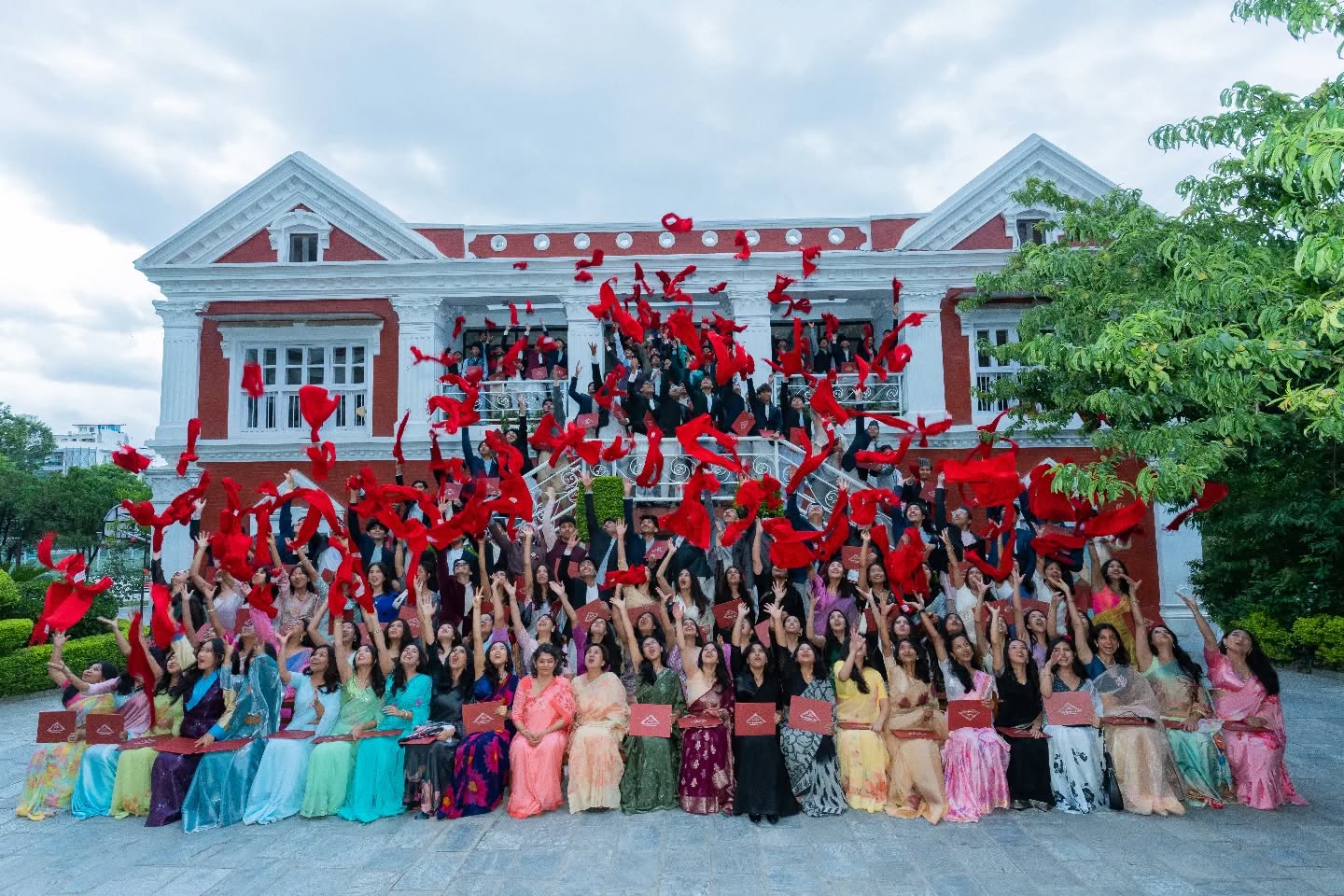
Rato Bangala's academic organisation extends from preschool education to Cambridge International A Levels. The school has separate divisions for different age groups, allowing teaching methods and academic expectations to change as students progress.
Its educational activities also have connections with teacher development, children's publishing and school outreach initiatives. These activities involve related organisations whose responsibilities differ from the school's regular academic provision.
The developmental-interaction approach shapes teaching across Rato Bangala's school divisions. It gives attention to children's intellectual, social, emotional and physical development while connecting academic subjects with activities that require participation and investigation.
Classroom work involves more than reading textbooks and completing written exercises. Depending on the grade and subject, students participate in discussions, practical investigations, field visits, independent reading, creative assignments and presentations.
The approach changes with students' ages. Younger children explore ideas through play, stories, drawing and physical materials. Older students undertake extended reading, subject investigations, written analysis and projects requiring greater independence.
Several practices are reflected across the school:
Reading, writing and discussion in Nepali and English.
Observation, questioning and practical investigation.
Mathematics activities involving physical materials and problem-solving.
Science learning through experiments and projects.
Social studies connected with local communities, history and civic life.
Creative expression through visual arts, music, theatre and writing.
Field visits and activities outside classrooms.
Participation in age-appropriate school and community responsibilities.
Patan and the wider Kathmandu Valley also provide subjects for classroom investigation. Students examine aspects of local history, occupations, cultural practices, public services and community life.
These activities connect academic questions with places and experiences that students can observe and discuss directly.
Rato Bangala divides its academic programme into five educational stages.
|
School Division |
Grade or Level |
Main Learning Areas |
|---|---|---|
|
Early Childhood Centre |
Pre-Kindergarten and Kindergarten |
Play, language, exploration and early learning |
|
Lower School |
Grades I–III |
Literacy, mathematics, science, social studies and creative activities |
|
Middle School |
Grades IV–VI |
Subject learning, field studies, investigation and practical work |
|
Upper School |
Grades VII–X |
Secondary education, projects, assignments and examinations |
|
A Level |
Grades XI–XII |
Cambridge International AS & A Level qualifications |
Each division has its own academic responsibilities and teaching arrangements.
The Rato Bangala Early Childhood Centre (RBECC) provides pre-primary education through activities involving play, communication, movement and exploration.
Children work with materials such as blocks, books, paint, clay, sand and water. These activities introduce early ideas about shapes, quantities, relationships, language and the physical world.
Stories, conversations and classroom interaction support early language development in Nepali and English.
Children also encounter counting, spatial relationships and basic problem-solving through practical activities rather than relying entirely on written exercises.
The Centre uses indoor and outdoor learning spaces. Gardens and play areas provide opportunities for movement and observation of plants, animals and natural surroundings.
Teachers observe children's participation and interactions as part of planning classroom activities.
Daily routines also contribute to early learning. Children take part in simple responsibilities, including organising materials and participating in shared classroom tasks.
Communication with families is part of the Early Childhood Centre's teaching arrangements.
Its practices include:
Home-school link books.
Parent-teacher conferences.
Curriculum meetings.
Discussions about children's classroom experiences.
Parent or caregiver participation during the initial transition into preschool.
These arrangements allow families and teachers to exchange information about children's experiences and development.
The Early Childhood Centre also has a role in demonstrating early childhood teaching practices to educators, separate from its regular preschool programme.
The Lower School covers Grades I–III and includes classroom teaching supported by subject specialists.
Its academic subjects include Language Arts, Mathematics, Science, Social Studies, Digital Literacy, Character Education, Performing Arts and Library Studies.
Physical education, visual arts, music and movement-related activities also form part of school learning.
Reading and writing receive regular attention through read-aloud sessions, guided reading, independent reading and writing workshops.
Students encounter Nepali and English literature and practise different forms of written expression. Nepali-language activities include chhanda recitation, connecting verse with rhythm and language learning.
Mathematics lessons incorporate physical manipulatives, games, calculation and problem-solving. Science teaching includes observation, experiments and work with materials.
Social Studies connects classroom learning with nearby communities. Students investigate neighbourhoods, occupations, transport, public services and aspects of city life through discussions, field visits and projects.
These activities give younger students opportunities to work with questions related to their surroundings while developing reading, writing and subject knowledge.
Grades IV–VI form the Middle School division.
Students continue studying English, Nepali, Mathematics, Science and Social Studies, alongside arts, music, technology and physical education.
Teaching places greater attention on extended investigations and subject-related activities.
The school's location in Patan is particularly relevant to Middle School social studies. Students examine the history, culture and community life of Patan and the Kathmandu Valley through classroom investigations and fieldwork.
Grade IV learning includes Nepal Bhasa in connection with studies of the Kathmandu Valley.
This allows students to encounter local language while examining historical and cultural subjects.
Mathematics continues through conceptual exercises and problem-solving, while science includes observation and practical investigation.
Reading, discussion and written expression remain part of language learning.
Middle School students also participate in environmental activities and projects associated with their interests.
The Upper School covers Grades VII–X, combining secondary academic study with projects, discussions, presentations and independent assignments.
Students continue studying languages, mathematics, science and social studies while preparing for the examinations associated with Nepal's school education system.
In Grades VII and VIII, a classroom teacher handles Language Arts, Social Studies and Character Education, with specialist teachers responsible for other subjects.
Upper School teaching includes written analysis, literature, mathematical problem-solving, scientific inquiry and digital literacy.
Social Studies also incorporates activities connected with civic understanding.
One example is the Grade VIII mock federal parliament exercise, in which students take representative roles and discuss public issues through a simulated parliamentary activity.
Such work connects classroom study of government with communication and discussion.
Students encounter two examination stages during Upper School:
Grade VIII: Government-mandated basic-level examination.
Grade X: Secondary Education Examination (SEE).
Projects, creative activities and participation in school programmes continue alongside examination preparation.
Rato Bangala School provides a two-year Cambridge International AS & A Level programme at its senior educational stage.
The programme follows Grade X education and offers an academic qualification route assessed through Cambridge International Education.
A Level students undertake subject-based academic study and participate in school activities and guidance services.
Separate Collegenp pages cover Rato Bangala School GCE A Level Science and Rato Bangala School GCE A Level Non-Science.
The A Level programme is a senior school qualification, not a university degree.
Rato Bangala uses internal assessment alongside external examinations at the relevant educational stages.
In the early years, teachers observe children's participation, activities and communication. Assessment becomes more closely connected with classroom assignments, written work and examinations as students progress through the grades.
Upper School reporting considers academic development alongside students' social-emotional growth.
The main external examination stages are:
|
Educational Stage |
Examination |
|---|---|
|
Grade VIII |
Basic-level examination |
|
Grade X |
Secondary Education Examination (SEE) |
|
A Level |
Cambridge International AS & A Level examinations |
The examinations serve different purposes. Grade VIII and SEE belong to Nepal's school assessment arrangements, while Cambridge International qualifications apply to the A Level division.
Rato Bangala's teaching arrangements differ across the school's divisions.
The academic structure includes school leadership, academic coordinators, administrative personnel, classroom teachers and subject specialists.
Lower School and Middle School teaching includes two-teacher classroom arrangements, supported by specialist instruction in designated subjects.
Upper School uses subject-specialist teaching, with a separate classroom-teacher arrangement for Grades VII–VIII.
The school's educational work also includes teacher professional development.
Related teacher-training programmes have been undertaken through Rato Bangala Foundation, which operates separately from the school's regular teaching divisions.
Rato Bangala School has facilities for academic study, reading, practical work, creative activities and physical education.
The school has library facilities containing Nepali and English literature.
A separate reading room includes picture books and audiovisual resources.
Library Studies is part of Lower School learning, connecting classroom reading activities with the use of books and other educational materials.
Reading activities also form part of language teaching across the school.
The school's facilities include science laboratories, computer laboratories and spaces for practical and creative work.
Its learning resources include:
Science laboratories.
Computer laboratories.
STEAM laboratory.
Wood workshop.
Art and design rooms.
Audiovisual presentation room.
Theatre or auditorium.
Music and dance rooms.
These facilities support different aspects of the school's academic programme.
Science and technology spaces are used for investigation and subject-related activities. Workshops and creative rooms provide space for making, design and artistic work.
Pottery, programming, robotics-related activities and practical projects also appear in the school's educational activities.
The theatre and auditorium provide space for assemblies, lectures and performances.
Rato Bangala has spaces for sports, recreation and learning outdoors.
Its facilities include:
Playground and outdoor play areas.
Basketball areas.
Football and multi-sports field.
Tennis facility.
Gardens and wooded outdoor spaces.
Vegetable and herb garden.
Dining hall.
Outdoor areas are also used for observation and activities associated with classroom learning.
Gardens provide opportunities for younger students to examine plants and natural surroundings, while sports facilities support physical education and organised games.
Activities beyond regular subject lessons are part of school life at Rato Bangala.
Students participate in creative writing, music, theatre, visual arts, environmental activities and discussions about public issues.
Model United Nations and debate are among the activities associated with student participation.
School clubs provide further opportunities for involvement according to students' grades and interests.
Middle School activities have included Roots and Shoots environmental work.
The A Level division has also included clubs associated with science, photography, chess, debate, music and robotics.
These activities allow students to participate in work that differs from ordinary classroom assignments.
Student writing is represented through publications associated with different school groups.
|
Publication |
Association |
|---|---|
|
Rato Bangala Samachar |
School newsletter |
|
Cornice |
Literary publication associated with Grades I–X |
|
The Circle |
Magazine associated with A Level students |
These publications provide opportunities for literary expression, writing and communication about school-related subjects.
They also connect classroom language activities with writing intended for a wider readership.
Rato Bangala incorporates community participation and service learning into student activities.
Responsibilities vary according to age and school division.
Younger students participate in everyday shared tasks, including helping with dining arrangements.
Older students take part in community-related activities and organised work beyond their immediate classrooms.
Such participation also connects with Social Studies, where students examine neighbourhoods, public services, civic responsibilities and the relationship between individuals and communities.
The school's approach gives practical responsibilities a place alongside academic lessons.
Rato Bangala has a parent-teacher association structure that supports family participation in school activities.
Class parent representatives serve as communication links between families and the school.
Parent involvement includes volunteering, participation in events and sharing feedback.
Parent-teacher conferences provide opportunities to discuss students' classroom experiences and progress.
The Early Childhood Centre also uses home-school link books and curriculum meetings to maintain communication with families.
These arrangements connect individual student discussions with broader participation by parents and guardians in school affairs.
Rato Bangala's health arrangements include an infirmary with a nurse during school hours.
The school also conducts earthquake drills as part of its emergency preparation activities.
Student guidance arrangements extend into the senior school.
The A Level division includes guidance counselling for students' social-emotional needs and a separate college-counselling service for further education planning.
College counselling activities include individual and group guidance, discussions about prospective higher education institutions and interactions with university representatives.
These services assist students in considering further education without replacing the admission decisions of individual universities.
Rato Bangala has separate admission arrangements for preschool, other school grades and A Level students.
Pre-Kindergarten and A Level are the usual larger entry points.
Admission to other grades depends on the availability of places.
The general admission arrangements include:
Submission of an application.
Shortlisting of applicants.
Assessment or interview according to the entry stage.
Selection and enrolment.
Waiting-list arrangements are also used for some grades.
Families may register their interest in grades without regular entry opportunities. Applicants can be contacted when a suitable vacancy becomes available.
Waiting-list registration does not constitute an admission offer.
The A Level admission route includes consideration of SEE, IGCSE or equivalent qualifications and an academic assessment process.
The school's official admissions channels handle applications and related communication.
Rato Bangala School has connections with organisations involved in teacher education, publishing and educational outreach.
These organisations perform functions separate from the school's regular academic divisions.
Rato Bangala Foundation (RBF) was established in 2002 as a not-for-profit organisation working in teacher education and school improvement.
Its activities include professional development and programmes associated with child-centred teaching.
The Foundation has undertaken teacher-training work involving educational partners, including Kathmandu University and Bank Street College of Education.
These activities serve teacher development and school-improvement purposes rather than functioning as regular academic programmes for Rato Bangala School pupils.
Rato Bangala Kitab (RBK) is a children's publishing organisation associated with the Rato Bangala educational network.
Its activities focus on books and publishing for children.
The organisation's publishing role is separate from the school's classroom teaching and administration.
The Rato Bangala Partnership in Outreach Programme (RBPOP) is an independently managed outreach activity associated with the school.
Its work has involved participation by parents and staff and partnerships supporting community and government schools.
Historical activities include school-support initiatives in several districts and the Dailekh School Project, undertaken in cooperation with Rato Bangala Foundation and government counterparts.
These outreach activities are distinct from the school's regular enrolment and academic programmes.
Rato Bangala School is located at Patan Dhoka, Lalitpur, Nepal.
The surrounding area of Patan also features in classroom investigations involving local history, cultural practices and community life.
School Name: Rato Bangala School
Location: Patan Dhoka, Lalitpur, Nepal
Official Website: https://www.ratobangala.edu.np/
Email: contact@ratobangala.edu.np
Rato Bangala School is located at Patan Dhoka, Lalitpur, Nepal.
The school was established in 1992 by Shanta Dixit and Milan Dixit.
Rato Bangala provides Pre-Kindergarten and Kindergarten education, Grades I–X and a two-year Cambridge International AS & A Level programme.
Yes. Rato Bangala is a co-educational day school.
The school follows a developmental-interaction approach influenced by Bank Street College of Education. Classroom activities include reading, discussion, observation, projects, practical investigations and field studies.
Yes. Grade X students follow the Secondary Education Examination (SEE) route under Nepal's school examination system.
The school has libraries, science and computer laboratories, creative workspaces, music and art facilities, an auditorium, sports areas, gardens, outdoor learning spaces and a dining hall.
Yes. Rato Bangala offers a two-year Cambridge International AS & A Level programme.
The school has a parent-teacher association structure, class parent representatives, parent-teacher conferences and other arrangements for communication between families and teachers.
Rato Bangala Foundation is a related, separately administered organisation focusing on teacher education and school improvement. Rato Bangala School provides education to enrolled students from the early years through A Levels.
