



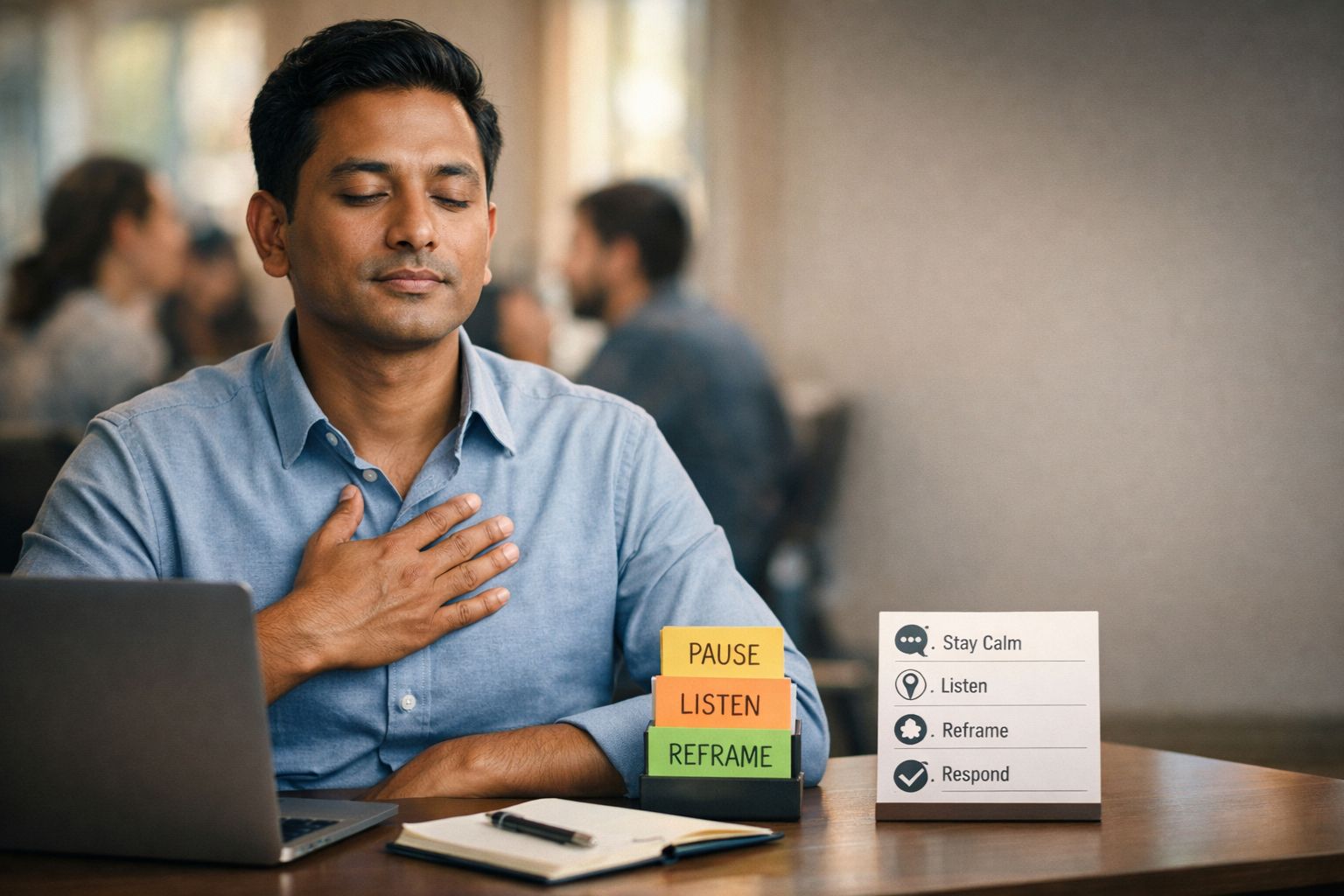
Self-Control and Communication Under Stress with Emotional Intelligence
Stress can make calm behavior and clear speech feel harder than they “should” be. You may notice a faster heartbeat, a sharper tone, or a blank mind at the exact moment you want to respond well. Emotional intelligence (EI) skills help by giving you repeatable ways to (1) notice what is happening inside you, (2) regulate intensity, and (3) communicate with structure when emotions run high.
This matters for students and early-career professionals because pressure shows up in predictable places: exams, group projects, feedback conversations, family misunderstandings, and online messages that are easy to misread. The goal is not to remove stress. The goal is to keep enough self-control to avoid impulsive damage and enough communication skill to stay clear about needs, boundaries, and next steps.
This guide explains what EI is (and is not), why stress changes behavior, which emotion regulation tools have research support, and how to use short scripts and simple structures to reduce escalation.
Summary
Emotional intelligence skills help you stay in control and communicate clearly under stress by improving self-awareness, emotion regulation, and interaction skills. Research on emotion regulation highlights the value of early strategies such as cognitive reappraisal and the limits of relying mainly on suppression. Stress research explains why hormones and arousal can narrow attention and increase reactivity. Practical tools—slow exhale breathing, short reappraisal prompts, active listening, and structured message formats like SBAR—can make high-pressure moments more manageable.
Table of Content
- Self-Control and Communication Under Stress with Emotional Intelligence
- What are emotional intelligence skills?
- Why does stress disrupt self-control and communication?
- What does self-control under pressure look like?
- Which emotion regulation strategies help most under stress?
- How can you communicate clearly when emotions are high?
- A short routine for stressful moments
- Real-life scenarios: school, work, and family
- Outcomes and limitations
- How to learn EI skills: self-practice, certificates, and degrees
- Conclusion
- FAQs
- Reference
Key Takeaways
-
EI is a set of skills—especially noticing, naming, regulating, and communicating emotions.
-
Stress hormones and arousal can narrow attention and increase reactivity, affecting speech and listening.
-
Early emotion regulation (before escalation peaks) is often easier than late “damage control.”
-
Cognitive reappraisal and suppression tend to have different patterns of outcomes in research.
-
Active listening helps understanding, but evidence depends on context and how it is practiced.
-
Short scripts (“pause request,” “repair statement”) reduce impulsive conflict escalation.
-
Training can improve EI measures on average, but programs vary, so quality checks matter.
What are emotional intelligence skills?
Emotional intelligence skills are abilities related to recognizing emotions, understanding what they signal, and responding in ways that support goals and relationships. An influential early definition framed EI as skills involved in appraising and using emotion information.
A practical way to think about EI is four linked skill areas:
-
Self-awareness: noticing emotions and body signals early
-
Self-management: regulating impulses and intensity
-
Social awareness: noticing cues in others (tone, pace, context)
-
Relationship skills: communicating clearly, listening well, and handling conflict respectfully
EI as abilities vs self-reports
EI is measured in different ways. Some tools aim to measure emotion-related abilities, while others ask people to rate their own emotional skills. These approaches can produce different results, which is one reason EI claims online sometimes conflict.
What EI is not
EI is not the same as:
-
Avoiding conflict
-
Agreeing with everyone
-
Hiding emotions all the time
-
Accepting boundary violations
High-EI communication can include clear “no,” direct requests, and calm disagreement.
Why does stress disrupt self-control and communication?
Stress disrupts self-control and communication because it changes physiology and attention, often pushing people toward faster, narrower, more defensive responses. The American Psychological Association describes stress responses that involve hormones such as cortisol and adrenaline, which affect multiple systems and can shape mood, focus, and behavior.
Stress appraisal shapes the intensity
Stress is not only the situation; it is also the meaning you assign to it. Lazarus and Folkman’s appraisal-based definition emphasizes that stress depends on whether a person evaluates demands as taxing or exceeding their resources and threatening well-being.
This helps explain why one student sees a presentation as a challenge, while another experiences it as threat. EI skills support better appraisal by making emotions easier to name and evaluate.
Common stress effects in conversations
In real conversations, stress often shows up as:
-
Interrupting or rushing speech
-
Going silent or “forgetting” points
-
Hearing criticism in neutral feedback
-
Fixating on one detail and missing the main issue
-
Overreacting to tone or wording
EI does not remove stress. It increases the chance you can choose a response instead of reacting on autopilot.
What does self-control under pressure look like?
Self-control under pressure is the ability to delay an impulsive reaction long enough to choose a response that fits your goals and values. It often looks small from the outside: a pause, a slower reply, a request for time, or a short boundary statement.
Long-term research has linked stronger childhood self-control with better outcomes across domains such as health, finances, and public safety indicators, even after accounting for other factors in the study design. This does not mean self-control solves every problem, but it does show that regulating impulses is a meaningful life skill.
Why “willpower alone” is an incomplete model
Many popular explanations treat self-control as a single limited resource. A large preregistered multi-lab replication found the ego-depletion effect to be small with confidence intervals that included zero in that paradigm, raising doubts about simple “fuel tank” stories.
A more useful approach for everyday life is skill + environment:
-
Skills: emotion regulation, attention control, communication scripts
-
Environment: sleep, workload, conflict patterns, digital distraction
-
Supports: routines, planning, feedback from trusted adults or mentors
Which emotion regulation strategies help most under stress?
Emotion regulation strategies help most when they match timing and context—what you do early in the emotional build-up often differs from what helps after escalation peaks. A widely used process model organizes regulation strategies based on where they act in the emotion timeline (before or after the response intensifies).
Cognitive reappraisal vs suppression
Research comparing common strategies highlights differences between:
-
Cognitive reappraisal: changing how you interpret a situation
-
Expressive suppression: inhibiting outward expression after emotion rises
Gross and John’s work shows these strategies relate differently to affect and social outcomes in their studies.
A grounded takeaway:
-
Reappraisal aims to change meaning, which can reduce intensity earlier.
-
Suppression can help short-term professionalism, but using it as a main strategy may carry relationship and well-being costs in many contexts.
Stress arousal reappraisal
Another option is reframing the stress response as functional for performance tasks. A 2024 meta-analysis examined stress arousal reappraisal and “stress-is-enhancing” mindset interventions, reporting small effects on subjective stress responses and no significant effect on physiological stress responses across included studies.
Use-case fit:
-
Presentations, interviews, exams, sports, performances
-
Situations where you need energy without panic
A simple reframe:
-
“This arousal is a signal that the task matters, and I can still take the next step.”
Body-based downshift tools
Some tools begin with physiology rather than thoughts. A systematic review and meta-analysis on voluntary slow breathing examined effects on heart rate variability (HRV), often discussed in relation to parasympathetic activity.
A practical version:
-
Inhale comfortably through the nose.
-
Exhale slightly longer than the inhale.
-
Keep shoulders low and jaw relaxed.
This is not a cure for stress, but it can reduce the chance that your next sentence comes out sharper than intended.
Mindfulness-based programs
Mindfulness-based stress reduction (MBSR) has been studied in nonclinical populations. A meta-analysis reported MBSR to be moderately effective for reducing stress and related outcomes in healthy individuals, while also noting that more research is needed to identify the most effective components.
If you choose mindfulness practice, a neutral goal is steadier attention and earlier detection of emotional build-up, not “never feeling anxious.”
How can you communicate clearly when emotions are high?
Clear communication under stress relies on two moves: slow the interaction and add structure. That means making understanding explicit, then using short sentences that separate observations, impacts, and requests.
Active listening: useful, with limits
Active listening is commonly defined as listening closely and responding in ways that show understanding and encourage clarification.
Evidence is not uniform across contexts. A study in the International Journal of Listening noted that relatively few studies provide convincing evidence that active listening always outperforms other response types in early interactions, which is a reminder to treat it as a skill—not a guarantee.
Two high-value active listening behaviors under stress:
-
Reflect content: “What I’m hearing is…”
-
Ask one clarifying question: “Do you mean…?”
Speak to reduce escalation
When emotions rise, aim for messages that are:
-
Short (one point at a time)
-
Concrete (observable facts)
-
Non-mind-reading (avoid claims about intent)
-
Request-based (what you want next)
A reliable sentence pattern:
-
Observation → impact → request
Example: “When the plan changed after we agreed (observation), I felt rushed and confused (impact). Can we confirm the final tasks and deadline now (request)?”
Two scripts you can reuse
Pause request (when you feel close to snapping):
-
“I’m getting overwhelmed and I want to handle this well.”
-
“Can we pause for 10 minutes and return at [time]?”
-
“When we return, I’ll start by summarizing what I heard.”
Repair statement (after a sharp comment):
-
“That came out harsher than I meant.”
-
“Let me say it again clearly.”
-
“My main point is [one sentence].”
These scripts work because they protect the relationship from impulsive escalation and keep the conversation goal visible.
Structured formats for high-stakes communication
Structured formats help when stress scrambles memory and sequencing. SBAR (Situation, Background, Assessment, Recommendation) is a mnemonic used to structure information sharing and reduce communication failures during handoffs in health care.
You can adapt SBAR for school or work:
-
Situation: What is happening right now?
-
Background: What context matters?
-
Assessment: What is the concern or interpretation?
-
Recommendation: What action do you want?
TeamSTEPPS, developed through work led by the U.S. Department of Defense and AHRQ, is a teamwork and communication system that includes structured communication tools and shared team language.
A short routine for stressful moments
A routine works when it is short enough to use during real stress.
30-second reset (body)
Start with a longer exhale than inhale for several cycles. Keep the goal simple: reduce intensity enough to choose your next words. Evidence reviews of slow breathing focus on physiological markers such as HRV, which are often used in research on autonomic regulation.
2-minute reset (mind)
Use one reappraisal prompt that avoids banned “might be/could be” phrasing:
-
“What else may be true here?”
-
“What outcome do I want after this conversation?”
-
“What is one respectful request I can make?”
If this is a performance situation, add a stress reappraisal frame:
-
“My body is preparing me; I can still follow my plan.”
10-minute reset (conversation)
If conflict is rising:
-
Use the pause request script with a return time.
-
During the break, write a one-sentence goal and one request.
-
Return and use a structured format (Observation → impact → request, or SBAR).
Real-life scenarios: school, work, and family
These examples focus on realistic moments where stress affects words and behavior.
Exam pressure
When your mind races before an exam, treat the goal as “steady attention,” not “no anxiety.” Stress physiology can affect focus, so pairing a longer-exhale pattern with a short plan (“first 5 questions, then re-check”) can keep you oriented.
Group projects
If you feel blamed or excluded, use structure instead of reacting:
-
“Situation: Our roles are unclear.”
-
“Background: We changed the plan yesterday.”
-
“Assessment: We may miss the deadline without task clarity.”
-
“Recommendation: Let’s confirm tasks and a checkpoint time.”
Family misunderstandings
In family conflict, tone and timing matter as much as content. If you sense overwhelm, ask for a pause and return with one request rather than a long argument. Research on emotional flooding in couple conflicts illustrates how feeling overwhelmed during conflict relates to anger and behavior patterns, supporting the practical value of pausing before escalation.
Outcomes and limitations
EI skill-building can improve day-to-day interactions, but it has limits based on context and power.
What research supports (with realistic framing)
-
EI research includes meta-analyses linking EI measures to job performance, with results affected by how EI is defined and measured.
-
Emotion regulation research connects EI with patterns of regulation strategy use; a meta-analysis integrating EI and emotion regulation traditions cautions against labeling strategies as always adaptive or maladaptive across contexts.
Common limits
-
Power differences: Calm speech does not remove unfair rules or unsafe environments.
-
Culture and family norms: Respectful communication differs across settings.
-
Load and sleep: High workload and low sleep reduce attention and patience.
-
Skill mismatch: Some conflicts need boundaries, mediation, or adult support.
Informational note: This article is educational and is not medical, legal, or financial advice.
How to learn EI skills: self-practice, certificates, and degrees
You can learn EI skills through self-practice, short trainings, certificates, or degree programs. The best fit depends on your goal: personal skill-building, professional requirements, or deeper academic study.
Certificate vs degree: a clear distinction
A certificate is usually a shorter program focused on a defined set of skills and completion requirements. A degree is a longer academic program with broader theory, research methods, and often formal assessment structures.
For EI-related learning, common options include:
-
Short courses/workshops (practice-focused, faster feedback cycles if well designed)
-
Certificates in communication, leadership, coaching, or counseling skills (varies by provider)
-
Degrees in psychology, education, management, social work, or counseling-related fields (broader scope and theory)
Pros and trade-offs (without invented numbers)
Workshops and short courses:
-
Pros: faster entry, practical focus, easier to fit around school
-
Trade-offs: quality varies; limited depth; assessment may be light
Certificates:
-
Pros: clearer structure than a single workshop; can signal focused training
-
Trade-offs: recognition depends on provider credibility and assessment rigor
Degrees:
-
Pros: depth, theory, research literacy, and broader transferable foundations
-
Trade-offs: longer time commitment; may include topics beyond EI and communication
What quality looks like in an EI program
Training outcomes depend on design. Meta-analyses have examined whether EI can be improved through training and report average positive effects, while also noting differences across study designs and measures.
Practical quality checks:
-
Clear skill outcomes (what you can do, not only what you “know”)
-
Practice with feedback (role-plays, observed exercises, coaching)
-
Assessment transparency (rubrics, behavior-based evaluation)
-
Instructor qualifications and curriculum references
-
A plan for transfer (how skills are practiced between sessions)
A simple self-check framework
Before choosing a learning path, ask:
-
Which situations matter most: exams, family conflict, public speaking, work feedback?
-
Do I need skills fast, or do I want deeper theory and supervised practice?
-
Will this program give feedback on real behavior, or only information?
-
How will I practice weekly?
A neutral sequence many learners follow:
-
Pick one body tool (longer exhale pattern).
-
Pick one cognitive tool (reappraisal prompt).
-
Pick one communication tool (pause request + one structured format).
-
Practice in low-stakes moments, then apply to higher-stress settings.
Conclusion
Emotional intelligence skills support self-control and communication under stress by strengthening how you notice emotions, regulate intensity, and structure what you say next. Stress research helps explain why arousal can narrow attention, while emotion regulation research highlights strategy timing and trade-offs between tools such as reappraisal and suppression. If you want a practical starting point, choose one body tool, one reappraisal prompt, and one communication script, then practice them when stakes are low so they are available when stakes rise.
FAQs
1) What is emotional intelligence in one sentence?
Emotional intelligence is a set of skills for recognizing emotions and using that information to guide thinking, decisions, and relationships.
2) Why do I say things I regret when stressed?
Stress can increase arousal and narrow attention, which makes impulsive reactions more likely and careful word choice harder.
3) Is staying calm the same as suppressing emotions?
No. Calming aims to reduce intensity so you can choose your response, while suppression mainly focuses on hiding expression after the emotion rises.
4) Does active listening always fix conflict?
Active listening can improve understanding, but research suggests results depend on context and how it is practiced, so it is a tool rather than a guarantee.
5) Can emotional intelligence be improved with training?
Meta-analyses indicate EI training can improve EI measures on average, but results vary by program design, measurement, and practice quality.
Reference
-
Salovey, P., & Mayer, J. D. (1990). Emotional Intelligence. Imagination, Cognition and Personality. SAGE.
-
Gross, J. J. (1998). The Emerging Field of Emotion Regulation: An Integrative Review. Review of General Psychology. SAGE.
-
Gross, J. J., & John, O. P. (2003). Individual Differences in Two Emotion Regulation Processes. Journal of Personality and Social Psychology.
-
American Psychological Association. Stress effects on the body; How stress affects your health. APA Topics pages.
-
Lazarus, R. S., & Folkman, S. (1984). Appraisal-based definition of stress (quoted in scholarly reference). SpringerLink.
-
Moffitt, T. E., et al. (2011). A gradient of childhood self-control predicts health, wealth, and public safety. PNAS.
-
Hagger, M. S., et al. (2016). A Multilab Preregistered Replication of the Ego-Depletion Effect. Perspectives on Psychological Science (SAGE).
-
Laborde, S., et al. (2022). Effects of voluntary slow breathing on heart rate and heart rate variability: A systematic review and meta-analysis. Neuroscience & Biobehavioral Reviews.
-
Khoury, B., et al. (2015). Mindfulness-based stress reduction for healthy individuals: A meta-analysis. Journal of Psychosomatic Research.
-
Tennant, K. (2023). Active Listening. StatPearls (NCBI Bookshelf).
-
APA Dictionary of Psychology. Active listening.
-
Weger, H., et al. (2014). The Relative Effectiveness of Active Listening in Initial Interactions. International Journal of Listening (Taylor & Francis).
-
PSNet (AHRQ). SBAR communication tool.
-
King, H. B., et al. (2008). TeamSTEPPS™: Team Strategies and Tools to Enhance Performance and Patient Safety. NCBI Bookshelf / PubMed.
-
Hodzic, S., et al. (2018). How Efficient Are Emotional Intelligence Trainings: A Meta-Analysis. Emotion Review (SAGE).
-
Mattingly, V., & Kraiger, K. (2019). Can emotional intelligence be trained? A meta-analytical investigation. Human Resource Management Review (ScienceDirect).
-
Peña-Sarrionandia, A., Mikolajczak, M., & Gross, J. J. (2015). Integrating emotion regulation and emotional intelligence traditions: a meta-analysis. Frontiers in Psychology / PMC.
-
Bosshard, M., et al. (2024). Meta-analysis on stress arousal reappraisal and stress mindset interventions (Scientific Reports / PubMed).
-
Malik, J. (2019). Emotional flooding in response to negative affect in couple conflicts (open-access article on PMC).
-
Joseph, D. L., & Newman, D. A. (2010). Emotional intelligence: an integrative meta-analysis and cascading model. Journal of Applied Psychology (PubMed).
-
O’Boyle, E. H., et al. (2011). The relation between emotional intelligence and job performance: A meta-analysis. Journal of Organizational Behavior (Wiley).







Comments 0
No comments yet. Be the first to start the conversation.