



Table of Content
- The Growing Appeal and Importance of Banking Internships
- The Current Context and Institutional Structure of Banking Internships in Nepal
- The Reality of Banking Internships: Student Expectations and the Ground Situation
- The Vast Opportunities Banking Internships Can Create
- Major Challenges Freshers Face During Internships
- How to Start a Banking Internship Effectively and Succeed in It
- Internship and Confidentiality: A Serious Legal Matter
- Class A or Other Banks: Which Institution Should You Choose?
- The Project Report or Internship Report Submitted to College
- The Journey from Intern to Full-Time Employee
- Conclusion
The Growing Appeal and Importance of Banking Internships
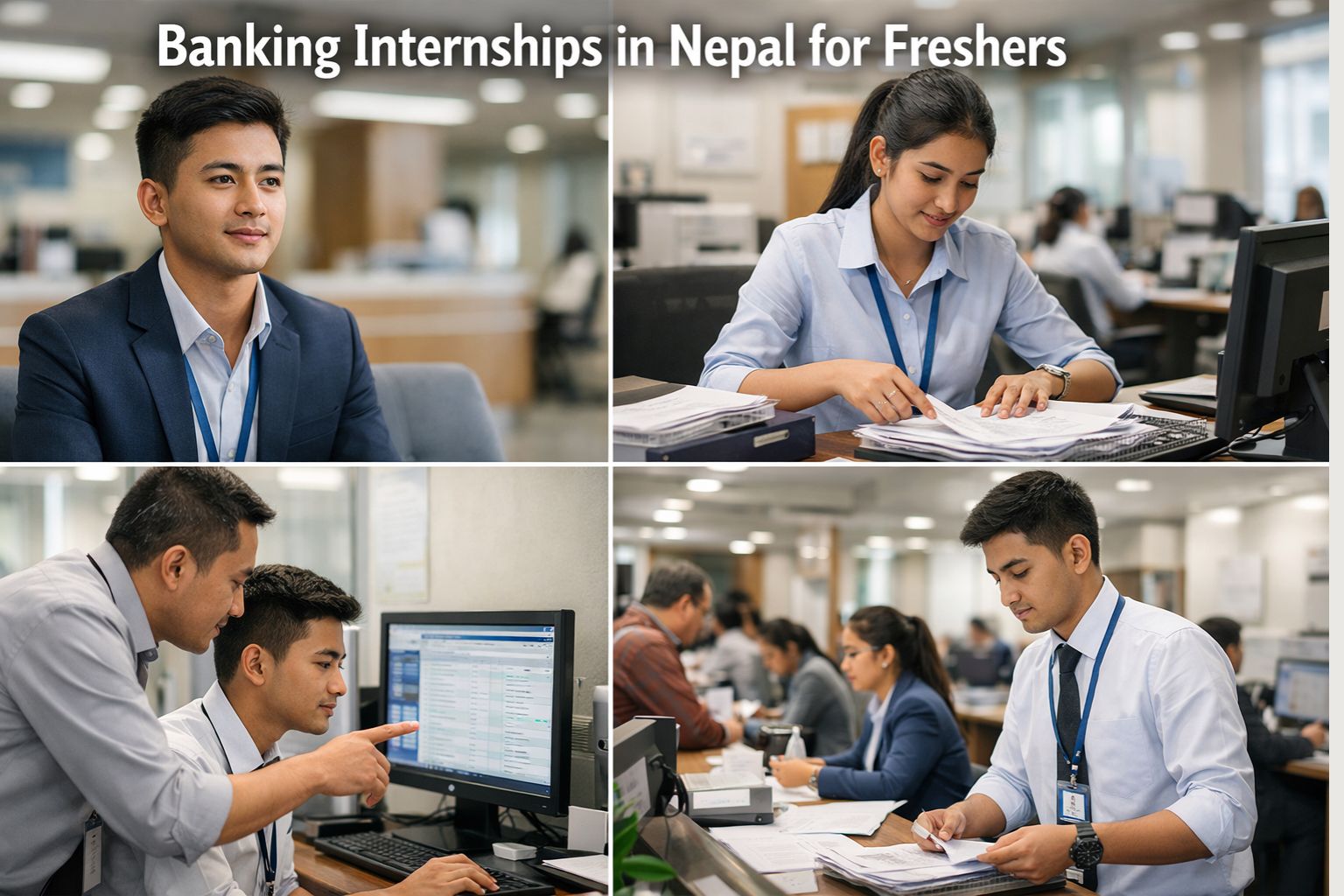
Nepal’s job market has long treated the banking and financial sector as one of the most attractive career destinations. Every year, thousands of young people who have studied management subjects such as BBA, BBS, BBM, MBS, and MBA graduate from universities with the dream of building a banking career. For these freshers, the most reliable bridge from theoretical knowledge to professional practice is an internship, or workplace training.
Major universities in Nepal, including Tribhuvan University (TU), Pokhara University (PU), and Kathmandu University (KU), have made internships for a fixed period, along with a project report based on that experience, a compulsory part of completing certain degrees.
This first step from student life to corporate life is as exciting as it is uncertain. The neat and polished environment inside a bank can be highly attractive from the outside, but the day-to-day reality can be different and more demanding.
This article provides a detailed and factual analysis of the realities freshers face during banking internships in Nepal, the opportunities these internships can create, the major challenges students must deal with, and the preparation needed for effective learning. Students planning to enter this sector may also find it helpful to read how to start a banking career in Nepal for freshers.
The Current Context and Institutional Structure of Banking Internships in Nepal
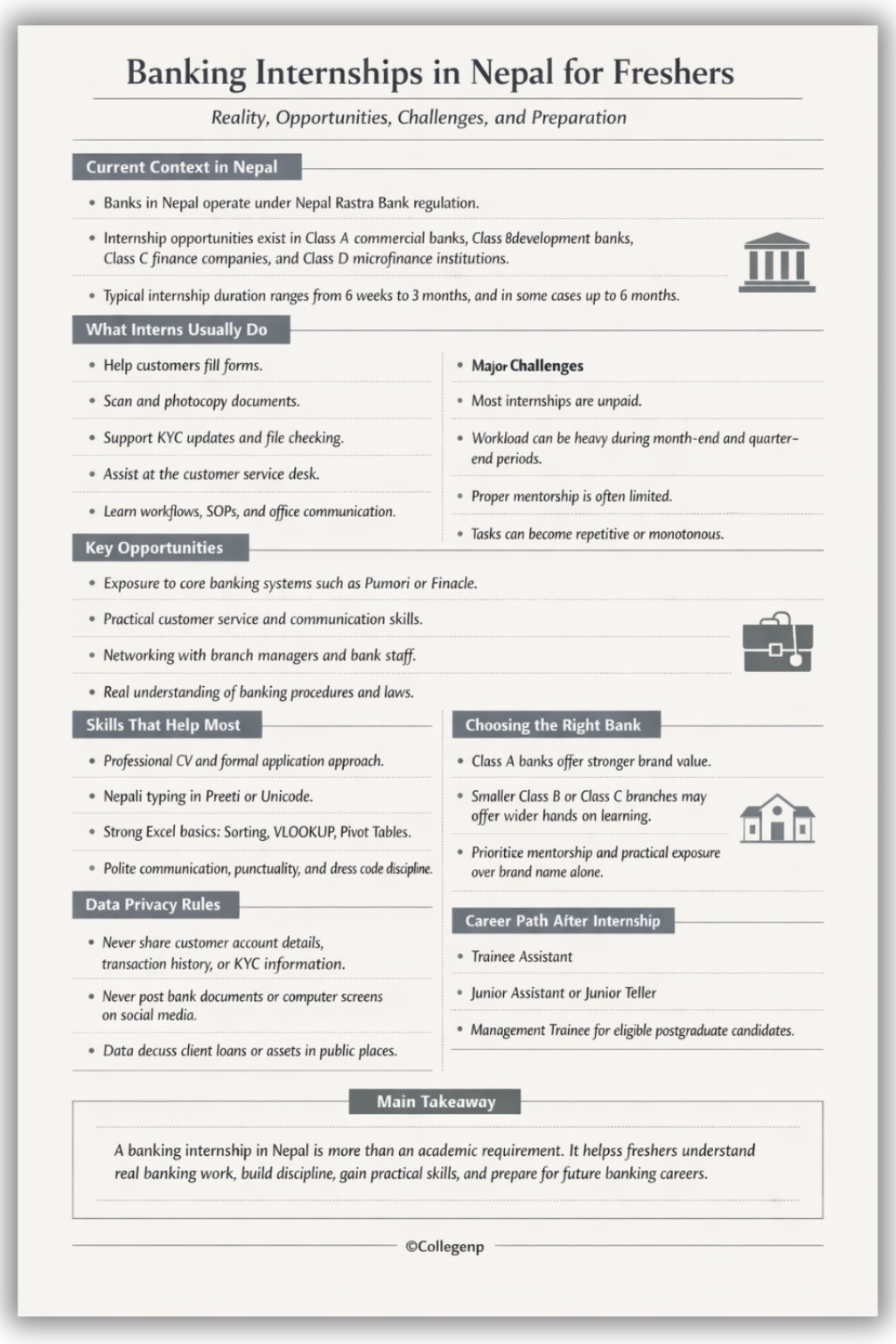
Nepal’s financial system operates mainly under the strict regulation and supervision of Nepal Rastra Bank. It includes Class A commercial banks, Class B development banks, Class C finance companies, and Class D microfinance institutions. All four types of institutions provide internship opportunities to management students.
Purpose of internships
From the banks’ point of view, internships are partly a matter of institutional social responsibility and brand building, but they also serve as a way to assess unskilled or inexperienced human resources.
For management students, internships provide a platform to see how the theories they studied in accounting, finance, and management are actually applied in real working life. In Nepal, depending on university requirements, banking internships generally range from 6 weeks or 45 days to 3 months or even 6 months.
The Reality of Banking Internships: Student Expectations and the Ground Situation
When students think about internships, many imagine working on financial data analysis at a computer, sitting in meetings with managers, or handling important loan files. The actual reality in Nepalese banks is somewhat different.
Banks operate with highly sensitive data, cash transactions, and strict internal control systems. Because of this, no new student is given risky tasks or responsibilities involving financial decision-making on the first day.
Common tasks during the first month
Administrative support
In most banks, the initial tasks assigned to interns include helping customers fill out application forms, learning how to prepare vouchers, scanning documents, and making photocopies. Many freshers may find this tedious or low-level work, but it helps them understand the basic profile of customers.
KYC management
One of the most time-consuming tasks in banking today is updating KYC records. Verifying customer details and checking files before uploading them into the system becomes a major duty for many interns.
Customer Service Desk (CSD)
Interns are often assigned to guide new customers visiting the branch, such as telling them which counter provides which service, or explaining how mobile banking or ATM services work.
The truth is that interns do not usually receive major or complex financial analysis work at the beginning. What they really learn first is the bank’s work culture, standard operating procedures, communication style, and the way the banking ecosystem functions.
Only after an intern starts showing responsibility and accuracy in small tasks do employees begin involving them in support work related to clearing, remittance, or credit departments.
The Vast Opportunities Banking Internships Can Create
Even if the reality is somewhat demanding, banking internships can become highly valuable for freshers who take them seriously and approach them positively.
a. Direct exposure to the Core Banking System (CBS)
No matter how much modern banking is studied in books, students usually do not know how the software used daily in banks actually works. Most banks in Nepal use core banking systems such as Pumori or Finacle.
As interns, students may get the opportunity to enter or search data in such systems under employee supervision. This becomes a major advantage later when applying for positions such as Trainee Assistant (TA).
b. Professional communication and customer service skills
Every day, interns may have to deal with hundreds of customers with different personalities, ages, and backgrounds. Learning how to calm an angry customer, help someone who is illiterate or unfamiliar with technology, and explain banking processes in simple language is not something that can be fully learned in a classroom.
These soft skills strengthen a person’s dealing power, which is essential in almost every banking role.
c. Corporate networking
Inside a bank, interns interact directly with the Branch Manager, Operation In-Charge, and Relationship Managers. Managers closely observe interns who work well, behave honestly, and show eagerness to learn.
If good relationships are built, it is common in Nepal for banks to inform such capable candidates about future vacancies or give them preference.
d. Practical knowledge of financial procedures and laws
What is the legal process when a cheque bounces? How is collateral evaluated? How can a person avoid being blacklisted? Seeing such matters directly provides knowledge that is far more lasting and useful than textbook learning.
Major Challenges Freshers Face During Internships
Every opportunity comes with challenges. Banking internships are not always pleasant for everyone. Most interns face the following issues in one form or another.
a. Unpaid work
Most Class A and other banks in Nepal do not provide interns with wages or a stipend. A few foreign-invested or corporate banks may provide a small amount for snacks or transportation, but in most places the internship is completely unpaid.
Working every day from 10:00 a.m. to 5:00 p.m. for 2 to 3 months without pay can create severe disappointment, along with financial stress from travel and food costs. As a result, some students begin to feel that it is simply a form of free labour.
b. Heavy workload and a stressful environment
Nepal’s banking sector is extremely busy. At the end of each month or quarter, such as the ends of Asoj, Poush, Chaitra, and Ashar, banks experience intense pressure.
Employees may work until 9 or 10 at night, and during such times interns may also feel more pressure to help. Students can find it difficult to handle the stress or harsh words that may come from senior staff when mistakes occur.
c. Lack of proper mentorship
Banks usually do not assign a dedicated mentor for teaching interns. Employees already under pressure from regular work often do not have enough time to explain tasks patiently to freshers.
As a result, interns may spend a significant amount of time confused about how to work. Students who are shy or afraid to ask questions may even spend a whole month at the same desk without learning anything new.
d. Monotonous or repetitive work
Because many banks do not want to take risks by assigning complex tasks to interns, some students spend months only scanning documents, checking old records, or reviewing SMS alert forms. In such cases, the internship can feel less like a learning opportunity and more like a waste of time.
How to Start a Banking Internship Effectively and Succeed in It
To get the maximum benefit from a banking internship, freshers should take the following strategic steps before applying and throughout the internship period.
1. Preparation and application process
Build a professional CV
Competition for internship placements in banks is high. A neat and well-prepared CV or resume plays an important role. Do not copy what your friends have written. Clearly mention your computer skills, communication abilities, and language proficiency. Before applying, it is useful to review these resume tips for freshers.
How to approach a bank
Sending a CV only to a general email address on a website often has very little chance of getting attention. Carrying a recommendation letter from your college to a nearby branch office, requesting time through the security guard to meet the Branch Manager or Operation In-Charge, and confidently expressing your willingness to learn can increase your chances.
Another good method is to submit your application directly to the Human Resources department at the corporate office.
2. Crucial skills needed
Nepali typing
A large portion of banking work involves preparing loan deeds, writing reports, and creating vouchers, where Nepali typing in Preeti or Unicode can become a major strength. An intern who can type well in Nepali is rarely left without work.
Strong Excel skills
Many students think MS Office means only knowing how to use Word. In reality, the banking sector relies heavily on Excel. If a student knows how to sort data, use basic formulas such as VLOOKUP, and work with Pivot Tables, they can prove useful in almost any department.
3. The right attitude toward work
Never forget the basic principle that no work is too big or too small. Even if you are asked to do photocopying in the first week, read what is being photocopied. It could be a loan deed or a corporate guarantee. Even that can help you understand banking policies.
Speaking politely with staff, arriving before office hours, and fully following the dress code help build professional discipline. Practical workplace habits also matter, and students may benefit from these tips to be a successful intern.
Internship and Confidentiality: A Serious Legal Matter
Becoming an intern in a bank also means taking on a very serious responsibility: protecting customer financial confidentiality.
Under the strict rules of Nepal Rastra Bank and the Banks and Financial Institutions Act (BAFIA), disclosing any customer data, such as account balances, transaction history, or KYC details, is considered illegal.
Freshers working inside a bank must never make the following mistakes:
-
Taking selfies or photos showing bank documents or computer screens and uploading them to TikTok, Instagram, or Facebook.
-
Secretly checking the bank balances of friends, family members, or relatives, or sharing such information with anyone.
-
Leaving the office and then discussing bank clients and their loans or assets in public places such as tea shops or cafes.
If a data breach is found, the bank has the right to dismiss the intern immediately and even pursue legal action.
Class A or Other Banks: Which Institution Should You Choose?
Most freshers prefer to intern at large and established commercial banks. There is a common belief that the brand value of a commercial bank looks better from the outside.
However, from a learning perspective, doing an internship at a smaller development bank or finance company may be even more beneficial.
Why?
Large Class A corporate branches often have a high level of departmentalization. Because of this, an intern may be assigned only one small task within a single department for 2 to 3 months. In smaller Class B or Class C branches, limited manpower means one employee may handle vouchers, remittance, and customer service all at once.
Because interns in smaller branches get more chances to mix with managers and staff, they often gain the unusual benefit of learning a little bit of everything. For that reason, it is often wiser to prioritize a place with better mentorship rather than choosing only by brand at the beginning.

The Project Report or Internship Report Submitted to College
After completing the internship, the final stage is preparing a strong project report for the university. This is where students make one of the biggest mistakes: they simply copy the reports of seniors or friends, change the name, and submit them.
A genuine fresher should include the following based on actual experience:
-
The real condition of the department where they worked.
-
The problems they observed there.
-
Their own suggested solutions or recommendations to reduce delays or errors in banking operations or customer service.
During the university viva or oral examination, external examiners mainly try to find out whether the report is copied or based on real experience. Therefore, students should prepare their draft honestly.
The Journey from Intern to Full-Time Employee
Not every intern gets a job immediately at the same bank. However, an internship builds a solid foundation for starting a banking career in Nepal.
After internship completion, freshers are generally qualified to apply for the following positions:
1. Trainee Assistant (TA)
This is the position where many new graduates begin. It is designed for fresh graduates without prior experience. However, a fresher who has already done an internship has prior exposure to banking terminology, software, and work culture, which significantly increases their chances in interviews.
2. Junior Assistant or Junior Teller
A few months of internship can sometimes be presented as a form of work exposure, allowing candidates to sit directly for entry examinations for such roles.
3. Management Trainee (MT)
If a fresher has a postgraduate degree such as MBA or MBS and strong academic performance, some banks offer direct entry advertisements at the junior officer level. This is known as MT.
Passing MT examinations requires theoretical knowledge, familiarity with financial laws, and a sound understanding of the national economy. Former interns who already understand the banking system often have an advantage here as well.
Students who are still comparing sectors may also want to read government vs banking vs IT career in Nepal.
Conclusion
For fresh graduates in Nepal, a banking internship is not just a compulsory academic formality. It is one of the strongest first steps toward securing a reliable and professional future.
It helps bridge the gap between the imagined corporate world shaped inside college classrooms and the actual working reality outside them.
The truth, however, is that banks often assign limited responsibility and many small administrative tasks, such as filling forms and making photocopies, at the beginning of the internship. Spending weeks at the same desk without any stipend can feel discouraging, and this remains one of the biggest complaints among young people today.
Even so, the crowded banking environment, direct interaction with customers of many kinds, and the discipline of the workplace gradually build professionalism in ways students may not immediately notice.
As Nepal’s banking market continues to become more dynamic, competitive, and technology-driven, freshers need to see internships not as a way to merely pass three months, but as an opportunity to absorb the language and systems of banking.
Students who set aside ego, remain willing to learn, closely observe even small details, strictly follow banking rules and laws, and actively expand their professional network are the ones most likely to open the door to future success in management and finance. A good banking internship, carried out with patience, consistency, and strong ethics, creates a solid foundation for turning freshers into successful bankers and capable managers in the future.







Comments 0
No comments yet. Be the first to start the conversation.