



Table of Content
- Major Challenges to Finding Employment in Nepal
- Deep Mismatch Between the Education System and Market Demand
- The Reality of Underemployment and Low Pay
- The Forced Condition for Freshers: The Experience Paradox
- Nepotism, Favoritism, and the Culture of “Source-Force”
- Weak Industrial and Productive Base
- Lack of Geographic Decentralization and Concentration of Opportunities
- Weak and Non-Transparent HR Systems
- Additional Barriers Faced by Women, Marginalized Groups, and Minorities
- Policy Instability and Declining Confidence in the Private Sector
- Limitations Among Job-Seeking Youth and Lack of Information
- Conclusion and the Way Forward
Major Challenges to Finding Employment in Nepal
The economic transformation and development of any nation depend on how effectively it uses its young workforce. At present, Nepal is passing through the era of a “demographic dividend,” meaning that the population of working age (15 to 59 years) is larger than the dependent population.
This is a golden opportunity for any nation to make a leap in development. Unfortunately, for Nepal, this opportunity has become tied to the painful reality of thousands of young people leaving every day for Gulf countries, Malaysia, or for Europe and Australia in the name of higher education.
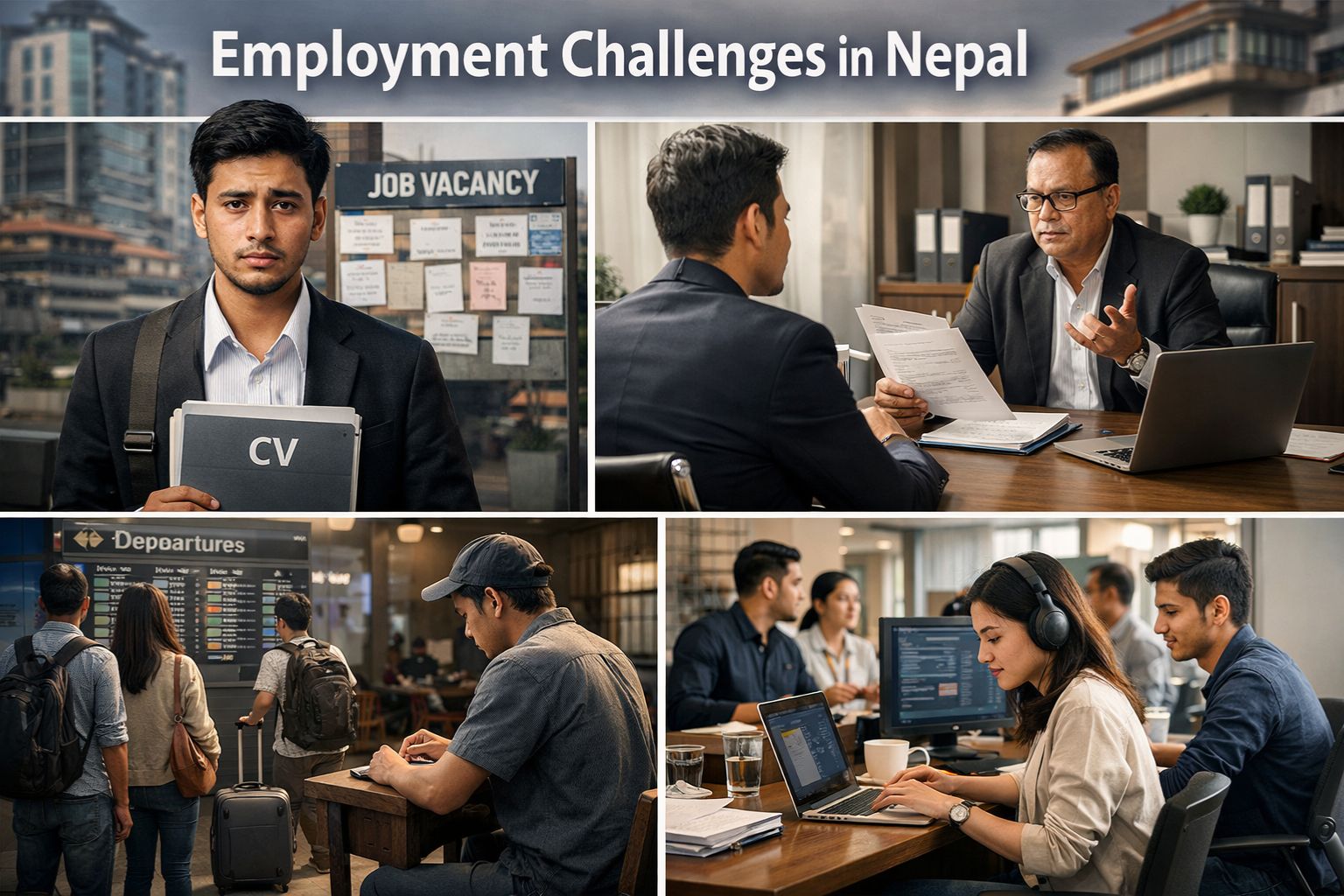
Young people seeking opportunities within the country, or those who have just completed university, face many institutional, structural, and policy-related barriers when they enter the job market. This article presents an objective and evidence-based analysis of the major challenges faced by new job seekers in Nepal’s labor market.
Deep Mismatch Between the Education System and Market Demand
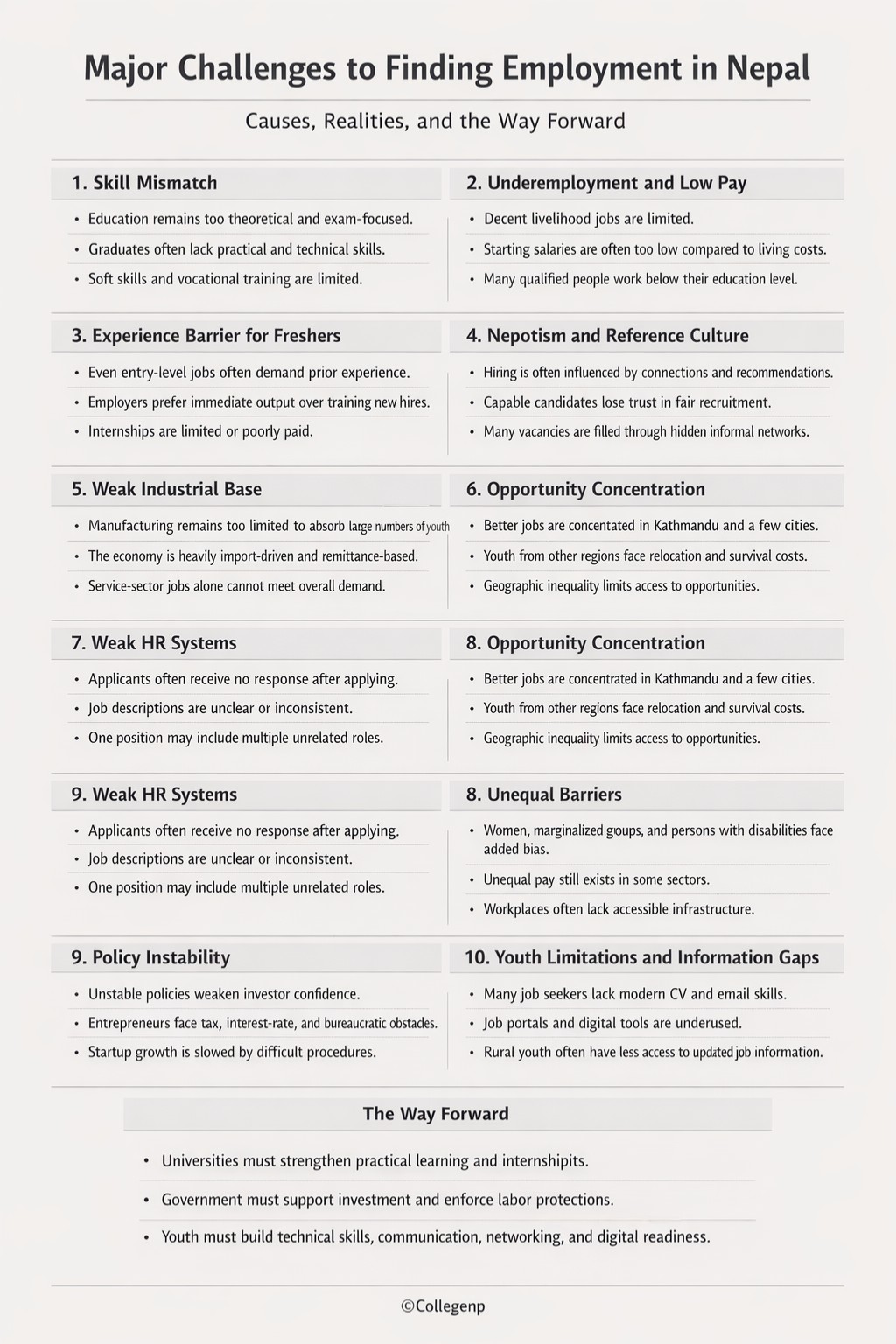
In Nepal, the most immediate challenge in finding a job is the mismatch between skills and market needs. Every year, universities and colleges produce hundreds of thousands of graduates and postgraduates, yet business owners and the corporate sector consistently complain of a shortage of skilled human resources. The main reasons behind this contradiction are as follows:
Focus Only on Theoretical Knowledge
Nepal’s education system is mainly textbook-based and exam-oriented. University curricula are, to a large extent, outdated and have failed to provide the practical and technical knowledge demanded by the modern market.
For example, when IT companies look for software developers, students often have only theoretical concepts rather than practical coding skills.
Lack of Soft Skills
Fresh graduates often lack the soft skills the market requires, such as effective communication, teamwork, analytical thinking, and logical problem-solving ability.
Shortage of Vocational Training
Compared to European or developed Asian countries, Nepal’s structure for vocational training and technical education is extremely narrow. Strengthening vocational education and employability outcomes is essential if graduates are to become job-ready.
The Reality of Underemployment and Low Pay
In Nepal, the issue is not only a lack of jobs, but a lack of decent jobs that can provide a sustainable livelihood. Even when a candidate finally secures employment after a long struggle, the next challenge is salary.
Low Wages Compared to Inflation
Most private-sector employers, especially in the informal sector and small or medium enterprises, offer very low starting salaries. Although the Government of Nepal has fixed a minimum wage, it is not strictly enforced in many informal workplaces.
Inability to Get Work Matching One’s Qualifications
When a person with a postgraduate degree is forced to work in data entry or at a general reception desk for a monthly salary of only NPR 10,000 to 15,000, that is a representative example of underemployment. In Nepal, underemployment has spread in a more alarming way than unemployment.
Forms of Labor Exploitation
Young workers face very difficult conditions because of policies such as “no salary until you learn the work” or “only a minimum allowance will be provided during the first six months of probation.”
The Forced Condition for Freshers: The Experience Paradox
A review of vacancy announcements makes one thing clear: even entry-level jobs often demand one or two years of experience. This traps young people in a frustrating cycle:
Experience is required to get a job, but a job is required to gain experience.
Employers are often reluctant to invest in training and learning. They want experienced workers who can deliver output from the very first day. Internship opportunities are also very limited, and even when available, many offer no pay or only a very small transport allowance, making it financially difficult for young people to continue for long.
Nepotism, Favoritism, and the Culture of “Source-Force”
Young people have deep distrust in the transparency of recruitment processes in Nepal’s labor market. In many government institutions, NGOs, and large corporate houses, opportunities are often influenced less by a person’s skills and more by who they know or whose recommendation they carry.
A Blow to Merit
When a capable young person performs well in an interview but still fails to get the job because of nepotism or political connections, it creates extreme frustration across the younger generation.
The Hidden Job Market
In Nepal, many small and medium job openings are still not published in newspapers or job portals. These vacancies are filled through personal circles, friends, relatives, or references. For young people from ordinary families without strong professional networks, entering this market is very difficult.
Weak Industrial and Productive Base
In any country, the manufacturing sector is what creates jobs for hundreds of thousands of young people. But Nepal’s economy has long become import-driven and consumption-based, sustained heavily by remittances.
Nepal does not have a sufficient number of factories and production-oriented industries. As older garment, footwear, textile, and carpet industries declined, the possibility of mass employment through industrialization also weakened.
Relying only on the service sector, such as banking, insurance, telecommunications, or hotels and restaurants, cannot create opportunities for all young people. Service-sector jobs are limited in number and competition is extremely tough. The low growth rate of such industries has created a labor supply far greater than demand.
Lack of Geographic Decentralization and Concentration of Opportunities
Despite the implementation of federalism, attractive private-sector jobs are still concentrated in Kathmandu and a few urban centers such as Pokhara, Chitwan, Butwal, and Biratnagar.
This creates a double burden for candidates from other regions. First, they are compelled to move to Kathmandu. Second, they must arrange the finances needed to struggle in an expensive city like Kathmandu.
With high rent, rising living costs, and low starting salaries, it becomes very hard to survive. As a result, many talented young people from remote areas are forced to abandon corporate job opportunities at home and move directly toward foreign employment.
Weak and Non-Transparent HR Systems
Even today, some Nepali employers still do not have clear and effective human resource systems.
No Response to Applicants
Applicants may spend time and effort submitting a CV, yet months pass without any information on whether they were shortlisted, rejected, or what shortcomings existed in their application.
Lack of Clear Job Descriptions
In Nepal, it is common for what is said in the vacancy notice to differ from what is said in the interview. It is also common to hire a person for one post but make them perform three or four different roles.
Additional Barriers Faced by Women, Marginalized Groups, and Minorities
In this already complex and highly competitive race for jobs, the playing field is not equal for everyone. In Nepali society, women, persons with disabilities, and people from marginalized regions and communities face additional subtle biases.
Attitudes Toward Women
Some private-sector employers hesitate to hire married women or women of an age likely to marry soon, because they view maternity leave or relocation after marriage as a risk.
Unequal Pay for Equal Work
In some sectors, especially agriculture and informal wage labor, serious wage inequality still exists between men and women even when they perform the same type of work.
Lack of Physical Accessibility
Very few employers have paid adequate attention to creating office structures or working environments that are accessible for persons with disabilities.
Policy Instability and Declining Confidence in the Private Sector
Jobs are created when investors and the private sector feel encouraged to establish new enterprises. In Nepal, however, changing political equations and policy instability have prevented foreign direct investment from reaching a satisfactory level, while domestic industrialists are also discouraged.
Because of tax complications, fluctuating bank interest rates, and bureaucratic obstacles, even people who want to become entrepreneurs and create jobs for five others are themselves being pushed toward migration. Those trying to launch startups are often discouraged by the difficult investment climate and the complicated process of obtaining grants or support.
Limitations Among Job-Seeking Youth and Lack of Information
The full picture cannot be understood by blaming only the state and industry. Many job-seeking youths also face limitations related to technical preparedness and self-presentation.
A large number still do not know how to create a modern CV or write a professional email.
There is also a lack of knowledge about how to use job portals effectively, such as Merojob, JobsNepal, and LinkedIn, and how to update profiles regularly. Many rural youths still depend only on the Wednesday vacancy listings in Gorkhapatra, while remaining unfamiliar with modern data-driven or AI-filtered employment portals.
Conclusion and the Way Forward
It is not that Nepal has no jobs or no possibilities at all. Even today, there is a strong shortage of highly capable workers in sectors such as IT, banking, marketing, and digital marketing. However, the path is not easy for people with only average or basic competence.
These problems cannot be addressed through isolated efforts alone.
1. From Universities and Policymakers
Practical systems must be integrated into theoretical education. Work-study models and internships should be made compulsory alongside academic study.
2. From Government and Regulatory Bodies
It is essential to create an investment-friendly environment in which small enterprises can grow. The government must strictly regulate any labor exploitation that violates minimum wage standards or labor law.
3. From Young Candidates
Young people must accept that today’s world is highly competitive. Rather than relying only on traditional degree certificates, they must prepare themselves to become skilled through technical courses, strong professional networking, communication ability, and proper use of information technology. The growing shift toward skills-first hiring makes this even more important.
If this reality inside the country is confronted with determination, it is still possible to sow the seeds of progress in this very soil. But for that, along with personal patience, structural change is already overdue.







Comments 0
No comments yet. Be the first to start the conversation.