



Table of Content
- Why Is It So Hard for Fresh Graduates in Nepal to Find Jobs?
- The Gap Between Theoretical Education and Real Market Needs
- The Paradox of Experience and Reluctance to Invest in Training
- Lack of Soft Skills and Professional Presentation
- Ineffective Job Search Strategy
- Hidden Job Market and the Dominance of Networks and Nepotism
- Serious Lack of Effective Internship and Mentorship Culture
- Nepal’s Limited Corporate and Industrial Base
- Conflict Between Salary Expectations and Ground Reality
- Youth Morale and the Tendency to Seek Quick Results
- Conclusion and the Way Forward
Why Is It So Hard for Fresh Graduates in Nepal to Find Jobs?
Every year, hundreds of thousands of students complete their bachelor’s and master’s degrees from various universities in Nepal, including Tribhuvan University, Kathmandu University, Purbanchal University, Pokhara University, and other national and international academic institutions.
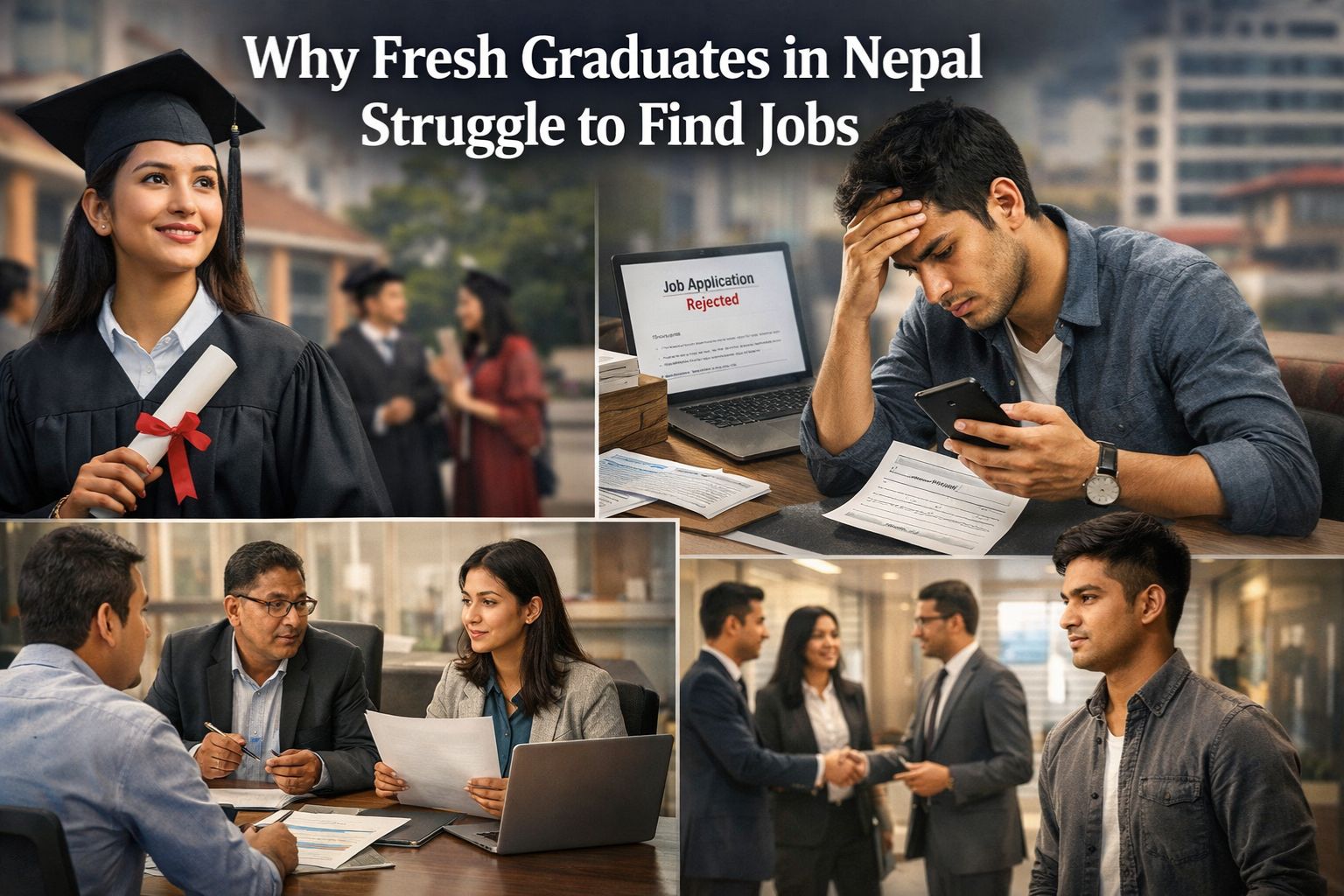
At campus graduation ceremonies, as they receive their certificates wearing gowns and caps, most young people carry dreams of a good career, an attractive salary, and a secure future. But when these “freshers” — young people who have just completed their studies and have no professional experience — begin knocking on the doors of the job market, they are forced to confront an extremely harsh, unexpected, and challenging reality.
Everyone knows that Nepal’s unemployment rate is high, but an even more worrying fact is that even in sectors where jobs are available, freshers are often unable to make it through employers’ selection processes.
For most young graduates in Nepal, it has become a common experience to apply to hundreds of companies for months without receiving a single positive response or even an interview opportunity.
Why does a fresher, who enters the market full of excitement after earning a degree, have to struggle so much? This issue is not just an individual problem. It is a complex matter tied to the country’s education system, the structure of the labor market, government policy, and corporate culture.
This article presents a fact-based, detailed, and multidimensional analysis of the major reasons why freshers in Nepal fail to secure employment.
The Gap Between Theoretical Education and Real Market Needs
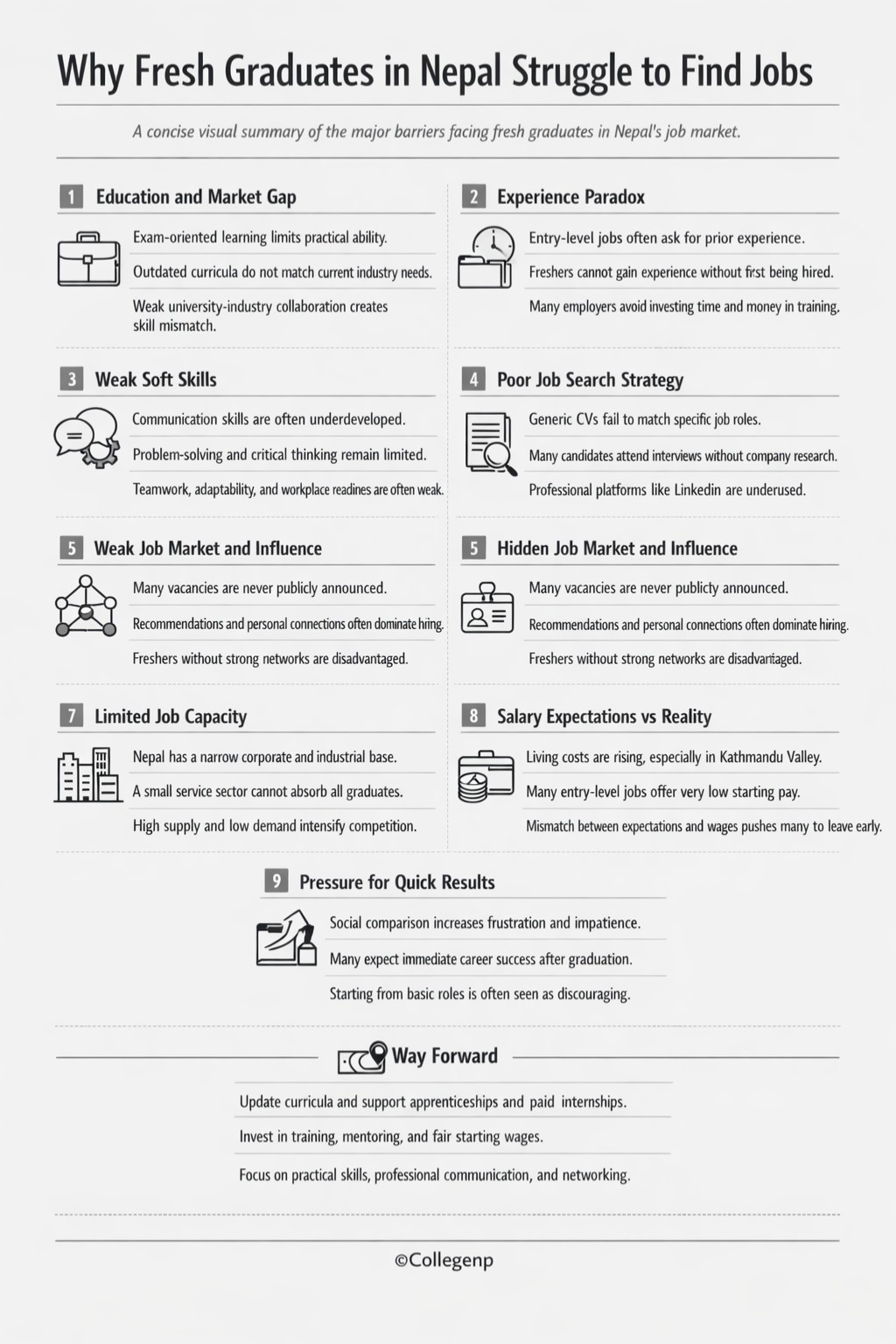
The first and strongest reason why freshers in Nepal do not get jobs is the wide gap between our current education system and the needs of the job market, or what is often called a skill mismatch.
Exam-Oriented Learning
Most campuses and colleges in Nepal are still fully exam-oriented. Students are evaluated less on what they have learned to do in practical terms over four years and more on how many memorized answers they can reproduce in a three-hour exam.
When that same student arrives in an office or industry setting with a GPA of 3.5 or 4.0, they often do not possess the skills the market demands — such as writing business proposals, performing data analysis in Excel, or doing practical software coding. This is closely tied to the wider disconnect between jobs, skills, and degrees in Nepal’s labor market.
Outdated Curriculum
Technology, business models, and workplace requirements are changing every day in the market, but the curricula of most Nepali universities are not updated for years.
Students in management, IT, humanities, science, and other disciplines continue studying theoretical concepts that are five to ten years old, which do not align with the realities of today’s corporate world.
Lack of Collaboration Between Universities and Industry
In developed countries, there is a strong industry-academia linkage. Universities prepare students according to the type of workforce companies need.
In Nepal, this kind of academic dialogue barely exists. Universities are largely limited to functioning as certificate-distributing institutions that teach theory.
The Paradox of Experience and Reluctance to Invest in Training
If one carefully studies job advertisements in newspapers and online job portals in Nepal, a revealing and frustrating pattern appears. Even entry-level positions, which are actually meant for freshers, often require a minimum of one to two years of experience. This is where students get trapped in the “paradox of experience.”
The paradox is simple: experience is mandatory to get a job, but how can one gain experience without first getting a job?
Why does this happen in Nepal? Because employers in Nepal — especially small and medium-sized enterprises and companies with limited budgets — often do not want to invest time and money in hiring a fresher and training them for the first two or three months.
What employers want is for an employee to deliver full productivity from the very first day of appointment. Institutions here are often extremely hesitant to allow a learning period or to show flexibility for “learning through mistakes.” As a result, when employers search for people through a plug-and-play model, freshers are automatically left out of the cycle.
Lack of Soft Skills and Professional Presentation
In the corporate market and modern offices, employers often prioritize soft skills more than degrees. According to the general understanding of many human resource experts, this is one of the weakest areas among many Nepali fresher graduates. A lack of soft skills includes the following:
-
Effective communication: The ability to express ideas clearly, speak in a professional manner, avoid artificial language, and follow proper email etiquette is often weak among Nepali students. A large number of freshers hesitate to communicate in both English and Nepali or show a lack of confidence.
-
Problem-solving and critical thinking: Because universities often train students to memorize ready-made answers, many students do not develop the habit of thinking critically or searching for out-of-the-box solutions when new problems arise. Companies need employees who can identify and solve problems, not just follow orders.
-
Teamwork and leadership: The workplace environment is entirely different from college. People must collaborate with colleagues of different ages and viewpoints, and freshers are often accused of adapting slowly in such settings.
Ineffective Job Search Strategy
Many young people are unemployed, but the way they search for jobs is often equally flawed. The major mistakes made by a typical fresher cause their biodata and profile to be rejected right at the beginning, even when they reach employers.
Weak and Unprofessional CV or Resume
More than 90 percent of freshers in Nepal look for jobs using the same old format that has circulated in cyber cafés for decades. The practice of customizing a CV according to the specific position being applied for has not yet developed.
A long biodata filled with irrelevant information and grammatically incorrect English leaves a poor first impression. A stronger resume for freshers can make a significant difference.
Attending Interviews Without Preparation
Students often attend interviews without even researching the company they applied to, including its main purpose and services.
Failing to answer a basic question like “Why do you want to work here?” with a clear and objective response is one of the biggest technical mistakes a fresher can make. Proper job interview preparation remains essential.
Minimal Use of Professional Digital Profiles
In developed cities today, professional digital networks such as LinkedIn are considered one of the first tools of hiring. But many Nepali fresher students use Facebook and Instagram mainly for entertainment and do not invest time in building a professional image and network through LinkedIn.
Hidden Job Market and the Dominance of Networks and Nepotism
Another major barrier to employment for freshers is the hidden job market and the dominance of reference systems.
One fact must be acknowledged: in Nepal, many openings for small and mid-level positions — according to various data and studies, around 60 to 70 percent — are never formally published in newspapers or job portals as vacancies. People already inside institutions often shortlist friends, relatives, family connections, or people from their business network for the post in advance.
When a position is filled secretly through recommendation, a student from an ordinary family or from a remote area, without a strong professional network in Kathmandu or the relevant city, is automatically pushed aside.
Even though the process may appear fair in government or large non-governmental organizations, in private organizations and businesses run like family enterprises, the question of “Who recommended this person?” can weigh more heavily than qualifications and certificates. In everyday language, this is understood as “source-force” or “influence.”
Serious Lack of Effective Internship and Mentorship Culture
According to university rules in Nepal, some faculties require internships, but the way this system is actually used is deeply unfortunate.
There is a severe shortage of organizations in the market that offer internships. Even among those that do, two main tendencies are commonly seen:
Ritualistic and Certificate-Oriented Internships
Many institutions — especially some banks, government offices, and small private offices — only ask interns to make photocopies, carry files from one place to another, or sit idly at the reception desk.
By the end of a four- to eight-week period, these students have neither gained deep insight into work related to their field nor developed any meaningful skill.
Exploitation Through Free Labor
Some companies recruit interns simply to reduce their workload. They make them work full-time for a month, often eight to ten hours a day, without even covering basic tea, snacks, or transportation expenses.
Working for a long period under this kind of unpaid labor is simply not possible for rural and lower-middle-class fresher students in expensive cities like Kathmandu. As a result, the path to gaining experience gets blocked midway.
Nepal’s Limited Corporate and Industrial Base
On one hand, the line of people seeking jobs is long. On the other hand, the base of job providers is extremely narrow.
Nepal’s economy is not driven by large-scale manufacturing. In a market sustained by industries dependent on imported raw materials and a limited service sector, very few institutions are in a position to recruit large numbers of fresher graduate trainees at once.
Nepal’s major employment sectors include a few business houses, commercial banks, insurance companies, telecommunications providers, non-governmental organizations, and, more recently, expanding IT companies.
When 200,000 to 300,000 people graduate each year, these limited service sectors have the capacity to absorb only about 20,000 to 30,000 freshers at most. This imbalance in supply and demand intensifies competition, where even a small technical skill can make a major difference in the result.
Conflict Between Salary Expectations and Ground Reality
The issue is not only about failing to get a job. Even after starting work, many freshers cannot remain in jobs for long, or they leave very early because of the wide gap between their expectations and the reality offered by Nepal’s labor market.
Inflation has risen sharply. To meet even basic needs such as rent, daily living expenses, and internet costs, an average fresher in the Kathmandu Valley cannot manage with Rs. 15,000 to Rs. 20,000.
Yet many private firms, agencies, schools, and hospitals offer only Rs. 10,000 to Rs. 12,000 per month for entry-level positions. After years of study and large financial investments in quality education, hearing such a low starting salary often feels like labor exploitation to young people.
Because salary expectations do not match reality, or because no compromise seems possible, hundreds of young people leave these opportunities behind and choose foreign destinations through student visas or working visas instead.
Youth Morale and the Tendency to Seek Quick Results
Everything cannot be blamed only on the system. It is equally important to understand the psychology of today’s youth.
Because we live in an “instant” world — where social media constantly shows friends progressing abroad, buying luxury cars, or enjoying life — freshers are often overwhelmed by impatience, depression, or a sense of competition.
Students feel they should be sitting in an attractive and respectable chair by the very next month after completing their degree. In reality, career growth usually requires entering an institution, learning from the basic level, and struggling upward over three to four years.
Many students appear to lack the patience for this process. Opportunities are also being lost because some are not prepared to begin from small and entry-level roles.
Conclusion and the Way Forward
In Nepal, for a new graduate, crossing the initial threshold of the job market is as difficult as chewing iron. Carrying irrelevant education imposed by the university and entering the market without skills, while expecting to perform some kind of miracle, almost guarantees disappointment.
But this is not the end. Once the problem is clearly identified, it becomes easier to outline solutions. To help freshers secure employment, both young people and educational institutions need to change their approach from now on:
-
Responsibility of universities and government: Nepal’s curricula must be revised immediately. The government should create a legal framework to promote apprenticeships and paid internships across both small and large industries. Universities should establish career placement cells.
-
Mindset of corporate houses: Employers need to understand that if they avoid training freshers today, the country will face a shortage of skilled and leadership-ready employees tomorrow. Along with a mentoring culture, there should be a guarantee of humane living wages for young workers from the start.
-
Responsibility of students themselves: While studying, students should prioritize learning and practical skill-building over certificates alone. Learning basic IT skills such as MS Word and Excel, writing emails and reports properly, and preparing a professional biodata no longer require large amounts of money and can be learned at home. If students begin building networks in their relevant field through LinkedIn or professional events in time, the journey toward a first job can become unimaginably easier.







Comments 0
No comments yet. Be the first to start the conversation.