



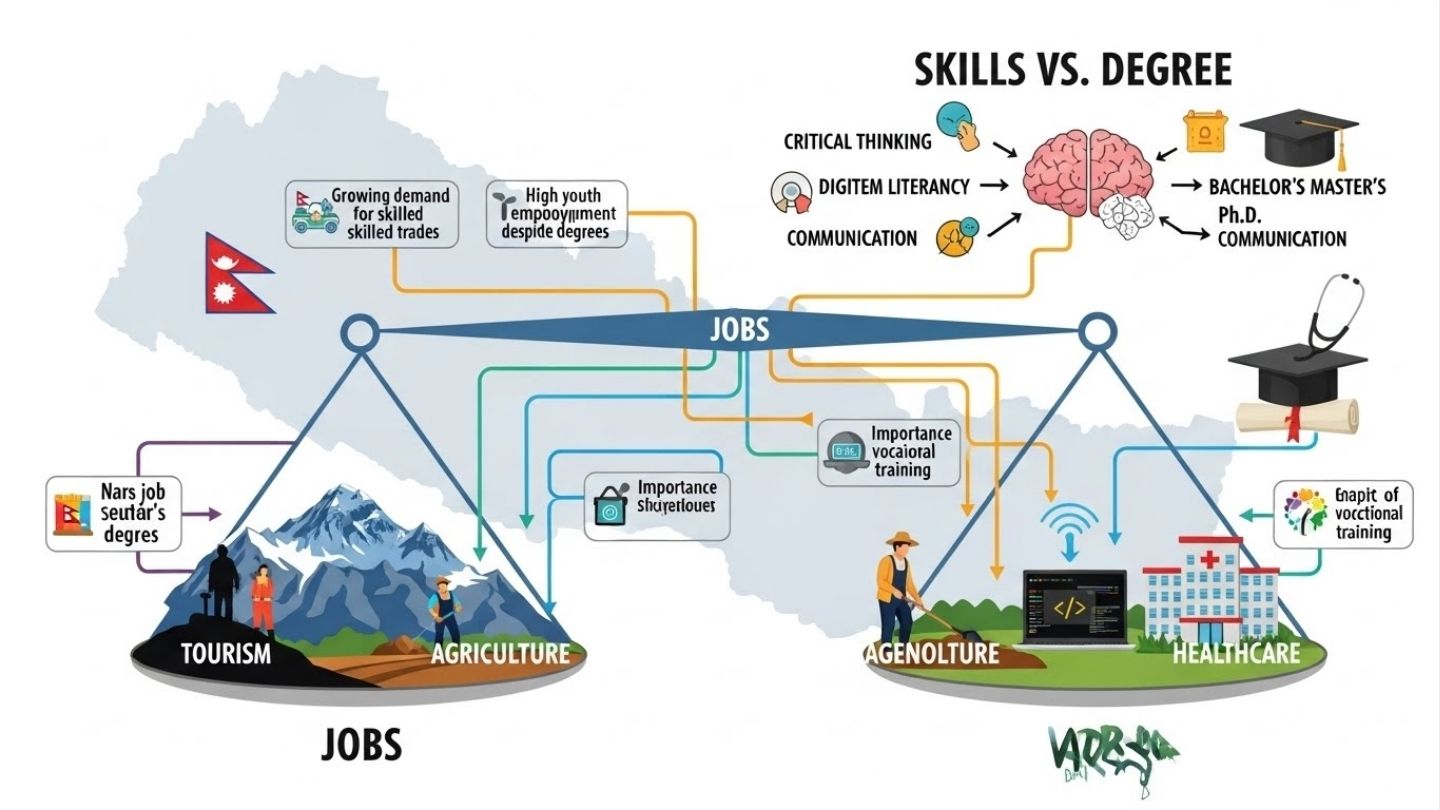
Jobs, Skills, and Degrees: What Really Sells in Nepal’s Labor Market?
In Nepal’s current social and economic landscape, a serious paradox exists. Tribhuvan University sets records for graduating one of the world’s largest numbers of students in its convocation ceremonies, and thousands of young people receive “Master’s degree” certificates in their hands. But the very next day, those same young people are found standing in line at the passport office or expressing frustration, saying, “There is nothing in Nepal.”
On the other hand, the complaint I repeatedly hear from HR managers of Nepal’s reputed banks, corporate houses, and IT companies—where I have worked as a consultant—is always the same: “We have opened vacancies for months, but we cannot find a competent candidate who can actually do the job.”
Why this gap? There is a long line of degree holders on one side and a line of unfilled jobs on the other. Why are these two not meeting? My 30 years of study, research, and market analysis suggest that the core problem here is not only unemployment. The key problem is unemployability.
In this article, we will dissect the decades-old debate of “Which is bigger: degree or skill?” not through emotion, but through data, market psychology, and the global job market shift.
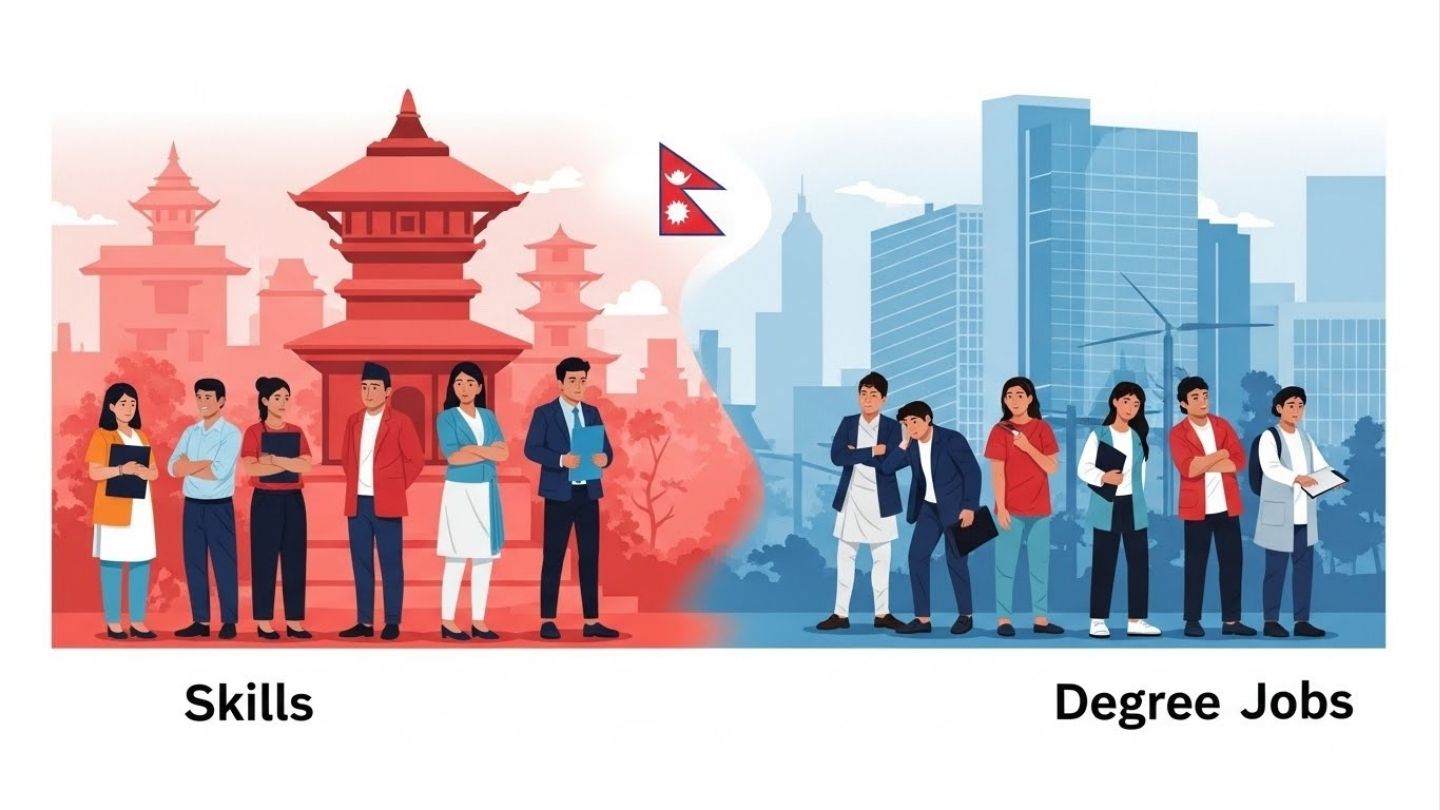
Yesterday’s Market and Today’s Reality (A Comparative Study)
Yesterday (1990–2010): The Dominance of Degrees
We must understand that our parents or society were not wrong when they said, “Study and become someone.” Twenty to thirty years ago, a university degree was rare in Nepal. Anyone who passed a BA or SLC was considered intellectual by society.
Government jobs (Lok Sewa) were the main source of employment, and a degree was mandatory to enter them. At that time, a “degree” itself was proof of “skill.” Having a degree was seen as evidence that you were disciplined and able to perform assigned tasks.
Today (The Post-2020 Era): The Rise of Skills
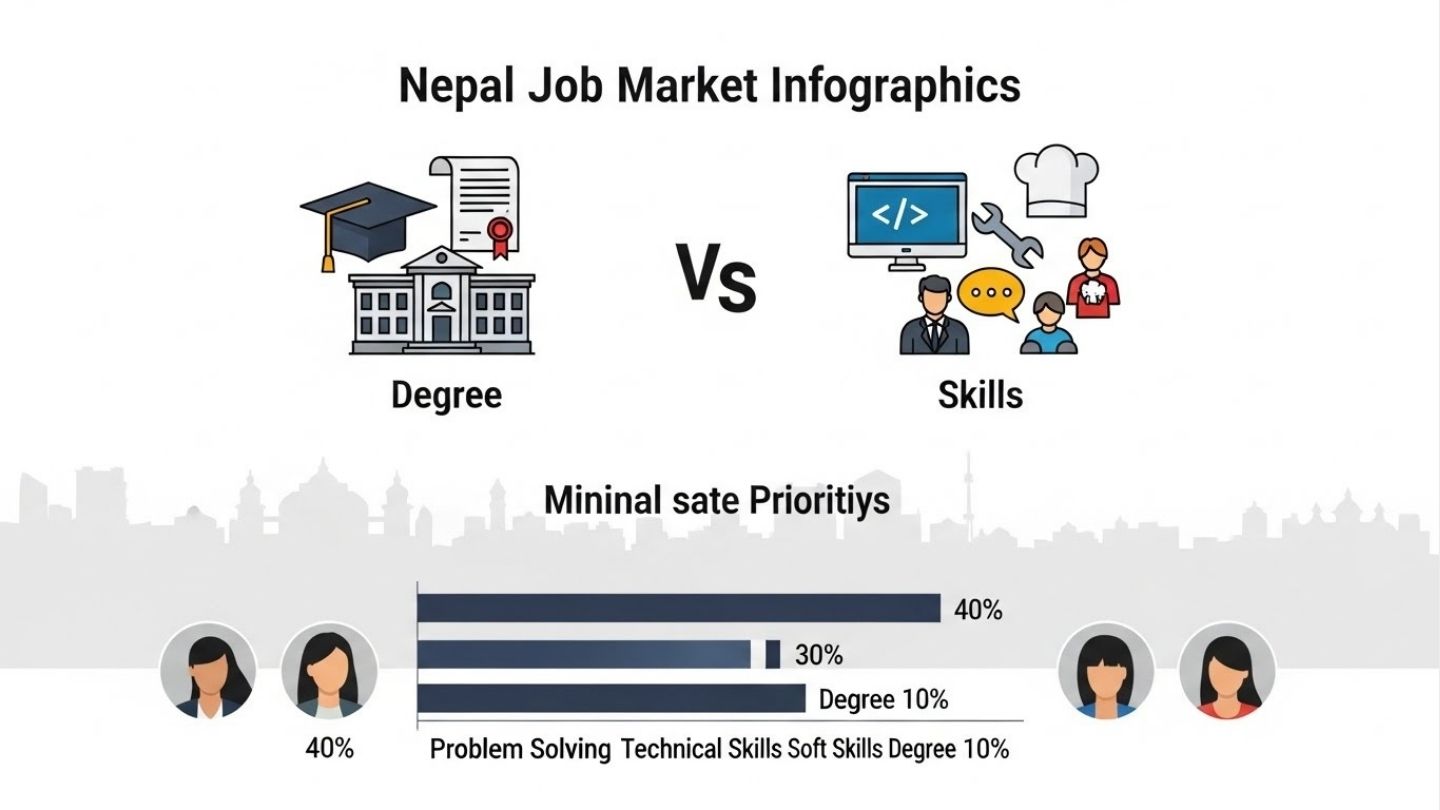
Times have changed. The “Information Age” has brought us into the “Skill Age.” In today’s market, a degree is only an “entry pass,” not a “survival kit.”
Based on analyses of recent informal surveys and reports from the Federation of Nepalese Chambers of Commerce and Industry, the private sector’s hiring priorities appear to be as follows:
-
Problem-solving ability: 40%
-
Practical/technical skills: 30%
-
Attitude/soft skills: 20%
-
Academic degree: 10%
These figures clearly show that the weight of degrees is declining.
The Degree Dilemma
Is a degree just a useless piece of paper? As a scholar, I cannot say that, and it is not true. A degree has its own value, but its role has changed.
Where and why is a degree needed?
-
Government and regulatory bodies: In Nepal’s context, degrees are mandatory for entering the Public Service Commission, Teacher Service Commission, banking (for some positions), and the civil service. This is a legal requirement.
-
Foundation of basic knowledge: A university gives you a way of thinking (critical thinking), a method of research, and a network.
-
Social signaling: In Nepal, even today, from the marriage market to social respect, the sentence “his/her son/daughter has done a Master’s” still carries strong meaning.
Where did the degree fail?
There is a major mismatch between our education system (curriculum) and market demand.
Examples:
-
A management student may memorize balance sheets but cannot maintain accounts using Tally or Excel.
-
An engineering graduate may master theory but cannot manage labor onsite or use modern software effectively.
Because of this gap, degree holders are becoming unemployed. They have knowledge, but not the skill to apply it.
Skills: The Currency of a New Era
If a degree is a passport, skills are the visa. You may have a passport, but without a visa, you cannot fly. In Nepal’s job market today, three types of skills are in high demand.
(a) Hard Skills: Technical Competence
These are skills you can demonstrate through work.
Key areas:
-
IT and digital: Coding, digital marketing, data analytics.
-
Skilled trades and technical work: A good plumber or electrician can earn NPR 50,000 to 100,000 per month in Nepal, which is higher than the salary of a typical junior bank assistant.
-
Professional skills: Cooking (chef), hair styling, fashion designing, machine operating.
(b) Soft Skills: Behavioral Competence
In my 30-year career, I have seen many gold medalists lose jobs because they lacked soft skills.
Key areas:
-
Communication: Can you express your ideas clearly? Can you convince a client?
-
Teamwork: An office is not a place to run alone. The ability to work with others is a top requirement today.
-
Adaptability: The COVID pandemic showed that those who can change with change are the ones who survive.
(c) Financial Literacy
This is not taught in school or college. Earning money alone is not a complete skill. Managing what you earn—saving, investing, and tax planning—is also a major life and career-protecting skill.
Nepal’s Job Market Reality (Sector-Wise Breakdown)
Before saying “There are no jobs in Nepal,” we must look deeply at the real condition of different sectors.
1. Banking and corporate sector
Situation:
-
A degree is mandatory here (at least a bachelor’s).
-
Employers prefer those who can use banking software (Pumori/Finacle), speak good English, and deliver presentations, rather than those with only degrees.
Conclusion:
-
Here, the balance is roughly 50% degree and 50% skill.
2. Information Technology (IT Sector)
Situation:
-
This is Nepal’s fastest-growing sector.
-
Companies like Leapfrog and Cotiviti look at your GitHub profile (code portfolio) rather than your certificate.
Case study:
I know many young people who have only passed Grade 12 or even dropped out, yet are earning NPR 200,000 to 300,000 per month while living in Nepal and working for foreign companies.
Conclusion:
-
Here, skills are 90% and degrees are 10% (or are not needed).
3. Tourism and hospitality
Situation:
-
To become a manager in a five-star hotel, a degree is needed.
-
But to become a chef, barista, or tour guide, skills and language are essential.
-
A guide who speaks good French or Chinese can earn well.
Conclusion:
-
Practical skills and languages dominate here.
4. Self-employment and freelancing (The Gig Economy)
Situation:
A large community in Nepal now works through Upwork and Fiverr in graphic design, video editing, and content writing. No one asks, “Which college did you study in?” They ask, “Show me your portfolio.”
The Root of the Problem and the Path to Solutions
Now the question arises: What should a young person do? Leave degrees and learn only skills? Or study only for degrees?
My expert recommendation is a hybrid model.
Problem 1: Degree without skills
Many students spend 3–4 years in college, pass exams, but remain unfamiliar with the outside world.
Solutions:
-
Make internships mandatory while studying. Even if unpaid, go to learn.
-
Allocate two hours daily outside college time to learn a new skill such as data analysis, graphic design, or public speaking.
Problem 2: Skills without degrees
Such young people earn well early on but can face career stagnation later. Promotions to manager-level roles or PR pathways abroad can be blocked without a degree.
Solutions:
If you are busy with work, complete your degree through Open University or online learning. This provides a safety net for the future.
Problem 3: Choosing the wrong subject
The habit of choosing science because a neighbor chose science, or management because friends chose management, is harmful.
Solutions:
-
Take career counseling.
-
Many in Nepal still do not know that those trained through vocational routes (CTEVT) can have stronger job prospects than many university pathways.
Experts Tips
I have reviewed the career graphs of thousands of young people. The difference between successful and unsuccessful individuals is not the degree, but their approach.
Here are my five golden rules:
-
Treat your degree as Plan B: A degree is your protective shield, but the weapon is skill. You need weapons (skills) to fight; the shield (degree) only helps you survive.
-
Strengthen your English: No matter how much we emphasize nationality, English remains the gateway to global knowledge and opportunities. Treat it as a skill.
-
Be tech-savvy: Whether you become a doctor, lawyer, or farmer, if you cannot use technology (AI, social media, internet research), you will fall behind. Learn to use AI tools like ChatGPT as your assistant.
-
Networking: In Nepal, “Who you know” often works more than “What you know.” This does not mean flattery. It means connecting with experts in your field, attending seminars, expanding relationships, and staying active on LinkedIn.
-
Lifelong learning: Learning does not end on the day you get your degree; it begins. The market changes every six months. Those who do not update themselves disappear like Nokia phones.
Conclusion
Finally, in the triangle of “jobs, skills, and degrees,” which one is primary?
The answer is simple: Jobs are the outcome, degrees are the foundation, and skills are the pillars that stand on that foundation.
In Nepal’s context, if you have only a degree, you are incomplete. If you have only skills, you may be insecure. But if you combine both degree and skills, you are unstoppable.
Nepali youth should no longer wait for university certificates alone. They must reskill and upskill according to market demand. It is not that there are no opportunities in Nepal. Opportunities have narrowed for those carrying only traditional qualifications, while the sky is wider for those with competent and modern skills.
Show your degree to your parents, but show your skills to employers. Success is in your hands.







Comments 0
No comments yet. Be the first to start the conversation.