



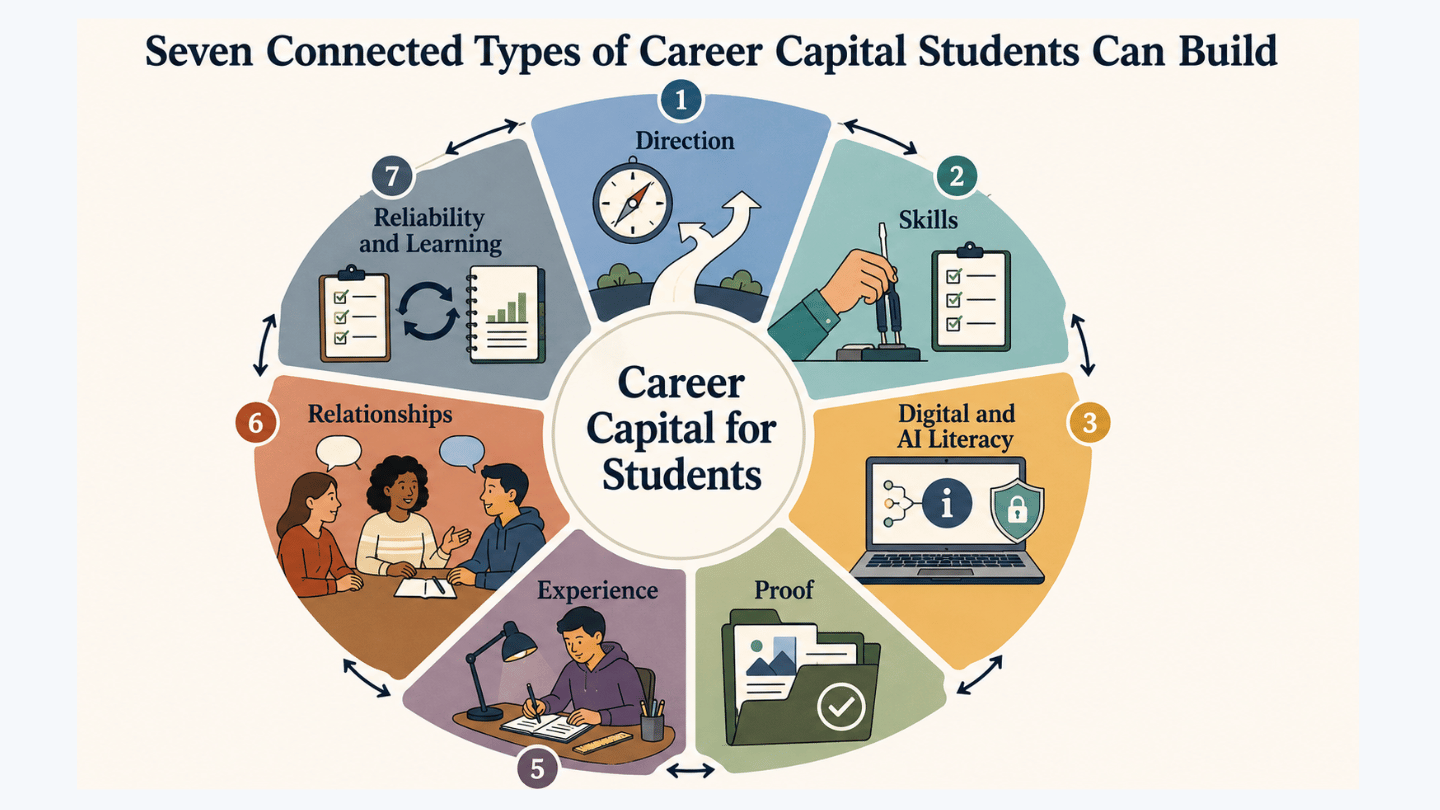
Career capital for students is the set of useful assets that can improve future career choices. It includes skills, evidence of ability, practical experience, relationships, career direction, responsible use of digital and artificial intelligence tools, and a record of dependable learning.
A degree can contribute to career capital, but it is only one part of the picture.
Students often receive separate advice about grades, internships, networking, portfolios, certificates, and technology. A more useful question is how these elements connect. An activity creates career capital when it helps a student learn something relevant, apply it, produce evidence, receive feedback, and make a clearer next decision.
This article uses a seven-part Collegenp editorial framework. It draws on recognised career-readiness and digital-competence frameworks, but it is not a universal academic classification. Priorities differ by field, education stage, location, access, responsibilities, and personal goals.
Answer Summary: Students should build connected career assets rather than collect unrelated activities. Start with direction, develop useful skills, apply them in realistic tasks, save evidence, seek feedback, form genuine relationships, and demonstrate that you can learn and follow through. Focus on one weak area at a time. A completed project with evidence and feedback is often more useful than several activities with no clear purpose.
Table of Content
- What Is Career Capital for a Student?
- The Seven Types of Career Capital Students Can Build
- How an Activity Becomes Career Capital
- How to Build Experience Without an Internship
- How Career Capital and Credentials Work Together
- A Career Capital Audit for Students
- A Realistic 90-Day Plan
- Common Career-Capital Traps
- What Students Should Build First
Key Takeaways:
-
Career capital is broader than a résumé or qualification.
-
Skills become more credible when they are applied and documented.
-
An internship is one route to experience, not the only route.
-
A portfolio can be private, offline, or designed for a specific field.
-
Credentials and demonstrated capability often work together.
-
One focused priority is more useful than random accumulation.
What Is Career Capital for a Student?
Career capital is an umbrella term for resources that support a person’s capability, credibility, access, and future career options. Different researchers and career organisations group these resources in different ways, so students should use the idea as a planning lens rather than a fixed score.
Career capital can include:
-
knowledge and practical skills;
-
qualifications and assessed learning;
-
work samples and other evidence;
-
experience with real tasks and constraints;
-
relationships that provide information or feedback;
-
understanding of career options;
-
dependable work habits;
-
the ability to learn and adapt.
The value of each asset depends on context. A laboratory record may matter in one field, while a performance sample, technical drawing, writing portfolio, practical assessment, or code repository may matter in another.
Career capital is more than a résumé
A résumé summarises selected education, responsibilities, and achievements. Career capital is what those experiences have helped a student learn, demonstrate, understand, and connect.
Organising a school event, for example, may develop planning, communication, teamwork, and follow-through. The event title alone reveals little. Stronger evidence includes the student’s responsibilities, decisions, challenges, results, and feedback.
The same principle applies to coursework, part-time work, volunteering, research, clubs, performances, practical training, and family responsibilities.
Career capital and employability are related, not identical
Career capital refers to assets a person can develop, such as skills, knowledge, experience, evidence, and relationships.
Employability is broader. It concerns a person’s capacity and opportunity to prepare for, enter, and move through work.
Neither term promises employment. Outcomes also depend on the occupation, location, economic conditions, formal requirements, employer practices, access, discrimination, and circumstances beyond a student’s control.
Skills, credentials, experience, and proof are different signals
A credential records completion, achievement, or formal recognition within a defined programme or assessment.
A skill is the ability to perform a task.
Experience shows that learning has been used under real or realistic conditions.
Proof helps another person assess what the student did and how well it was done.
These signals overlap without being interchangeable. A certificate may show structured learning but provide limited evidence of independent application. A work sample may demonstrate capability but fail to meet a formal qualification requirement.
Students should examine curriculum scope, assessment quality, provider credibility, recognition, practical application, and relevance to their intended field.
The goal is better options, not constant accumulation
Career capital should support informed and meaningful decisions. It should not turn every class, hobby, friendship, or community activity into résumé material.
A useful stopping rule is to select one main career-capital priority for a semester. Build it, collect evidence, seek feedback, and review whether the next step still fits your interests, values, responsibilities, health, and available time.
The Seven Types of Career Capital Students Can Build
The seven assets below form a Collegenp editorial synthesis rather than a ranked or universal model.
A student may have strong skills but weak evidence. Another may have recognised qualifications but limited knowledge of the roles connected to them.
| Asset | What it includes | Evidence to capture |
|---|---|---|
| Direction | Self-knowledge, exploration, and pathway awareness | A clearer idea of what to test next |
| Skills | Transferable and field-specific capability | Improved work or assessed practice |
| Digital and AI literacy | Critical, safe, ethical, and purposeful technology use | A responsible process and completed output |
| Proof | Field-appropriate evidence of ability | Work samples, records, or performance evidence |
| Experience | Contact with real tasks, people, or constraints | Specific examples, lessons, and feedback |
| Relationships | People who provide information, perspective, and support | Maintained, reciprocal connections |
| Reliability and learning | Follow-through, communication, reflection, and continued development | Examples of dependable work and revision |
1. Direction: know what you are testing and why
Direction capital means having enough self-knowledge and career information to choose a sensible next experiment. It does not require certainty about one lifelong occupation.
Students can develop direction by:
-
comparing roles;
-
reviewing education pathways;
-
observing work;
-
speaking with informed people;
-
trying small field-related tasks;
-
reflecting on what they enjoyed or found difficult.
A secondary student interested in design might compare graphic design, product design, and architecture before attempting a small project. A vocational learner might speak with a graduate about daily tasks, working conditions, and qualification requirements.
Useful evidence includes notes from a career conversation, a comparison of two roles, a project reflection, or a clearer statement of what to investigate next.
For a broader decision process, see career planning for students.
Common mistake: Treating an early preference as a permanent identity.
2. Useful skills: combine portable and field-specific abilities
Skill capital includes abilities that transfer across settings and abilities connected to a particular field.
Portable skills may include:
-
communication;
-
teamwork;
-
planning;
-
critical thinking;
-
information evaluation;
-
problem-solving;
-
self-management.
Field-specific skills may include bookkeeping, laboratory technique, coding, technical drawing, interviewing, translation, equipment use, performance, or technical writing.
The National Association of Colleges and Employers presents eight career-readiness competencies: career and self-development, communication, critical thinking, equity and inclusion, leadership, professionalism, teamwork, and technology. NACE is based in the United States, so its model is a useful reference rather than a universal global standard.
Students develop skills through practice, application, standards, and feedback. Reading about presentations builds knowledge; preparing, delivering, evaluating, and revising a presentation provides stronger evidence.
A science student may revise a laboratory report after feedback. A student working in a family business may improve stock records or customer communication.
Related practice areas are covered in essential communication skills.
Common mistake: Naming a skill without showing where or how it was used.
3. Digital and AI literacy: use tools critically and responsibly
Digital and artificial intelligence literacy means using technology with judgment. It includes information evaluation, privacy, security, content creation, data handling, ethical decision-making, and awareness of tool limitations.
UNESCO’s AI Competency Framework for Students outlines 12 competencies across four dimensions: a human-centred mindset, ethics of AI, AI techniques and applications, and AI system design. It is an educational framework, not evidence that learning one AI tool will produce employment.
The European Commission’s DigComp 3.0 describes digital competence through knowledge, skills, and attitudes. It covers five competence areas and integrates topics such as AI, cybersecurity, digital rights, wellbeing, and misinformation while retaining a technology-neutral structure.
Students may build this asset by:
-
checking information against reliable sources;
-
explaining how a digital output was produced;
-
testing AI-generated material for errors;
-
protecting private and confidential information;
-
following academic-integrity rules;
-
identifying when a human decision is required.
Examples include a spreadsheet with explained formulas, a cited research brief, a responsibly edited video, or a project log recording where an AI tool was used and how its output was checked.
Students should not upload confidential school, workplace, family, research-participant, or client information into an online tool.
Students under 18 should seek guidance from a school or trusted adult when a platform involves public posting, unfamiliar contacts, payments, or sensitive personal information.
Common mistake: Treating speed or familiarity with one tool as proof of digital competence.
4. Proof: create work samples that show what you can do
Proof capital is organised evidence that makes ability easier to assess. Its format should match the field and does not need to be public.
A portfolio may be:
-
a website;
-
a document or project folder;
-
a laboratory record;
-
a design book;
-
a code repository;
-
a performance recording;
-
a lesson plan;
-
a writing sample;
-
an approved photograph of practical work.
A résumé and portfolio serve different purposes. A résumé summarises experience and responsibilities. A portfolio presents selected evidence and explains the work behind it.
Each sample should state:
-
the task or problem;
-
the student’s role;
-
the process followed;
-
the result or output;
-
the feedback received;
-
the revision or lesson that followed.
A literature student might include an edited essay with a short reflection. A vocational student could keep approved photographs, process notes, and assessment records. A computing student might document a small program and explain its design choices.
Remove private information and obtain permission before sharing group work, workplace files, school records, client materials, or images of other people.
The guide on how to build a professional portfolio provides a practical structure for organising work samples.
Common mistake: Saving finished outputs without explaining their context, responsibility, or learning.
5. Experience: learn from real tasks, people, and constraints
Experience capital develops when students apply knowledge in situations involving responsibility, standards, other people, users, deadlines, or practical limits.
Internships are one route. Other routes include:
-
part-time work;
-
volunteering;
-
supervised projects;
-
research;
-
job shadowing;
-
school responsibilities;
-
community roles;
-
practical training;
-
family work.
The OECD’s 2025 report on teenage career preparation draws on PISA data and wider longitudinal research. It reports associations between several career-development activities and later employment outcomes, while also documenting differences in access. These findings do not prove that one activity directly causes a particular outcome.
A student helping in a shop may develop accuracy, stock tracking, customer communication, and time management. A student club officer may develop record-keeping, coordination, and accountability.
The experience becomes more useful when the student records tasks, decisions, problems, feedback, and lessons.
Common mistake: Assuming that an organisation’s name determines how much the student will learn.
6. Relationships: build genuine sources of information and feedback
Relationship capital consists of people who help one another learn, understand work, solve problems, and gain perspective. It is not a contact count.
Students can begin with:
-
teachers;
-
classmates;
-
alumni;
-
supervisors;
-
advisers;
-
relatives in varied occupations;
-
people working in fields of interest.
Useful questions concern daily tasks, common entry routes, working conditions, required preparation, and advice for a beginner.
Networking should be reciprocal and respectful. Students can contribute by sharing useful information, helping with agreed tasks, acknowledging assistance, and maintaining appropriate contact.
No single number of connections applies to every student. A small group of people familiar with a student’s interests or work may be more useful than a large list of unfamiliar contacts.
Students without family or institutional connections should not be treated as deficient. School groups, community organisations, alumni programmes, career events, professional associations, and supervised online communities provide alternative routes.
Common mistake: Contacting people only when requesting a job, reference, or favour.
7. Reliability and learning: show that you can improve
Reliability and learning capital make other assets more useful. It includes preparation, follow-through, honest communication, attention to standards, reflection, and response to feedback.
Evidence may include:
-
completing an agreed responsibility;
-
communicating early when a problem affects a deadline;
-
checking work before submission;
-
revising a project after feedback;
-
returning to a skill over time;
-
keeping a record of improvements.
A teacher’s comment, supervisor’s reference, repeated responsibility, revised sample, or assessment record may provide evidence.
Reliability does not mean accepting unsafe conditions, unreasonable demands, unpaid labour, or responsibilities beyond a student’s training.
Common mistake: Describing reliability as a personal trait without showing a pattern of actions.
How an Activity Becomes Career Capital
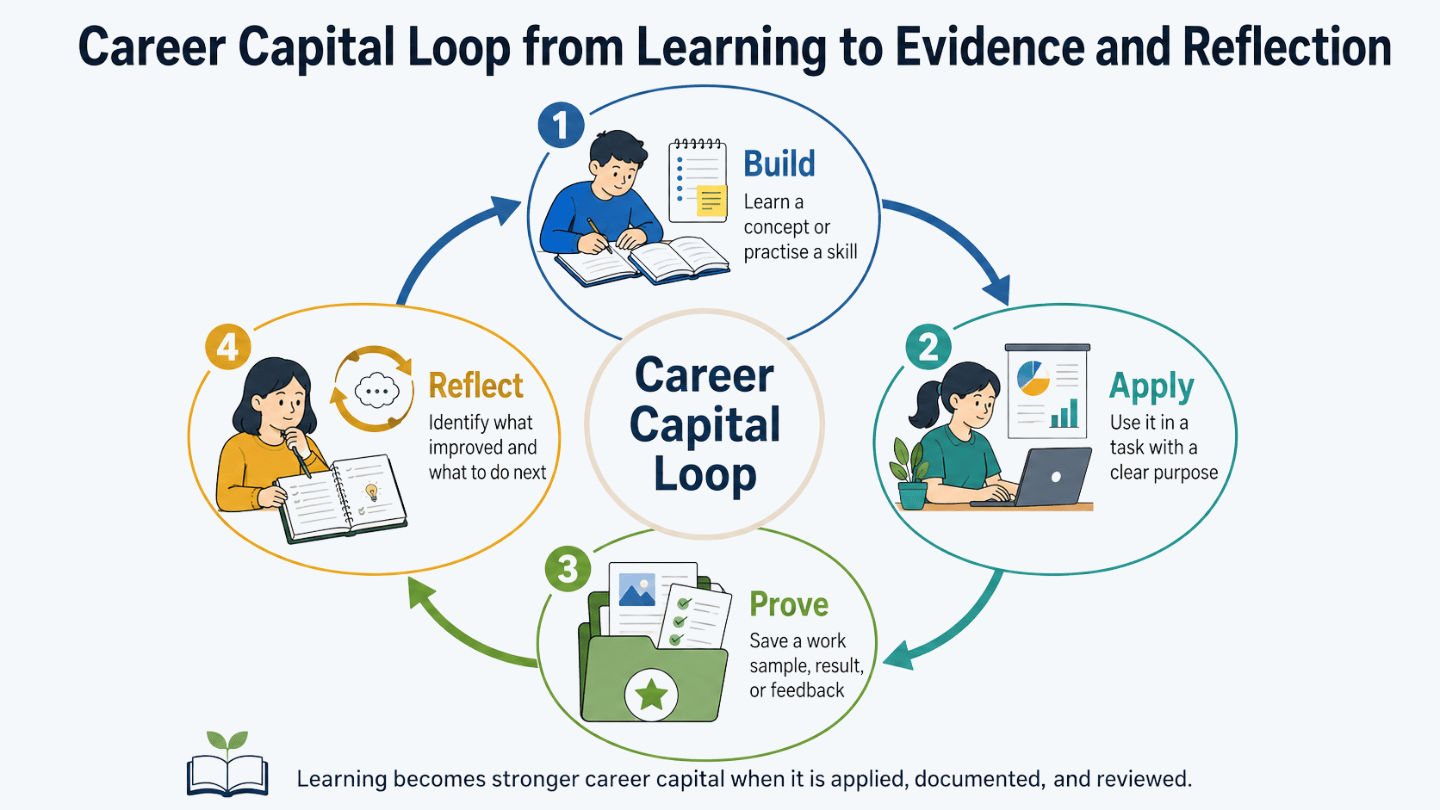
An activity becomes career capital when it moves through a clear cycle: build, apply, prove, and reflect.
Participation alone does not show what a student learned or can now do.
The build–apply–prove–reflect loop
-
Build: Learn a concept or practise a skill.
-
Apply: Use it in a task with a defined purpose.
-
Prove: Save a work sample, result, record, or feedback.
-
Reflect: Identify what improved, what remains weak, and what to test next.
A class assignment enters the cycle when a student revises it after feedback and stores the finished work with a short explanation.
Part-time work enters the cycle when the student identifies responsibilities and skills rather than listing the job title alone.
Turn ordinary responsibilities into evidence
Classwork, clubs, jobs, volunteering, family responsibilities, and community activities can produce evidence when students record what happened.
A useful note contains four parts:
-
Situation: What needed to be done?
-
Responsibility: What part did the student own?
-
Action: What decision or output followed?
-
Learning: What changed after the result or feedback?
This note can later support a résumé, application, portfolio, or interview answer.
Use feedback to decide what to build next
Feedback is most useful when it comes from someone who has seen the work and understands the relevant standard.
Instead of asking, “Was this good?”, a student can ask:
-
Which part was clear?
-
Where is more evidence needed?
-
What one change would improve the work?
-
What skill should be practised next?
A teacher may assess academic quality, while a practitioner may identify field expectations. Both perspectives can be useful because they assess different parts of the work.
How to Build Experience Without an Internship
Students can develop experience without an internship by choosing safe, relevant activities that produce learning, evidence, and feedback.
Use projects, observation, volunteering, work, and research
Possible routes include:
-
a class or personal project;
-
supervised community work;
-
part-time or family work;
-
job shadowing;
-
laboratory or library research;
-
a school or student-organisation role;
-
practical training;
-
a small problem solved for a school or local organisation with permission.
A narrow, finished project can provide clearer evidence than an ambitious plan that remains incomplete.
Choose safe, supervised, and realistic opportunities
Before accepting an opportunity, check:
-
who supervises the work;
-
what duties are involved;
-
what training is provided;
-
how much time is required;
-
whether travel or equipment creates risk;
-
what personal or organisational information may be accessed;
-
how concerns will be reported.
Students under 18 should involve a school, guardian, or trusted adult when an activity includes unfamiliar adults, travel, payments, workplace equipment, private information, or public posting.
Do not treat unpaid work as a requirement
Career capital does not depend on accepting unpaid work. Labour rules, placement standards, and education requirements differ by country.
A paid job, school project, caregiving responsibility, community role, or self-directed project may provide relevant learning.
Students should evaluate an opportunity by its:
-
supervision;
-
safety;
-
fairness;
-
relevance;
-
time demands;
-
evidence value.
Country-specific questions about unpaid placements or work should be checked with the responsible labour, education, or placement authority.
How Career Capital and Credentials Work Together
Credentials and demonstrated capability serve different purposes. The useful question is how they work together in a particular role, field, and country.
Credentials can open doors and meet formal requirements
Degrees, diplomas, licences, and certificates may provide structured learning, assessment, recognition, or formal eligibility.
A degree and a certificate are both credentials, but their scope, depth, assessment, recognition, and legal value vary.
Students should examine:
-
curriculum content;
-
assessment methods;
-
provider credibility;
-
accreditation or recognition where relevant;
-
transfer options;
-
role requirements.
A certificate does not automatically prove independent skill. Its value is clearer when students can explain what they learned, how they were assessed, and where they applied the learning.
Demonstrated skills can make capability clearer
The OECD’s 2026 skills-first report examines ways to make skills more visible in education, hiring, and career development. It discusses skills information, modular learning, microcredentials, recognition of prior learning, and career guidance without arguing that formal qualifications are unnecessary.
A work sample, practical assessment, project record, performance, or reference may clarify what a student can do.
These forms of evidence do not replace every qualification.
Regulated fields require country-specific verification
Some occupations have defined education, licensing, registration, examination, or supervised-practice requirements.
Students should verify current requirements with the responsible authority in their country. A general article, overseas example, course advertisement, or social media post is not sufficient evidence of formal eligibility.
A Career Capital Audit for Students
A career-capital audit helps students identify one useful gap rather than create a longer activity list.
| Asset | Evidence to check | Next small action |
|---|---|---|
| Direction | Roles or pathways already investigated | Compare two roles or speak with one informed person |
| Skills | Work showing current ability | Practise one skill and revise the output |
| Digital and AI literacy | Safe, explained digital work | Complete one task with source and privacy checks |
| Proof | Organised samples with context | Add one sample and explain the student’s role |
| Experience | Real tasks, users, or constraints | Take one supervised responsibility |
| Relationships | People familiar with the student’s interests or work | Ask one specific learning question |
| Reliability and learning | Examples of follow-through and revision | Complete one agreed task and record feedback |
Rate relevance, evidence, access, and next-step value
For each activity, ask:
-
Does it support a field, role, or question being tested?
-
Can the student show evidence rather than only name the activity?
-
Is it safe and accessible with the available time and resources?
-
Will it help the student make a clearer decision?
An activity that performs poorly on all four questions may add little beyond résumé length.
Find the weakest link, not the longest list
The weakest link may be the connection between assets.
A capable student may lack proof. A student with several samples may lack feedback. A student with qualifications may still know little about the roles connected to them.
Use this decision path:
Goal → asset gap → small activity → evidence → feedback → next decision
Choose the gap that blocks the next useful application, project, subject choice, or career experiment.
Do not build everything at once
Trying to build all seven assets at the same time can create pressure without improving decision quality.
Select one priority for the current semester or project period. Study, family responsibilities, health, paid work, relationships, and rest remain valid parts of a student’s life.
Career preparation should support personal purpose rather than replace it.
A Realistic 90-Day Plan
A 90-day plan provides enough time to complete one small career-capital cycle without turning career development into another full-time course.
Weeks 1–2: choose one direction and one skill
Select one role, field, or problem to test.
Identify one related skill and define a small output suited to the student’s education stage, access, and field.
The output may be a report, design, presentation, practical task, research note, performance, spreadsheet, lesson plan, or documented service activity.
Weeks 3–8: complete a small project or experience
Work in manageable sessions.
Keep notes on sources, decisions, changes, responsibilities, and problems.
Seek supervision when the activity involves equipment, workplaces, sensitive information, public audiences, payments, or unfamiliar adults.
Weeks 9–10: ask for feedback and revise
Choose someone who can assess the relevant standard, such as a teacher, trainer, supervisor, peer, practitioner, or adviser.
Ask focused questions, revise the work, and record what changed.
Weeks 11–12: document evidence and choose the next experiment
Store the finished sample, a short context note, relevant feedback, and a reflection.
Then choose among three options:
-
deepen the same direction;
-
test a related role or skill;
-
stop because the activity did not fit.
Stopping after a useful test can help prevent a larger mismatch later.
Common Career-Capital Traps
Career capital loses value when quantity replaces relevance, evidence, fairness, safety, or purpose.
Collecting certificates without application
Before enrolling, check what will be taught, how learning will be assessed, whether the provider is credible, and what evidence the student will produce.
A certificate is a stronger signal when it is connected to applied work.
Networking only when you need something
Relationships require appropriate contact, contribution, and respect for another person’s time.
A short follow-up after a conversation or project is more genuine than contacting someone only when requesting a recommendation.
Building a public profile without a clear reason
A public website or social account is optional.
A private document, password-protected folder, printed portfolio, school platform, or directly shared file can demonstrate ability without exposing personal information.
Choosing prestige over learning quality
Compare the duties, supervision, feedback, safety, relevance, and evidence available in an opportunity.
A recognisable organisation does not ensure meaningful responsibilities or suitable supervision.
Comparing your timeline with other students
Students have different access to money, time, transport, technology, institutions, professional contacts, and unpaid opportunities.
Evaluate development against personal goals, responsibilities, and evidence rather than another student’s visible achievements.
Turning every activity into self-marketing
Not every hobby, friendship, community role, or personal interest needs to become a career signal.
Some activities are valuable because they support learning, relationships, health, culture, creativity, or community. Career capital should remain connected to purpose and ethical boundaries.
What Students Should Build First
Students should build one connected asset that improves the next decision.
Choose one direction, one accessible activity, one piece of evidence, and one suitable person who can provide feedback.
Career capital is not a race to collect credentials, contacts, or public achievements. It grows when learning becomes applied work, applied work becomes credible evidence, and evidence supports a clearer next choice.
The appropriate balance depends on the student’s field, education stage, location, responsibilities, resources, and available support.







Comments 0
No comments yet. Be the first to start the conversation.