



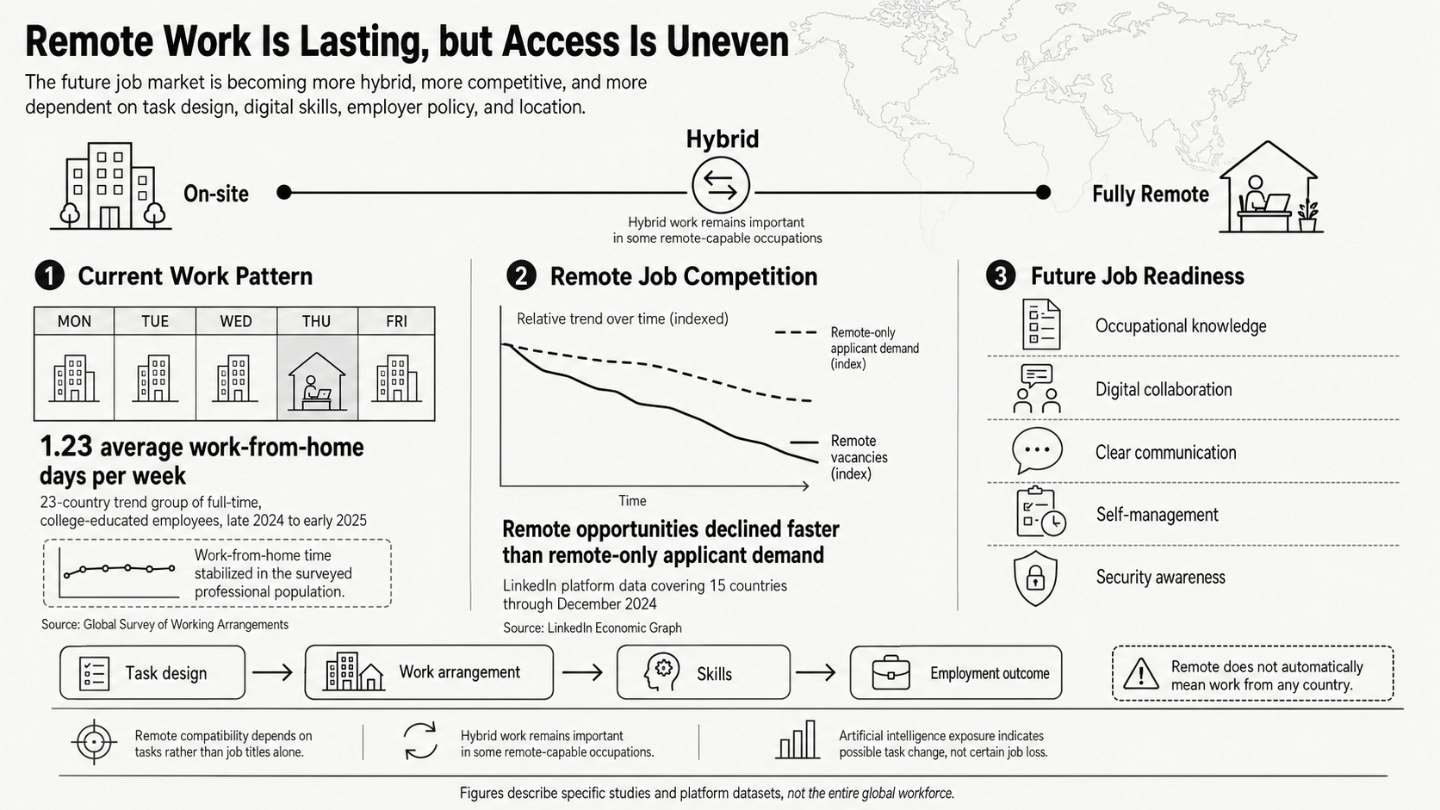
Remote work is likely to remain an important but uneven part of the future job market. The evidence does not support either extreme: office-based work is not disappearing, and remote work is not ending. The labor market is instead settling into a mix of on-site, hybrid, and fully remote arrangements.
Recent evidence also explains why remote work can feel established yet difficult to access. International research found that work-from-home time had stabilized among the full-time, college-educated employees it surveyed. LinkedIn’s platform data, however, showed that advertised remote opportunities declined more sharply than demand from people seeking remote-only work.
These findings measure different parts of the labor market. One examines where existing employees perform their jobs. The other examines advertised opportunities and applicant behavior. Neither represents every occupation, employer, country, or worker.
For students, job seekers, employees, and employers, the practical question is no longer simply whether remote work will remain. It is which tasks can be completed remotely, how applicants can demonstrate readiness, what working arrangement suits the role, and whether the employment conditions support learning, security, inclusion, and career progression.
Answer Summary: Remote work is becoming a lasting but selective part of the labor market. Hybrid arrangements are likely to remain important in remote-capable occupations, while many fully remote vacancies will continue to attract strong applicant demand. Access will depend on tasks, experience, infrastructure, employer policy, and location. Workers should build occupational knowledge, communication, self-management, digital collaboration, and security awareness.
Evidence boundary: Statistics from one professional group, platform, study, or country should not be presented as measurements of the entire global workforce.
Table of Content
- What Do Current Remote-Work Measures Show?
- How Do Remote, Hybrid, and Other Arrangements Differ?
- How Is Remote Work Changing Recruitment?
- Why May Hybrid Work Persist?
- How Can Workers Compare Remote, Hybrid, and On-Site Roles?
- How Is Artificial Intelligence Affecting Remote-Capable Work?
- What Does Research Say About Productivity and Retention?
- Which Tasks Are Compatible With Remote Work?
- What Opportunities and Risks Does Remote Work Create?
- What Should Students and Early-Career Professionals Do?
- What Should Employers and Educators Prepare For?
- What Might the Remote Job Market Look Like by 2030?
- What Should You Verify Before Accepting a Remote Role?
- What Remote Work Means for the Future Job Market
Key Takeaways:
-
Work-from-home prevalence and remote-job availability are different measures.
-
Home-working time stabilized in the professional population covered by recent international research.
-
LinkedIn recorded a greater decline in remote opportunities than in remote-only applicant demand.
-
Hybrid-work findings are encouraging in some settings but do not establish one suitable policy for every role.
-
Remote compatibility depends on tasks, systems, management, and security requirements.
-
Exposure to artificial intelligence indicates possible task change, not certain job loss.
-
A remote position may still restrict the employee’s location or working hours.
What Do Current Remote-Work Measures Show?
No single percentage describes the full state of remote work. Researchers, employers, and job platforms use different measures to answer different questions.
| Measure | What it shows | What it cannot establish |
|---|---|---|
| Work-from-home days | Where current employees complete paid work | How many remote vacancies employers advertise |
| Remote-job availability | The remote share of selected vacancies in a dataset | The remote share of every job in an economy |
| Remote-only applicant demand | The share of job seekers applying only to remote roles | Whether applicants receive interviews or offers |
A decline in advertised remote jobs does not prove that current employees have stopped working from home. Stable home-working levels also do not mean that obtaining a new fully remote position is easy.
What International Work-From-Home Research Found
The latest survey wave used in the international work-from-home study covered 16,422 full-time, college-educated employees in 40 countries between November 2024 and February 2025. Researchers used that sample to examine differences between countries.
The trend analysis used a separate balanced group of 23 countries included in the 2022, 2023, and late-2024 or early-2025 survey waves. Within that group, average fully paid work-from-home time declined from about 1.55 days per week in 2022 to 1.29 in 2023 and 1.23 in the latest wave. The researchers interpreted the smaller recent change as evidence that the post-pandemic decline had largely levelled off.
The 1.23-day figure represents roughly one-quarter of workdays for the surveyed college-educated employees. It should not be restated as one-quarter of all workers or jobs being remote.
The research also found substantial differences between countries. Employees in several English-speaking countries reported more home-working days than those in many East Asian countries, while much of Europe and Latin America fell between those groups.
The authors discuss occupational composition, housing, pandemic experience, and cultural factors as possible contributors. The study does not establish one proven cause for the differences.
What this means: Remote work has persisted among the professional employees studied, but its prevalence differs by country, population, and occupation.
Why Remote Vacancies Can Still Feel Scarce
The LinkedIn Economic Graph remote-work report examined remote-only applicant behavior and remote-job availability in 15 countries through December 2024.
The report found that applicant demand and remote-job supply rose before peaking around 2022. Both later declined, but remote-job availability fell more sharply in every country included in its comparison table.
In the United States portion of the dataset:
-
The remote share of jobs receiving applications peaked at approximately 27% in early 2022 and fell to 16% by late 2024.
-
In late 2024, 9% of newly listed US jobs were remote.
-
Among still-active jobs continuing to attract applicants, 16% were remote.
These are LinkedIn platform measures, not official estimates for the entire US labor market. Some parts of the report also use categories based on listing and applicant activity on LinkedIn.
What this means: Existing employees can retain flexible schedules while job seekers encounter fewer advertised remote openings and strong competition for those that remain.
How Do Remote, Hybrid, and Other Arrangements Differ?
Remote work describes paid work performed away from an employer’s usual site through digital communication or related systems. The term does not explain how often the employee works remotely or where the employee is permitted to work.
| Arrangement | Basic meaning | Main boundary |
|---|---|---|
| Fully remote | Work is normally performed away from an employer site | The permitted location may still be restricted |
| Hybrid | A planned combination of remote and employer-site work | Frequency and employee choice vary |
| On-site | Work is mainly performed at a workplace, client site, or operational location | Some duties may still be completed remotely |
| Work from anywhere | Permission to work beyond a usual home or commuting area | Employer and jurisdictional limits may remain |
Work from home is one form of remote work. A study that counts home-working days is not necessarily measuring the number of people formally employed in fully remote positions.
Home-based work can also include arrangements beyond salaried professional telework, such as independent contracting, online platform work, or paid work performed from home under different contractual conditions.
Freelancing is an employment-status category rather than a location model. A freelancer may work remotely or at a client site. An employee and an independent contractor may also perform similar tasks while having different entitlements, responsibilities, and protections.
A remote label therefore answers only part of the employment question. It does not confirm:
-
Whether applicants from every country are eligible.
-
Whether the worker will be an employee or contractor.
-
Which hours or time zones are required.
-
Whether benefits and paid leave are included.
-
Who supplies equipment.
-
Which security and confidentiality rules apply.
Readers who need country-specific context can review remote and hybrid work in Nepal. Its legal and policy discussion applies to Nepal and should not be generalized to other jurisdictions.
How Is Remote Work Changing Recruitment?
Remote recruitment can widen an employer’s hiring area and increase the number of people competing for one vacancy. It does not remove location, experience, licensing, language, or security requirements.
Wider Hiring Geography
A remote vacancy can become accessible to applicants who live outside an employer’s usual commuting area. This may reduce the need to relocate and widen access for some workers facing transportation, mobility, or care-related barriers.
Geographic reach still has limits. Employers may restrict a remote role because of:
-
The countries or regions in which they can employ workers.
-
Required overlap with the team’s working hours.
-
Client-contract or data-security requirements.
-
Occasional workplace attendance.
-
Access to approved systems and equipment.
-
Professional licensing or language requirements.
Applicants should read the location conditions rather than assume that “remote” means “open worldwide.”
Larger Applicant Pools
A site-based vacancy normally attracts candidates from a limited commuting area or people willing to relocate. A fully remote vacancy can draw applications from a much larger area.
LinkedIn’s data does not directly count competition per vacancy across the entire labor market. It does show sustained remote-only applicant interest alongside a sharper decline in remote opportunities on its platform. That combination is consistent with a more competitive search for remote work.
Applicants should not treat rejection from a remote position as proof that their skills lack value. The size and geographic reach of the applicant pool may differ greatly from those of a local role.
Remote Flexibility and Labor-Market Conditions
LinkedIn found a positive correlation between its measure of labor-market tightness and remote-job availability. Across the 15-country sample, remote availability generally rose while labor markets tightened and declined while they loosened.
This relationship does not establish that labor-market tightness caused employers to change workplace policies. Management preferences, workplace costs, client requirements, organizational culture, and security concerns may also affect those decisions.
The narrower conclusion is that location flexibility can operate as a non-wage employment feature whose availability may move with broader labor-market conditions.
Why May Hybrid Work Persist?
Hybrid work gives employees periods of remote work while retaining scheduled access to the workplace. For some roles, it balances independent work with activities that benefit from physical presence.
Hybrid arrangements tend to work more coherently when:
-
Remote days are used for tasks requiring sustained individual attention.
-
Workplace days have a defined purpose.
-
Teams coordinate attendance.
-
Remote participants receive the same documents and decisions.
-
Performance is assessed through relevant outcomes.
-
New employees receive planned access to feedback and mentoring.
A hybrid policy can create problems when employees travel to an office only to attend virtual meetings, important decisions occur informally without remote participants, or schedules change without adequate notice.
The appropriate schedule depends on the work. A design review, laboratory session, site inspection, client meeting, or practical training activity may benefit from physical presence. Report writing, coding, analysis, planning, and documentation may be easier to complete remotely when the required systems are available.
How Can Workers Compare Remote, Hybrid, and On-Site Roles?
No work model suits every worker or occupation. A sound comparison considers task requirements, career stage, management quality, and the practical working environment.
| Arrangement may fit when | Potential value | Questions to ask |
|---|---|---|
| Fully remote work | Tasks are digital and the worker can operate independently | How are feedback, collaboration, and visibility managed? |
| Hybrid work | The role combines focused tasks with in-person learning or coordination | Is the schedule predictable and connected to actual work needs? |
| On-site work | Equipment, direct service, practical work, or physical access is central | Which duties genuinely require presence? |
| Work from anywhere | The employer permits broader geographic mobility | Which locations, hours, and contract arrangements are allowed? |
Career stage matters. An experienced employee with established professional contacts may manage a fully remote position with limited guidance. A new worker may need closer access to observation, feedback, and informal learning.
The home environment also affects suitability. Remote work may be difficult without reliable connectivity, suitable equipment, privacy, or clear working-time boundaries. On-site work may create greater difficulty for people facing long commutes, mobility constraints, or care responsibilities.
The relevant comparison is therefore not simply home versus office. It is the full arrangement, including management, workload, accessibility, learning, security, and employment terms.
How Is Artificial Intelligence Affecting Remote-Capable Work?
Generative artificial intelligence is likely to change tasks in many remote-capable jobs because these roles already rely heavily on digital documents, data, software, and communication systems.
Exposure to artificial intelligence is not the same as job loss.
Task Change Is Different From Job Elimination
The International Labour Organization’s occupational-exposure index estimated in 2025 that one in four workers was employed in an occupation with some exposure to generative artificial intelligence. It placed 3.3% of global employment in the highest-exposure category.
The research emphasizes that most exposed occupations still include tasks requiring human involvement. It therefore presents job transformation as a more likely broad outcome than complete replacement.
Exposure measures technical potential. It does not confirm that:
-
An employer has adopted a specific system.
-
Every task in the occupation can be automated.
-
A worker will lose a job.
-
Productivity will increase.
-
Benefits and risks will be distributed equally.
Remote-capable workers should distinguish between tasks that an approved system may assist and duties requiring independent review, contextual judgment, confidentiality, or professional accountability.
Skills Identified by Employers
The World Economic Forum’s Future of Jobs Report 2025 reflects responses from more than 1,000 employers representing over 14 million workers across 22 industry clusters and 55 economies.
Respondents identified artificial intelligence and big data, networks and cybersecurity, and technological literacy as the three fastest-growing skill areas. Analytical thinking remained the most frequently identified core skill. These findings describe employer expectations for 2025–2030 rather than guaranteed outcomes for every occupation or worker.
| Skill area | Why it matters | Evidence an applicant can show |
|---|---|---|
| Occupational knowledge | Supports accurate work in a specific field | Assessed projects, work samples, or documented results |
| Digital collaboration | Keeps distributed work organized | Shared projects, clear records, and version history |
| Communication | Reduces uncertainty across locations | Concise updates, instructions, and presentations |
| Self-management | Supports work with less direct supervision | Planning, deadline control, and early issue reporting |
| Security awareness | Protects accounts and information | Safe access practices and policy compliance |
Knowledge of software names is not the same as demonstrated ability. A portfolio or project record can show how a person planned work, responded to feedback, and produced a verifiable result.
Readers planning their development can use Collegenp’s guide to future-of-work skills as a broader skills reference.
What Does Research Say About Productivity and Retention?
Evidence on productivity varies because studies examine different tasks, organizations, and outcomes. Output volume, quality, innovation, promotion, retention, and job satisfaction are not interchangeable.
A randomized hybrid-work trial published in Nature studied 1,612 university-educated employees in Trip.com’s Airfare and Information Technology divisions in Shanghai during 2021–2022. Employees assigned access to the hybrid schedule could work from home on Wednesdays and Fridays and work in the office on the other three weekdays.
During the experiment, attrition was 7.2% in the control group and 4.8% in the hybrid group. This was a reduction of 2.4 percentage points, or one-third relative to the control-group rate. Job-satisfaction scores also improved.
The researchers found no evidence of a difference in performance grades or promotion rates over the later review periods. They also found no difference in lines of code submitted by the computer engineers studied. A finding of no detected difference does not prove that every possible performance outcome was identical.
The study has clear boundaries:
-
It covered one multinational technology company in China.
-
Participants worked in selected professional divisions.
-
The experiment examined a specific two-day home-working option.
-
Interns and employees in probationary periods were excluded.
-
Its findings do not establish the effects of fully remote work.
The trial supports a conditional conclusion: a defined hybrid arrangement can operate without reducing the measured performance outcomes in some settings, but task type and organizational design still matter.
Which Tasks Are Compatible With Remote Work?
Remote compatibility is better assessed through tasks than through job titles. Many occupations contain both remotely deliverable and site-dependent duties.
Tasks are generally more compatible with remote work when:
-
Outputs can be created, reviewed, and transferred digitally.
-
Workers can complete meaningful periods of independent work.
-
Required systems can be accessed securely.
-
Quality can be assessed through observable results.
-
Communication can be planned and documented.
-
Physical equipment, direct care, or site inspection is not central.
A lecturer may prepare teaching materials remotely while conducting laboratory sessions on campus. An engineer may complete analysis remotely but visit a site for inspection. An administrator may process records from home while other duties require secure workplace access.
These are simplified illustrations, not reports about specific employees.
Technology can change remote compatibility, but it does not remove every constraint. Security, regulation, client expectations, and the physical nature of a service may remain decisive.
Collegenp’s guide to remote-work technology provides narrower coverage of collaboration systems, connectivity, secure access, and implementation challenges.
What Opportunities and Risks Does Remote Work Create?
Remote work can widen access for some people while creating or intensifying other inequalities.
Possible Opportunities
Remote arrangements may:
-
Reduce commuting.
-
Expand the geographic reach of a job search.
-
Give some workers more control over their work setting.
-
Improve access for some people with disabilities.
-
Help some workers combine paid work with care responsibilities.
These outcomes depend on accessible systems, suitable employment terms, manageable workloads, and practical working conditions. Flexibility alone does not guarantee inclusion.
Unequal Access and Working Conditions
Remote opportunity depends partly on infrastructure and resources. Workers may have very different access to:
-
Reliable electricity and internet.
-
Current devices.
-
A private or workable environment.
-
Technical support.
-
Accessible software.
-
Professional networks.
-
Employers able to hire in their location.
These differences are particularly relevant in countries where connectivity, device affordability, and digital skills vary widely. Readers seeking a Nepal-specific discussion can review the digital divide in Nepal.
Remote work may also involve social isolation, unclear boundaries, inconsistent communication, or unequal access to informal workplace information. These effects vary by worker, role, household, and organizational practice.
Visibility, Feedback, and Progression
Remote employees may have fewer unplanned interactions with managers and colleagues. This does not establish that remote work prevents promotion. The Trip.com trial found no detected difference in promotion rates under the hybrid arrangement studied.
Transparent systems still matter. Workers can ask how:
-
Assignments are distributed.
-
Achievements are documented.
-
Feedback is scheduled.
-
Training is delivered.
-
Promotion criteria are communicated.
-
Remote participants are included in decisions.
Employers should examine whether access to information, projects, and development differs by work location.
What Should Students and Early-Career Professionals Do?
Students and early-career workers should develop occupational competence and evidence of reliable work. They should also assess whether a role provides the feedback and mentoring needed at their career stage.
Build Evidence of Completed Work
A useful portfolio shows more than a finished product. It can document:
-
The problem or goal.
-
The worker’s specific responsibility.
-
The process followed.
-
Decisions and revisions.
-
Feedback received.
-
The completed result.
-
Any limitations or unresolved issues.
Examples include assessed projects, research summaries, spreadsheet work, designs, code, presentations, or documented group assignments.
Develop Remote-Work Habits
Useful habits include:
-
Clarifying the expected outcome before starting.
-
Dividing a project into manageable stages.
-
Recording decisions and changes.
-
Reporting progress without unnecessary messages.
-
Raising obstacles early.
-
Reviewing work before submission.
-
Protecting accounts and confidential information.
-
Checking AI-assisted material rather than accepting it without review.
These habits are useful in remote, hybrid, and on-site work.
Evaluate Onboarding and Mentoring
The Trip.com experiment excluded interns and employees in probationary periods because the company considered on-site learning and mentoring particularly important for those groups. This does not prove that entry-level work must be on-site, but it reinforces the need to assess how a remote employer supports new workers.
Applicants can ask:
-
Who supervises new employees?
-
How frequently is work reviewed?
-
How are questions handled?
-
Are procedures documented?
-
Is mentoring formally assigned?
-
Are any in-person sessions required?
-
What indicates satisfactory progress?
A structured remote role may provide better development than a poorly managed office role. A well-designed hybrid position may also give an early-career worker access to independent practice and direct guidance.
Collegenp’s guide to the future of work for students and professionals provides wider career-planning context.
What Should Employers and Educators Prepare For?
Employers should assess remote eligibility through task requirements rather than applying one policy to every role.
Relevant employer practices include:
-
Defining which duties require physical presence.
-
Stating geographic and attendance requirements in vacancies.
-
Coordinating hybrid schedules.
-
Measuring outcomes relevant to the role.
-
Providing structured onboarding.
-
Recording decisions where all team members can access them.
-
Addressing equipment, accessibility, and security.
-
Training managers in distributed communication.
-
Reviewing whether remote and on-site workers receive comparable opportunities.
Educators can prepare learners through assignments that require shared planning, clear responsibilities, progress reporting, peer review, and individual accountability. These practices teach distributed-work habits without depending on one commercial platform.
The World Economic Forum estimates that broader labor-market changes between 2025 and 2030 may create 170 million roles and displace 92 million, producing net growth of 78 million. These figures combine surveyed employer expectations with employment data and extrapolation. They are not observed outcomes or estimates of jobs created specifically by remote work.
What Might the Remote Job Market Look Like by 2030?
No authoritative source establishes one exact worldwide remote-work share for 2030. Scenario planning provides a more responsible way to discuss possible directions without presenting one outcome as certain.
| Scenario | Conditions | Indicators to watch |
|---|---|---|
| Hybrid stabilization | Employers retain planned home and workplace schedules | Stable home-working time and fewer policy reversals |
| Tighter fully remote supply | Vacancy availability remains below applicant interest | Larger applicant pools and narrower location conditions |
| Broader remote access | Infrastructure and secure workflows improve | Wider regional participation and more digital tasks |
Scenario One: Hybrid Stabilization
Home-working time may remain near its recent plateau among remote-capable professional employees, with hybrid arrangements accounting for much of the flexibility.
This scenario is consistent with the international work-from-home study and the Trip.com evidence. Neither source proves that hybrid work will dominate every country or occupation.
Scenario Two: Fully Remote Roles Become More Selective
Remote jobs may remain available while attracting applicants from larger geographic areas. Employers may add experience, location, or time-zone conditions to manage applicant numbers and operational requirements.
LinkedIn’s data documents a remote supply-demand gap through late 2024, but later economic conditions and employer policies may change that pattern.
Scenario Three: Access Expands Through Infrastructure and Task Redesign
Better connectivity, secure systems, accessible technology, and redesigned workflows may make more tasks remotely deliverable.
Expansion would still depend on management, skills, worker protection, and employer capacity to hire people in different locations. The ILO exposure index does not predict the speed of AI adoption or the employment outcome for individual workers.
What Should You Verify Before Accepting a Remote Role?
A remote label should not replace normal vacancy and employer checks.
Verify:
-
The employer’s identity through its official channels.
-
The countries or regions from which the work may be performed.
-
Whether the arrangement is employment, contracting, or freelancing.
-
Required hours and time-zone overlap.
-
Workplace attendance or travel expectations.
-
Who provides the computer, software, and other equipment.
-
Which expenses are reimbursed.
-
Which security and confidentiality rules apply.
-
How onboarding and feedback operate.
-
Which benefits and leave provisions are stated.
-
How performance and promotion are assessed.
-
Whether the vacancy appears through the employer’s official recruitment process.
Country-specific employment, tax, immigration, payroll, and licensing matters should be checked through the relevant official authorities or an appropriately qualified professional. This article does not determine an individual reader’s legal position.
What Remote Work Means for the Future Job Market
Remote work is becoming a persistent but selective part of the labor market rather than a universal replacement for workplaces.
The reviewed evidence supports three central conclusions:
-
Work-from-home time stabilized among the full-time, college-educated employees covered by the international trend study.
-
Remote-job availability on LinkedIn declined more sharply than remote-only applicant demand in its 15-country analysis.
-
A defined hybrid arrangement reduced attrition without a detected difference in the measured performance and promotion outcomes at one Chinese technology company.
For workers, the most useful response is not to pursue a remote label in isolation. Occupational knowledge, completed work, communication, self-management, digital collaboration, and security awareness remain central.
For employers and educators, the task is to design work and learning around duties, outcomes, access, feedback, and fair treatment. Flexibility can support opportunity, but its value depends on the quality of the full arrangement.







Comments 0
No comments yet. Be the first to start the conversation.