




Table of Content
- How Is the Future of Work Changing for Students and Professionals?
- What Does the Future of Work Mean?
- Main Drivers of Change
- What This Means for Students
- What This Means for Professionals
- Important Skills for the Future
- Opportunities and Limitations
- Common Misunderstandings
- Practical Guidance for Students
- Practical Guidance for Professionals
- Global Perspective: The Impact Is Not the Same in Every Country
- Conclusion
How Is the Future of Work Changing for Students and Professionals?
The future of work is no longer only a matter of prediction. It is a change already visible in schools, universities, workplaces, career planning, skill development, and employment structures. Artificial Intelligence, automation, digital technology, data, climate change, demographic change, and economic uncertainty are changing how both students and professionals work.
It is not correct to limit this change to a single question: “Will AI take away jobs or not?” The real questions are broader: How will work be done now? Which skills are becoming more valuable? What should students learn along with their studies? How can professionals keep their experience updated? And which claims should be trusted when making career decisions?
According to the World Economic Forum’s Future of Jobs Report 2025, technological change, geo-economic fragmentation, economic uncertainty, demographic change, and the green transition are the main factors shaping the global labor market up to 2030. The report is based on the views of more than 1,000 employers across 55 economies and 22 industry clusters, representing more than 14 million workers.
This article is prepared for students, young readers, parents, professionals, people seeking a career change, and general readers. The perspective here is global. However, education systems, work rights, labor laws, salaries, licensing, taxes, visas, social security, and professional recognition differ by country. Before making decisions on such matters, it is necessary to check updated information from local and official sources.
What Does the Future of Work Mean?
The future of work does not mean only new jobs. It refers to the changing nature of work, required skills, workplaces, employment relations, productivity, learning systems, worker protection, and career development.
In the past, many formal careers appeared relatively stable. Students studied one subject, found a related job, gained experience, and moved ahead in the same field or organization. Such career paths still exist in some sectors, but they are no longer the only common route for everyone.
Work in many sectors is now changing in these directions:
-
More focus on tasks and skills than job titles
-
Increased use of digital tools and data
-
Greater importance of practical skills, project work, and portfolios along with formal degrees
-
A shift from one-time learning to continuous learning
-
Use of remote, hybrid, or flexible work in some fields
-
Growing need for human judgment, ethics, and critical thinking
Therefore, when understanding the future of work, the more useful question is not “Which job is safe?” but “Which skills, mindset, and proven abilities will remain useful over the long term?”
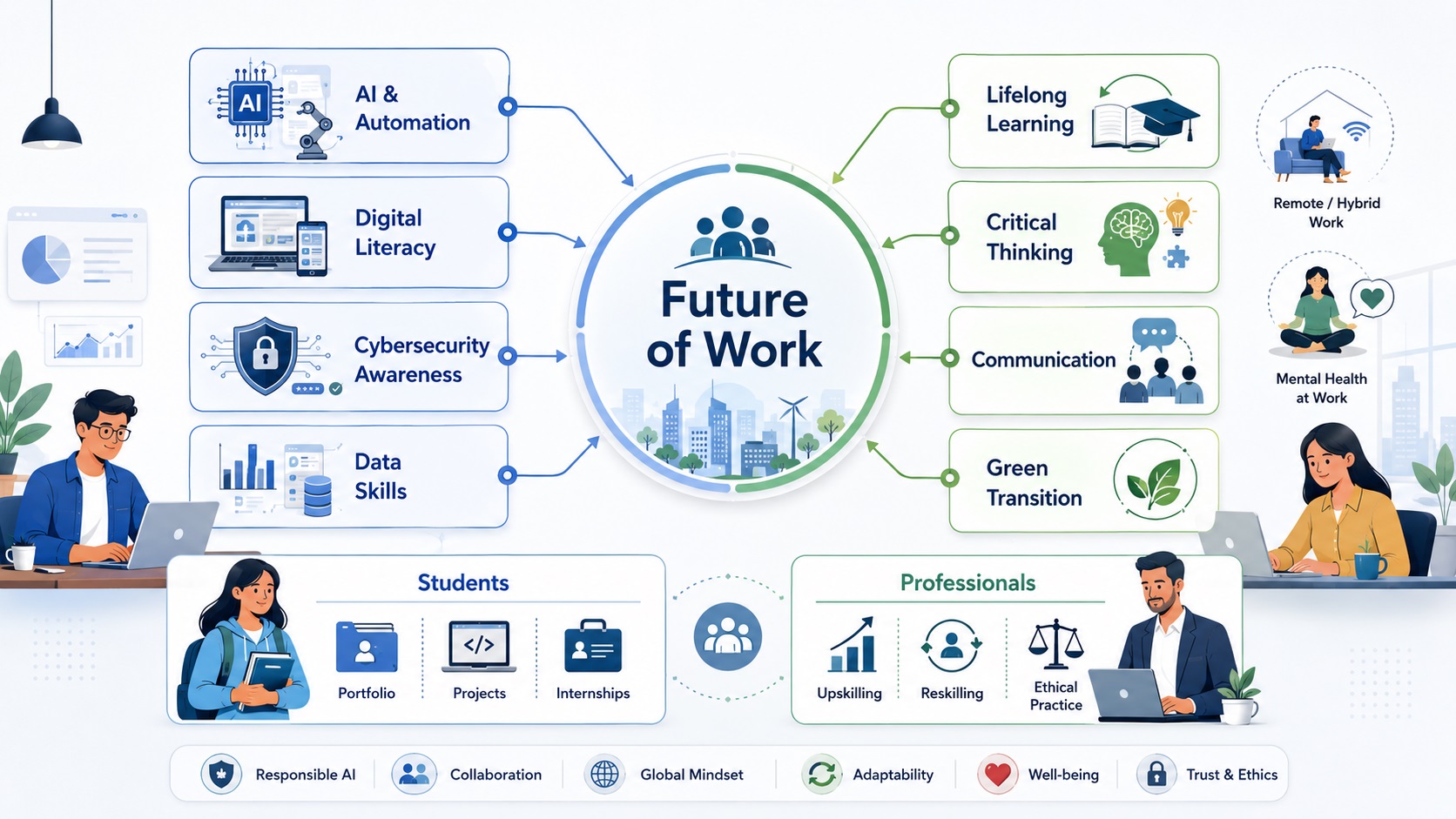 Main Drivers of Change
Artificial Intelligence and Automation
AI has begun to affect parts of writing, translation, coding, report preparation, customer service, data analysis, research support, administrative processes, and creative work. However, its effect is not the same in every field.
According to the IMF, about 40 percent of global employment may be exposed to AI. The estimated share may be around 60 percent in advanced economies, 40 percent in emerging markets, and 26 percent in low-income countries. The IMF has identified both possibilities: AI may complement some work, while it may reduce demand for human labor in some work.
The ILO’s 2025 study also indicates that the impact of GenAI should be understood more as a change in job tasks than as a complete removal of jobs. According to the ILO, about one in four workers globally are in occupations with some level of GenAI exposure, but only 3.3 percent of global employment falls in the highest exposure category. The study notes that exposure is high in clerical occupations and is also increasing in some digitized professional and technical roles.
This means AI will not remove all jobs at once. In many cases, AI may change the way work is done, the speed of work, the skills required, and the nature of human roles.
Skill Demand Is Changing
According to the WEF, employers expect 39 percent of key skills required in the labor market to change by 2030. Skills such as AI and big data, networks and cybersecurity, and technological literacy are expected to become more important. Creative thinking, resilience, flexibility, agility, curiosity, and lifelong learning are also becoming important.
This gives students a clear message: passing exams alone is not enough. Along with subject knowledge, problem-solving, communication, digital literacy, source verification, ethical judgment, and continuous learning are necessary.
For professionals, experience alone is not sufficient protection. Experience is valuable, but it must be connected with new tools, new processes, and changing market expectations.
Green Transition and Sustainability
Climate change and the green transition are also affecting the future of work. The WEF has identified the green transition as one of the major macrotrends changing the labor market.
This does not mean everyone must enter the environmental field. However, in many professions, issues such as sustainability, resource efficiency, environmental risk, responsible production, or climate awareness may gradually become connected. Such effects differ according to industry, country, policy, and local economic structure.
Demographic Change
In many countries, the population is aging, while in some countries the youth population is larger. Both situations create different types of demand for work. The WEF’s analysis notes that care jobs, such as nursing professionals, social workers, and counseling professionals, are among the roles expected to grow in the coming years, especially in connection with demographic trends such as aging working-age populations.
However, in fields such as health, counseling, education, or care work, qualifications, licenses, language, training, safety standards, and professional codes of conduct may differ by country. Therefore, before entering such fields, local regulatory requirements should be checked.
What This Means for Students
For students, the future of work requires a new way of thinking about study, skill development, and career planning. The important question is no longer only “Which subject will help me get a job?” It is also “Which subject will make me capable of solving problems, understanding new technology, and continuing to learn?”
Degrees Still Matter, but Degrees Alone Are Not Enough
Degrees are still entry points for many professions. In medicine, law, engineering, education, accounting, public service, and regulated professions, formal education, recognition, examinations, or licenses may be required. Therefore, the claim that degrees no longer have any value is not correct.
Along with degrees, students should pay attention to these areas:
-
Foundational subject knowledge
-
Basic ability to understand data
-
Clear writing and presentation
-
Project work or portfolio
-
Internship or practical exposure
-
Responsible use of AI
-
Critical thinking
-
Collaboration and communication skills
For example, a student studying writing can show writing samples and editing work. A computer science student can show coding projects or a problem-solving portfolio. A management student can prepare case analysis, spreadsheet work, or a research presentation.
AI Literacy Is Now a Necessary Skill
Knowing how to use AI and automatically accepting AI-generated answers as correct are different things. Students can use AI for support, but they must understand source verification, fact-checking, plagiarism, data privacy, bias, and academic integrity.
UNESCO’s guidance on Generative AI states that when using GenAI in education and research, attention should be paid to issues such as a human-centered approach, data privacy, age-appropriate use, ethical validation, and pedagogical design.
Students should use AI not as a shortcut but as a learning support tool. When using it, it is useful to ask these questions:
-
What source is this information based on?
-
Could the facts be wrong?
-
Have I converted this into my own understanding, or have I only copied it?
-
Is it safe to enter personal or sensitive data?
-
What does my school, college, or university’s AI policy say?
Multidisciplinary Thinking Is Necessary
Many future jobs will not be solved by knowledge of only one subject. Data literacy may be useful in health. Digital verification is necessary in journalism. Businesses need to understand cybersecurity and privacy. Education may connect learning technology with student psychology.
This does not mean everything must be learned at an expert level. But having a basic understanding of another field connected with one’s main subject can be useful for a career.
What This Means for Professionals
For professionals, the main challenge is not only competing with the new generation. The real challenge is aligning their experience with new technology, new work styles, and new professional expectations.
Experience Must Be Updated
Experience is valuable. It helps with judgment, sectoral understanding, practical knowledge, relationship management, and problem-solving. But if experience remains limited to old tools, slow processes, or outdated knowledge, its impact may decline.
Professionals should regularly ask these questions:
-
Which repetitive tasks in my work can be made easier through automation or AI?
-
What new software, regulation, standard, or market expectation has emerged in my profession?
-
Which skill will improve the quality or speed of my work?
-
How can I show my experience through measurable output?
-
How can I help my team or organization adapt to change?
Upskilling and Reskilling
Upskilling means adding new skills useful for the current job. Reskilling means learning new skills required to move into a different role or field. Both may be necessary in the future labor market.
Not everyone needs to become a programmer. However, basic knowledge of digital tools, data basics, AI-supported workflows, cybersecurity awareness, and online collaboration is becoming useful in many professions.
For example:
-
Teachers can understand AI-assisted lesson planning, but human judgment and institutional policy remain important in student assessment.
-
Journalists can use digital verification tools, but source-checking and editorial judgment remain essential.
-
Accountants can use automation software, but professional responsibility remains in compliance and risk interpretation.
-
Managers can use dashboards, but team motivation, conflict handling, and ethical decisions still depend on human skills.
Mental Health and Work-Life Balance
The future of work is not only about productivity. Digital work, constant connectivity, job insecurity, workload pressure, and the pressure to update skills can affect mental health.
According to the WHO, in 2019, an estimated 15 percent of working-age adults had a mental disorder. The WHO has stated that depression and anxiety cause an estimated 12 billion working days to be lost globally every year, with productivity losses of about US$1 trillion.
For workplace mental health, the WHO recommends measures such as prevention of psychosocial risks, mental health promotion, manager training, worker training, reasonable accommodation, and return-to-work support. The ILO/WHO joint policy brief has also called on governments, employers, workers, and their organizations to adopt practical strategies for mental health at work.
Therefore, when discussing the future of work, safe, respectful, and mentally healthy workplaces must be prioritized along with skills and income.
Important Skills for the Future
Digital Literacy
Digital literacy does not mean only knowing how to use a mobile phone or computer. It includes the ability to search for online information, verify sources, use secure passwords, use cloud tools, understand digital communication, and recognize privacy risks.
Students should learn documents, spreadsheets, presentations, online research, and collaboration tools. Professionals should understand the digital workflows used in their fields.
AI and Data Literacy
AI literacy does not mean everyone must become an AI engineer. At a basic level, people should understand that AI produces output based on patterns, its answers may be wrong, data quality affects results, and there may be risks related to bias, privacy, and copyright.
Data literacy means being able to read data, compare it, understand basic statistics, and draw conclusions from facts. Wrong data or wrong interpretation can lead to wrong decisions.
Critical Thinking
AI can give quick answers, but human thinking remains necessary for forming the right questions, understanding context, checking sources, identifying limitations, and making ethical decisions. Critical thinking protects students and professionals from misinformation and shallow conclusions.
Communication and Collaboration
Clear writing, active listening, presentation, the habit of giving and receiving feedback, negotiation, and cross-cultural communication are useful in future work. When working in global teams, it is necessary to understand language, time zones, work styles, and cultural sensitivity.
Cybersecurity Awareness
Not everyone needs to become a cybersecurity specialist, but basic security awareness is necessary. Phishing, weak passwords, unsafe links, unnecessary data sharing, and misuse of confidential information can put both individuals and organizations at risk.
Students and young professionals can also benefit from learning cybersecurity basics for safer digital work.
Continuous Learning
One of the most useful skills in the future of work is lifelong learning. This does not mean following every trend. It means keeping knowledge related to one’s field updated, testing new tools, learning from mistakes, and improving skills over time.
Opportunities and Limitations
Viewing the future of work only as a risk is an incomplete perspective. It also brings new opportunities.
According to the WEF, global macrotrends may create about 170 million new jobs and displace 92 million roles during this decade, resulting in a net employment increase of about 78 million. Such estimates are based on surveys and modeling, so they should be understood as indicators of the possible direction of the labor market rather than certain predictions.
Online learning, digital portfolios, remote collaboration, and global platforms can help students and professionals understand cross-border opportunities. However, cross-border work requires caution regarding contract clarity, payment security, tax rules, work permits, data protection, and platform dependency. These rules differ by country.
AI and automation can reduce repetitive work and support research, analysis, content preparation, service quality, or decision support. But incorrect use can increase errors, misinformation, plagiarism, bias, and overdependence. Therefore, human review, ethical use, and institutional policy are important.
Common Misunderstandings
“All Jobs Will Disappear After AI Arrives”
This is an exaggerated claim. AI can automate some tasks, change some roles, and increase productivity in some work. But exposure and job loss are not the same thing. The impact differs according to profession, country, industry, skills, and policy structure.
“Degrees No Longer Matter”
This is also incorrect. In many fields, degrees, accreditation, licensing, or professional registration are still necessary. The right approach is: degree + practical skill + portfolio + experience + continuous learning.
“Only Tech Skills Are Enough”
Technical skills are important, but they are not enough. Communication, judgment, ethics, leadership, empathy, problem-solving, and adaptability are also necessary.
“Remote Work Is Best for Everyone”
Remote or hybrid work can be useful in some fields, but it is not possible in every job. Physical presence may be necessary in health care, construction, manufacturing, agriculture, logistics, hospitality, and field-based services. Remote work can also bring challenges related to isolation, time zones, communication gaps, and work-life boundaries.
Practical Guidance for Students
When preparing for the future of work, students should avoid both fear and blind trend-following. Just because a subject is popular does not mean it is suitable for everyone. Decisions should be made by considering personal interest, ability, financial condition, local opportunities, language, education system, and long-term goals.
Useful steps for students:
-
Strengthen your main subject. If the foundation is weak, tools alone cannot build a career.
-
Learn digital literacy. Become capable in research, documents, spreadsheets, presentations, and online collaboration.
-
Use AI responsibly. Check facts, evaluate sources, and avoid plagiarism.
-
Prepare a portfolio. Include articles, projects, code, case studies, designs, research notes, or presentations.
-
Gain practical exposure. Internship, volunteering, project work, or real-world assignments make classroom learning practical.
-
Improve communication skills. Practice writing, email etiquette, presentations, and teamwork.
-
Check local rules. In regulated professions, licenses, examinations, registration, or degree equivalence may be required.
Practical Guidance for Professionals
Professionals should take the approach of updating their careers rather than merely protecting them. A plan based on evidence is more useful than fear.
Useful steps for professionals:
-
Conduct a task audit. Identify which parts of your daily work are repetitive, analytical, creative, interpersonal, or regulated.
-
Identify appropriate use of AI and automation. Take special care in work involving sensitive data, client information, and legal responsibility.
-
Learn targeted skills. Do not try to learn everything at once; choose a tool or framework related to your role.
-
Measure results. Show how a new skill has improved time, quality, accuracy, cost, or team output.
-
Build a professional network. Mentors, peers, industry groups, and professional communities provide updated information.
-
Protect work-life boundaries. Clear boundaries are necessary to avoid the pressure of being constantly available in digital work.
-
Understand legal and institutional policies. Check rules related to AI tools, confidential data, remote work, copyright, and contracts.
Global Perspective: The Impact Is Not the Same in Every Country
Although the future of work is a global issue, its impact is not the same across all countries and communities. The IMF has stated that AI exposure may be higher in advanced economies, but opportunities to benefit from AI may also be greater there. In emerging markets and low-income countries, immediate disruption may appear lower, but a lack of digital infrastructure and skilled workforce may make it difficult to benefit from AI, creating a risk of increased inequality. (IMF)
Therefore, after reading international trends, readers should ask these questions in their local context:
-
Which industry is growing in my country or region?
-
Which professions require a license or registration?
-
Which language and digital skills are necessary?
-
What are the salary and working conditions like?
-
What are the tax, contract, and payment rules for online work?
-
Is the study or training program recognized?
-
What information has the official labor department, professional council, or education authority issued?
Conclusion
The future of work is changing, but it should not be viewed only through fear. AI, automation, digital tools, the green transition, demographic change, and global platforms will change the nature of work. Some tasks will decline, some roles will change, some new opportunities will open, and many professions will require a mix of human and digital skills.
For students, the main lesson is to connect study with practical skills, portfolios, digital literacy, responsible AI use, and critical thinking. For professionals, the main lesson is to align experience with updated knowledge, new tools, measurable output, and ethical practice.
The future of work cannot be fully predicted. However, strong foundational knowledge, continuous learning, the habit of checking sources, digital capability, attention to mental health, and understanding of local rules can make both students and professionals more capable in a changing labor market.




Comments 0
No comments yet. Be the first to start the conversation.