



You can understand an explanation while reading it, recognize the examples, and remember the terminology, yet struggle to explain how the new idea relates to something you learned earlier.
This difficulty often appears when subjects become more complex. Mathematics introduces unfamiliar procedures based on earlier rules. Science lessons combine processes that were previously taught separately. Reading becomes harder when a text assumes knowledge you have not fully developed.
The problem is not necessarily that you have forgotten everything. You may remember the relevant information without recognizing how it applies to the new material.
Connecting new knowledge with what you already know means identifying a relevant existing idea, explaining how it relates to unfamiliar information, and checking whether that relationship is accurate. The connection becomes more useful when you can recall it later and apply it appropriately.
Research summarized in How People Learn II by the National Academies of Sciences, Engineering, and Medicine explains that learners develop understanding by integrating information and identifying relationships. It also cautions that prior knowledge can interfere with learning when existing assumptions bias the interpretation of new information.
The practical aim is not to create as many associations as possible. It is to develop connections that explain something, recognize where those connections have limits, and correct them when necessary.
What Makes a Connection Between Old and New Knowledge Meaningful?
A meaningful knowledge connection explains a valid relationship between something you already understand and something you are learning.
Recognizing similar words, remembering a familiar example, or associating a topic with a personal experience does not necessarily establish understanding.
For instance, knowing that a battery supplies energy to an electrical circuit provides useful background when studying electric current. However, recognizing the word battery does not explain the relationship among voltage, current, and resistance.
The learner still needs to understand the relevant concepts and how they interact.
Prior knowledge includes more than remembered facts
Prior knowledge consists of information, concepts, procedures, skills, and experiences acquired before a new learning activity.
It can include:
-
A mathematical rule learned in an earlier class.
-
A scientific explanation that helps interpret a new process.
-
Vocabulary needed to understand unfamiliar reading material.
-
A procedure previously practised in another setting.
-
An everyday observation that provides a starting point for investigation.
These forms of knowledge do not contribute equally to every learning task.
Carnegie Mellon University's Eberly Center explains that prior knowledge supports learning when it is accurate, sufficiently developed, and activated at an appropriate time. Inaccurate, insufficient, or inappropriately applied knowledge can interfere with learning.
This distinction matters when you recognize a topic but cannot solve the problem in front of you.
You may possess some relevant knowledge without having the particular understanding the task requires.
A useful connection must explain a relationship
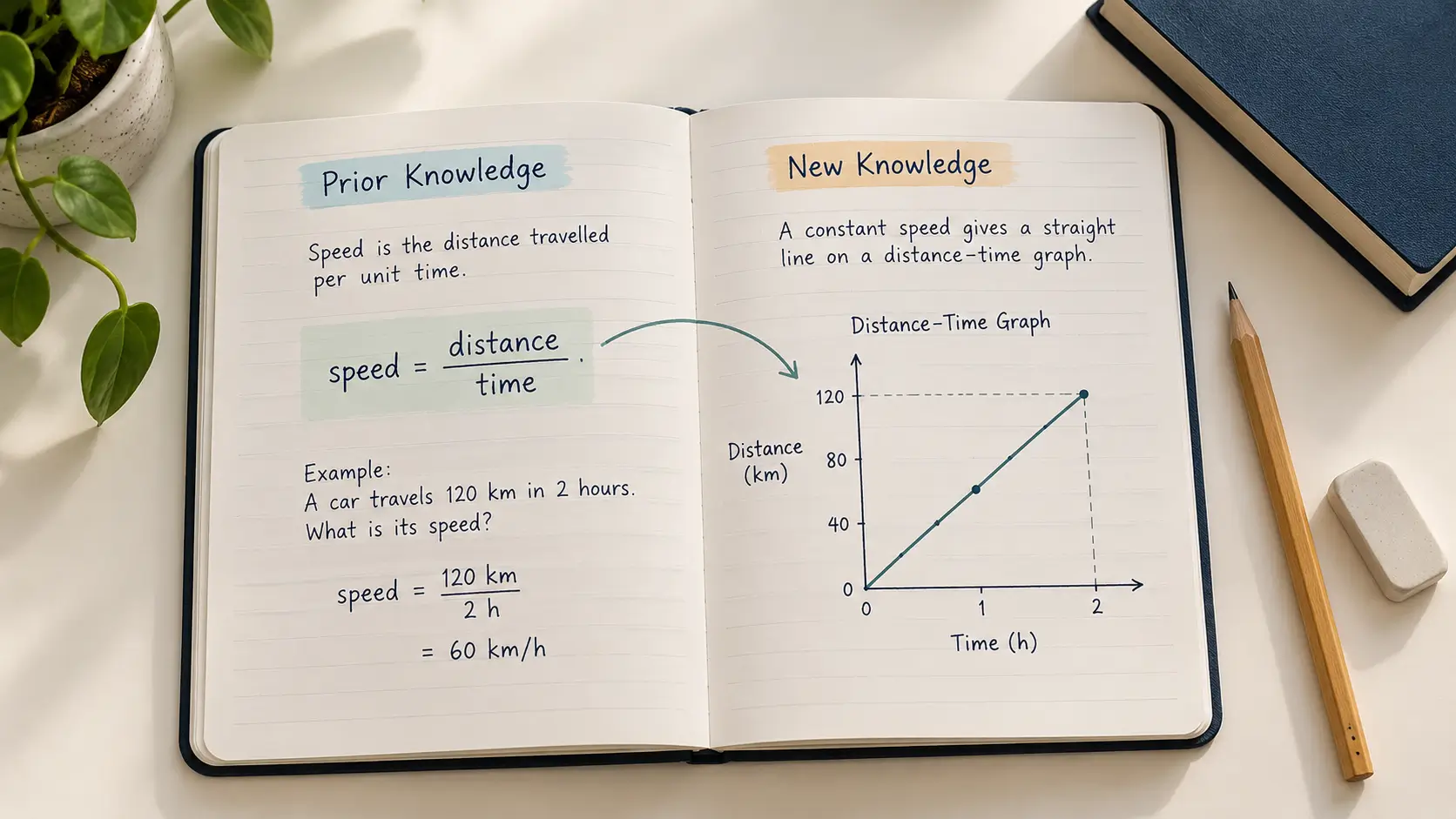
Consider learning how to interpret a distance–time graph.
You may already know the relationship between distance, speed, and time:
This knowledge can help you understand why the slope of a straight line on a distance–time graph represents constant speed.
The connection is meaningful because both the calculation and the graph describe how distance changes with time.
Recognizing that both lessons involve distance is a starting observation. Explaining what the slope represents establishes the conceptual relationship.
The difference is important: a useful connection should help you explain, calculate, interpret, or predict something accurately.
Begin by Identifying the Knowledge You Actually Need
Before trying to connect an unfamiliar concept with earlier learning, identify what the new material requires you to understand.
A broad question such as "What do I already know about this subject?" may produce numerous memories without identifying the knowledge that matters.
A more focused question is: "Which earlier concept helps explain this particular idea?"
Start with the new question
Suppose you are beginning a lesson on percentage change.
You may remember how to convert fractions into percentages and calculate a percentage of a number.
Those skills are relevant, but they do not fully explain percentage change.
The new concept requires understanding how a change compares with an original value.
For example, if a quantity increases from 40 to 50, the increase is 10. The percentage increase is calculated relative to the original value:
The important connection is between the earlier understanding of percentages and the new use of the original value as a reference.
Recognizing that distinction helps prevent the mistake of calculating the increase relative to the final value.
Check whether the earlier idea is understood
Before using previous knowledge, try explaining it without consulting notes.
For percentage change, you should be able to explain what a percentage represents and calculate a percentage of a quantity.
If those operations are uncertain, reviewing them first provides a more reliable foundation.
This is different from repeatedly reading the new explanation while the prerequisite remains unclear.
A short preliminary check can help:
-
Identify the unfamiliar concept or problem.
-
Name one earlier concept directly related to it.
-
Explain that earlier concept in your own words.
-
Check whether the explanation is accurate before using it.
This is a practical study routine informed by research on prior knowledge, rather than a separately validated instructional formula.
Its usefulness lies in making the necessary relationship explicit.
Compare Old and New Ideas Without Confusing Their Differences
Comparison is useful when two concepts share an important feature but differ in a way that affects their meaning or application.
The learner needs to identify both the relationship and its limitations.
Identify what the concepts share
Consider a student who understands the arithmetic mean and is beginning to study the median.
Both describe aspects of the centre of a numerical dataset, but they are calculated differently.
The mean is obtained by adding the values and dividing by the number of values.
The median is the middle value after the data have been arranged in order, or the average of the two middle values when there is an even number of observations.
Recognizing their shared purpose provides an initial connection.
Identify the difference that matters
Consider these values:
Both the mean and median equal 4.
Now consider:
The median remains 4, while the mean becomes 8.
The comparison shows that an unusually large observation affects the mean differently from the median.
The learner has moved beyond remembering two definitions. The relationship now helps explain why the measures can describe the same dataset differently.
The point is not that one measure is universally preferable. Their usefulness depends on the distribution of the data and the question being examined.
Recognize where the comparison stops working
A familiar concept can provide an incomplete explanation of something new.
This often happens when learners rely on analogies.
An analogy can clarify an unfamiliar process by comparing it with something familiar, but the two situations may differ in important ways.
For example, comparing electrical current with water flowing through pipes can help introduce certain circuit relationships. However, electrical circuits and flowing water are not identical systems, and the analogy does not accurately represent every electrical phenomenon.
A useful analogy should identify the specific relationship being compared and explain where the comparison becomes misleading.
If you cannot identify what the two situations genuinely share, the connection may be based on resemblance rather than understanding.
Explain How the Relationship Works in Your Own Words
Once you have identified a relevant connection, explaining it can reveal whether you understand the relationship or are repeating familiar terminology.
In learning research, self-explanation involves generating an explanation of why a statement, procedure, or relationship makes sense.
It differs from copying a definition or summarizing a paragraph without explaining the underlying reasoning.
Connect the new idea to an established principle
Return to the distance–time graph example.
A learner who memorizes that a steeper line represents greater speed may answer familiar graph questions correctly.
A stronger explanation identifies why the relationship holds:
"When time is measured on the horizontal axis and distance on the vertical axis, the slope shows the change in distance divided by the change in time. That is the average speed over the interval."
For a straight line, the constant slope represents constant speed.
This explanation connects the graph to the earlier calculation rather than treating the graphical rule as a separate fact.
Research by Michelene Chi and colleagues, published in Cognitive Science in 1989, examined how students explained worked examples in mechanics. The study associated productive self-explanations that connected solution steps to underlying principles with stronger conceptual understanding.
The study concerned particular learners and mechanics problems. It does not establish that every explanation attempt improves learning.
An explanation may be incomplete or incorrect, especially when the learner lacks the necessary background.
Ask questions that reveal the reasoning
Useful self-explanation questions include:
-
Which earlier concept helps explain this new information?
-
Why does the relationship work?
-
What has changed from the earlier example?
-
Under what conditions does the same rule apply?
-
What would make the explanation incorrect?
These questions direct attention toward meaning rather than the quantity of information remembered.
A brief explanation can be sufficient when it accurately identifies the relationship. More writing is not inherently evidence of deeper understanding.
For learners who need further practice generating explanations, Collegenp's article on self-explanation as a learning tool provides additional examples of the technique.
Make Complicated Relationships Visible
When several concepts interact, explaining each relationship separately may not make the overall structure clear.
A concept map can help by placing related ideas together and identifying how they connect.
Use a map when several ideas depend on one another
Consider studying the water cycle.
A learner may understand evaporation, condensation, and precipitation individually but struggle to explain their relationships.
A concept map can connect the processes through statements such as:
-
Evaporation changes liquid water into water vapour.
-
Condensation changes water vapour into liquid water.
-
Precipitation transfers water from the atmosphere to Earth's surface.
These relationships help explain parts of the water cycle, although a fuller account would include additional processes and conditions.
The value of the map comes from accurately representing the relationships, not from placing familiar words inside boxes.
Carnegie Mellon University's Eberly Center describes concept maps as representations of knowledge in which connecting words specify the relationships between concepts. The centre also recommends revising maps as understanding develops.
Check what each connection means
A diagram with arrows but no explanation can conceal misunderstanding.
Instead of drawing an unexplained line between two concepts, label the relationship.
Words such as causes, requires, is part of, differs from, or depends on can help, provided the statement they create is accurate.
A concept map is particularly useful when understanding the organization of several ideas is more important than recalling a single definition.
However, a map is not necessary for every topic.
If the relationship can be explained accurately in one or two sentences, a longer diagram may add little value.
For learners dealing with several interconnected topics, Collegenp has a separate guide to concept mapping and knowledge retention.
Check the Connection Before Accepting It as Correct
An explanation can feel convincing because it resembles something familiar, even when the underlying relationship is inaccurate.
This is why verification belongs within the learning process.
After forming a connection, compare it with a reliable textbook, worked example, teacher's explanation, or appropriate academic source.
The check should establish whether the relationship holds under the conditions being discussed.
When earlier knowledge becomes a misconception
Consider the familiar observation that multiplying two positive whole numbers greater than one produces a result larger than either factor.
A learner who turns that observation into the rule "multiplication makes numbers bigger" may struggle when multiplication involves fractions.
Compare:
with:
Both calculations involve multiplication, but the second produces a smaller result than 4.
The difficulty comes from extending a pattern learned in one setting into a more general rule that is not correct.
The learner does not need to discard the earlier calculation. Instead, the earlier understanding must be revised to recognize that the result of multiplication depends on the values of the factors.
This illustrates a distinction between extending previous knowledge and correcting a misconception.
Carnegie Mellon University's learning principles identify inaccurate or inappropriately activated prior knowledge as potential obstacles to new learning.
Correct the specific misunderstanding
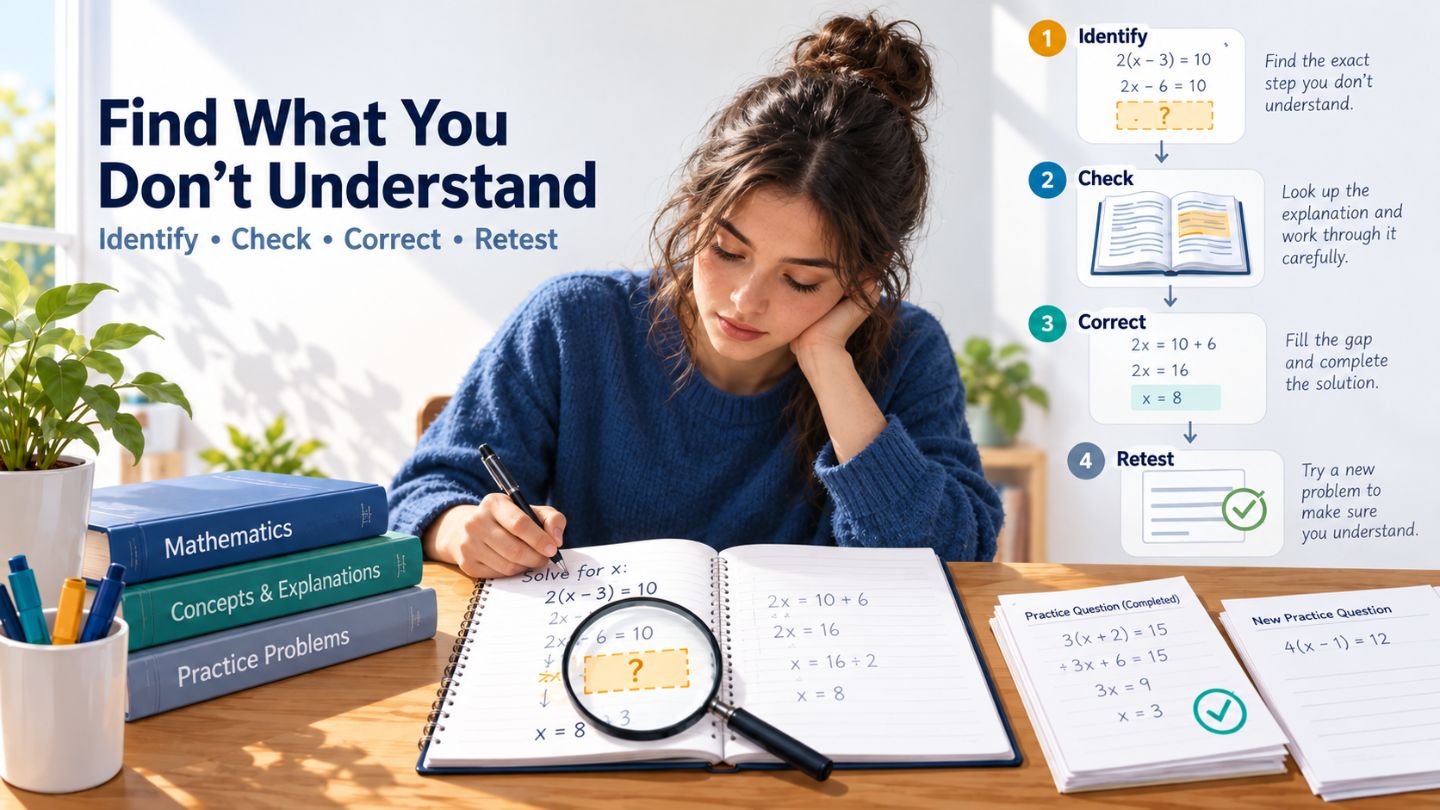
When a new explanation conflicts with what you previously believed, identify the exact point of disagreement.
Ask whether:
-
The earlier rule applied only under certain conditions.
-
The new problem introduces a feature that changes the reasoning.
-
A term has a different meaning in the new context.
-
The earlier explanation was incomplete or incorrect.
-
The new source provides evidence that requires revising the original understanding.
The aim is not to replace every familiar explanation whenever you encounter an unfamiliar result.
It is to evaluate the conflict and determine which understanding is supported by the evidence.
Personal experience can help make an idea understandable, but familiarity does not establish scientific or mathematical accuracy.
Test Whether You Can Remember and Use the Connection
Understanding a relationship while reading an explanation is different from recalling or applying it independently.
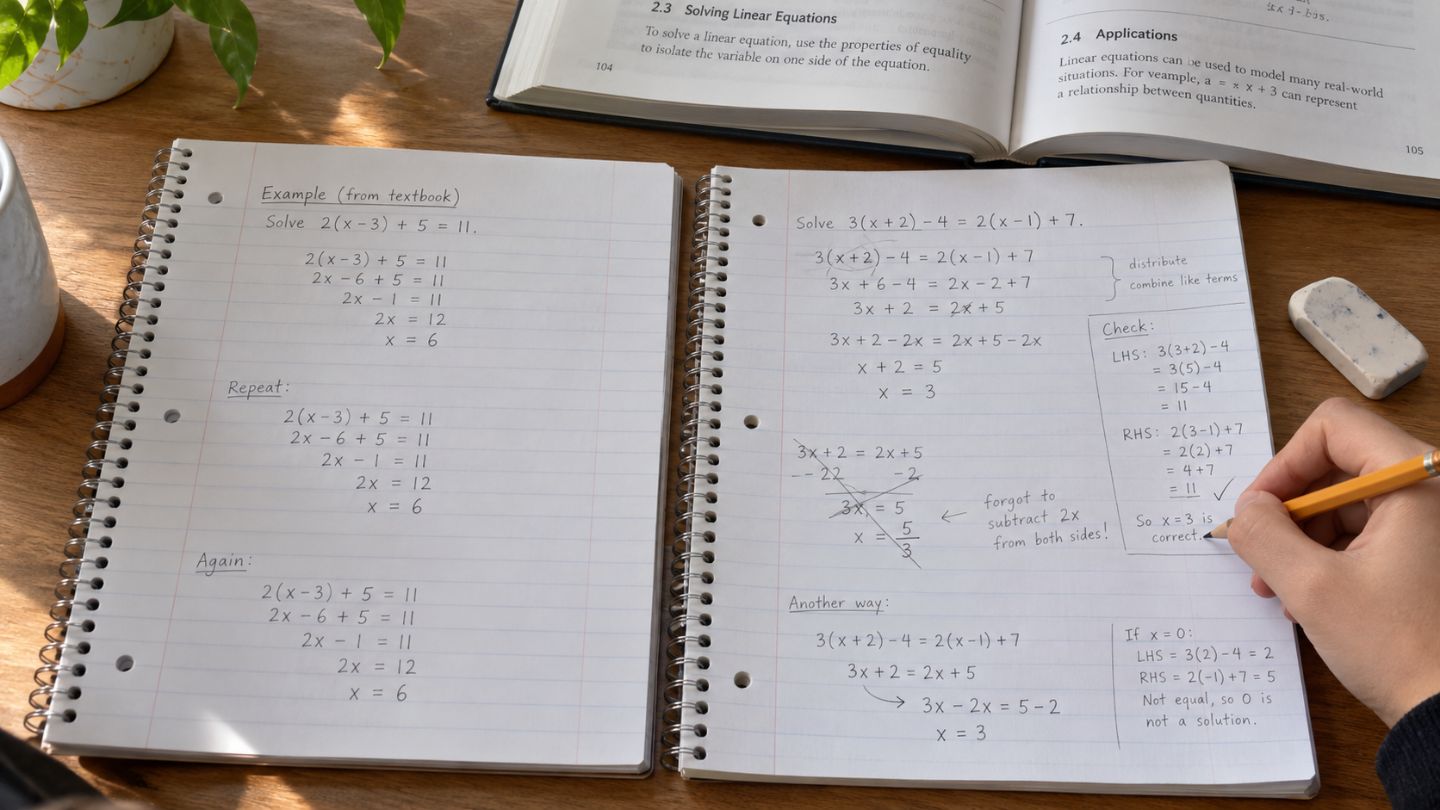
A learner may follow the reasoning in a worked example but struggle to reconstruct it later.
This difficulty can occur even when the explanation initially appeared clear.
Recall the relationship without looking
After studying, close the material and try to explain the connection from memory.
For a distance–time graph, you might ask:
"What does the slope represent, and how does that connect to the formula for speed?"
For percentage change:
"Why do I divide the change by the original value?"
Then compare your explanation with the source and correct any missing or inaccurate reasoning.
This activity uses retrieval practice, which involves attempting to bring previously learned material to mind.
A major review by Dunlosky and colleagues, published in Psychological Science in the Public Interest in 2013, rated practice testing and distributed practice highly among the learning techniques it examined. The review also considered self-explanation and other elaborative techniques, with distinctions in their evidence and appropriate use.
Retrieval practice is not limited to memorizing isolated facts. Questions can require recalling explanations and identifying relationships.
Apply the connection to a changed problem
Recalling a relationship is useful, but applying it to an unfamiliar situation requires another check.
Suppose you understand how to calculate speed from a distance–time graph showing a straight line.
You can then examine a graph where the slope changes over time.
The earlier understanding remains relevant, but the interpretation becomes more demanding. A changing slope on a distance–time graph indicates that speed is changing, rather than remaining constant.
The learner must recognize which principle continues to apply and what the changed representation means.
Using learned knowledge in a different situation is called transfer of learning.
Research summarized in How People Learn II emphasizes that applying knowledge depends on recognizing relevant relationships and understanding when established principles are appropriate.
Successful application to one changed example is encouraging, but it does not demonstrate that the learner can apply the concept correctly in every unfamiliar situation.
Collegenp's article on transfer of learning discusses this distinction in greater detail.
Return to the relationship after some time
A connection that makes sense immediately after studying may become difficult to recall later.
Returning to the material after a delay gives you an opportunity to check whether you can reconstruct the explanation without relying on immediate familiarity.
Retrieval practice can be useful here.
In a 2011 study published in Science, Jeffrey Karpicke and Janell Blunt reported advantages for retrieval practice over a particular elaborative concept-mapping study condition, including on questions assessing comprehension and inference.
That comparison does not establish that retrieval practice is superior to every form of concept mapping or for every learning objective.
The methods address related but distinct tasks: explaining and mapping can help clarify relationships, while retrieval checks whether the knowledge can be brought back and used.
The review by Dunlosky and colleagues also supports distributing learning activities over time, but it does not establish one review schedule suited to every learner and subject.
The practical consideration is whether you can retrieve the explanation accurately after time has passed, not whether you have followed a particular timetable.
What to Do When the Connection Is Missing or Misleading
Different difficulties require different responses. A learner who lacks a prerequisite does not need the same intervention as someone who understands the original idea but applies it incorrectly.
The following distinctions can help identify a useful next action.
|
Difficulty |
What to do next |
What to check |
|---|---|---|
|
Nothing relevant comes to mind |
Review an introductory explanation or necessary prerequisite |
Can you explain the prerequisite accurately? |
|
The connection seems familiar but remains unclear |
Compare the concepts and identify their precise relationship |
Does the connection explain more than a shared word or feature? |
|
The new concept contradicts an earlier belief |
Examine both explanations against reliable evidence |
Was the earlier understanding incomplete or incorrect? |
|
The explanation makes sense only while reading |
Attempt to explain it without notes, then check the result |
Can you reconstruct the reasoning independently? |
|
Familiar problems are manageable, but new ones are difficult |
Compare the original and changed problems |
Which conditions still apply, and which have changed? |
When you lack the necessary background
Trying to connect unfamiliar material with unrelated personal experiences may create confusion rather than resolve it.
For example, understanding a lesson on chemical reactions may require familiarity with atoms, molecules, and chemical symbols.
If those foundations are missing, a detailed analogy about the new reaction cannot necessarily replace them.
Begin with the relevant prerequisite. A teacher's explanation, introductory textbook section, or worked example can provide the necessary starting point.
The important question is whether the learner has the background needed for the task, not whether every learner can recall the same experience.
When the explanation is too complicated
If a connection involves several unfamiliar rules, narrow the immediate task.
Identify the first relationship you cannot explain and examine it separately.
Suppose a learner understands how to calculate a percentage but struggles with a multi-stage percentage-change problem.
The learner can first establish how one percentage change affects the original quantity before attempting successive changes.
Once the individual relationship is understood, it becomes easier to examine how the calculations connect.
This does not mean every complex topic can be learned through isolated steps. Some concepts require understanding interactions among several elements.
The point is to reduce unnecessary confusion while preserving the relationships needed for accurate understanding.
How Teachers Can Support Connections Between Lessons
Teachers can help students connect new material with earlier learning by making prerequisites visible and checking whether those prerequisites are accurately understood.
A previous lesson does not automatically become available to students when a related topic appears.
Reveal the relevant earlier knowledge
Before introducing a more complex concept, a teacher can ask a short question that requires students to use the necessary prerequisite.
For example, before teaching equations involving fractions, students might complete a fraction calculation and explain the reasoning.
Their responses can reveal whether the upcoming lesson requires additional review.
The question should examine understanding rather than ask students to judge how familiar the topic feels.
Explain the connection without assuming shared experience
Students bring different educational, cultural, and linguistic backgrounds to lessons.
An illustration familiar to one group may require explanation for another.
Teachers can reduce this difficulty by introducing essential background, defining unfamiliar terminology, and providing more than one way to understand a concept when appropriate.
The American Psychological Association identifies existing knowledge, context-dependent learning, practice, and feedback among the psychological principles relevant to instruction.
These principles support checking what learners know instead of assuming that earlier teaching has produced equivalent understanding for everyone.
Examine students' reasoning, not only their answers
A correct answer does not necessarily reveal how it was obtained.
When a student connects an earlier rule with a new problem, asking why that rule applies can provide more information about the student's understanding.
If the explanation contains an error, feedback should identify the specific misunderstanding.
If the relationship is correct, a changed problem can provide a further opportunity to examine whether the student recognizes its conditions of use.
This makes the connection between lessons explicit while leaving room to correct incomplete understanding.
Conclusion
Connecting new knowledge with what you already know involves more than remembering familiar information. It requires identifying a relevant earlier concept, explaining the relationship, and checking whether that explanation is accurate.
A familiar idea may provide a foundation for learning, but it can also be incomplete or misleading. When the necessary background is missing, that foundation needs to be developed. When earlier understanding is incorrect, it needs to be revised.
Explanations, comparisons, and concept maps can help make relationships clearer. Retrieval and application provide further opportunities to examine whether those relationships remain accessible and useful.
When studying something unfamiliar, begin with one relevant concept you understand. Explain how it relates to the new material, identify where the relationship has limits, and test it with a different example.
The purpose is not to make unfamiliar information feel familiar. It is to develop an understanding you can explain, examine, and use appropriately.
References
The article draws on seven educational research and institutional references from the V1 evidence base.
1. National Academies of Sciences, Engineering, and Medicine. (2018). How People Learn II: Learners, Contexts, and Cultures, Chapter 5: Knowledge and Reasoning. National Academies Press.
2. Carnegie Mellon University, Eberly Center. (n.d.). Learning Principles. Teaching Excellence & Educational Innovation.
3. Chi, M. T. H., Bassok, M., Lewis, M. W., Reimann, P., and Glaser, R. (1989). Self-Explanations: How Students Study and Use Examples in Learning to Solve Problems. Cognitive Science, 13(2), 145–182.
4. Carnegie Mellon University, Eberly Center. (n.d.). Using Concept Maps. Teaching Excellence & Educational Innovation.
5. Dunlosky, J., Rawson, K. A., Marsh, E. J., Nathan, M. J., and Willingham, D. T. (2013). Improving Students' Learning With Effective Learning Techniques: Promising Directions From Cognitive and Educational Psychology. Psychological Science in the Public Interest, 14(1), 4–58.
6. Karpicke, J. D., and Blunt, J. R. (2011). Retrieval Practice Produces More Learning Than Elaborative Studying With Concept Mapping. Science, 331(6018), 772–775.
7. American Psychological Association. (n.d.). Top 20 Principles: Thinking and Learning. American Psychological Association.





Comments 0
No comments yet. Be the first to start the conversation.