



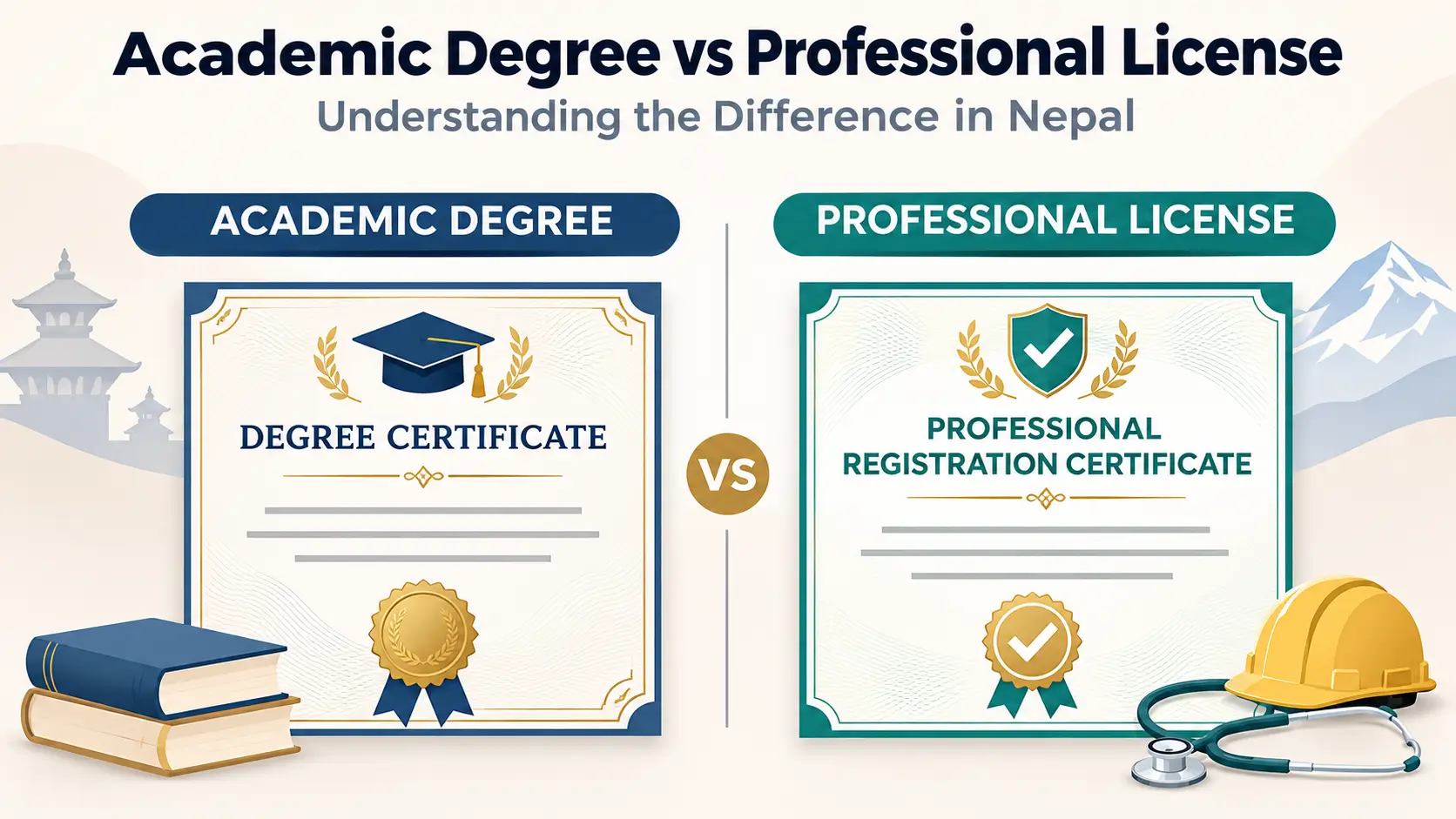
An academic degree and a professional license serve different purposes in Nepal. A degree confirms that a person has completed an academic programme, while a professional license or registration establishes authorization to undertake certain regulated professional activities.
Completing a Bachelor of Engineering, MBBS, BDS, nursing qualification, education degree, or law programme does not automatically establish permission to practise the corresponding regulated profession.
This distinction matters before choosing a course, applying for professional registration, or accepting a job involving regulated responsibilities.
For students, the concern is whether a qualification will meet the requirements of their intended profession. For graduates, it is whether additional examinations, internships, training, or registration are necessary. Those who studied abroad face another question: whether academic equivalence and professional recognition must be obtained separately.
Nepal does not have one licensing system covering every profession. Different councils and authorities regulate different occupations, and not every career requires statutory professional registration.
Answer Summary: In Nepal, an academic degree establishes educational achievement, while a professional license or registration confirms authorization under the rules of a particular profession. Engineering, medicine, nursing, teaching, law, and other regulated fields have different requirements. Passing a licensing examination, receiving academic equivalence, and obtaining employment are also separate processes. Graduates should verify the exact qualification, relevant regulatory authority, and required permission before undertaking regulated professional work.
Key Takeaways:
-
An academic degree establishes educational achievement, not automatic professional authorization.
-
Different professions in Nepal have separate councils, registration categories, and eligibility requirements.
-
Passing a licensing examination does not necessarily mean professional registration is complete.
-
Some professional registration pathways accept specified certificates or diplomas rather than bachelor's degrees.
-
Academic equivalence for a foreign qualification does not replace professional council approval.
-
Professional registration does not guarantee employment or unrestricted independent practice.
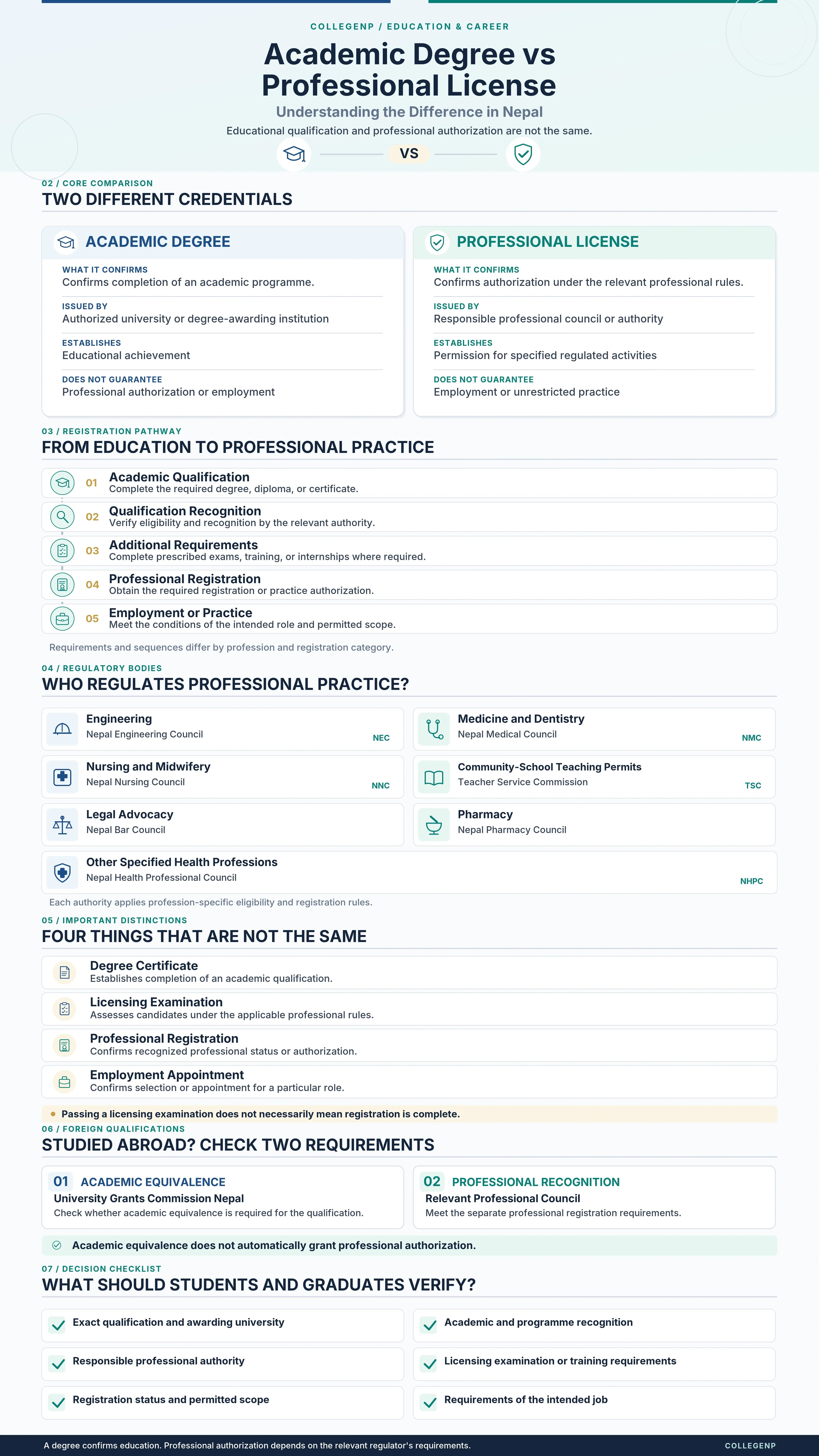 Academic Degree vs Professional License: Main Differences
The main difference between an academic degree and a professional license lies in what each credential establishes and who has the authority to issue it.
What Is an Academic Degree?
An academic degree is a qualification awarded by a university or another authorized degree-awarding institution after a student completes the prescribed academic programme.
Bachelor's, master's, and doctoral degrees represent different levels of higher education.
A degree establishes that its holder has satisfied the academic requirements of the awarding institution. These ordinarily include completing the curriculum, meeting assessment requirements, and fulfilling the conditions for graduation.
For example, a Bachelor of Engineering establishes an academic qualification in engineering. It does not, by itself, confirm registration with the Nepal Engineering Council (NEC).
Similarly, an MBBS or BDS degree is an academic medical or dental qualification. Professional registration is handled separately by the Nepal Medical Council (NMC).
A degree can also be relevant outside regulated professional practice. Graduates may pursue further education or apply for roles where professional registration is not a statutory requirement, subject to the receiving institution's or employer's criteria.
What Is a Professional License?
A professional license is an authorization issued by the relevant regulatory authority to a person who satisfies the applicable requirements for a regulated professional activity.
Depending on the occupation, those requirements may involve academic qualifications, licensing examinations, practical training, professional experience, or registration.
In Nepal, authorities use different terms for professional authorization, including:
-
Professional registration or name registration.
-
Licensing certificates.
-
Teaching permits.
-
Certificates authorizing particular professional activities.
These terms do not necessarily represent identical legal processes.
For example, the Nepal Engineering Council distinguishes general registered engineers from Professional Engineers, while the Teacher Service Commission (TSC) issues teaching permits and separately handles recommendations for permanent appointments in community schools.
The meaning and permitted scope of each credential must be determined from the responsible authority's rules.
Academic Degree vs Professional License: Comparison
|
Basis |
Academic Degree |
Professional License or Registration |
|---|---|---|
|
Purpose |
Establishes educational qualification |
Establishes professional authorization |
|
Issuing authority |
University or authorized academic institution |
Professional council or designated authority |
|
Assessment |
Academic curriculum and examinations |
Applicable professional eligibility and assessment requirements |
|
Recognition |
Academic recognition or equivalence, where relevant |
Recognition under the applicable professional rules |
|
Permitted activities |
Does not independently authorize regulated work |
Authorizes activities within the prescribed professional scope |
|
Employment |
May satisfy educational eligibility |
May satisfy professional eligibility |
|
Limitations |
Does not guarantee registration or a job |
Does not guarantee employment or unrestricted practice |
These credentials are complementary where both are required. They should not be treated as competing alternatives.
Why a Degree Does Not Automatically Permit Professional Practice
Completing an academic programme and receiving permission to perform regulated professional activities are separate decisions.
An educational institution assesses whether a student has met the requirements for a qualification. A professional regulator determines whether an applicant satisfies the requirements governing entry into its profession.
The distinction can be seen in Nepal Engineering Council's general registration system. NEC's application portal identifies bachelor's engineering graduates from Council-recognized universities as its intended applicants and requires them to follow the applicable examination and registration process.
The university's decision to award the degree does not replace the Council's registration decision.
Professional pathways may involve several stages:
-
Completing the required academic qualification.
-
Establishing that the qualification meets the regulator's recognition or eligibility requirements.
-
Completing any prescribed examination, internship, training, or experience.
-
Obtaining professional registration or another required authorization.
-
Meeting the separate requirements of the intended employment role or professional activity.
This is an illustrative sequence, not a uniform process for every profession.
Some registration categories do not require a bachelor's degree. Others involve additional requirements after initial registration.
A professional license also has boundaries. General registration does not necessarily establish specialist recognition, independent-practice rights, or eligibility for every position within a profession.
Professional Licensing Across Major Professions in Nepal
Professional regulation in Nepal varies by occupation. Engineering, medicine, nursing, teaching, law, pharmacy, and other health professions are governed through different arrangements.
The following examples explain the main distinction between academic qualification and professional authorization without treating one profession's rules as applicable to another.
Engineering: Degree vs Nepal Engineering Council Registration
An engineering degree and NEC registration establish different qualifications.
The Nepal Engineering Council administers the registration of engineers under its applicable Act and regulations. Its general registration portal is intended for eligible bachelor's engineering graduates from universities recognized by the Council.
Applicants must satisfy the applicable examination and registration requirements before receiving general registration.
A graduate should verify the exact awarding university and engineering qualification rather than relying solely on a college's claim that it offers an engineering programme.
NEC also maintains a separate Professional Engineer registration route involving additional qualifications and professional competence requirements. This advanced designation should not be confused with general engineer registration.
For applicants, the important distinction is between academic graduation, eligibility for registration, and completed professional registration.
Medicine and Dentistry: Degree vs NMC Registration
Medical and dental degrees do not automatically establish professional registration in Nepal.
The Nepal Medical Council identifies registering qualified doctors and conducting licensing examinations before registration among its responsibilities.
For MBBS and BDS graduates, the professional pathway may involve completing the academic programme, satisfying applicable internship requirements, passing the required licensing examination, and obtaining registration.
The precise conditions depend on the qualification and registration category.
A medical degree certificate, internship-completion document, licensing-examination result, and professional registration certificate establish different facts.
Graduates should not assume that passing the examination automatically completes every registration requirement.
Nursing: Nursing Qualification vs Council Registration
Nursing qualifications and professional registration are separate under the Nepal Nursing Council (NNC).
The Council's application system identifies several qualification categories, including Proficiency Certificate Level (PCL) Nursing, BSc Nursing, Bachelor in Midwifery Science (BMS), and specialist nursing qualifications.
This illustrates why professional licensing should not be described as a process exclusively for bachelor's degree holders.
Different categories have different educational foundations. Applicants must satisfy the Council's applicable eligibility, examination, and registration conditions.
For students considering nursing education, the relevant question is whether the exact qualification meets the Council's requirements for the intended registration category.
Teaching: Education Degree vs Teaching Permit
An education degree, teaching permit, and permanent teaching appointment are separate matters.
The Teacher Service Commission's stated responsibilities include issuing teaching permits and recommending candidates for permanent teaching appointments and promotions in community schools.
A teaching permit establishes authorization under the applicable permit system. It does not mean that its holder has received a permanent teaching appointment.
Prospective teachers should verify the requirements associated with their intended teaching level, subject, qualifications, and recruitment category.
The TSC's community-school appointment arrangements should not automatically be applied to every private-school employment situation.
Law: Law Degree vs Advocate Registration
A law degree does not automatically establish professional registration as an advocate.
The Nepal Bar Council administers advocate examinations and certification-related processes. Its official services include examination applications, results, and professional certificate services.
A graduate intending to undertake regulated legal advocacy must satisfy the applicable professional requirements.
The distinction is particularly relevant because studying law and practising as a registered advocate are not identical activities.
Graduates pursuing other positions involving legal knowledge should examine the requirements of the specific role rather than assume that every law-related occupation has the same licensing conditions.
Pharmacy and Other Health Professions
Pharmacy and other health professions have their own registration arrangements.
The Nepal Pharmacy Council distinguishes diploma-level and bachelor's-level qualifications and maintains professional name-registration services.
The Nepal Health Professional Council (NHPC) regulates specified categories of health professionals. Its stated scope excludes medical doctors, nurses, pharmacists, and Ayurveda practitioners from its registration jurisdiction.
A graduate in a health-related discipline should therefore identify the regulator responsible for the precise professional category.
The academic title alone may not establish which council is responsible or which registration route applies.
Degree Certificates, Licensing Exams, Registration, and Employment
An academic qualification, licensing-examination result, professional registration, and employment appointment establish different statuses.
Confusing them can cause applicants to misunderstand their eligibility or assume that an administrative process has been completed.
Passing a Licensing Exam vs Receiving Registration
Passing a licensing examination does not necessarily mean professional registration is complete.
An examination determines whether a candidate has met the specified assessment requirement. Registration records or certificates establish the professional status recognized by the issuing authority.
NEC's regulations distinguish the professional examination, registration in the Council's register, and the certificate issued under its rules.
Likewise, NMC distinguishes licensing examinations from the registration of doctors.
Applicants should confirm whether successful examination results must be followed by additional registration approval or certificate issuance.
An admit card, application receipt, examination result, or payment record should not automatically be treated as proof of authorization.
Professional Registration vs Employment Selection
Professional registration does not guarantee employment.
A license can establish an essential professional qualification for a regulated position, but employers may impose additional selection requirements.
These can involve academic qualifications, professional experience, relevant skills, selection examinations, or role-specific conditions.
For public-sector teaching, TSC's separate responsibilities for teaching permits and appointment recommendations provide a clear example.
A candidate may satisfy the permit requirement without having been selected for a permanent teaching position.
Does Professional Registration Permit Independent Practice?
Professional registration should be understood within the scope defined by the responsible authority.
Some occupations distinguish initial registration from specialist status, advanced professional titles, or independent-practice permissions.
For instance, NEC distinguishes general engineer registration from its Professional Engineer category.
Applicants should examine the specific responsibilities attached to their professional status before assuming that registration permits every activity associated with the occupation.
How to Verify Professional Licensing Requirements in Nepal
The most reliable way to verify licensing requirements is to start with the exact qualification and intended professional role, then consult the responsible authority.
General statements about a college, degree, or profession may not establish an individual's eligibility.
Step 1: Identify the Exact Qualification
Record the full qualification title, awarding university, academic level, and institution providing the programme.
Check the relevant academic recognition and programme information.
For regulated professions, determine whether the responsible council recognizes that qualification for the intended registration category.
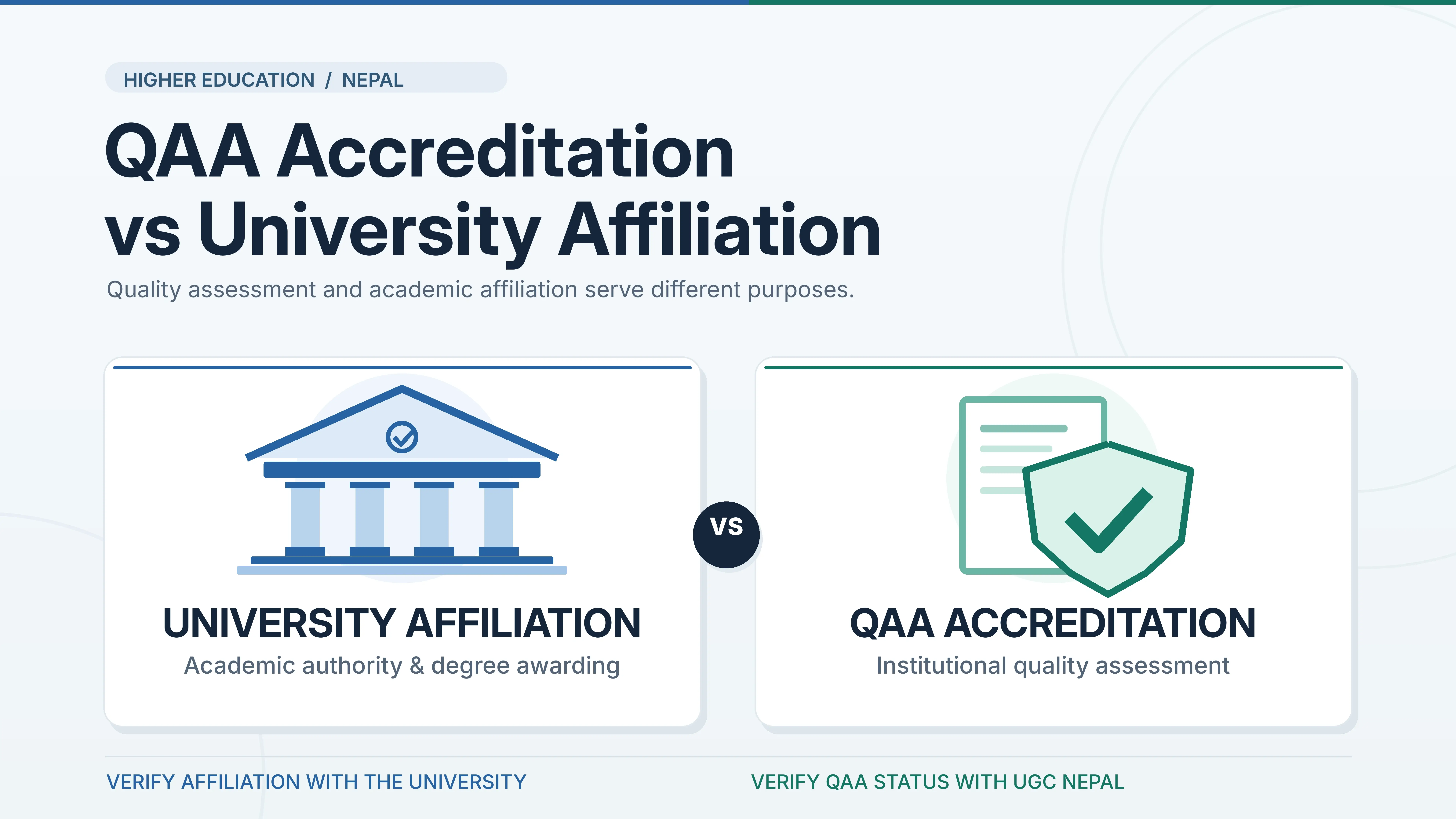
A college's academic affiliation, institutional quality status, and professional council recognition serve different purposes. One should not be treated as proof of the others.
Step 2: Find the Responsible Professional Authority
Identify the authority regulating the actual work.
For example, NEC is relevant to engineering registration, NMC to medical and dental registration, and NNC to nursing and midwifery registration.
Applicants should use the regulator's official information rather than applying requirements taken from another occupation.
Step 3: Check Additional Requirements
Read the current rules for the relevant category.
Determine whether the pathway requires a licensing examination, internship, supervised practical experience, additional qualifications, or other prescribed conditions.
Requirements may differ according to the qualification, applicant category, and professional activity.
An older licensing notice should not automatically be treated as current guidance.
Step 4: Confirm the Evidence of Authorization
Identify the document or official registration status that demonstrates completion of the process.
Where the authority provides an official register or professional-status verification service, consult it.
If the available records are unclear, seek clarification from the responsible authority rather than inferring approval from an examination result.
Step 5: Check the Intended Job Requirements
Review the specific vacancy notice or employment criteria separately.
Determine whether the position requires an academic qualification, professional registration, experience, or additional recruitment assessment.
This helps distinguish eligibility to practise a profession from eligibility for a particular job.
For a student considering a course, the same checks can be performed before enrolment. The central issue is whether the intended qualification provides an eligible route toward the desired professional status.
Foreign Degree Equivalence and Professional Registration
Foreign academic equivalence and professional registration are separate recognition processes in Nepal.
A qualification awarded outside Nepal may require an academic equivalence assessment for certain educational or employment purposes. That assessment does not independently grant permission to practise a regulated profession.
Which Authority Handles Foreign Degree Equivalence?
Nepal's University Grants Commission (UGC) now provides the higher-education degree equivalence service.
UGC operates an official online portal for assessing academic qualifications awarded by foreign universities. The portal distinguishes regular equivalence from cases requiring further procedural assessment.
The current service follows a change in administrative responsibility during 2026, when Tribhuvan University's Curriculum Development Centre stopped receiving new higher-degree equivalence applications and the responsibility moved to UGC.
Applicants should consult UGC's current instructions rather than rely on older TU CDC application guidance.
Is Academic Equivalence Enough for Professional Registration?
Academic equivalence does not automatically satisfy every professional registration requirement.
For example, a foreign engineering graduate may need academic equivalence where applicable and must separately satisfy NEC's recognition and registration conditions.
The same distinction applies to foreign qualifications intended for other regulated professions, subject to the responsible council's rules.
A receiving professional authority may assess qualification recognition, training, examination results, or other relevant conditions independently.
Students planning to work outside Nepal should also avoid assuming that Nepalese professional registration guarantees authorization abroad. Each destination jurisdiction has its own professional recognition requirements.
Common Misunderstandings About Degrees and Licenses
Several assumptions about educational and professional credentials can lead to incorrect decisions.
Every Academic Degree Requires a License
Not every occupation requires a statutory professional license.
Whether authorization is necessary depends on the profession and the activities involved.
A graduate should identify the specific duties of the intended role before determining whether professional registration is required.
A Recognized Degree Guarantees Professional Registration
Academic recognition does not automatically establish professional eligibility.
A regulatory authority may separately assess the qualification, awarding institution, examination requirements, practical preparation, and other conditions.
This matters when choosing a programme intended to lead to regulated work.
A Licensing Exam Result Is a Professional License
A successful examination result is not necessarily equivalent to completed registration.
Applicants should verify the final professional status recorded or issued by the responsible authority.
Professional Registration Guarantees Employment
Registration establishes a professional status under applicable rules, not an employer's decision to appoint the individual.
Recruitment criteria and employment selection remain separate.
A Professional License Has Unlimited Scope
Professional permissions may be limited by registration category, professional role, and applicable regulatory conditions.
A general registration certificate does not automatically establish specialist recognition or authorization for every independent professional activity.
Conclusion
An academic degree and a professional license answer different questions.
A degree establishes educational achievement. A professional license or registration establishes authorization under the applicable rules of a regulated occupation.
For students and graduates in Nepal, the distinction affects course selection, professional eligibility, licensing examinations, foreign qualification recognition, and employment decisions.
Before making a decision, establish three facts: what qualification is awarded, which authority regulates the intended profession, and what evidence of professional authorization that authority requires.
These checks provide a more reliable basis for planning education and professional entry than relying on a degree title or assuming that graduation automatically permits regulated practice.
Editorial Note: The professional and academic recognition arrangements described here are specific to Nepal. Individual eligibility and permitted professional activities are governed by the applicable rules and official decisions of the responsible authority. This article provides general educational information rather than individual legal or licensing advice.



Comments 0
No comments yet. Be the first to start the conversation.