



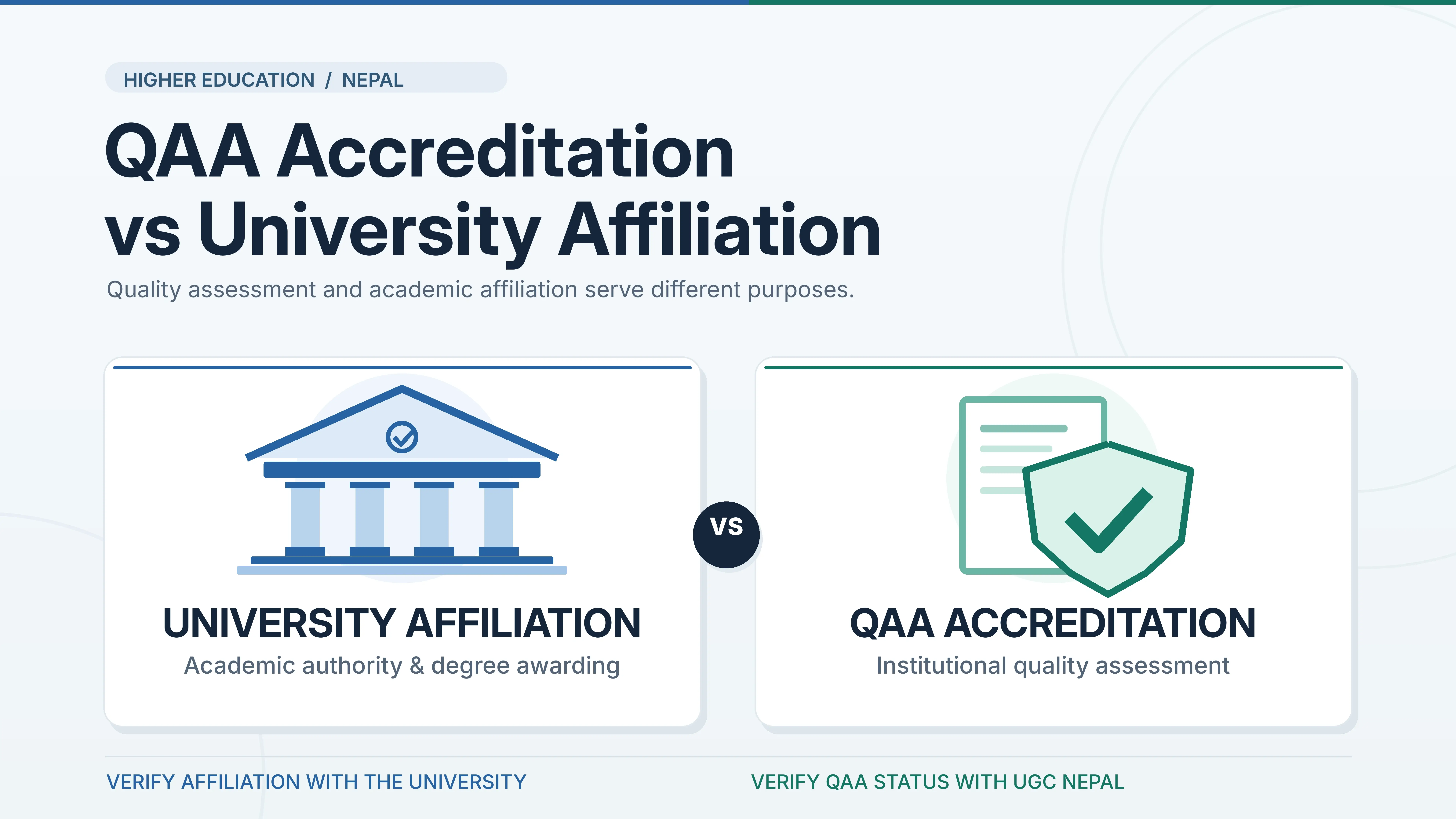
University affiliation and Quality Assurance and Accreditation (QAA) serve different purposes in higher education. University affiliation establishes a college's academic relationship with a university, while QAA accreditation confirms that an institution has undergone a formal quality assessment against specified standards.
The distinction matters when choosing a college, checking whether a programme is authorised, or determining which institution will award a degree.
In Nepal, the University Grants Commission (UGC) administers the national QAA framework. Universities establish affiliation arrangements under their respective academic rules and applicable laws.
A college may have valid university affiliation without holding a current QAA accreditation certificate. Equally, QAA accreditation does not independently authorise a college to offer every programme it advertises.
Understanding both statuses helps students distinguish academic authorisation from institutional quality assessment and identify when further verification is necessary.
Answer Summary: University affiliation establishes the academic relationship under which a college delivers specified programmes associated with an awarding university. QAA accreditation confirms that an institution has been assessed against an accreditation body's quality standards. In Nepal, affiliation should be verified with the relevant university, while QAA status should be checked with UGC. Neither status alone guarantees professional recognition, international degree equivalence, employment, or approval of every academic programme.
What Do QAA Accreditation and University Affiliation Mean?
Both terms relate to higher education institutions, but they answer different questions.
Affiliation concerns the academic authority under which a college operates. Accreditation concerns whether an institution has undergone evaluation against defined quality requirements.
QAA Accreditation: Institutional Quality Assessment
In Nepal, QAA stands for Quality Assurance and Accreditation. It is a formal process overseen by UGC to assess higher education institutions against established quality standards.
The UGC's Handbook for Self Study and Peer Review (2020) describes an institutional assessment system covering academic, administrative, and supporting activities.
Its assessment framework includes institutional policies, curriculum-related activities, teaching and evaluation, research, infrastructure, student support, information systems, and public information.
The process involves institutional self-assessment and external peer review before an accreditation decision.
A successful QAA assessment provides evidence that the institution has met the applicable criteria within the scope of the award.
However, accreditation should not be interpreted as a college ranking or a guarantee that every student will receive the same educational experience.
It also does not independently establish degree-awarding authority.
The specific institution, accreditation cycle, applicable standards, and certificate validity remain important when interpreting QAA status.
University Affiliation: Academic Authority and Degree Awarding
University affiliation is the formal academic relationship through which a college is authorised to deliver specified university programmes.
The affiliated college provides teaching and other academic services under the conditions established by the relevant university.
For example, Pokhara University describes its affiliated colleges as independent institutions operating under its academic affiliation and guidance.
The university explains that its affiliated colleges follow university curriculum frameworks, academic standards, and examination arrangements. Graduates receive degrees certified by Pokhara University.
This establishes an important distinction between the teaching institution and the degree-awarding institution.
An affiliated college does not become an independent university merely because it conducts university programmes.
Affiliation must also be interpreted within its approved scope. Permission to deliver one programme does not automatically establish permission to offer another programme or academic level.
For readers unfamiliar with Nepal's university system, the distinction between constituent and affiliated colleges is another separate consideration.
QAA Accreditation vs University Affiliation: Main Differences
The main difference between affiliation and accreditation lies in what each status confirms, who grants it, and what students can reasonably conclude from it.
|
Comparison |
University Affiliation |
QAA Accreditation in Nepal |
|---|---|---|
|
Primary purpose |
Establishes a formal academic relationship for delivering university programmes |
Assesses institutional quality against specified standards |
|
Responsible authority |
Affiliating university, subject to applicable requirements |
UGC through its accreditation framework |
|
Main focus |
Academic authorisation, curriculum, examinations, and awarding arrangements |
Governance, educational processes, resources, student support, and quality systems |
|
Degree awarding |
Identifies the university responsible for the qualification under the applicable arrangement |
Does not independently confer degree-awarding authority |
|
Evidence to verify |
University affiliation records and programme approvals |
UGC accreditation records and current certificate |
|
Validity considerations |
Depends on the relevant affiliation and programme arrangements |
Depends on the accreditation cycle, certificate, and applicable conditions |
|
Main limitation |
Does not guarantee institutional quality or separate professional recognition |
Does not independently approve every programme or guarantee degree recognition |
Neither status replaces the other.
Affiliation establishes the academic relationship through which a college operates. QAA provides information about the institution's assessed quality systems.
A college advertising both statuses is therefore making two distinct claims.
Students should examine those claims separately rather than treating their combination as automatic evidence of superior education.
The same principle applies when comparing colleges: an accredited institution may have undergone additional documented quality review, but that alone does not establish stronger teaching, better facilities, or better career outcomes in every academic discipline.
Can a College Be Affiliated Without QAA Accreditation?
A college can hold university affiliation without necessarily possessing a current QAA accreditation certificate because affiliation and accreditation are separate processes.
UGC's QAA framework includes affiliated colleges, constituent campuses, and relevant university academic units.
However, participation in the framework does not mean every institution has completed accreditation.
A college may have submitted an application, prepared a self-study report, or entered the peer-review process without receiving an accreditation award.
These stages must not be represented as equivalent to successful accreditation.
Whether accreditation is compulsory requires additional care.
The UGC's 2020 handbook describes the accreditation system in its historical policy context. That description should not be used to establish a universal present-day rule for every category of higher education institution.
Nepal has also introduced newer requirements for institutions operating foreign educational programmes, including the Foreign Educational Programs (Operation and Regulation) Regulations, 2083, listed by the Ministry of Education and Sports in 2026.
The applicable obligations depend on the institution's category and current regulatory arrangements.
Students should therefore avoid either assumption: that every affiliated college must already hold QAA accreditation, or that QAA participation is optional for every type of institution.
How Does QAA Assessment Differ From University Affiliation?
QAA accreditation involves formal institutional evaluation. University affiliation involves academic authorisation and an ongoing relationship with the awarding university.
How the QAA Process Works
The UGC framework describes a process that generally includes four major stages.
An institution first submits a Letter of Intent (LOI) to enter the QAA process and establish its eligibility.
It then prepares a Self-Study Report (SSR), examining its policies, academic activities, institutional resources, and quality arrangements.
External peer reviewers assess the submitted evidence and conduct institutional review activities.
The relevant accreditation bodies consider the findings before UGC makes the final accreditation decision.
Tribhuvan University's Quality Assurance and Accreditation Centre describes this sequence and notes that revised assessment indicators have been introduced.
The UGC's 2020 handbook uses eight institutional assessment criteria. These remain useful for understanding the framework historically, but they should not be presented as an unchanged list of current indicators.
The important principle is that QAA examines institutional systems and practices, rather than merely confirming that a university has authorised particular courses.
How University Affiliation Works
University affiliation is governed by the academic and regulatory arrangements of the relevant university.
Depending on the university and programme, these may address curriculum requirements, examinations, academic monitoring, institutional obligations, and continued authorisation.
Pokhara University's published affiliation explanation demonstrates how its university maintains academic oversight while affiliated colleges conduct teaching.
Affiliation also has a relationship with accreditation.
The UGC's 2020 handbook indicates that the validity of accreditation for an affiliated institution is linked to the validity of its university affiliation.
This means that the two processes are distinct without being entirely independent.
An institution's quality certificate should not be interpreted separately from its continuing academic authorisation.
How Long Does QAA Accreditation Remain Valid?
QAA accreditation is granted for a defined period rather than automatically continuing indefinitely.
The UGC's 2020 handbook generally specifies a five-year accreditation period. It also describes reaccreditation and the need for affiliated institutions to maintain valid affiliation.
The exact certificate and currently applicable requirements must be examined before confirming an institution's present status.
UGC publishes a list of accredited higher education institutions containing accreditation dates, expiry information, university relationships, and separate reaccreditation records.
Some historical entries display past expiry dates. Others contain information about subsequent accreditation cycles.
This creates a distinction between having received accreditation at some point and holding a currently valid certificate.
An institution listed as accredited in an earlier year should not automatically be described as currently accredited.
At the same time, a past expiry date in an older entry does not establish that reaccreditation has been refused or that no later certificate exists.
Students should examine the relevant accreditation cycle and seek confirmation when the published information is incomplete.
Does QAA Accreditation Guarantee Degree Recognition?
QAA accreditation does not guarantee that a degree will be accepted by every university, employer, professional regulator, or foreign authority.
Degree recognition involves several separate questions.
Academic Recognition
Academic recognition concerns the legitimacy and acceptance of the awarding institution and qualification under the relevant education system.
For affiliated colleges in the Nepal model described by Pokhara University, the university awards the approved qualification.
Nuffic, the Dutch organisation specialising in international education recognition, distinguishes Nepalese universities from affiliated campuses and explains how their recognition is assessed.
Its Nepal education-system guidance also identifies additional recognition considerations for particular fields.
An institution's QAA certificate does not replace verification of the awarding university or the programme concerned.
Professional Recognition
Professional recognition concerns eligibility to enter a regulated profession.
Some qualifications must satisfy requirements established by a professional council or another competent authority.
Engineering provides a relevant Nepalese example.
The Nepal Engineering Council publishes separate guidance for engineering programme recognition and monitoring.
Its requirements are distinct from general university affiliation and institutional QAA accreditation.
A student planning to enter engineering should verify the relevant programme's recognition and professional registration requirements.
Comparable questions arise in other regulated disciplines, but the responsible authority and requirements differ by profession.
International Recognition and Equivalence
A qualification awarded in one country is not automatically accepted for every educational or professional purpose in another country.
The receiving university, credential-evaluation organisation, employer, or professional regulator may assess the qualification according to its own requirements.
For example, admission to a postgraduate programme abroad may involve checking the awarding university, qualification level, curriculum, and other eligibility conditions.
QAA accreditation may provide relevant institutional information, but it does not substitute for the receiving authority's recognition decision.
Students intending to study or work internationally should confirm requirements with the institution or authority that will assess their qualification.
How to Verify University Affiliation and QAA Before Admission
A reliable verification process should examine the exact college, programme, awarding institution, and current accreditation status.
The following checks provide a practical approach based on the official records and regulatory distinctions discussed above.
1. Identify the Exact College and Programme
Begin with the institution's official name, campus location, programme title, academic level, intended admission session, and awarding university.
These details help distinguish institutions with similar names and clarify which academic arrangement is being advertised.
A college's general affiliation claim may not establish authorisation for a particular course.
Ask which university will award the final qualification and whether the intended programme falls within the college's approved affiliation.
2. Verify Affiliation With the Awarding University
Check the university's official affiliated-college, faculty, institute, or programme records.
Pokhara University, for example, maintains an official affiliated-colleges directory.
Other universities may publish their records in different sections or formats.
Match the institution's name, location, programme, and academic level against the available information.
If the public directory confirms the college but does not identify the programme, request the relevant affiliation or authorisation evidence.
When the information remains unclear, seek confirmation directly from the appropriate university office.
A university logo or general statement on a college website should not be treated as sufficient documentary proof.
3. Check QAA Status With UGC
Use the official UGC list of QAA-receiving higher education institutions.
Find the exact college or campus and examine its accreditation details.
Pay particular attention to the date of accreditation, expiry information, and any subsequent reaccreditation record.
Check whether the award concerns the institution being considered rather than another unit or campus with a related name.
An accreditation certificate displayed by a college should be consistent with the appropriate official record.
When dates are unclear, request confirmation from UGC instead of interpreting an old listing as proof of current validity.
Readers seeking additional context can consult this guide to QAA-receiving higher education institutions in Nepal.
4. Verify Additional Programme Requirements
Some programmes require recognition or approval beyond university affiliation.
For regulated professional education, identify the appropriate council or competent authority.
Engineering students can consult the Nepal Engineering Council's programme-recognition guidelines.
Students considering foreign-affiliated programmes delivered in Nepal should separately verify the overseas awarding university and the relevant local permission.
The exact requirements depend on the programme and regulatory framework.
5. Confirm Acceptance for the Intended Purpose
Finally, consider how the qualification will be used.
A student planning postgraduate study should examine the receiving university's eligibility requirements.
Someone entering a regulated profession should consult the relevant registration authority.
An applicant seeking qualification equivalence should identify the body responsible for that determination.
For decisions with significant consequences, obtaining written confirmation and retaining the relevant official documents may help prevent misunderstandings.
The central verification questions are straightforward: Which authority permits the programme, which university awards the degree, who assessed the institution's quality, and which authority will evaluate the qualification afterward?
When Does the Difference Matter Most?
The distinction between QAA accreditation and university affiliation becomes particularly relevant when institutional claims affect educational decisions.
Comparing Two University-Affiliated Colleges
Consider a hypothetical situation involving two colleges affiliated with the same university, where one also holds current institutional QAA accreditation.
The accreditation provides additional documentary evidence of quality assessment.
It does not establish that the accredited college performs better in every subject or produces stronger academic outcomes for every student.
A useful comparison should also examine the relevant department's teaching arrangements, academic resources, student support, affordability, and programme suitability.
These considerations require evidence beyond accreditation status.
Reviewing an Expired Accreditation Certificate
An institution may continue displaying a certificate from an earlier accreditation cycle.
The appropriate response is to verify whether a subsequent certificate or reaccreditation decision exists.
A historical certificate confirms an earlier award, not necessarily current accreditation.
Similarly, an outdated web entry should not be interpreted as proof that the institution has lost accreditation without checking later records.
Choosing a Foreign-Affiliated College
Foreign university affiliation introduces additional questions about the awarding university, the institution delivering the programme, and local authorisation.
A Nepal-based college offering a foreign qualification should be assessed against the relevant foreign-university relationship and applicable Nepalese rules.
The 2083 regulations make it particularly important to avoid relying solely on older descriptions of foreign-programme requirements.
Detailed regulatory obligations should be checked against the current official provisions rather than assumed from historical affiliation arrangements.
Understanding QAA Outside Nepal
The acronym QAA also has a different institutional meaning in the United Kingdom.
There, QAA refers to the Quality Assurance Agency for Higher Education.
It undertakes quality review and accreditation activities under its own frameworks. This is distinct from Nepal's UGC-administered QAA process.
The fact that an overseas university has undergone quality review does not automatically establish accreditation of a Nepal-based teaching partner.
International academic partnerships may also use terms such as affiliation, validation, or franchising. Their exact legal and academic effects depend on the governing arrangements.
Readers should identify the responsible authority rather than assuming that similar terminology carries the same meaning across countries.
Common Mistakes When Comparing Accreditation and Affiliation
Several misunderstandings can distort how students evaluate institutional claims.
One is treating an application for QAA as successful accreditation. A submitted Letter of Intent or Self-Study Report confirms participation in a process, not its successful completion.
Another is assuming that an entire university's accreditation automatically covers every affiliated college, campus, and programme. The actual scope of the accreditation award determines what it establishes.
Students should also avoid assuming that a university affiliation automatically authorises every course offered by a college. Programme-specific evidence is necessary where the approval arrangements require it.
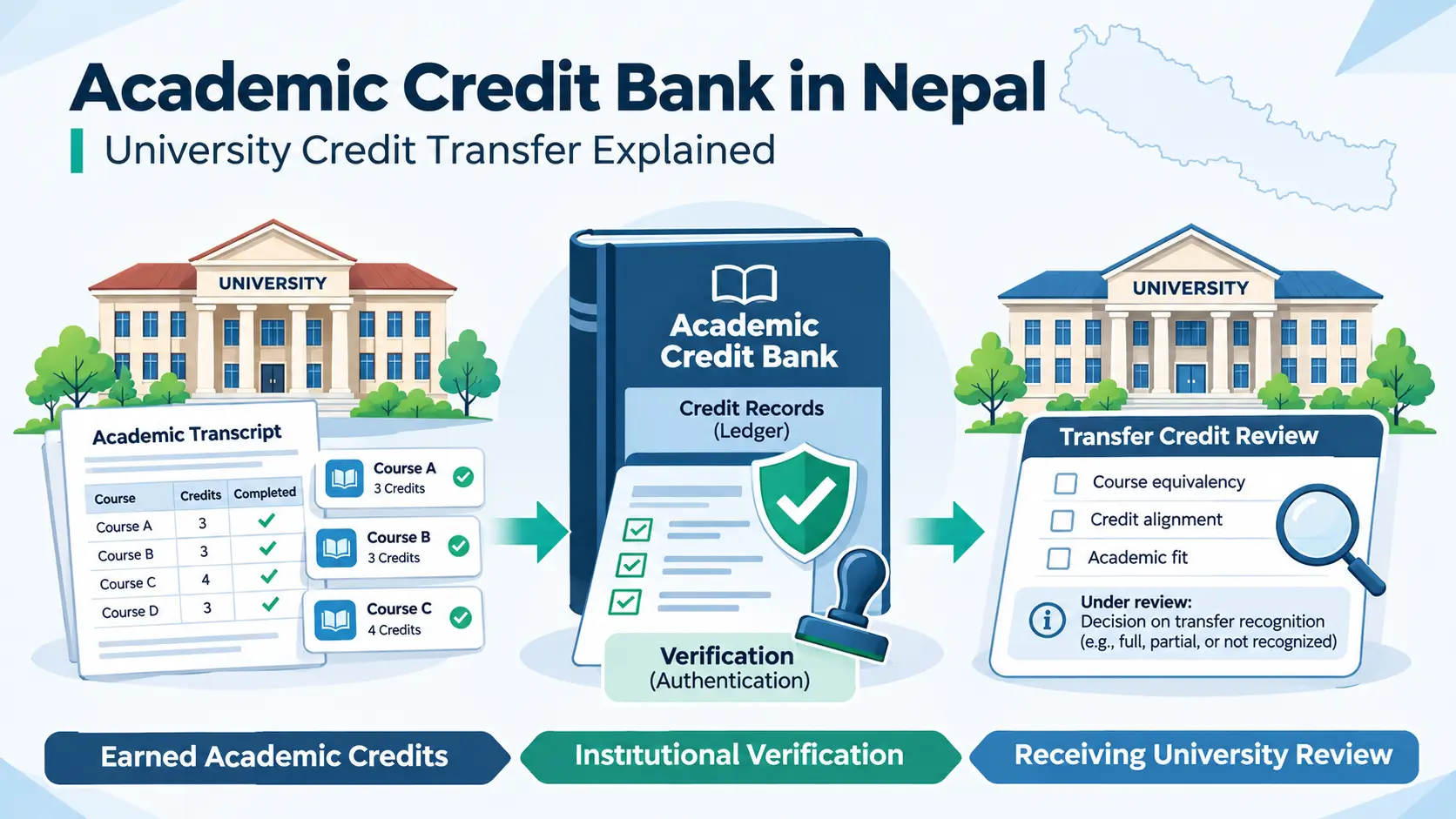
Finally, neither affiliation nor accreditation should be interpreted as a guarantee of employment, credit transfer, professional registration, or international acceptance.
Each involves additional conditions and decisions by the responsible authority.
The most useful correction is to match each institutional claim with the specific official record capable of confirming it.
Conclusion
QAA accreditation and university affiliation are complementary forms of institutional information, not competing approvals.
Affiliation establishes the academic relationship through which a college delivers university programmes and identifies the relevant awarding arrangements. QAA accreditation provides evidence that an institution has undergone formal quality assessment within a defined framework and accreditation period.
Students should verify both statuses independently while also checking programme approval, professional requirements, and qualification acceptance where relevant.
A college's institutional labels provide useful starting information. The official documents behind those labels establish what they mean for a particular programme and educational decision.




Comments 0
No comments yet. Be the first to start the conversation.