




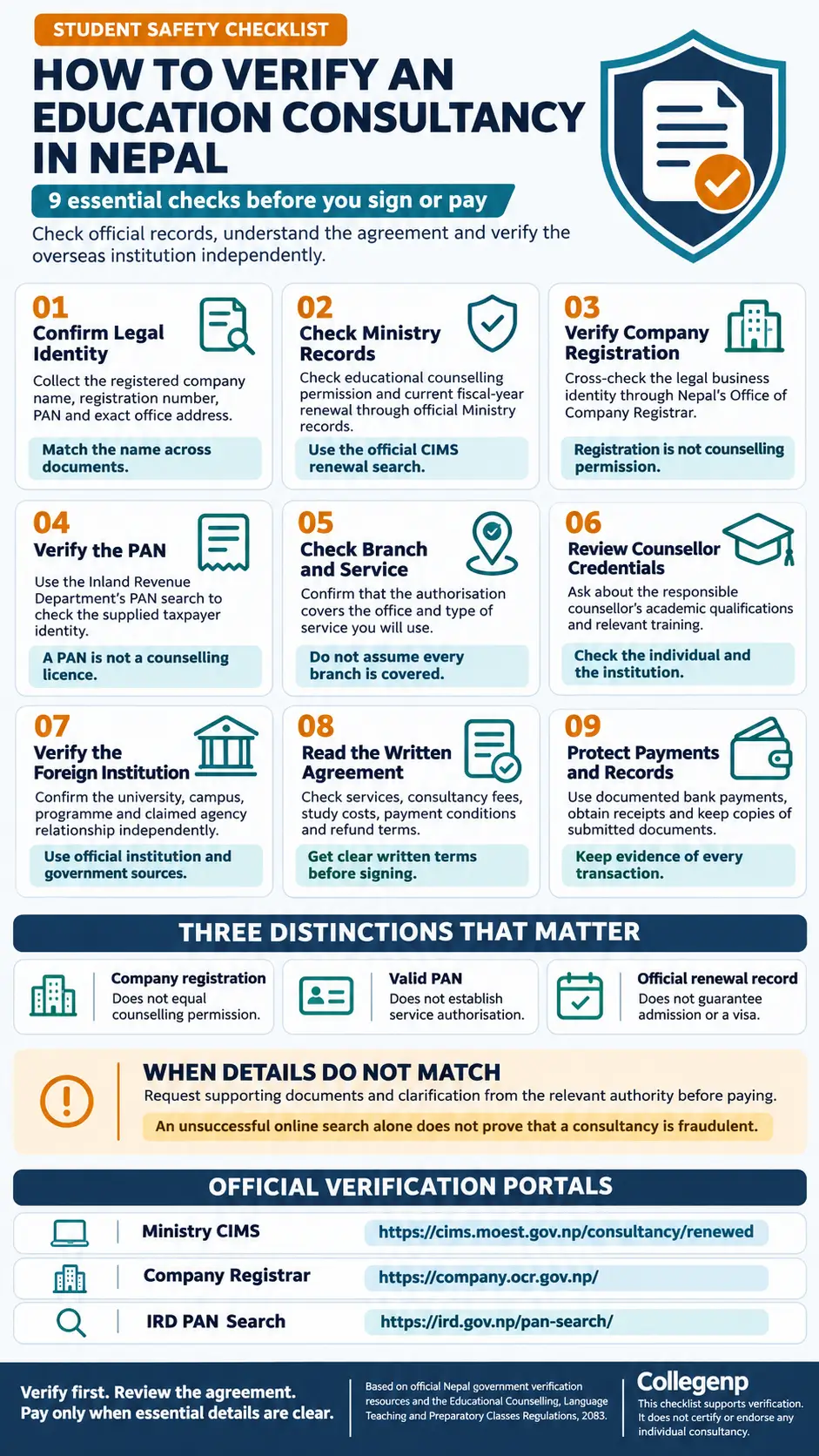
Before paying an education consultancy in Nepal, check whether the business has the required permission to provide educational counselling, whether that permission is current, and whether it covers the office handling your application.
Start with the Ministry of Education and Sports' Renewed Consultancy Search. Then cross-check the company's legal identity through the Office of Company Registrar (OCR) and its Permanent Account Number (PAN) through the Inland Revenue Department (IRD).
These checks answer different questions. A company registration certificate does not establish permission to provide educational counselling. A PAN confirms tax identity, not the quality or legality of consultancy services. Even a current counselling permit does not guarantee admission to a foreign university or approval of a student visa.
Nepal's Educational Counselling, Language Teaching and Preparatory Classes (Operation and Management) Regulations, 2083 establish requirements concerning permission, renewal, branches, qualified counsellors, service charges, payments and written agreements.
This guide explains how to use the official records, identify discrepancies and decide what needs clarification before signing an agreement, sharing documents or making a payment.
Which Official Records Should You Check?
Three official systems provide the starting point for verifying an education consultancy in Nepal. They should be used together because none provides a complete assessment of a business.
|
Official system |
What to verify |
What it cannot establish |
|---|---|---|
|
Ministry CIMS Renewal Search |
Whether the consultancy appears in the Ministry's renewal search for the current fiscal year |
Every aspect of permission, branch coverage or service quality |
|
Office of Company Registrar |
Registered company identity and available incorporation details |
Permission to provide educational counselling |
|
Inland Revenue Department PAN Search |
Taxpayer identity associated with the supplied PAN |
Counselling authorisation, renewal or overseas partnerships |
A matching result provides evidence about the particular record checked. It is not an endorsement of the consultancy.
The difference is especially important when a business describes itself as "government-registered." Ask which government body issued the document, which service it covers and whether the authorisation remains valid.
Step 1: Collect the Consultancy's Legal Details
Reliable verification begins with identifying the exact business responsible for your application.
A consultancy may advertise under a trading name that differs from its registered company name. It may also operate several offices under the same brand. These arrangements are not necessarily improper, but they make accurate identification essential.
Before using the government portals, request the registered legal name, company registration number, PAN, educational counselling permit number, issuing authority, renewal evidence and office address.
Ask which legal entity will sign your service agreement and receive your payments.
Compare that information with the consultancy's displayed certificates, website, proposed agreement and invoice.
If the names differ, the consultancy should explain the relationship and provide supporting documents.
Under Rule 12 of the 2083 Regulations, permitted institutions must display important registration, permission, tax, service and fee information at their offices. They are also required to make their service charges public through their websites.
Examining those records is useful, but a displayed certificate should still be checked against the issuing authority's information.
Step 2: Verify Ministry Permission and Renewal
The Ministry of Education and Sports is the principal authority to consult when checking permission for educational counselling services under the current federal regulations.
Its public Consultancy Information Management System (CIMS) offers a specific renewal-search function.
How to Use the CIMS Renewal Search
Open the official Renewed Consultancy Search.
The page instructs users to enter a consultancy name, examine matching names and select a result to view details. Its stated purpose is to check whether a consultancy has been renewed for the current fiscal year.
Use the registered legal name where available. If the business uses a different name in its advertising, request clarification about which name should appear in the Ministry's records.
Compare any returned information with the permit and renewal documents supplied by the consultancy.
Pay particular attention to whether the result identifies the same business you intend to deal with.
What Does a Matching Result Mean?
A matching record is evidence relating to the Ministry's renewal information for the period covered by the search.
It does not independently establish that every office using the consultancy's name has permission, that all services offered fall within the permit or that its overseas university claims are accurate.
The search page should therefore be treated as a renewal-checking tool rather than a complete certificate of business reliability.
What If No Consultancy Appears?
An unsuccessful search is inconclusive.
The registered name may differ from the advertised name, or the business may have records affected by administrative or transitional arrangements.
A missing result is not sufficient evidence to accuse a consultancy of operating unlawfully.
However, it is also not a reason to accept the consultancy's permission claim without further checking.
Request its permit and current renewal documents. If the discrepancy remains, contact the Ministry for clarification before making a financial commitment.
Step 3: Check Company Registration and PAN
Company registration and tax records help establish which legal business is responsible for the service.
They are supporting checks, not alternatives to educational counselling permission.
Verify Company Registration Through OCR
The Office of Company Registrar's public portal provides a route for checking company information.
Use the registered business name or other identifying information supported by the search interface.
Compare the returned details, where available, with the company's registration certificate and service agreement.
A matching legal name and registration number help connect the consultancy's paperwork to a registered business.
If the record is unavailable or the portal cannot be accessed, seek confirmation through the registrar's official channels rather than drawing conclusions from a failed search.
Company incorporation alone does not establish that the business has permission to provide study-abroad counselling.
Verify the PAN Through IRD
The Inland Revenue Department provides an official PAN Search.
Enter the PAN supplied by the consultancy and compare the available taxpayer information with the legal entity named in its agreement or invoice.
The purpose is to establish consistency across the documents.
For example, if the consultancy's agreement identifies one company but its payment instructions identify an unrelated entity, request a documented explanation before paying.
A valid PAN does not confirm that a counsellor is qualified, that the business holds current educational counselling permission or that an overseas institution has appointed it as an agent.
Step 4: Check the Exact Branch and Service
Permission for a consultancy's head office should not be assumed to cover every branch operating under the same brand.
Rule 3(6) of Nepal's 2083 Regulations addresses separate permission for branch operations. Rule 12 also requires an institution to provide the services for which it has received permission.
If you are dealing with a branch outside Kathmandu, or with any office other than the main registered location, request evidence covering that particular office.
The same question applies to the service itself.
Educational counselling, language teaching, language testing and preparatory classes are distinct activities under the regulatory framework. A document covering one activity should not automatically be treated as permission for all of them.
What About Older Provincial Permission?
The 2083 Regulations distinguish federal educational counselling authority from certain provincial and local permissions.
The Ministry also issued notices in August and September 2026 concerning the previous 2073 directive and arrangements affecting institutions with earlier permission.
An older provincial certificate therefore requires careful interpretation.
It should not be accepted as permanent evidence of current federal authorisation. Equally, the presence of such a certificate does not establish wrongdoing.
Ask the Ministry to clarify the current status of the particular institution, service and branch. The Ministry's official CIMS notices page provides relevant regulatory announcements.
Step 5: Check the Counsellor's Qualifications
A consultancy's permission and an individual counsellor's qualifications are separate matters.
Rules 12 and 13 of the 2083 Regulations address counselling personnel. They include a bachelor's-level qualification and relevant educational counselling training.
Ask who will be responsible for advising you and handling your application.
The person should be able to explain the entry requirements, qualification, programme duration, academic costs and application procedures of the institution being recommended.
If a counsellor claims specialist training or certification, ask for appropriate evidence.
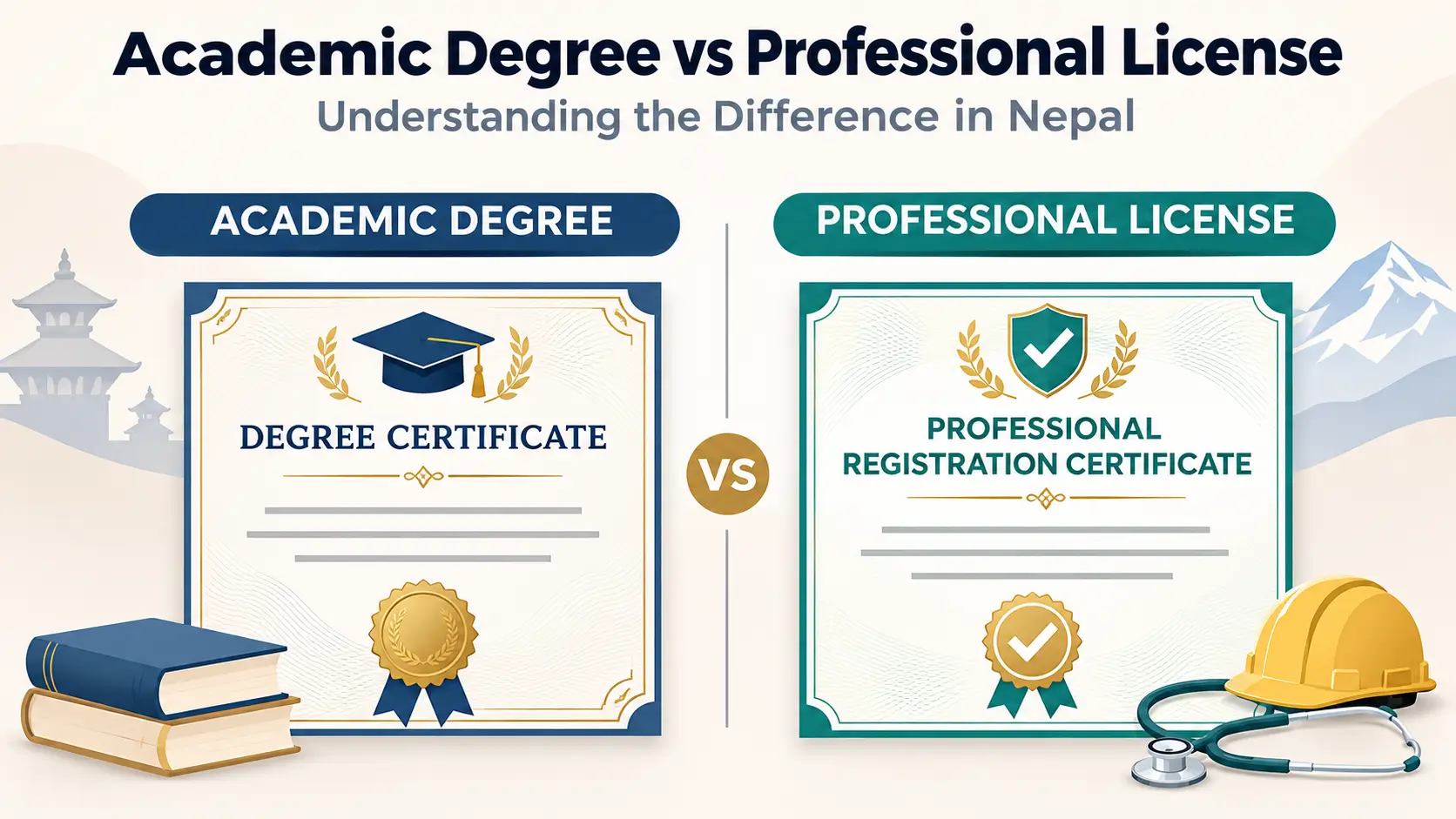
A professional training certificate does not replace the consultancy's government permission. Membership in an industry association, including the Educational Consultancy Association of Nepal (ECAN), is also distinct from statutory authorisation.
The practical concern is whether both the business and the person providing the service meet the relevant requirements.
Step 6: Verify the Foreign University Independently
Even when a Nepal consultancy has appropriate permission, the overseas institution and programme require separate checks.
Begin with the university or college's official website. Confirm that the proposed course, qualification, campus and admission requirements match what the consultancy has presented.
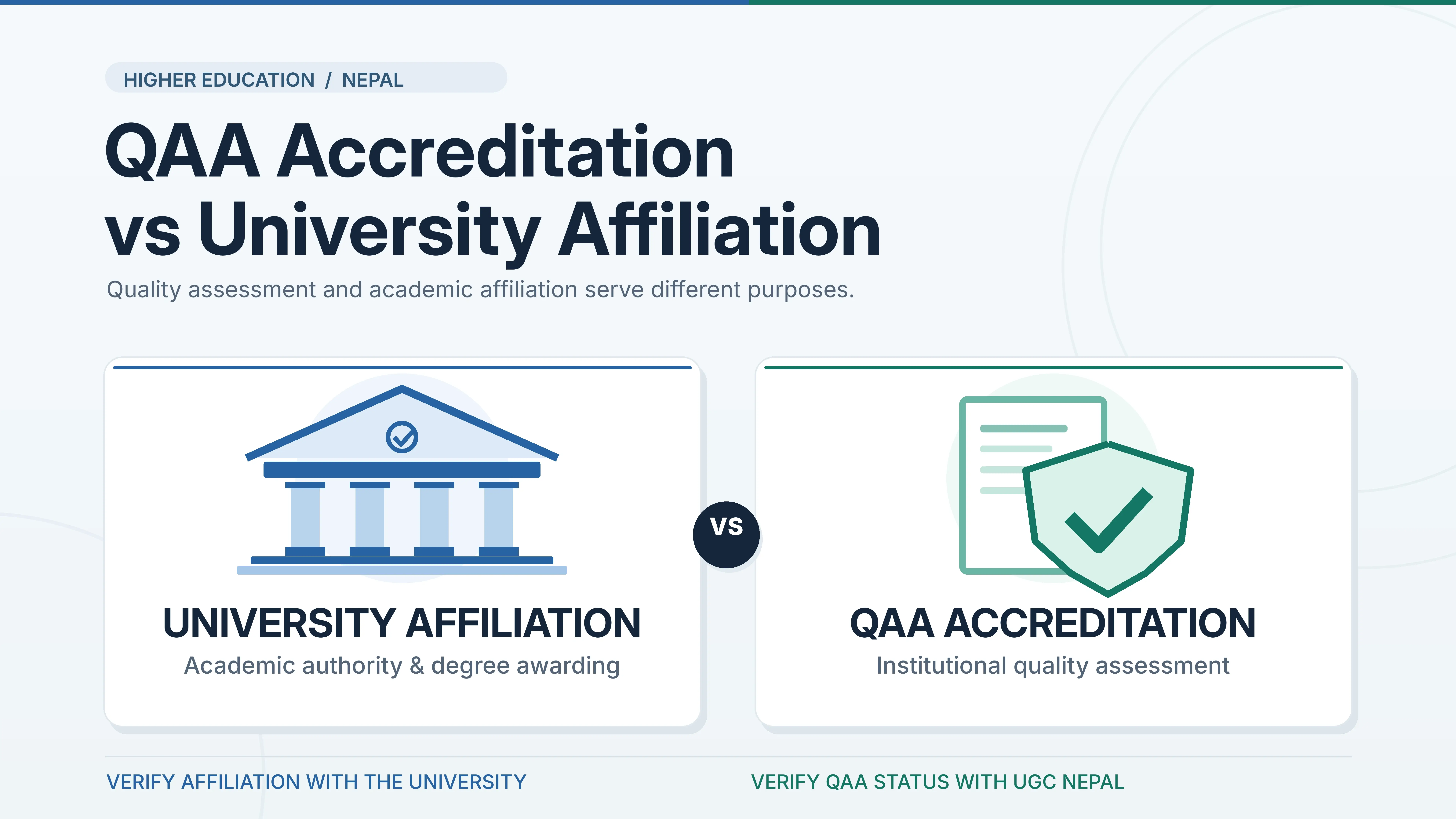
Check the institution's authorisation through the relevant government or education regulator in the destination country.
For commonly considered destinations, official registers include:
-
Australia: Commonwealth Register of Institutions and Courses for Overseas Students (CRICOS), which lists registered providers and courses for international students.
-
United Kingdom: Register of Licensed Student Sponsors, which identifies institutions licensed to sponsor students under the relevant immigration routes.
-
Canada: Designated Learning Institutions (DLI) List, which identifies institutions designated to host international students.
These systems answer destination-specific questions.
For example, Canada's DLI status does not mean every programme is eligible for a post-graduation work permit. Immigration, Refugees and Citizenship Canada instructs students to check programme eligibility and other applicable conditions separately.
Confirm the Consultancy's Claimed University Partnership
An overseas university may be authorised to teach international students without having appointed the Nepal consultancy that advertises it.
If the consultancy claims to be an official representative, contact the foreign institution through independently obtained official contact details.
Provide the consultancy's registered business name and ask whether the claimed relationship is current.
A university logo, promotional brochure or agency certificate should not replace independent confirmation where the relationship matters to your decision.
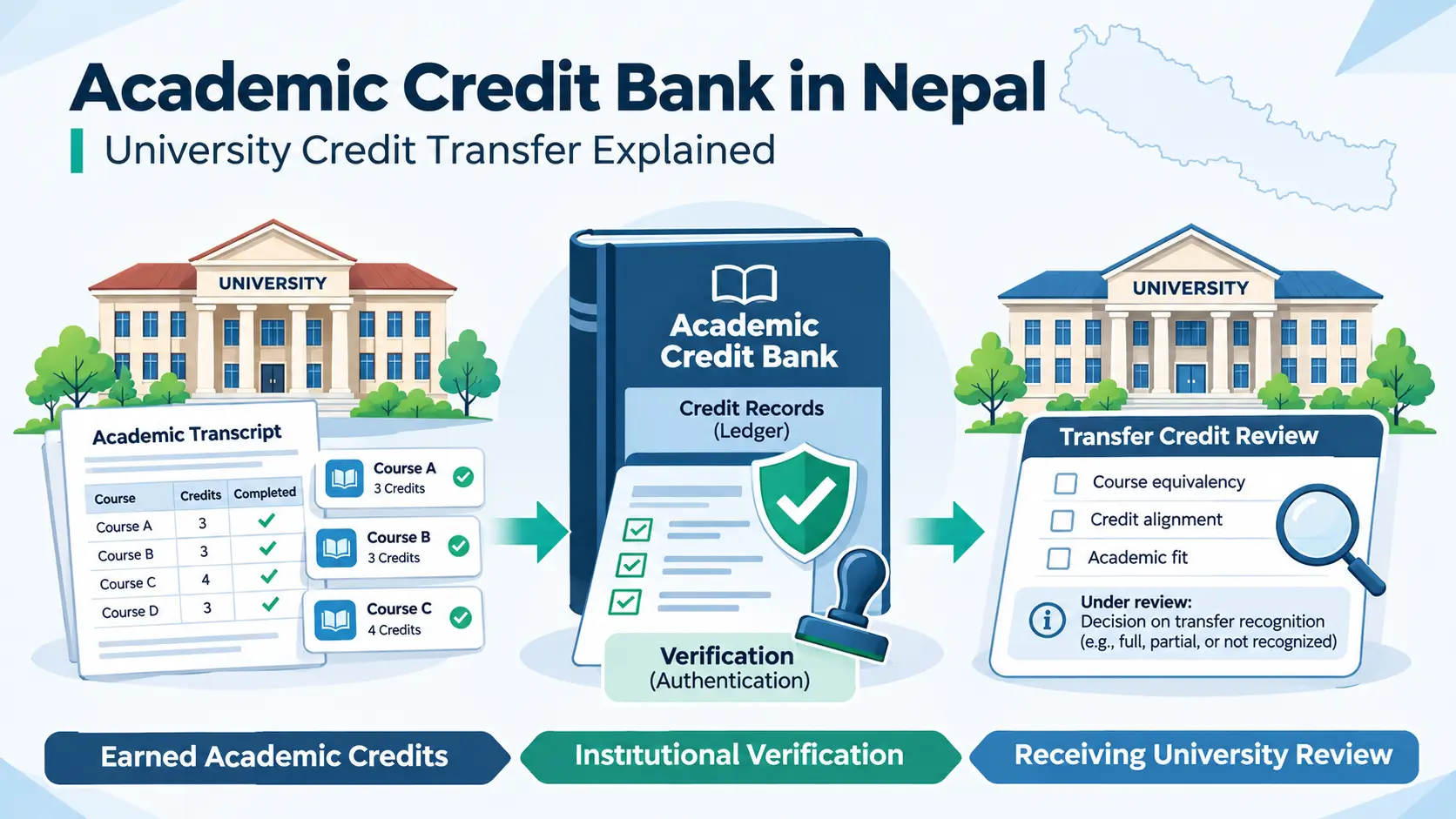
Similarly, university registration does not guarantee admission, visa approval, employment or future professional recognition.
These decisions depend on separate requirements and responsible authorities.
Step 7: Examine the Written Agreement Before Paying
The agreement is one of the most important documents in the consultancy verification process because it defines the service being promised and the financial commitments involved.
Rule 20 of the 2083 Regulations requires an educational counselling institution to enter into a written agreement with the service recipient before beginning the service.
The regulation specifies information concerning counselling charges, the foreign institution's status, admission conditions, study level and duration, available facilities, study costs, payment arrangements and refunds.
Check What the Consultancy Has Agreed to Provide
Read the agreement carefully and establish the scope of the consultancy's responsibility.
It should be clear which institution and programme are being considered and which application-related services the consultancy will perform.
Review the information concerning academic fees, any scholarship or facility claims, and the conditions that apply to admission.
Pay particular attention to whether the agreement distinguishes the consultancy's own service fee from charges payable to foreign institutions or other third parties.
Where services or charges are unclear, request written clarification before signing.
For students who are minors, a parent or guardian should review the agreement and proposed payments with them.
Understand the Payment and Refund Terms
Rule 12 addresses disclosure of service charges, billing and bank-based payment arrangements.
The regulation requires the consultancy to issue appropriate billing documentation for its service charges and arrange for payments received from service recipients to be deposited through bank accounts rather than collected in cash.
It also addresses payment of foreign educational institution charges through banks after the student receives the relevant No Objection Certificate.
Before making a payment, check the recipient's identity against the agreement and request suitable payment documentation.
Keep receipts, invoices and transaction records.
Refund terms deserve separate attention. Rule 20 requires the written agreement to address refunds, while Rule 21 provides for responsibility and compensation in specified circumstances.
These provisions do not establish an automatic full refund whenever admission or visa approval does not occur.
The applicable agreement, circumstances and legal requirements determine what may be owed.
Keep Copies of Your Application Documents
Rule 12 requires educational counselling institutions to provide students with copies of documents submitted on their behalf to foreign universities.
The same rule addresses obtaining certified copies of necessary documents from service recipients.
Review application materials before authorising submission, particularly academic records, financial information and declarations.
Retain copies of the submitted forms, supporting documents and institutional correspondence.
Maintain control of personal application accounts and credentials. If the consultancy manages correspondence, establish how you will receive official updates and access your application records.
These precautions help identify mistakes and provide a record if disagreements arise later.
Warning Signs That Deserve Further Checking
Some practices create reasons to pause a consultancy arrangement, although none automatically proves fraud or unlawful operation.
Concern is warranted when a business refuses to identify its legal entity, cannot explain conflicting registration details or supplies a permission document unrelated to the office or service being offered.
Other concerns include an unexplained personal payment account, a demand for cash, the absence of written fee or refund terms, and a refusal to provide copies of submitted application documents.
Promises of guaranteed admission or visa approval are also misleading. Those decisions rest with the foreign institution and relevant immigration authorities, not the consultant.
A claimed overseas university partnership that cannot be confirmed independently is another unresolved issue.
The appropriate response is to request evidence and avoid additional commitments while material questions remain unanswered.
An attractive office, favourable reviews, association membership or advertising history should not be treated as a substitute for official verification.
What Should You Do If the Records Do Not Match?
Not every verification attempt produces a clear yes-or-no answer.
A useful approach is to distinguish three outcomes.
Records Match, but Further Checks Remain
When the Ministry information, business registration and tax identity appear consistent, the available evidence supports those specific checks.
You should still examine branch permission, the agreement, the proposed foreign institution and any claimed agent relationship.
A matching record does not establish the consultancy's future conduct.
Verification Is Inconclusive
An absent search result, an older certificate, a changed company name or unclear branch information requires clarification.
Ask the business for supporting records. If the explanation cannot be independently confirmed, pause payments and signing until the relevant authority provides sufficient information.
For permission, renewal or regulatory questions, use the Ministry of Education and Sports' official feedback page or contact information.
Describe the discrepancy accurately and provide the relevant business identifiers.
There Is a Material Discrepancy or Suspected Deception
Where the documents are inconsistent or suspected wrongdoing involves money or personal information, preserve the available evidence.
Relevant material may include the agreement, receipts, transaction records, correspondence, advertised claims and official responses.
Report regulatory concerns through the appropriate Ministry channel.
For suspected electronic or online financial fraud, the Nepal Police Cyber Bureau's reporting page provides an official reporting route and describes the evidence required.
An ordinary disagreement about service quality or a refund is not automatically a cybercrime. Different circumstances may require different regulatory, consumer or legal responses.
This article provides general information, not individual legal or financial advice.
Education Consultancy Verification Checklist
Before committing to a consultancy, check the following:
If an important item remains unresolved, seek clarification before proceeding.
Conclusion
Verifying an education consultancy in Nepal requires checking more than its registration certificate.
The Ministry's records address counselling permission and renewal. OCR and IRD records help establish the legal and tax identity of the business. Separate checks are needed for branches, counsellor qualifications, foreign institutions, agreements and payments.
The most useful distinction is between what has been confirmed, what remains uncertain and what requires an official response.
A current record is evidence, not a promise of service quality. An unsuccessful search is a reason to investigate, not an automatic finding of misconduct.
Before paying or signing, establish which business is responsible, what it is authorised to provide, which foreign institution is involved and what both parties have agreed to in writing.
Source review date: 8 November 2026.
Verification scope: The official regulations and public verification portals were examined. No individual consultancy's permission, renewal result, branch authorisation or foreign agency appointment was established through a named-entity verification. Readers should check the current records for the specific business and office before making a commitment.



Comments 0
No comments yet. Be the first to start the conversation.