



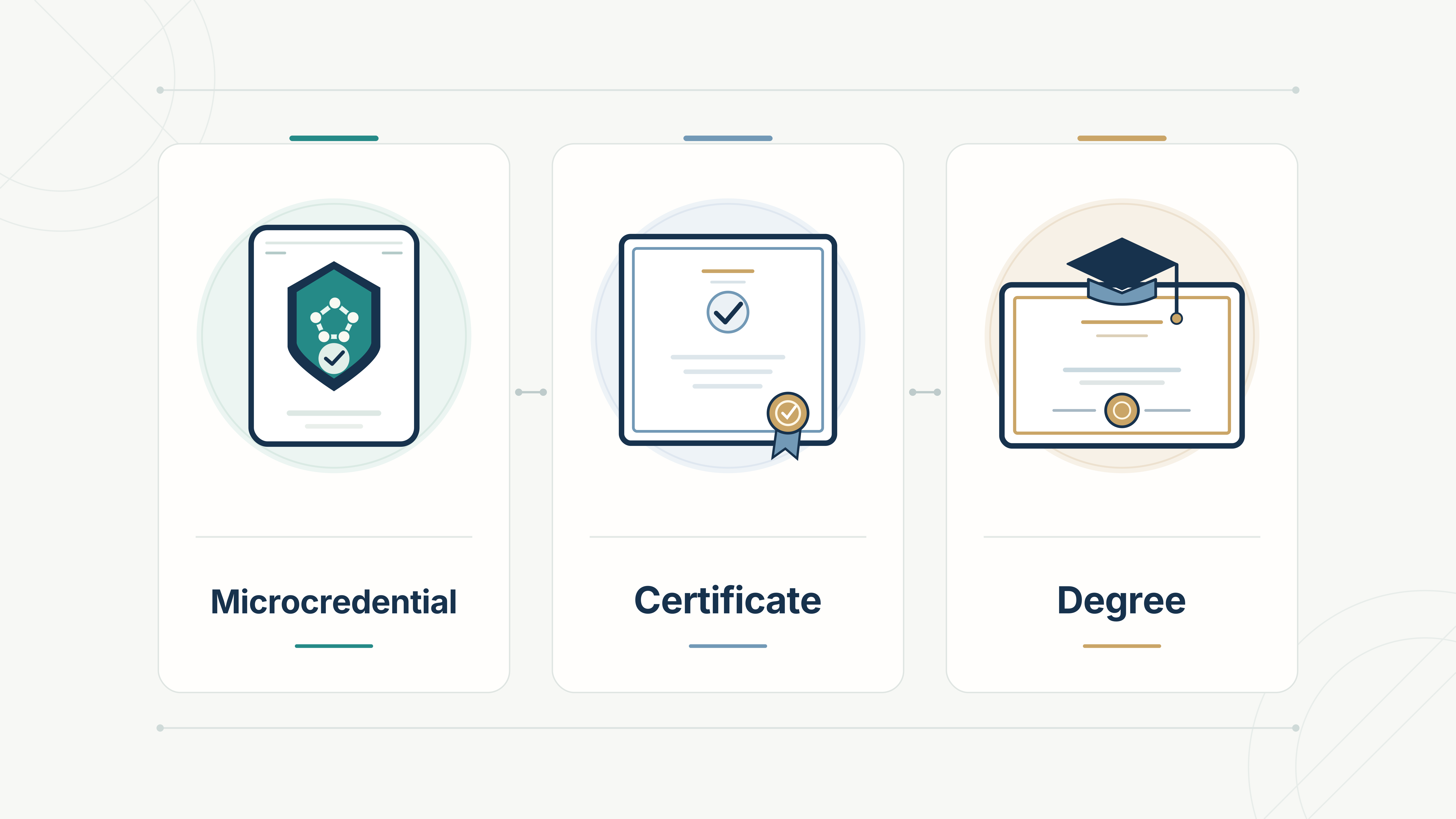
A microcredential, a certificate, and a degree can all document learning, but they do not represent the same educational achievement.
A microcredential usually records assessed learning in a focused area. A certificate may confirm anything from completing a short course to earning a formal academic award. A degree is a recognized higher-education qualification built around a defined program of study.
The difficulty is that these labels are not used consistently across countries or institutions. Two certificates with similar names may have different academic levels, assessment requirements, and recognition. Even a university-issued microcredential may not carry credit toward a degree.
For students, working professionals, and career changers, the useful question is therefore not which credential sounds more impressive. It is what the credential proves and whether it meets the requirements of the next step.
Answer Summary: Microcredentials generally suit focused learning, certificates can provide specialized training or formal academic recognition, and degrees offer broader qualifications within an established education system. Their practical value depends on the awarding institution, learning outcomes, assessment, academic level, credit status, and acceptance by employers, universities, or professional regulators. Before enrolling, check whether the exact credential meets your intended purpose rather than relying on its name.
Key Takeaways:
-
A microcredential normally documents a specific, assessed learning achievement.
-
A certificate may be credit-bearing, noncredit, or evidence of course completion.
-
A degree is a formal qualification, but its level and recognition depend on the education system.
-
Academic level, volume of learning, and credit transfer are different considerations.
-
A digital badge verifies information about an achievement; it does not establish its academic status.
-
A credential's value depends on whether the relevant institution, employer, or regulator accepts it.
What Do Microcredentials, Certificates, and Degrees Mean?
The three terms describe different approaches to documenting education and training. Their boundaries can overlap, especially when institutions offer short programs alongside traditional qualifications.
Microcredentials: Focused and Assessed Learning
A microcredential records achievement in a particular area of knowledge or skill.
UNESCO's International Institute for Educational Planning describes microcredentials as records of focused learning achievements assessed against defined standards. They can have independent value or contribute to other qualifications, subject to appropriate recognition arrangements.
A microcredential may relate to a particular technical skill, professional practice, or specialized area of study. Its scope is generally narrower than a full degree, but its academic level can vary.
The word micro refers to the amount or scope of learning rather than necessarily indicating an introductory level.
A credible offering should explain:
-
What the learner is expected to know or demonstrate.
-
How achievement will be assessed.
-
Who awards the credential.
-
Whether an academic level or credit value applies.
-
How the achievement can be verified.
A short online course is not automatically a microcredential in the standards-based sense. If it provides only participation evidence without assessing learning outcomes, the distinction matters.
The European Union's 2022 recommendation offers a model for describing microcredentials consistently, although its approach does not govern providers worldwide.
Certificates: A Broad Category With Different Meanings
A certificate can be an educational award, a record of completing training, or confirmation of participation.
The term covers several possibilities:
-
A course-completion certificate documenting attendance or completion.
-
A noncredit training certificate demonstrating study in a particular subject.
-
A credit-bearing academic certificate with formally assessed coursework.
-
A certificate awarded within a recognized vocational or qualifications system.
These differences affect how the certificate may be used.
For example, the Universities of Wisconsin distinguish credit-bearing certificates and microcredentials that appear on academic transcripts from noncredit offerings. The transcript establishes an academic record at the issuing institution; it does not require another institution to accept that credit.
The distinction between a certificate and a degree therefore involves more than comparing their duration or course content.
A certificate might provide useful, focused preparation. It might also be part of a formal academic progression route. Its title alone does not establish which.
Degrees: Formal Higher-Education Qualifications
A degree is a formal qualification awarded by an institution authorized to grant that type of academic award.
Degrees are generally built around a structured program that develops knowledge and abilities across a field. Depending on the qualification, study may include foundational subjects, specialization, practical work, research, or advanced professional preparation.
Common degree categories include bachelor's, master's, and doctoral qualifications. Some education systems also award associate or other degree types.
A degree normally represents a larger integrated program than an individual microcredential, but study requirements and qualification levels vary internationally.
Degrees can provide access to further education or satisfy formal entry requirements for certain occupations. However, holding a degree does not necessarily establish professional authorization to practise.
Certificates, Certifications, Licenses, and Badges Are Different
Similar terminology can conceal important differences.
A certificate usually documents an educational activity or award.
A professional certification generally confirms that an individual has met requirements set by a certifying body. Those requirements may involve an examination, demonstrated experience, or periodic renewal. A training certificate is not automatically equivalent to professional certification.
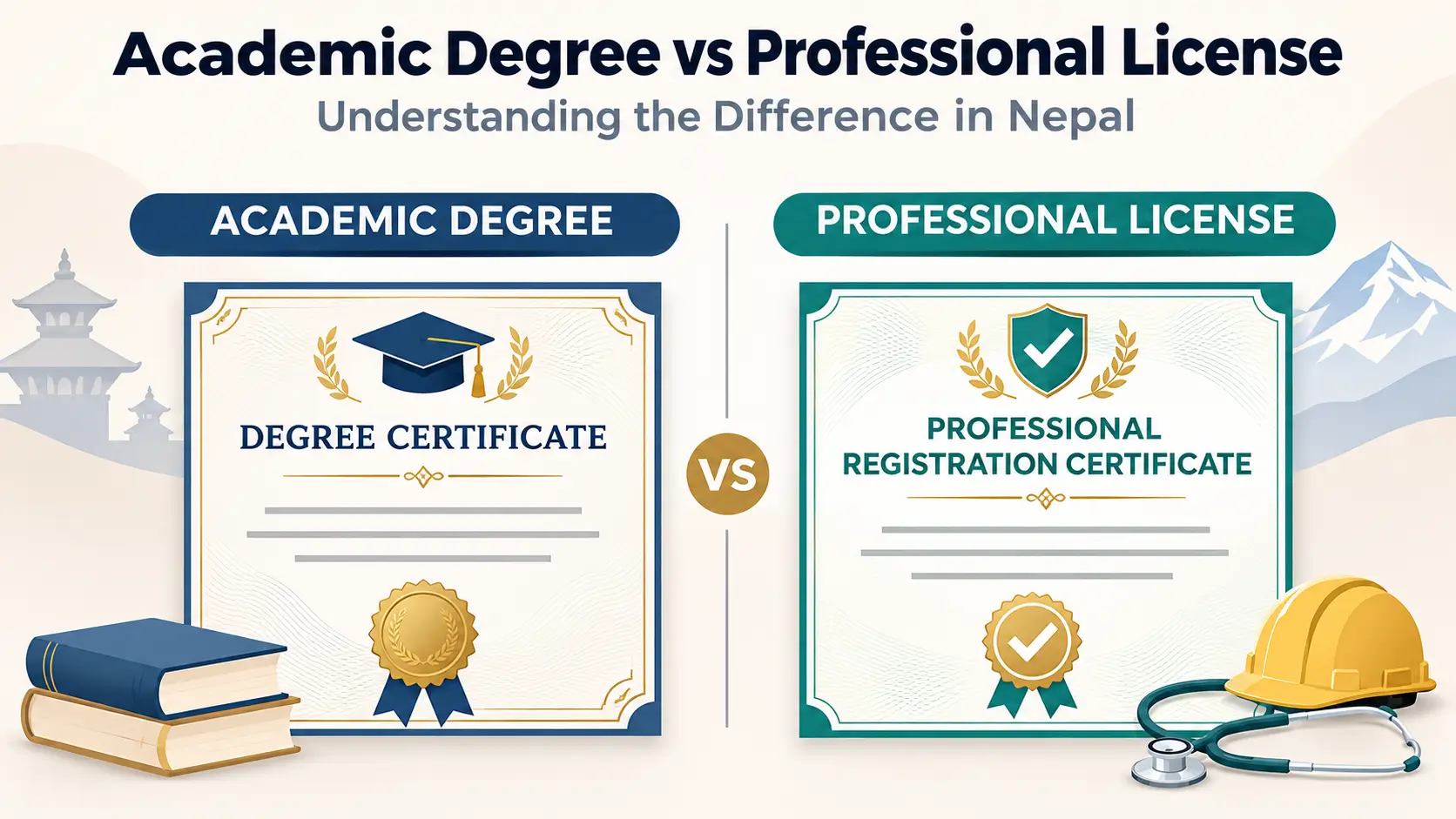
A professional license or registration concerns legal permission to practise in a regulated occupation. Applicable rules are established by the relevant authority.
A digital badge is a way to represent and share information about an achievement. Under the 1EdTech Open Badges standard, that information can include the issuer, recipient, achievement criteria, and supporting evidence.
The badge is the record or representation. It does not independently establish that the underlying achievement carries academic credit, professional recognition, or legal standing.
Microcredential vs Certificate vs Degree: Key Differences
The following comparison describes common patterns, not universal rules.
|
Criterion |
How the credentials typically differ |
What to verify |
|---|---|---|
|
Learning scope |
Microcredentials focus on specific outcomes; certificates vary from individual courses to structured programs; degrees usually cover broader study. |
Curriculum and stated learning outcomes |
|
Assessment |
Standards-aligned microcredentials require assessment; certificates may assess learning or record completion; degrees include formal academic assessment. |
Assessment method and passing requirements |
|
Academic level |
Any of the three may involve learning at different levels, depending on the system. |
Official qualification level, if assigned |
|
Academic credit |
Microcredentials and certificates may be credit-bearing or noncredit; degrees follow formal award requirements. |
Credit type, value, and transcript status |
|
Recognition |
Acceptance varies by employer, institution, profession, and country. |
Requirements of the intended recipient |
|
Progression |
Some shorter credentials contribute to larger awards; others remain standalone. |
Published pathways and transfer conditions |
|
Time and resources |
Focused offerings often involve less study than degrees, but there is no global duration rule for each label. |
Actual workload, fees, schedule, and prerequisites |
Learning Volume Is Not the Same as Academic Level
A shorter credential is not necessarily less advanced.
The United Kingdom government's qualification-level guidance for England, Wales, and Northern Ireland lists different kinds of certificates at several levels. Its examples include postgraduate certificates at Level 7, where master's degrees are also listed.
This does not make a postgraduate certificate equivalent to a master's degree. Awards at the same level can differ substantially in study volume, requirements, and qualification status.
An academic level describes the complexity or standard of learning. Workload or credit describes a different aspect of study. Award type identifies the qualification granted.
Readers comparing international awards should examine all three instead of treating the name as proof of equivalence.
For more context, see how qualification levels differ across education systems.
Recognition Matters More Than the Credential's Name
A credential can be genuine and academically meaningful without being accepted for every purpose.
Recognition is a decision made in context. An employer may consider a short credential relevant evidence of skill while a university declines to award transfer credit for it. A professional regulator may require a particular qualification regardless of the applicant's additional training.
Will Employers Recognize a Microcredential or Certificate?
Employer recognition depends on the occupation, the employer's requirements, and the evidence behind the credential.
The Organisation for Economic Co-operation and Development (OECD), in its October 2026 International Review of Micro-Credential Systems, identifies fragmented arrangements and difficulties in understanding and recognizing microcredentials. The report emphasizes clear definitions, trusted quality arrangements, and connections to labor-market needs.
That research does not establish that employers generally prefer microcredentials over degrees or that a particular certificate reliably improves earnings.
For a specific job, a useful credential should communicate more than its title. It should make clear what the learner studied, what was assessed, and how the achievement relates to the role.
A practical assignment or project may provide additional evidence of capability where appropriate. It does not replace a compulsory qualification.
The decisive test is the employer's actual requirement, not a broad claim about changing hiring practices.
Do Microcredentials Count Toward a Degree?
Some do. Others carry no academic credit, and credits from one institution are not necessarily accepted by another.
Three concepts need to be separated:
-
Credit-bearing means an educational institution assigns recognized academic credit to the learning.
-
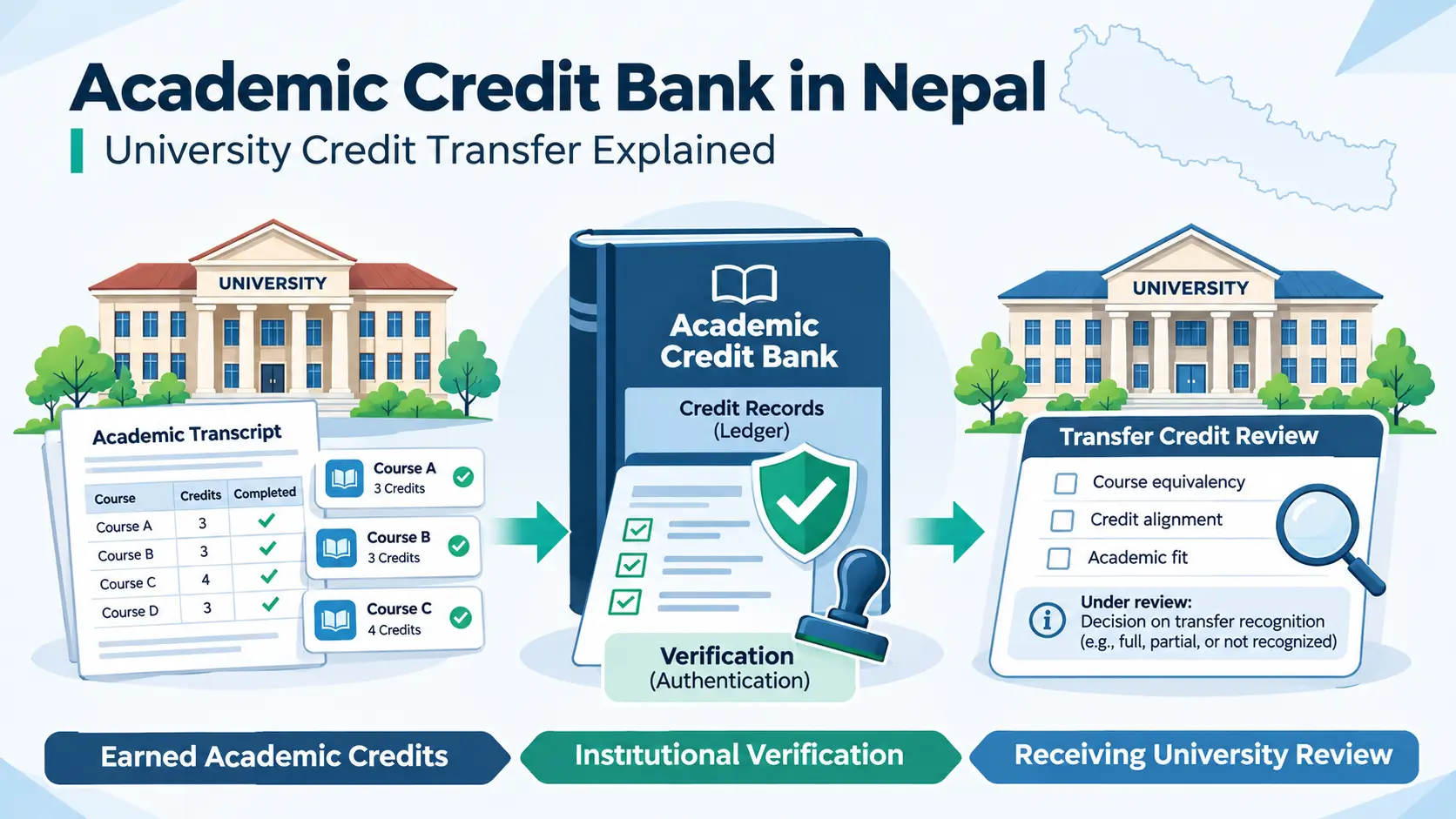
Credit transfer means another institution accepts some or all of that credit toward its requirements.
-
Stackability means different learning achievements may be combined or built upon, where appropriate.
The EU Council's 2022 recommendation makes clear that stacking microcredentials does not automatically entitle a learner to a qualification or degree. Decisions remain with the receiving organization and the relevant awarding authorities.
Institutional practice illustrates the distinction.
Charles Sturt University in Australia identifies different categories of short learning. Under its published approach, only its specified credit-bearing micro-subject category automatically carries award credit. Other assessed microcredentials may be considered separately, without guaranteed recognition.
The lesson is not that one system defines microcredentials everywhere. It is that a provider's published rules determine what its awards mean, while the receiving institution determines how they count toward another qualification.
Before depending on a pathway, confirm:
-
Whether the exact offering carries academic credit.
-
Which institution awards the credit.
-
Whether it appears on an official academic transcript.
-
Which named program will accept it.
-
What conditions apply to admission, grades, credit limits, or recognition of prior learning.
A published credit-transfer agreement or written institutional confirmation offers stronger evidence than a general statement that courses are stackable.
European Credit Transfer and Accumulation System credits, American academic credits, and other national credit systems should not be treated as automatically interchangeable.
Can a Short Credential Qualify Someone for a Regulated Profession?
Not unless it meets the rules established by the relevant regulator.
Some occupations require specified qualifications, examinations, registration, supervised experience, or combinations of these conditions. Requirements can differ between countries and regions.
The European Commission's guidance on regulated professions, for example, directs applicants to check the rules in the country where they intend to work.
Neither a microcredential nor a course certificate should be assumed to satisfy those requirements. A degree may be required but may also be insufficient without additional authorization.
If the intended occupation is regulated, identify the responsible professional authority before choosing a program. Its requirements take precedence over general course descriptions.
Which Credential Fits Your Learning or Career Goal?
The appropriate choice begins with the outcome you need rather than the type of award being advertised.
When You Need One Specific Skill
A focused microcredential or certificate may be suitable when you already have relevant educational or professional foundations and want to address a defined knowledge gap.
For example, a person whose work requires a particular software technique might compare short courses by their assessed learning outcomes and practical assignments.
In that situation, studying an unrelated broader curriculum may not be necessary to meet the immediate learning objective.
However, the short credential's usefulness still depends on the quality of instruction, assessment, and relevance to the task.
When You Need a Formal Qualification
A degree or formally recognized certificate may be necessary when the next step specifies a particular educational award.
This can apply to university admission, professional preparation, or jobs with explicit qualification requirements.
The distinction is particularly important for career changers.
A short course may help someone understand a new field and develop introductory abilities. It does not establish eligibility for a profession that requires a designated qualification.
Start by reading the requirements of the target occupation or study program. Then assess which educational pathway actually meets them.
When You Want to Study Further Later
If future degree study is a realistic possibility, credit status and transfer arrangements deserve particular attention.
A lower-commitment course may seem attractive initially. But if it cannot contribute to the intended qualification, the learner may have to repeat similar material later.
This does not make noncredit learning inherently less useful. Its value depends on the purpose.
Someone studying for personal development may have little need for transferable credit. Someone planning a defined academic progression route has a stronger reason to seek documented recognition before enrolling.
When You May Study or Work in Another Country
Cross-border recognition requires checking the destination country's education system and the institution or authority making the decision.
A credential can have a clear standing in its home country without having the same status abroad.
Applicants should retain the official award document, transcript where applicable, course outline, assessment information, and evidence of the awarding body's status.
Where formal evaluation is required, seek guidance from the competent authority or receiving institution rather than relying on informal comparisons of credential titles.
What to Verify Before Enrolling
The questions below help distinguish a credible learning opportunity from an unclear credential claim.
1. Who Actually Awards the Credential?
Identify the legal or institutional awarding body, not merely the website or platform advertising the course.
A platform may deliver teaching while a separate institution issues the award. Check which organization is responsible for academic standards and what authority it has to grant the stated qualification.
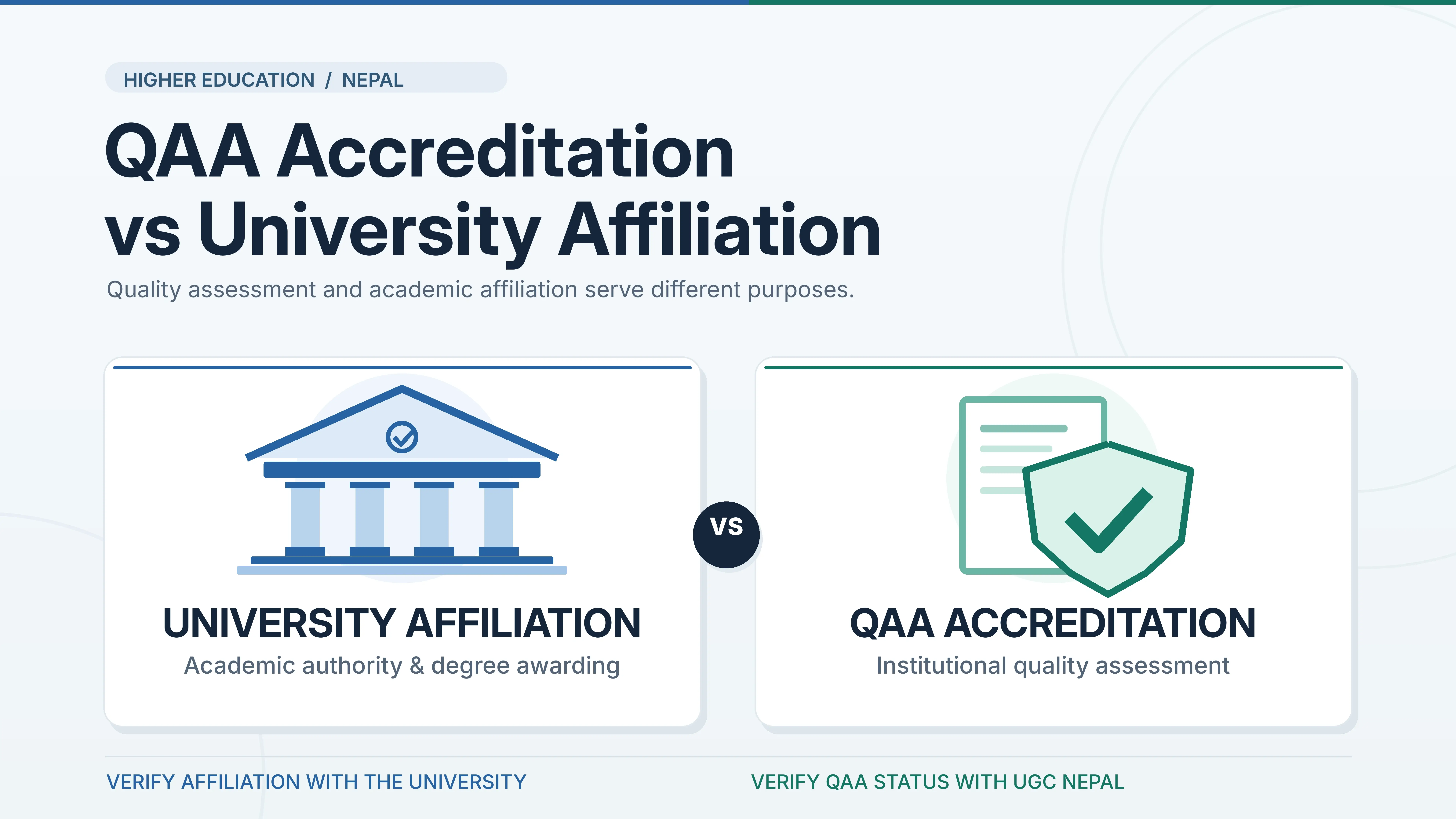
Where accreditation or external quality assurance applies, verify its scope. Institutional accreditation does not automatically establish that every short course is accredited or credit-bearing.
2. What Learning Will Be Assessed?
Look for documented learning outcomes and the assessment requirements.
A final examination, assessed project, practical demonstration, or evaluated coursework may support a claim of achievement. Attendance alone establishes something different.
The assessment should correspond to the skills or knowledge you want to gain.
3. What Is the Official Level and Credit Status?
Check whether the offering has an assigned academic level, recognized credit value, or formal qualification-framework listing.
If it is described as noncredit, do not infer that the learning will later convert into academic credit.
If it is credit-bearing, establish the credit system and the awarding institution.
4. Who Will Accept It?
Recognition should be checked with the organization whose decision matters.
For employment, examine the actual job requirements or ask the employer when clarification is available.
For further study, check with admissions, the academic department, or the registrar responsible for credit decisions.
For regulated practice, consult the competent professional authority.
The issuer's claim that an award is recognized is incomplete unless it identifies the recognizing body and the relevant purpose.
5. Is There a Documented Progression Route?
Some learning providers promote a sequence of microcredentials that may lead to a larger award.
Ask whether that sequence has a formally approved destination. Check any admission requirements, time limits, minimum grades, or limits on usable credit.
A possible future recognition process is different from a preapproved transfer arrangement.
6. Can the Achievement Be Verified?
Establish what the learner receives after successful completion.
It may be a transcript, formal award document, digital badge, or combination of records.
A verifiable digital badge can help another party inspect information about the achievement and issuer. Its technical authenticity does not, by itself, demonstrate that the institution is accredited or that the award meets academic or professional requirements.
7. What Is the Full Commitment?
Compare the actual requirements rather than assuming every short credential is convenient or inexpensive.
Relevant questions include the expected study workload, assessment deadlines, course access period, additional fees, prerequisites, and available academic support.
For working learners, flexibility depends on scheduling and assessment conditions, not simply whether teaching is online.
A shorter course may involve a smaller initial commitment, but that does not establish better value if it fails to meet the intended requirement.
A Useful Credit-Recognition Request
When credit transfer matters, a concise inquiry can prevent misunderstandings:
Does this exact credential award academic credit, and will that credit appear on an official transcript? Which institution awards it? Would it be accepted toward the specific program I intend to enter, and under what conditions? Is there a published policy or written confirmation I can consult?
Send the relevant questions to both the awarding provider and the institution that would receive the credit. Their responsibilities are different.
Common Mistakes When Comparing Credentials
Several misunderstandings can lead to unsuitable enrollment decisions.
-
Treating microcredentials, certificates, and degrees as a universal ranking from lowest to highest. Academic level and learning volume do not follow that simple order.
-
Assuming every certificate proves assessed competence. Some document participation or course completion.
-
Confusing a training certificate with an independently awarded professional certification.
-
Treating a digital badge as evidence of accreditation, academic credit, or legal authorization.
-
Assuming that stackable credentials automatically transfer into a degree.
-
Comparing national credit values without checking the relevant recognition rules.
-
Believing an online course must be noncredit, or that university branding guarantees transferability.
The recurring problem is relying on the label instead of the conditions attached to the actual award.
Conclusion
Microcredentials, certificates, and degrees serve different educational purposes, and their meanings can overlap.
For focused learning, the assessment and relevance of a short credential may matter most. For academic progression, formal credit and recognition become decisive. For regulated occupations, the requirements of the responsible authority must guide the choice.
Before committing time or money, identify the qualification or capability you need, examine what the program actually awards, and confirm acceptance with the organization whose decision matters.



Comments 0
No comments yet. Be the first to start the conversation.