



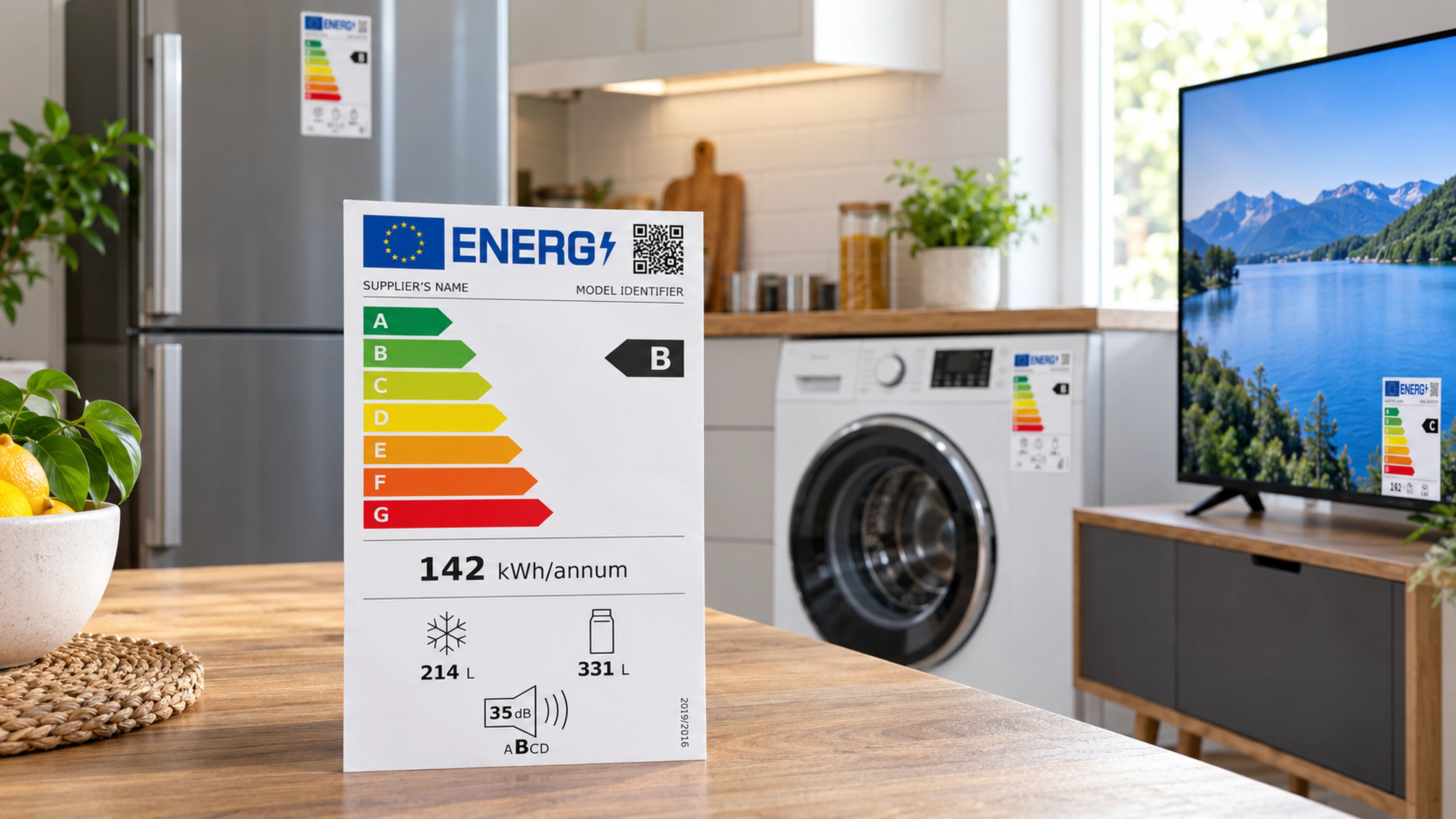
Energy efficiency labels help you understand how much energy household appliances use and how their performance compares with similar products. But choosing an appliance based on the highest star rating or a favorable letter grade can be misleading.
A five-star refrigerator may consume more electricity than a smaller three-star model. An A-rated washing machine in Europe cannot be compared directly with a five-star appliance in India. Even two products carrying the same efficiency grade can have different running costs.
The distinction matters because energy labels measure performance under standardized testing conditions, while household electricity consumption depends on appliance size, operating settings, frequency of use, and local electricity prices.
The labels also differ across countries. The European Union uses A–G grades for many appliance categories, India uses a one-to-five-star system, and Australia uses star ratings with annual energy consumption estimates. The United States and Canada have separate labeling systems.
Understanding what these markings represent helps you compare appliances more accurately, identify potentially misleading comparisons, and estimate electricity costs before purchasing.
Answer Summary: To read an appliance energy efficiency label, identify the applicable rating system, check its efficiency class or stars, and examine the electricity consumption figure in kilowatt-hours (kWh). Confirm whether consumption is measured annually, per 100 cycles, or per 1,000 operating hours. Compare models with similar capacities and functions using equivalent measurements. For estimated running costs, multiply expected electricity consumption by the applicable local tariff. Actual household consumption may differ from standardized test results.
Key Takeaways:
-
Energy efficiency and total electricity consumption are different measurements.
-
Higher ratings generally indicate greater efficiency within the same labeling system and comparable product category.
-
The kWh figure helps estimate electricity consumption under specified conditions.
-
European A–G ratings, Indian star ratings, and Australian ratings are not directly interchangeable.
-
Appliance capacity, operating frequency, and electricity tariffs affect running costs.
-
Official product records provide a way to verify energy-label information.
What Do Energy Efficiency Labels Mean?
An appliance energy efficiency label provides standardized information about a product's energy performance. Its main purpose is to support comparisons between products performing similar functions.
Depending on the appliance and country, the label may show an efficiency class, star rating, electricity consumption estimate, product capacity, operating noise, or water consumption.
Two concepts are essential to interpreting this information correctly.
Energy efficiency versus energy consumption
Energy efficiency describes how effectively an appliance performs its intended function relative to the energy it uses.
Energy consumption measures the amount of energy required during a specified period or activity.
These measurements are connected, but they are not identical.
Consider two refrigerators with different storage capacities. The larger refrigerator may receive a higher efficiency rating because it uses energy effectively relative to its size and characteristics.
However, the smaller refrigerator may still consume less electricity over a year.
This means a higher efficiency rating does not automatically indicate the lowest total electricity consumption.
The Australian Greenhouse and Energy Minimum Standards (GEMS) regulator advises consumers to compare appliances with similar sizes and features before using star ratings to evaluate their energy performance.
What information appears on an energy label?
Energy labels vary according to product category and national requirements.
Common information includes the appliance's efficiency rating, estimated electricity consumption, model identification, and technical specifications.
Some labels also include additional performance measurements.
For example, washing machine labels may show rated load capacity, water consumption, programme duration, and noise emissions.
Refrigerator labels may indicate storage capacity, while television labels can show display size and energy consumption under different viewing modes.
The European Commission explains that supplementary measurements help consumers evaluate appliance characteristics beyond electricity consumption.
An energy label should be treated as a product comparison tool rather than a complete assessment of the appliance.
It does not independently establish durability, repair costs, manufacturing quality, or suitability for a particular household.
How to Read an Appliance Energy Label
The most reliable approach is to examine the rating system, efficiency grade, electricity consumption figure, measurement conditions, and appliance specifications together.
1. Identify the country and rating system
Start by determining which country's labeling system applies to the appliance.
Different countries use different assessment methods, rating thresholds, and presentation formats.
A European A rating and an Indian five-star rating do not represent identical efficiency standards.
Even countries using similar star symbols may calculate ratings differently.
If you are purchasing an imported appliance, confirm whether its energy label applies to the market where it will be used.
2. Check the efficiency class or stars
The most visible part of an energy label is often its efficiency indicator.
European labels for rescaled product categories use letters from A to G, generally displayed alongside a green-to-red color scale.
India's Bureau of Energy Efficiency (BEE) uses ratings from one to five stars for registered products in applicable categories.
Australia's Energy Rating Label uses a star system that can extend to ten stars.
Within the same rating framework and comparable appliance category, a more favorable rating indicates better energy efficiency according to that system.
However, the rating alone does not tell you how many electricity units the appliance will consume.
3. Read the electricity consumption figure
Find the number followed by kWh, which stands for kilowatt-hour.
This represents a quantity of electricity consumed under specified conditions.
Check the measurement period carefully.
A label may express consumption as:
-
kWh per year.
-
kWh per 100 operating cycles.
-
kWh per 1,000 operating hours.
These figures cannot be compared directly without converting them to a common usage basis.
For example, 60 kWh per 100 washing cycles describes electricity consumption across a specified number of washes. It does not mean that the washing machine consumes 60 kWh annually.
4. Examine capacity and performance information
Capacity affects how much work an appliance can perform.
For refrigerators, this may be expressed in litres. Washing machines commonly use kilograms of dry laundry. Air conditioners have heating and cooling capacity ratings.
Two appliances with the same efficiency grade may have substantially different capacities.
Comparing their energy consumption without considering size and function can lead to an unsuitable purchase.
Additional measurements also deserve attention when relevant. A washing machine's water consumption, for instance, may matter alongside electricity use.
5. Check the conditions behind the measurement
Energy labels rely on standardized testing procedures rather than measurements from every household.
The stated consumption may reflect a designated programme, operating temperature, load pattern, or number of annual operating cycles.
These conditions affect how closely the published figures resemble expected household use.
Before comparing products, establish whether the measurements refer to similar operating conditions.
Understanding kWh, Watts, and Appliance Electricity Use
Kilowatt-hours measure energy consumption, while watts measure the rate at which energy is used.
Confusing these units is a common source of incorrect appliance comparisons.
What is a kilowatt-hour?
One kilowatt-hour represents the energy consumed by equipment operating at one kilowatt for one hour.
For example, a device drawing a constant 100 watts for ten hours consumes one kilowatt-hour.
The basic relationship is:
However, this formula assumes the device draws the stated power continuously.
Many household appliances vary their power consumption during operation.
Refrigerators switch their compressors on and off. Washing machines alternate between washing, heating, spinning, and other stages. Air conditioners adjust operation according to cooling or heating requirements.
For these appliances, standardized energy-consumption figures are generally more informative than multiplying the maximum rated wattage by operating hours.
What does kWh per year mean?
Annual kWh indicates estimated electricity consumption over one year under the applicable test assumptions.
It is commonly used for refrigerators and freezers.
Suppose a refrigerator label states 250 kWh/year.
This means its standardized estimated annual electricity consumption is 250 kWh.
The household's actual consumption may differ because of room temperature, operating settings, installation conditions, and usage.
What does kWh per 100 cycles mean?
This measurement represents the electricity consumed during 100 specified operating cycles.
For European washing machines, energy labels use the eco 40–60 programme as the basis for their energy-consumption figures.
According to the European Commission, these labels also include water consumption per cycle, programme duration, rated capacity, spin-drying performance, and noise information.
If a washing machine displays 60 kWh per 100 cycles, its standardized average consumption is:
That average relates to the specified test procedure. Other washing programmes and load conditions can produce different consumption levels.
What does kWh per 1,000 hours mean?
This measurement describes electricity consumption over 1,000 hours of operation.
It appears on European energy labels for electronic displays, including televisions.
For example, a television labeled 70 kWh per 1,000 hours has a standardized average power consumption equivalent to 70 watts under the specified test conditions.
European television labels distinguish Standard Dynamic Range (SDR) and High Dynamic Range (HDR) operation.
These modes can have different energy requirements.
The European Commission explains that electronic display labels include information about energy consumption in these modes, alongside display dimensions and resolution.
When comparing televisions, check which mode the consumption figure represents.
Energy Efficiency Rating Systems Around the World
Countries use different energy-labeling frameworks to assess and communicate appliance performance.
Understanding these differences is particularly important when comparing imported appliances or researching models sold in multiple markets.
|
Country or region |
Labeling system |
Main information |
|---|---|---|
|
European Union |
Energy label, commonly A–G for rescaled categories |
Efficiency class, energy consumption, product-specific characteristics |
|
United States |
EnergyGuide |
Estimated annual energy use or operating costs and comparison information |
|
United States |
ENERGY STAR |
Certification against applicable energy efficiency requirements |
|
Canada |
EnerGuide |
Annual energy consumption and comparison with similar appliances |
|
India |
BEE Star Rating |
One to five stars and product-specific energy information |
|
Australia |
Energy Rating Label |
Up to ten stars and estimated annual energy consumption |
European Union: Understanding A–G energy ratings
The European Union introduced revised A–G energy labels for several appliance categories beginning in March 2021.
For product groups using this scale:
-
A represents the highest efficiency class.
-
G represents the lowest efficiency class.
-
Colors help distinguish efficiency levels.
-
Electricity consumption is displayed separately from the efficiency class.
The labels also include information relevant to individual appliance categories.
For example, a washing machine label may display water consumption, rated capacity, programme duration, and noise emissions.
The European Commission provides official explanations through its Understanding the Energy Label resource.
Why did older A+++ ratings change?
Earlier European labels commonly used categories such as A+, A++, and A+++.
As appliance efficiency improved, these additional classifications became widespread across certain product groups.
The European Union began replacing them with revised A–G classifications to improve differentiation between products.
An appliance previously classified as A+++ may receive a lower-looking letter under the revised scale even though its physical performance has not changed.
This happens because the classification boundaries changed, and some product categories also received revised assessment methods.
There is no universal conversion between the old and revised ratings.
The transition has taken place at different times for different product categories. Some products may therefore be encountered with different generations of labeling.
When comparing European appliances, confirm that both ratings belong to the same applicable system.
United States: EnergyGuide and ENERGY STAR
The United States uses two prominent labeling programmes with different purposes.
EnergyGuide provides comparative energy information, while ENERGY STAR identifies products certified to meet specified efficiency requirements.
What is the EnergyGuide label?
EnergyGuide is the familiar yellow label regulated by the Federal Trade Commission (FTC).
For covered products, it provides information such as estimated annual operating costs, energy consumption, or efficiency ratings, depending on the appliance category.
It may also show a range that allows consumers to compare the model with similar products.
The estimates are based on standardized testing and specified assumptions.
A household's electricity tariff may differ from the price assumptions used on the label, so the displayed cost is not a guaranteed prediction of its annual bill.
The FTC explains the requirements in its Energy Labeling Rule
What does ENERGY STAR certification mean?
ENERGY STAR is a voluntary energy efficiency certification programme.
Products carrying the ENERGY STAR symbol must meet the relevant programme specifications and certification requirements.
Unlike a comparative energy label showing how much electricity a product is expected to consume, ENERGY STAR communicates that the product satisfies particular efficiency criteria.
A product may display both EnergyGuide information and ENERGY STAR certification.
The ENERGY STAR programme confirms that qualifying products undergo independent certification against its requirements.
Neither label independently guarantees the lowest purchase price, minimum lifetime cost, or longer appliance durability.
Canada: How the EnerGuide label works
Canada uses the EnerGuide system to communicate appliance energy performance.
For major household appliances, the label generally includes annual electricity consumption in kWh and a scale comparing the model with similar products.
The comparison considers the relevant appliance category and capacity.
On the appliance consumption scale, a lower kWh value indicates less electricity consumption under standardized conditions.
EnerGuide labels may also include the ENERGY STAR symbol for certified models.
Natural Resources Canada emphasizes comparing products with similar characteristics rather than treating energy consumption figures from unrelated appliance categories as equivalent.
India: Understanding BEE star ratings
India's Bureau of Energy Efficiency administers a Standards and Labelling programme covering specified appliances and equipment.
Registered products under the star-rating framework receive ratings from one to five stars.
Five stars indicate the highest energy efficiency classification within the applicable product assessment system.
However, a five-star label does not mean that every appliance with five stars consumes the same amount of electricity.
A refrigerator and an air conditioner are evaluated according to different requirements because they perform different functions.
Ratings may also change when the relevant standards or assessment periods are revised.
Consumers should examine the energy consumption details, product specifications, and applicable label period when comparing older and newer models.
The BEE explains the programme through its official Star Labelled Appliances guidance.
Australia: What Energy Rating stars represent
Australia's Energy Rating Label uses stars to show appliance energy efficiency.
The rating framework can extend to ten stars, with higher ratings indicating better efficiency among appropriately comparable products.
The label also provides estimated annual electricity consumption in kWh.
This figure is based on standardized tests and specified operating assumptions.
Australia's GEMS regulator notes that appliances with matching star ratings can have different operating costs when their sizes or features differ.
The regulator also explains that rating calculations can change as product standards are updated.
For accurate comparisons, consumers should consider similar appliances and check the energy consumption figures rather than relying exclusively on stars.
Official guidance is available through Understand the Energy Rating Label.
How to Compare Appliances Using Energy Labels
The most useful comparison starts with appliances that meet the same household requirements.
Efficiency ratings become meaningful when products have reasonably similar capacities, functions, and test conditions.
Compare similar appliance capacities
Consider two refrigerators.
One provides substantially more storage space than the other.
Even if the larger model has a favorable efficiency rating, it may consume more electricity annually because it serves a different capacity requirement.
For a meaningful comparison, first determine the required storage volume and essential features.
Then compare models within that category using their electricity consumption figures.
The same principle applies to washing machines, televisions, and air conditioners.
An appliance with excess capacity may not offer a practical advantage if that additional capacity is unnecessary.
Conversely, selecting an undersized appliance solely because it has lower annual consumption may create operational limitations.
Consider operating conditions
Energy consumption depends partly on how an appliance is used.
For washing machines, the selected programme and load can change electricity and water use.
For air conditioners, climate and operating settings affect consumption.
For televisions, operating hours and picture settings matter.
A comparison based on standardized test figures remains useful, but the expected operating conditions should resemble the intended household use where possible.
Compare energy consumption, not ratings alone
When two appliances provide similar functions and capacity, the lower standardized kWh figure generally indicates lower electricity consumption under those conditions.
However, check that both figures are expressed on the same basis.
A figure measured annually cannot be compared directly with one measured per 100 operating cycles.
Different national testing standards may also prevent direct comparison between otherwise similar models.
How to Calculate Appliance Electricity Running Costs
Electricity running costs can be estimated by combining appliance energy consumption with the local electricity tariff.
This allows a comparison between purchase price and expected operating expenses.
Calculating annual energy use
For an appliance labeled in kWh per 100 cycles:
Consider a hypothetical washing machine rated at 60 kWh per 100 cycles.
If the household expects to use the machine 200 times annually:
The resulting estimate is 120 kWh annually under the label's consumption assumptions.
Actual consumption may differ with programme selection, load size, and operating conditions.
For appliances labeled in kWh per 1,000 hours:
For an appliance already labeled in kWh/year, the published figure can serve as an initial annual estimate.
Converting electricity consumption into cost
The basic calculation is:
Suppose an appliance is expected to consume 120 kWh per year and the relevant electricity tariff is 0.20 currency units per kWh.
Its estimated annual electricity cost would be:
This is an illustrative calculation, not a published appliance performance result or actual electricity tariff.
The same method can be applied using the household's local currency and electricity rate.
The Australian GEMS regulator recommends this general calculation for estimating annual appliance running costs.
Where electricity tariffs vary by usage band, time of day, or season, a more detailed calculation may be necessary.
Fixed utility charges and other expenses should be considered separately.
Comparing purchase price with running costs
A more efficient appliance can have a higher initial purchase price.
Whether that additional expense is financially worthwhile depends on its expected electricity savings and the intended ownership period.
A basic ownership-cost comparison is:
Maintenance, repairs, and other relevant expenses may need to be added.
For appliances used frequently, energy consumption may represent a meaningful part of ownership costs.
For equipment used infrequently, the difference in electricity costs may be relatively small compared with the purchase-price difference.
The relevant question is not simply which appliance has the highest efficiency rating, but how its energy performance fits the household's actual requirements.
What Energy Efficiency Labels Cannot Tell You
Energy labels support standardized comparisons, but they cannot fully predict an appliance's performance in an individual home.
Several limitations deserve attention.
Actual consumption may differ from the label
Standardized tests use specified conditions to make comparisons consistent.
Household conditions vary.
A refrigerator installed in a warm location may consume a different amount of electricity from the standardized estimate.
Similarly, a washing machine used mainly on programmes other than the label's test programme may consume more or less electricity than expected.
Australia's GEMS regulator explicitly notes that household consumption may differ from published label estimates because of appliance settings and usage patterns.
Energy labels do not measure every product characteristic
A favorable efficiency grade does not establish that an appliance is more durable or economical to repair.
Energy labels generally focus on defined performance measurements rather than every aspect of ownership.
For some products, the label includes noise or water consumption information, but it does not provide a complete assessment of long-term reliability.
Consumers may need separate information about warranties, repair availability, maintenance requirements, installation conditions, and product suitability.
Older and newer ratings may not be comparable
Energy labeling systems evolve as regulations and testing methods change.
An appliance receiving a favorable rating under an older standard may receive a different classification under a revised system.
This does not necessarily indicate a change in its physical performance.
For comparisons across different label generations, use compatible energy measurements and verify the applicable testing rules.
Ratings cannot be compared directly across countries
Similar symbols do not establish equivalent efficiency performance internationally.
Star systems used by different countries can have different rating thresholds and calculation methods.
Products sold in multiple markets may also have different specifications or test results.
If internationally comparable energy-consumption data is unavailable, avoid concluding that one model is more efficient based solely on its national rating.
How to Verify an Appliance's Energy Rating
An energy label should match the exact appliance model and the market in which it is sold.
The model number is the starting point for verification.
Check the exact product model
Identify the manufacturer and full model identifier.
Models with similar names may differ in capacity, features, or energy performance.
Compare the identifier on the appliance or product documentation with the identifier attached to the energy-label record.
Use official product information
Where available, national energy-label databases and official product records provide a way to examine registered energy information.
For European appliances, the European Product Registry for Energy Labelling (EPREL) provides access to registered model details and product information sheets.
Newer EU labels for relevant product groups include QR codes linking to these records.
The European Commission advises ensuring that QR codes lead to the official database and correspond to the appliance being examined.
A product information sheet may contain additional details not displayed on the main label.
For other markets, consult the relevant national energy-efficiency authority, official product registration service, or verified manufacturer documentation.
What if the energy label is missing?
If an appliance does not display an energy label, first check whether the relevant product category requires one in that country.
For products subject to mandatory labeling, request the correct label or product documentation from the retailer.
When researching an older or second-hand appliance, look for the model's original technical information.
Do not assign an energy rating based on another appliance from the same brand or product range.
If the relevant energy information cannot be verified, the uncertainty should be considered before making a purchasing comparison.
Conclusion
Energy efficiency labels are most useful when their ratings and electricity consumption figures are interpreted together.
The efficiency grade or stars indicate performance within a particular assessment framework. The kWh figure provides a standardized measure of energy consumption. Appliance capacity, operating conditions, and local electricity prices determine how those figures relate to household costs.
Before purchasing, compare appliances with suitable capacities and equivalent functions, examine compatible energy measurements, and calculate expected running costs using realistic usage assumptions.
A favorable rating is useful evidence of energy performance, but it should inform the decision rather than determine it on its own.
References
1. European Commission. Understanding the Energy Label. European Commission, Energy Efficient Products. Explains EU efficiency classes, label information, rescaling, and EPREL.
2. European Commission. Washing Machines. European Commission, Energy Efficient Products. Details the EU washing machine energy label, eco 40–60 testing, consumption per 100 cycles, and supplementary measurements.
3. European Commission. Electronic Displays. European Commission, Energy Efficient Products. Explains energy labeling for televisions and electronic displays, including SDR and HDR information.
4. Federal Trade Commission. Energy and Water Use Labeling for Consumer Products Under the Energy Policy and Conservation Act. FTC Energy Labeling Rule, 16 CFR Part 305. Describes EnergyGuide labeling and product comparison information.
5. ENERGY STAR. How ENERGY STAR Works. Official ENERGY STAR programme guidance. Explains voluntary certification and energy efficiency requirements.
6. Natural Resources Canada. Reading the Label—EnerGuide. Government of Canada. Explains annual electricity consumption, appliance comparison ranges, and EnerGuide interpretation.
7. Bureau of Energy Efficiency, Government of India. Star Labelled Appliances. Ministry of Power, Government of India. Explains the Standards and Labelling programme and one-to-five-star efficiency classifications.
8. Australian Government, Greenhouse and Energy Minimum Standards Regulator. Understand the Energy Rating Label. Official Energy Rating guidance. Explains star ratings, standardized consumption estimates, comparable appliance categories, and electricity running-cost calculations.




Comments 0
No comments yet. Be the first to start the conversation.