



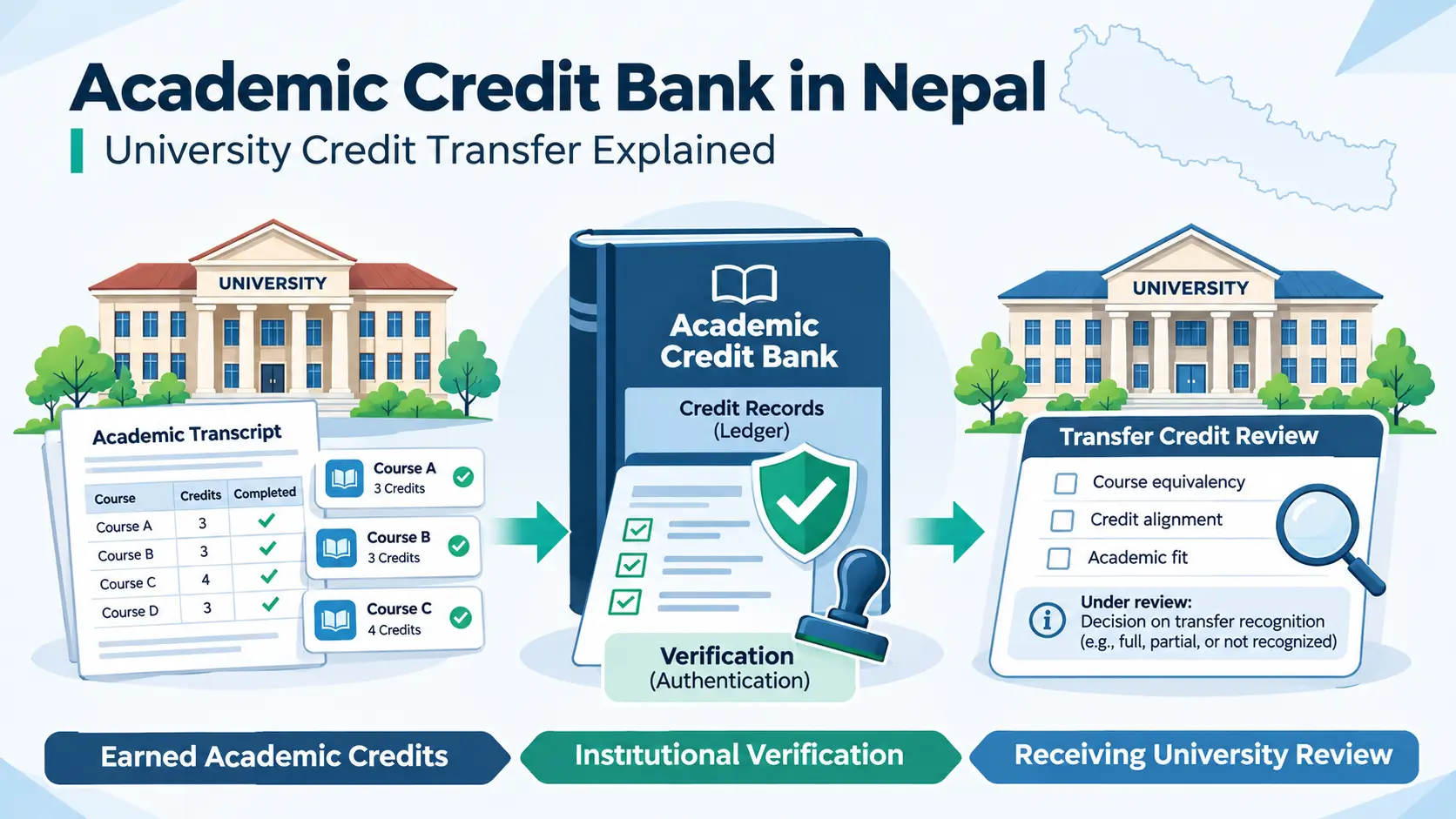
Students who change universities, return from studying abroad, or resume an interrupted degree may not have to repeat every course they previously completed. Nepal's Academic Credit Bank provides a framework for considering eligible academic credits toward further higher education.
The University Grants Commission (UGC) issued the Academic Credit Bank Establishment and Operation Directive, 2082 (एकेडेमिक क्रेडिट बैङ्कको स्थापना र सञ्चालन निर्देशिका, २०८२) to establish common rules for recording, verifying, accumulating, and transferring academic credits earned in Nepal and abroad. The directive is published on the UGC's official website.
However, holding academic credits does not guarantee their acceptance by another university. The receiving institution must determine whether the completed coursework satisfies its curriculum requirements. Credit validity periods, transfer limits, and institutional verification also affect the decision.
Students need to distinguish the credit-transfer rules from the availability of the centralized digital service. Although the directive has been issued, a fully functioning nationwide student application portal was not independently verified as of 6 November 2026.
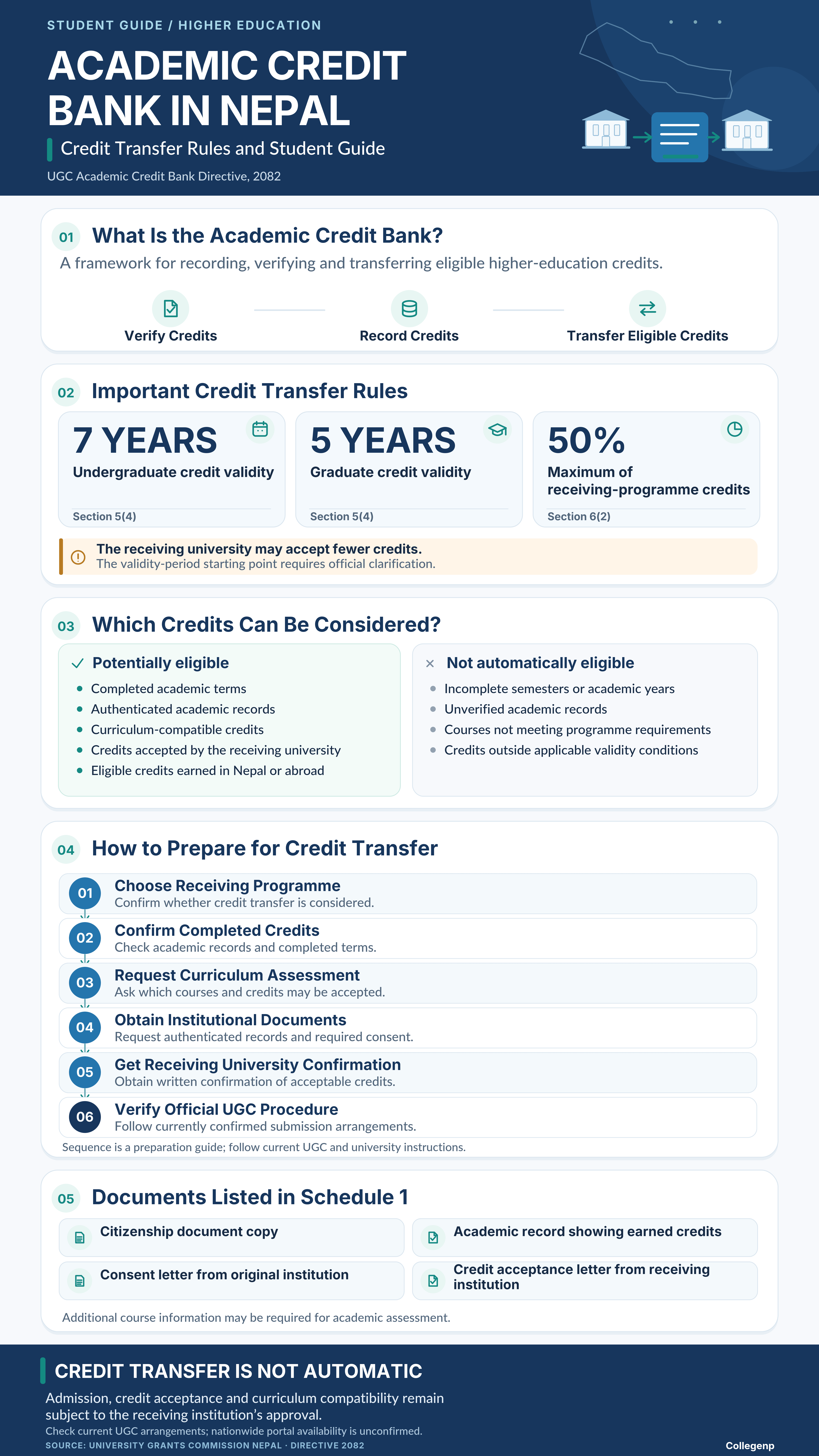
Answer Summary: Nepal's Academic Credit Bank is a UGC framework for preserving and transferring eligible higher education credits. Students generally need completed academic terms, authenticated records, and approval from the receiving university. The directive specifies seven-year validity for undergraduate credits, five-year validity for graduate credits, and a transfer ceiling of 50% of the receiving programme. These rules do not guarantee admission or credit acceptance, and current application arrangements require official confirmation.
Key Takeaways:
-
The Academic Credit Bank is intended to record and transfer verified higher education credits.
-
Credits from incomplete semesters or academic years cannot be transferred under the directive.
-
The receiving university decides which credits meet its curriculum requirements.
-
Undergraduate and graduate credit-validity periods are seven and five years, respectively.
-
Transferred credits cannot exceed 50% of the receiving programme's curriculum.
-
Official academic records and confirmation from both institutions are central to the process.
-
Students must verify the current UGC application procedure before submitting documents.
What Is the Academic Credit Bank in Nepal?
The Academic Credit Bank (ABC) is a UGC-administered academic credit management system intended to verify, store, and transfer credits earned through higher education.
Sections 2–4 of the directive describe it as a digital service through which students can maintain individual Academic Bank Accounts containing authenticated academic credit records.
The system has three main functions:
-
Credit verification establishes that the academic credits were awarded by the institution concerned.
-
Credit accumulation allows verified credits to be recorded for potential future use.
-
Credit transfer enables eligible credits to be considered by another higher education institution or programme.
The bank is not a degree-awarding university. It maintains academic credit information, while universities remain responsible for admission, curriculum compatibility, and degree requirements.
What Is an Academic Credit?
An academic credit represents a defined amount of learning activity or academic workload.
Section 2 of the directive describes a credit in relation to 15–16 hours of learning activity. Schedule 2 addresses the documentation and assessment of courses, including workload, teaching activities, assessment, and learning outcomes.
Credits differ from grades. A credit represents the value assigned to completed academic work, while a grade indicates academic performance.
A student may earn credits in a course and still need the receiving university to determine whether that course matches its own curriculum.
This distinction matters particularly when transferring between institutions that use different academic calendars, credit systems, or methods of assessment.
Is the Academic Credit Bank Operational in Nepal?
Nepal has issued the directive establishing the Academic Credit Bank framework. However, issuing the directive and operating a nationwide digital credit-transfer service are separate developments.
In August 2026, UGC officials considered the directive available for universities to apply but acknowledged that additional technical and administrative work was required before the centralized bank became fully operational.
It is also reported that software development, application arrangements, and internal procedures remained under preparation at that time.
These reports describe the position in August 2026, not necessarily the system's subsequent operational status.
As of 6 November 2026, the reviewed sources did not establish a verified nationwide student-registration portal, an official account-opening link, or a complete list of universities processing transfers through the centralized bank.
Students should therefore confirm the current arrangements through UGC and their intended receiving university.
Individual universities may also have their own credit-transfer procedures. Such arrangements should not be mistaken for evidence that the centralized bank is accepting applications nationwide.
Which Academic Credits Are Eligible for Transfer?
The directive allows credits earned through higher education in Nepal and abroad to be considered for transfer, provided the relevant conditions are satisfied.
Eligibility depends on completion of academic terms, authentication of records, and acceptance by the institution where the student intends to continue studying.
Credits From Completed Academic Terms
Section 5(7) excludes credits from incomplete semesters or academic years.
A student who has completed earlier semesters but has not finished the entire degree may have credits eligible for consideration.
For example, a student who has completed two semesters and leaves during the third should distinguish credits formally earned during the first two semesters from coursework undertaken during the unfinished third semester.
The completed terms may qualify for assessment, but attendance or partial assessment in the unfinished term does not establish transferable credit under the directive.
Students should confirm which academic terms their institution has formally recorded as completed.
Curriculum and Subject Compatibility
Previously earned credits must be evaluated against the receiving programme's academic requirements.
Section 5 provides for credits to be used according to the similarity of curricula and subjects. Transfers involving interdisciplinary subjects also require confirmation of academic compatibility and approval by the relevant academic council or equivalent authority.
Two courses with similar names may differ in content, learning outcomes, workload, or assessment methods.
The receiving university must determine whether the earlier coursework satisfies its requirements. It may accept some credits while declining others.
The directive also provides for credit transfer between higher education institutions and within the same institution, subject to the applicable conditions.
What Are the Academic Credit Transfer Rules and Limits?
Nepal's directive establishes validity periods, curriculum requirements, and a maximum transfer proportion.
The main provisions appear in Sections 5 and 6.
|
Rule |
Requirement |
Source |
|---|---|---|
|
Undergraduate credits |
Transfer and use within seven years |
Section 5(4) |
|
Graduate credits |
Transfer and use within five years |
Section 5(4) |
|
Maximum transfer |
Up to 50% of the receiving programme's curriculum |
Section 6(2) |
|
Completed academic term |
Credits from incomplete semesters or years are excluded |
Section 5(7) |
|
Academic compatibility |
Receiving institution assesses subject and curriculum suitability |
Sections 5–6 |
|
Transcript record |
Transferred credits must appear in the academic transcript |
Section 6(3) |
Source: UGC, Academic Credit Bank Establishment and Operation Directive, 2082. Read the eight-page directive PDF.
Understanding the 50% Transfer Limit
The maximum transferable amount is calculated against the curriculum of the programme the student intends to join.
It is not calculated as half of the credits previously earned at the original institution.
Consider a hypothetical programme requiring 120 credits.
The directive's 50% ceiling would limit transferred credits to 60 toward that programme.
This is a maximum, not an entitlement. If the receiving university determines that only 36 credits match its curriculum, the 50% rule does not require it to accept additional credits.
Students must meet the remaining academic requirements under the receiving institution's regulations.
When Does the Credit-Validity Period Begin?
The directive specifies seven years for undergraduate credits and five years for graduate credits, but the examined provision does not clearly establish the exact event from which the period begins.
Students should not independently assume that the calculation starts from admission, course completion, transcript issuance, or credit-bank registration.
The applicable starting date and any transitional arrangements for credits earned before the directive require authoritative clarification.
These validity periods should also not be extended automatically to doctoral, school-level, or other qualifications without a separate applicable rule.
What Documents Are Required for Credit Transfer?
Schedule 1 of the directive provides an application format for requesting credit transfer through UGC.
The form asks for student identification, Academic Bank Account information, the original institution, completed courses, earned credits, and the intended receiving institution and programme.
It identifies four supporting documents:
-
A copy of the student's citizenship documentation.
-
An academic record showing credits earned at the original institution.
-
A consent letter from the institution that awarded the credits.
-
A letter from the receiving institution confirming that the credits can be used.
Each document serves a different purpose.
The academic record establishes the completed coursework. The original institution's consent supports the proposed use of its credits. The receiving institution's letter establishes whether those credits are acceptable for the intended programme.
Section 4(4) separately requires the institution concerned to send academic documents directly to UGC for authentication.
A transcript submitted independently by a student does not replace that institutional verification requirement.
Why Course Descriptions May Be Necessary
Schedule 2 establishes standards for evaluating academic credits. These include course level, objectives, workload, assessment, learning outcomes, and supporting documentation.
A receiving university may therefore need detailed syllabi, course descriptions, or grading information to assess compatibility.
These materials support academic comparison, but the precise supplementary documents required by each university must be confirmed separately.
Students should transmit citizenship records and academic documents only through verified institutional procedures, not unofficial registration websites or third-party intermediaries.
How Should Students Prepare for Credit Transfer?
Students considering a transfer should establish whether the proposed move is academically feasible before withdrawing from their current institution.
The following sequence is practical preparation based on the directive, not a verified online application procedure.
1. Identify the Receiving Programme
Contact the university or institution where you want to continue studying.
Ask whether credit transfers are considered for the specific programme, whether admission conditions apply, and which academic authority evaluates previously completed coursework.
An institution's general willingness to consider transfers does not guarantee acceptance into every programme.
2. Confirm Your Completed Academic Terms
Request an official record showing the semesters or years you have completed and the credits awarded.
Check whether any results remain pending.
If you are leaving during an ongoing semester, distinguish earlier completed coursework from the unfinished term.
3. Request an Academic Compatibility Assessment
Ask the receiving institution to examine your completed courses against its curriculum.
Provide the required transcript and, where requested, detailed course information.
Seek clarification on which credits may be accepted, which subjects do not match, and what academic requirements would remain after transfer.
For interdisciplinary changes, confirm whether approval by an academic council or equivalent body is necessary.
4. Contact the Institution That Awarded the Credits
Ask whether the original institution can supply the authenticated academic record and consent letter identified in the directive.
For foreign institutions, establish how official documents can be sent directly to UGC or through the procedure UGC confirms.
Do not assume that a downloaded transcript satisfies every authentication requirement.
5. Obtain Written Confirmation From the Receiving Institution
Request written confirmation of the credits considered usable toward the intended programme.
Clarify whether the decision is provisional or final and whether admission remains subject to additional requirements.
This is particularly important before paying for a new programme, relocating, or giving up an existing enrolment.
6. Verify the Current UGC Submission Procedure
Confirm where and how applications are currently accepted.
The directive envisages individual digital accounts and a prescribed transfer application. However, a current nationwide account-registration route was not independently verified during the November 2026 review.
Students should use only official instructions and retain copies of institutional correspondence.
If a transfer is approved, confirm how the receiving university will show the transferred credits on the academic transcript.
What If You Studied Abroad or Interrupted Your Degree?
The directive includes students who earned credits at higher education institutions established under the laws of other countries, as well as students whose studies ended before they completed a qualification.
This makes foreign study and interrupted education relevant circumstances under the framework. Neither situation creates an automatic entitlement to admission or credit recognition.
Returning to Nepal From a Foreign University
A student who completed part of a foreign degree may seek consideration of eligible credits toward a programme in Nepal.
The original institution must be able to authenticate the academic record, and the receiving university must assess the coursework.
Differences in curriculum, academic workload, course level, and grading can affect the outcome.
A student planning to return should therefore obtain a complete record of finished coursework and request an assessment from the intended Nepali institution before assuming that previously completed study will count.
Resuming Studies After Several Years
Students returning after a long interruption must consider the credit-validity periods and current curriculum requirements.
Even if credits remain within the applicable period, the receiving institution may find that some earlier courses do not satisfy its present programme.
The precise starting point for calculating the directive's validity periods also requires official clarification.
Students should request an individual assessment rather than calculating an expiry date from an assumed starting point.
Credit Transfer, GPA Conversion, and Degree Equivalence
Credit transfer, grade conversion, and degree equivalence answer different academic questions.
Confusing them can lead students to follow the wrong procedure or misunderstand what an institutional decision establishes.
Credit Transfer Versus GPA Conversion
Credit transfer determines whether previously completed academic work may count toward another programme.
Grade Point Average (GPA) conversion expresses academic performance using a different grading scale.
Sections 8–9 and Schedule 4 of the directive address grading and conversion.
For a ten-point GPA, Schedule 4 provides a proportional conversion to a four-point scale. Its official example converts 8.5 out of 10 into 3.4 out of 4.
This example concerns grade representation. It does not establish that the courses themselves satisfy another university's curriculum.
The formula should not be treated as a universal method for converting every foreign grading system.
Credit Transfer Versus Foreign Degree Equivalence
Credit transfer concerns individual academic credits earned during study.
Degree equivalence concerns the recognition or comparability of a completed qualification.
A student who completed a foreign degree may need to investigate the applicable qualification-equivalence requirements.
A student who completed part of a degree and wants to continue studying in Nepal instead needs to establish whether previously earned credits can be accepted by the receiving programme.
Credit acceptance also does not independently establish eligibility for professional registration or licensing.
Nepal's Academic Credit Bank Versus India's APAAR
India operates its own Academic Bank of Credits system, connected to the Automated Permanent Academic Account Registry (APAAR).
India's official Academic Bank of Credits FAQ explains that its service uses an APAAR identity to manage academic records and credit transfers.
Nepal's directive describes a separate UGC-administered framework.
The available evidence does not establish that an Indian APAAR ID is required to use Nepal's Academic Credit Bank or that accounts in the two countries' systems are interchangeable.
Students should rely on Nepal's official application instructions rather than using an Indian credit-bank registration process.
What Should Students Confirm Before Changing Universities?
Before leaving an existing programme or committing to a new institution, students should obtain clear answers to three questions.
-
Have the academic credits been formally awarded through completed terms, and can the original institution authenticate them?
-
Has the receiving university confirmed which credits satisfy the intended programme's requirements?
-
What official application or transfer procedure is currently available, and what additional admission conditions apply?
Written confirmation is particularly valuable when an academic decision may involve additional tuition, relocation, or interruption of an existing course.
The Academic Credit Bank provides a framework for considering previous study. Its practical value in an individual case depends on the academic evidence, receiving-institution approval, and available procedures.
Conclusion
Nepal's Academic Credit Bank Directive 2082 establishes rules intended to help students preserve and transfer eligible higher education credits when changing institutions or resuming interrupted studies.
The directive provides a basis for considering completed academic work earned in Nepal and abroad. However, credit transfer remains subject to verification, curriculum compatibility, validity periods, transfer limits, and the receiving university's decision.
Students should confirm academic acceptability before withdrawing from an existing programme and verify current UGC application arrangements before submitting documents.





Comments 0
No comments yet. Be the first to start the conversation.