Nepal Engineering Council (NEC) is a statutory body connected with engineering profession management and engineering education oversight in Nepal. It was established under the Nepal Engineering Council Act, 2055 in 1999 to make the engineering profession more systematic and scientific. Its work covers engineer registration, professional conduct, recognition of engineering degrees and institutions, monitoring of engineering colleges, and professional capacity development for engineers.
NEC’s role connects individual engineering practice with academic standards. Engineers practicing in Nepal are required to register with the Council, and engineering colleges and programs are subject to recognition and monitoring requirements. The Council also works through professional registration procedures, education recognition guidelines, and capacity-building rules that define how engineering practice and engineering education are administered.
| Area | Details |
|---|---|
| Name | Nepal Engineering Council (नेपाल इन्जिनियरिङ्ग परिषद्) |
| Abbreviation | NEC |
| Established | 1999 |
| Legal basis | Nepal Engineering Council Act, 2055 |
| Office | Minbhawan, New Baneshwor, Kathmandu, Nepal |
| Main functions | Engineer registration, education recognition, college monitoring, professional conduct |
| Engineer registration categories | General Registered Engineer, Professional Engineer, Non-Nepali Registered Engineer |
| Phone | +977-1-4520655, +977-1-4520656 |
| necgov@ntc.net.np | |
| Website | www.nec.gov.np |
Nepal Engineering Council was formed after engineering activities and engineering education began expanding in Nepal. The engineering profession was increasingly connected with national development, and student enrolment in engineering colleges was growing. NEC was established under the Nepal Engineering Council Act, 2055 to manage the engineering profession through a formal statutory framework.
The Nepal Engineering Council Act, 2055 was promulgated on 11 March 1999. The Act gives the Council statutory authority for planning, coordinated development, and monitoring of the engineering profession and engineering education in Nepal. It also outlines the formation of the Council, its tenure, and the roles and responsibilities of the Chairperson, Vice Chairperson, and Registrar.
Nepal Engineering Council Rules, 2057 define the registration categories for engineers and provide the basis for professional conduct. These rules classify engineers into General Registered Engineer, Professional Engineer, and Non-Nepali Registered Engineer.

The objective of Nepal Engineering Council is to make the engineering profession effective by mobilizing engineering resources in a systematic and scientific manner. This objective is applied through policies, standards, registration, monitoring, and professional conduct measures.
The Council’s work is centered on professional regulation and education quality. It fixes qualifications for engineering practice, registers engineers, sets standards for engineering education, grants permission and approval for engineering education where required standards are met, recognizes degrees and certificates, and monitors the quality of engineering education provided by colleges and institutions.
NEC prepares policies, plans, and programs for the functioning of the engineering profession and executes them. It also sets norms and standards for engineering education in Nepal.
The Council grants permission and approval to engineering colleges and institutions that meet required norms and standards. It recognizes engineering degrees and certificates connected with approved engineering education. It also monitors and inspects engineering education quality in colleges and institutions.
NEC fixes the necessary qualifications for engineering practice and registers qualified engineers. It also has authority to cancel the registration of an engineer found to have violated the Code of Ethics.
Engineer registration is one of NEC’s core functions. Engineers practicing in Nepal are required to register with the Council under the Act. The registration framework links engineering practice with recognized academic qualifications and professional conduct.
The registration categories are:
General Registered Engineer
Professional Engineer
Non-Nepali Registered Engineer
All engineers working with government bodies, diplomatic missions, private sectors, NGOs, INGOs, academic institutions, and consulting firms must register with the Council and follow its Code of Conduct.
NEC registers engineers from different engineering disciplines. The listed disciplines include Aeronautical Engineer, Agri-irrigation Engineer, Agricultural Engineer, Architect Engineer, Automation Engineer, Automobile Engineer, Biomedical Engineer, Biotechnology Engineer, Chemical Engineer, Civil & Rural Engineer, Civil Engineer, Computer Engineer, Electrical & Electronics Engineer, Electrical Engineer, Electronics & Instrumentation Engineer, Electronics & Telecommunication Engineer, Electronics and Communication Engineer, Electronics Engineer, Energy Engineer, Environmental Engineer, Food Engineer, Forestry Engineer, Geology Engineer, Geomatics Engineer, Industrial Engineer, Information Technology & Telecommunication Engineer, Information Technology Engineer, Instrumentation Engineer, Mechanical Engineer, Metallurgical Engineer, Mining Engineer, Radio Engineer, Software Engineer, Survey Engineer, System Engineer, Textile Engineer, and Urban & Physical Planning Engineer.
This discipline coverage shows that NEC registration applies across many branches of engineering. The registration system supports professional identification by field and connects practice with qualification-based recognition.
NEC Rules 2057 lay down the Professional Code of Conduct for engineers registered with the Council. Registered engineers are expected to practice with integrity, impartiality, and confidentiality.
Professional conduct requirements also include personal responsibility in engineering work, working within the field related to one’s study or acquired knowledge and skills, and recommending relevant experts for work outside one’s professional area. Engineers signing engineering documents such as maps, designs, specifications, and estimates must mention their name, position, and registration number clearly.
The conduct framework also restricts actions that can harm engineering practice. It includes requirements not to prepare or recommend false reports, not to perform work with negligence or recklessness, and not to advertise professional services in a way that creates unnecessary influence on clients.
NEC has responsibility for recognizing engineering degrees, academic certificates, and educational institutions. The NEC Act, 2055, as amended in 2079, includes provisions on recognition of engineering degrees or academic certificates, recognition of educational institutions, and regular monitoring of educational institutions.
Engineering education recognition is tied to procedures and standards for programs conducted by universities. The requirements include indicators used to guide teaching-learning activities and support the preparation of skilled and ethical engineering graduates.
Engineering colleges may operate as university constituent campuses or schools, public or community colleges, or private colleges. These institutions may offer undergraduate and graduate engineering programs. Courses, examinations, admission requirements, entrance examinations, and academic degrees are managed by the respective universities.
The Recognition and Monitoring Guidelines for Engineering Colleges, 2024 apply to undergraduate and graduate programs. The guidelines are connected with the Recognition and Monitoring Bylaws for Undergraduate Programs of Engineering Institutions, 2024 and Recognition and Monitoring Bylaws for Graduate Programs of Engineering Institutions, 2024.
NEC uses quality indicators to assess engineering institutions and programs. The main indicators are:
Institutional Policy, Governance and Leadership
Curriculum Management and Teaching Learning Process
Research, Knowledge Generation and Extension
Physical Resources
Human Resources
Student Welfare and Support Services
These indicators are used in inspection and monitoring. They help structure evaluation of academic administration, teaching-learning systems, research activity, infrastructure, staffing, and student support.
NEC has set minimum requirements for enrolment in Bachelor’s degree engineering programs. Students must pass I.Sc. or 10+2 in the Science stream from Higher Secondary Schools, or hold a Diploma in Engineering degree. Students must have secured at least second division or the equivalent in the grade point system. Degrees from abroad must be recognized by the respective authorities in Nepal. Universities regulate enrolment for Bachelor’s engineering programs within their jurisdiction.
Engineering programs are conducted through the semester system. An academic year consists of two semesters. Colleges must maintain student numbers according to approved class size and number of classes, and each academic program must be conducted separately by discipline within the approved class-size limit. For Bachelor’s engineering programs, the maximum number of students in one class is 48.
For graduate-level engineering programs, the recognition and monitoring regulation defines the student number-class as 48 for undergraduate level and 30 for postgraduate level.
The recognition process for engineering academic programs and institutions includes temporary recognition, renewal of temporary recognition, recognition of additional programs or additional class size, permanent recognition, and continuation of permanent recognition.
Temporary recognition is issued to newly established engineering colleges to start engineering programs after threshold criteria are verified through field inspection. Renewal of temporary recognition is issued after regular monitoring and is valid for one year. Recognition of additional programs or additional class size is issued for an existing engineering college after field inspection against the criteria set for that purpose.
Permanent recognition applies after five years from the first-time recognition of the programs. The certificate for upgrading to permanent recognition is issued through field inspection of required resources for that status.
The threshold for temporary recognition of a new institute or college is a minimum of 50 percent in each criterion and 60 percent total average. For continuation of temporary recognition, recognition of additional programs or additional class size, permanent recognition, and continuation of permanent recognition, the threshold is a minimum of 60 percent in each criterion and 70 percent total average.
For Bachelor’s programs under regular monitoring, NEC applies six criteria totaling 100 marks. Institutional Policy, Governance and Leadership carries 12 marks; Curriculum Management and Teaching Learning Process carries 18 marks; Research, Knowledge Generation and Extension carries 8 marks; Physical Resources carries 25 marks; Human Resources carries 25 marks; and Students’ Welfare and Support Services carries 12 marks.
For Master’s programs under regular monitoring, Institutional Policy, Governance and Leadership carries 5 marks; Curriculum Management and Teaching Learning Process carries 25 marks; Research, Knowledge Generation and Extension carries 30 marks; Physical Resources carries 10 marks; Human Resources carries 25 marks; and Students’ Welfare and Support Services carries 5 marks. The total is 100 marks.
Engineering colleges are categorized by marks secured in evaluation. Grade A applies to marks above 80. Grade B applies to marks above 65 to 79.0. Grade C applies to marks above 50 to 64.9.
NEC uses the Application Management Information System (AMIS) for the General Registered Engineer Registration Examination. Application forms can be submitted online by candidates who have completed a Bachelor’s Degree in Engineering from universities recognized by Nepal Engineering Council.
Candidates log in through the dashboard using their registered username or email and password. They make payment through the available dashboard gateways, fill in required details, select the examination center, and submit the application. After successful submission, candidates receive a confirmation notification or email. Candidates who have previously appeared in the NEC examination can reapply through their dashboard by completing payment and resubmitting the application.
The examination fee is Rs. 2,500, deposited during online application. After passing the examination, the registration fee is Rs. 5,000 and the ID card charge is Rs. 200, making a total of Rs. 5,200. Deposited fees are not refunded.
The application process requires notarized copies of the Nepalese Citizenship Certificate, SEE Mark Sheet, SEE Character Certificate, 10+2 Transcript, 10+2 Character Certificate, Bachelor’s Degree Transcript, Bachelor’s Character Certificate or documents showing duration of study, and Degree or Provisional Certificate of Bachelor’s Degree issued by the university.
Candidates who studied abroad must submit an equivalence certificate issued by an authorized agency of the Government of Nepal where applicable. One passport-size photo is also required. Approved uploaded documents cannot be changed once approved by NEC.
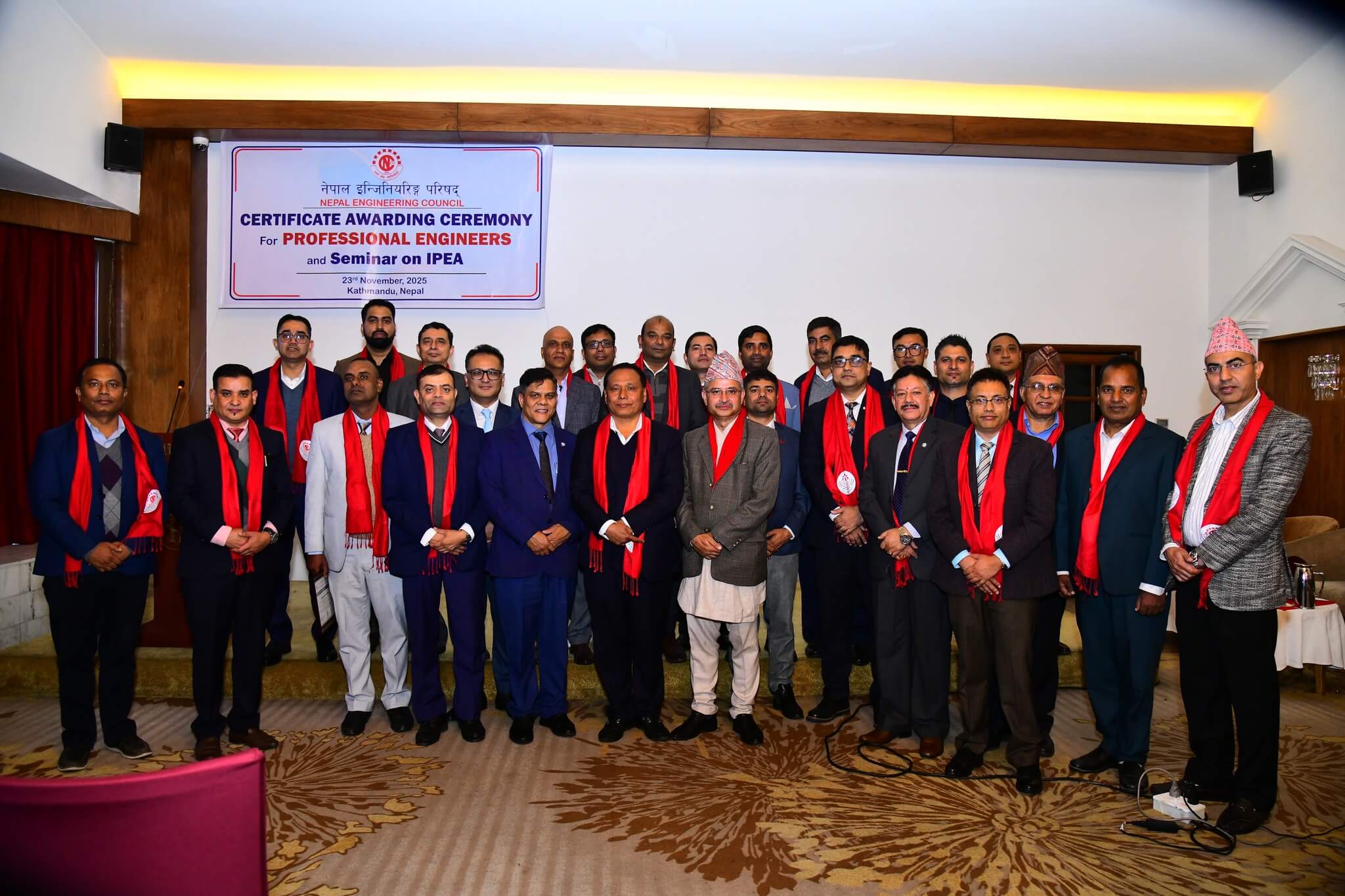
The Professional Engineers’ Registration Working Procedure 2025 provides the official procedure for awarding the Professional Engineer title in Nepal, denoted as PEng (NPL). The guideline was approved on 2081/11/06.
NEC started registration of Professional Engineer in 2018. Under the amended rules, an ordinary registered engineer with Master’s level academic qualification in a relevant engineering subject is eligible to apply for the title when the required professional experience and evaluation requirements are met.
The Professional Engineer title is awarded through two application routes: PE Standard Route and PE Registered Route. The Standard Route requires General Registered Engineer status at NEC, a Master’s degree in a relevant engineering subject, seven years of professional experience after receiving the Master’s degree, a minimum of two years in a responsible position involving significant engineering activities, and at least 30 hours of CPD in the previous year.
The Registered Route includes a four-year BE from a recognized university, a Master’s degree in the relevant engineering subject, seven years of professional experience after the Master’s degree, and a PE title from an internationally competent institution that is a member of the IEA.
The PE Standard Route includes self-assessment for eligibility, application submission, preliminary confirmation of documents and eligibility, forwarding to the PE Evaluation Committee, review of competence profile, written examination, interview, and award of PEng (NPL) for successful candidates.
The interview panel includes members of the evaluation committee and external experts. Candidates must demonstrate communication and presentation skills and respond to questions on professional ethics and relevant engineering problems in their field. Successful candidates in the interview are notified for the award of PEng (NPL).
The PE application file includes the application form and supporting documents. The application form covers applicant details, application route, background and expertise, registered engineer information, documents submitted, declaration, and supporters’ names and addresses. Two engineers who hold PE title or professional membership from IPEA member engineering bodies must support the application.
The PEng title awarded by Nepal Engineering Council is valid for five years. Engineers holding PEng (NPL) must apply for renewal before the five-year validity period expires. Renewal requires active engineering practice, Continuous Professional Development, and a supporter’s recommendation on the CPD record and application.
At the time of award of PEng (NPL), individuals receive guidance to maintain CPD records and submit them to the Council every year. CPD records are indexed and filed, reviewed each year by the Evaluation Committee, and used as a main criterion for renewal of the PE title.
Professional Engineers are required to complete a minimum of 30 hours of CPD per year. CPD activities include formal education in engineering, continuing education and trainings, authoring books, mentoring subordinate or junior engineers, writing technical papers or reports, and contribution to professional societies.
The Engineering Professional Capacity Building Regulation, 2082 was approved on 16 Chaitra 2082, corresponding to 30 March 2026. It applies from the date approved by the Council.
The regulation defines engineering professional capacity-building programs as study, research, training, workshops, seminars, and conferences conducted by institutions for the professional capacity building of engineers. It defines continuous professional development as capacity building and training conducted by institutions. It also defines continuous professional development time-load as the hour-based unit fixed by the Council for CPD programs.
The available institutional information includes a reference to cooperation between Nepal Engineering Council and the Institution of Civil Engineers, United Kingdom. NEC signed a Memorandum of Understanding with ICE, UK, to develop cooperation between the two institutions. The related content connects this cooperation with professional standards and support for Professional Engineers in Nepal.
The AMIS-related information also includes a description of the Washington Accord as a multilateral agreement between bodies responsible for accreditation or recognition of tertiary-level engineering qualifications within their jurisdictions. The Accord is connected with mutual recognition of accredited engineering degree programs among participating bodies.
Contact: Nepal Engineering Council
Location: Minbhawan, New Baneshwor, Kathmandu, Nepal
Phone: +977-1-4520655, +977-1-4520656
Email: necgov@ntc.net.np
Website: www.nec.gov.np
For General Registered Engineer Registration Examination support, NEC provides the contact number 9767472423 from Monday to Friday, 9:00 AM to 5:00 PM. The examination support email is exam_support@nec.gov.np. Payment-related contacts are listed for Khalti, eSewa, and Connect IPS.
Nepal Engineering Council is a statutory body established under the Nepal Engineering Council Act, 2055 in 1999. It works on engineering profession management, engineer registration, professional conduct, engineering education recognition, and monitoring of engineering institutions.
The engineer registration categories are General Registered Engineer, Professional Engineer, and Non-Nepali Registered Engineer.
Engineers practicing in Nepal are required to register with the Council. Engineers working with government bodies, diplomatic missions, private sectors, NGOs, INGOs, academic institutions, and consulting firms must register with NEC and follow its Code of Conduct.
NEC sets norms and standards for engineering education, grants permission and approval to engineering colleges and institutions that meet required standards, recognizes degrees and certificates, and monitors the quality of engineering education.
For Bachelor’s engineering programs, the maximum number of students in one class is 48.
PEng (NPL) is the Professional Engineer title awarded by Nepal Engineering Council under the Professional Engineers’ Registration Working Procedure 2025. The procedure includes eligibility review and evaluation through the relevant route.
The PEng title is valid for five years. Renewal is connected with active engineering practice, CPD records, and a supporter’s recommendation.
Professional Engineers are required to complete a minimum of 30 CPD hours per year.
AMIS is the Application Management Information System used for the General Registered Engineer Registration Examination. Candidates with a Bachelor’s Degree in Engineering from universities recognized by NEC can submit applications through the online system.


.png)


.jpg)