Teachers Service Commission (TSC)
- Established2002
- Services 6 offered
About Teachers Service Commission (TSC)
Teacher Service Commission (TSC) Nepal
The Teacher Service Commission (TSC) was established to improve the quality of Nepal’s public education system and to select competent, qualified, and impartial teachers for community schools in a fair manner.
In line with the state’s democratic values and principles, and by embracing “meritocracy” (a competency-based system), this body influences the future of thousands of young people and helps determine the learning level of millions of students.
To end political interference and ad hoc practices in teacher appointments in the past, this Commission was developed as a strong and autonomous structure through the Seventh Amendment (2058) to the Education Act, 2028.
Its main purpose is to recommend permanent teachers for approved positions in community schools, issue teaching licenses, and recommend promotions for teachers’ professional development.
The Teacher Service Commission is not only an examination-taking body; it is also a “gatekeeper” that ensures the quality of Nepal’s public education.
The future of Nepal’s education sector depends on the fairness and transparency of the examinations it conducts.
Functions, duties, and powers of the Commission are as follows:
-
To recommend permanent appointment and promotion of teachers.
-
To issue teaching licences to individuals who wish to teach in schools after completing the prescribed process.
-
To determine the syllabus for the teaching licence examination and carry out related examination work.
-
To provide suggestions to the Ministry regarding teachers’ services, terms and conditions, and facilities.
-
To determine the syllabus for examinations related to the appointment and promotion of teachers and carry out other related examination work.
-
To inspect and investigate the Commission’s work as required under the Act and these Rules.
This guide covers the background of the Commission’s establishment, the current digital application system, exam formats, legal provisions, and solutions to practical problems candidates commonly face.
The main purpose of this content is to reduce confusion and provide clear, evidence-based information about the Commission’s services.
Quick Facts
-
Official Name: Teacher Service Commission (Shikshak Sewa Aayog)/शिक्षक सेवा आयोग
-
Abbreviation: TSC (टी.एस.सी.)
-
Legal Basis for Establishment: Education Act, 2028 (with amendments)
-
Nature of the Body: A specialized and autonomous legal body of the Government of Nepal
-
Main Responsibilities: Teacher selection, recommendation, promotion, and issuance of teaching licenses
-
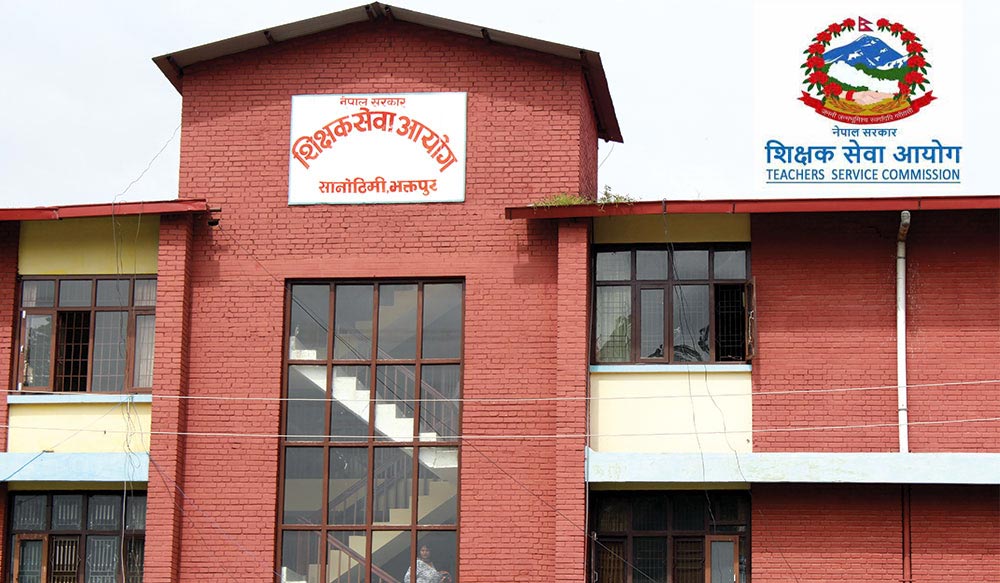
Central Office: Sanothimi, Bhaktapur, Nepal
-
Contact Phone: 01-6637873
-
Official Website: www.tsc.gov.np
-
Online Portal: online.tsc.gov.np
-
Email: info@tsc.gov.np / support@tsc.gov.np
Objectives of the TSC
Article 11B of the Education Act, 2028 (Eighth Amendment, 2062) provides for the Teacher Service Commission to recommend appointments to vacant teacher posts in community schools and to recommend the promotion of teachers serving in posts approved by the Government of Nepal. The same provision requires a teaching licence for eligibility as a teacher candidate and assigns the Commission the responsibility to issue such licences.
Accordingly, the Commission’s objectives are to:
-
Recommend permanent appointment and promotion of teachers through impartial, merit-based selection.
-
Issue teaching licences to eligible applicants after completion of the prescribed process.
-
Determine the syllabus for teaching licence examinations and carry out related examination work.
-
Determine the syllabus for examinations required for appointment and promotion, and carry out other examination-related work.
-
Provide suggestions to the Ministry regarding teachers’ service matters, including terms and conditions of service and facilities.
-
Inspect and investigate the Commission’s work as required under the Act and relevant rules to ensure accountability and legal compliance.
Beyond these statutory functions, the Commission aims to build public trust by standardising procedures, applying uniform criteria, and reducing inconsistencies previously seen in teacher recruitment and promotion. Ultimately, it seeks to support quality school education by helping community schools recruit competent, skilled, and professionally prepared teachers. It also works to make examination and recommendation schedules more predictable, ensure decisions are properly recorded, and minimise disputes arising from unclear criteria. In doing so, it helps protect students’ right to effective teaching in schools.
Leadership and Structure
The Commission is structured to include one Chairperson and two Members.
Appointments are made by the Council of Ministers of the Government of Nepal based on the recommendation of a special selection committee.
As the administrative head of the Commission, a Gazetted First Class officer of the Government of Nepal (Joint Secretary) works as the “Administrative Chief.”
Legal and Policy Framework
All operations of the Teacher Service Commission are guided by specified Acts and Regulations.
Before applying, it is mandatory for any candidate to understand these legal bases.
-
Education Act, 2028: Section 11K of this Act explains the establishment of the Teacher Service Commission and defines its functions, duties, and powers.
-
Education Regulations, 2059: This explains the overall administration of the education sector.
-
Teacher Service Commission Regulations, 2057: This is the most important regulation for the Commission. It sets detailed procedures for teacher appointment, promotion, punishment, and exam management.
-
Teacher Service Commission (Operational) Guidelines: These guidelines are used to systematize exam discipline, answer script evaluation, and interview procedures.
Jurisdiction of the Commission
-
Decision-making authority: setting advertisement timelines, revising syllabuses, fixing exam dates, and internal administrative work
-
Recommendation authority: recommending names for teacher appointment; the appointment itself is done in coordination with the relevant Education and Coordination Unit or the local level
Important terminology
-
Community school: a school that receives regular government grants
-
Approved position (Swikrit Darbandi): the number of teachers approved by the government based on budget and student numbers
-
Inclusive category: reserved quotas for women, Indigenous/Nationalities, Madhesi, Dalit, persons with disabilities, and people from backward regions
Institutional Mandate and Functions
The Commission primarily performs its work through the following four pillars.
A) Teacher Selection and Recommendation
It recommends permanent appointments through open competitive examinations for vacant teacher positions in community schools.
This is classified into three levels: primary, lower secondary, and secondary.
B) Promotion Recommendation
It recommends promotions to higher categories through performance evaluation (such as experience, academic qualification, training, and performance) or internal competitive examinations.
C) Teaching License
It issues teaching licenses through examinations to individuals who meet the minimum eligibility to become teachers.
Without a license, no one is allowed to apply for a teacher position.
D) Advice and Opinion
It provides necessary advice and suggestions to the Government of Nepal regarding teachers’ service conditions and facilities.
It also submits an annual report to the Government of Nepal.
Service Catalogue
The services provided by the Teacher Service Commission and how to use them are listed below.
Vacancy Advertisements
After receiving details of vacant approved positions, the Commission publishes notices in national newspapers and on its website.
-
Process: the notice includes the position, level, subject, minimum required qualification, and fees
-
Caution: candidates must ensure their academic qualifications and training match the conditions stated in the advertisement
Online Application System
The Commission currently accepts applications fully online.
-
Steps: create an account, fill in personal details, upload documents (photo, citizenship, academic certificates, training), pay fees (ConnectIPS or designated bank)
-
Required documents: transcript for minimum qualification, character certificate, training certificate, citizenship, and for inclusive groups, officially verified supporting documents
Admit Card and Exam Center
After approval of the application, candidates must download the admit card from the same portal.
A few days before the exam, the exam center details are published.
Results and Interview
The written exam has two stages: a general exam (General) and a subject-based exam (Subjective).
Only those who pass both are called for the interview.
How it Works: Process Maps
For candidates’ understanding, the main processes are explained step by step.
A) Open Competitive Teacher Recruitment Process
-
Notice publication: advertisement based on demand for vacant posts
-
Eligibility check: the candidate checks age (must have completed 18 years and must not exceed 40 years) and academic qualifications
-
Online form: submit the online application and pay fees within the specified time
-
Written exam (first stage): 100-mark objective (MCQs) exam; a minimum of 50 percent marks is mandatory
-
Written exam (second stage): subject-based exam; only those who pass the first stage can participate
-
Interview: interview and document verification for shortlisted candidates based on written results
-
Final recommendation: publication of merit list based on total marks from written and interview, and recommendation for appointment
B) Teaching License Process
-
Eligibility: prescribed academic qualifications for the relevant level and mandatory education training (Bachelor’s in education or 10-month training). For some technical subjects at the secondary level, it is available even without training.
-
Exam: exam based on objective questions
-
Result: those who score 50 percent are considered passed
-
Certificate: a digital certificate is obtained online or from the designated office
Practical Guidance: Common Problems and Solutions
Common issues candidates face in the online system and document process, and their solutions, are listed below.
Online Portal Issues
-
Email/OTP not received: check the spam folder or confirm the email was typed correctly
-
Duplicate account: if one person has two accounts, the form may be rejected; in such cases, contact the Commission’s technical unit to deactivate one
-
Payment pending: if money is deducted but “Submitted” does not appear, wait 24 hours and keep the voucher safe
Confusion on Eligibility and Documents
-
Equivalence: those who studied at foreign universities must upload an equivalence letter from Tribhuvan University or the relevant authority
-
Subject mismatch: the main subject shown on the transcript must match the subject demanded in the advertisement
Points to Note When Attending the Exam
-
Prohibited items: mobile phones, smart watches, calculators (except those permitted), and cheat materials are strictly prohibited
-
Original ID: along with the admit card, it is mandatory to carry citizenship or an official identity document
Exam Integrity and Fairness
The Teacher Service Commission adopts strict standards to maintain confidentiality and transparency.
-
Code system: answer scripts do not contain the candidate’s name; only a “code” is used, so the examiner does not know whose copy is being checked
-
Double coding: the main answer script is re-coded before being sent for evaluation
-
Security: security personnel at exam centers and strict monitoring by Commission supervisors
-
Support for persons with disabilities: for visually impaired or those unable to write, a helper writer is arranged as per rules; prior approval is mandatory
Transparency and Public Information Hub
The Commission makes all its decisions and notices public.
Candidates should regularly check the following.
-
Old advertisement archive: useful to understand trends by reviewing past notices
-
Result records: older results help understand how merit order is determined
-
Syllabus downloads: always download “updated” syllabuses only from the official website; market books may contain old syllabuses
Data and Statistics
A statistical glimpse of the Commission’s performance for research and policy understanding.
-
Application trend: in recent years, competition appears to have increased at the secondary level compared to the primary level
-
Pass percentage: statistics show many candidates fail the objective (General Paper), indicating preparation levels need to improve further
-
Inclusion: like the civil service, 45 percent quota is reserved for inclusive groups, increasing access for backward communities in schools
Grievance Redress and Official Communication
If you are not satisfied with any Commission process or face a problem:
-
For technical problems: call the “Support” number provided on the website
-
If not satisfied with results: within the specified days after result publication, you may submit an application for re-totaling by paying the prescribed fee
-
Formal letter: if there is legal ambiguity, you may write a letter addressed to the Administrative Chief
What the Commission cannot do
-
Accept forms after the deadline
-
Allow those without minimum qualifications to participate in the exam
-
Add marks without evidence merely on the claim that questions were outside the syllabus
Anti-fraud and Public Safety
Saying that “setting” or “access” works in the Teacher Service Commission exam is completely false and misleading.
-
Avoid middlemen: if anyone asks for money claiming they can ensure your name is selected, immediately inform the police or the Commission
-
Password security: do not share your online profile password with others
-
Official payment: always pay only through the government revenue account or the designated digital wallet
Institutional Structure and Accountability
Pursuant to Article 11 (e) of the Education Act, 2028 BS, the Commission has a separate secretariat. There is an arrangement for the Gazetted First Class, Education Service (Pvt.) (Joint Secretary) to work as the administrative head of the secretariat. There is a central office (Teacher Service Commission) under the Secretariat of the Teacher Service Commission.
Under the leadership of the Administrative Head (Joint Secretary of Education Service), there are 7 Deputy Secretaries of Education Service and 1 Accounts Group, 8 Deputy Secretaries, 8 Section Officers, and 18 others with a total of 34 employees.
Eight branches have been set up to manage the work of the commission. These branches include
1) Written Examination Operations Branch,
2) Promotion Branch,
3) Interview and Recommendation Branch
4) Statistics, Advertising, Curriculum, Capacity Development and Research Branch
5) Financial Administration Branch
6) Question Paper Creation and Modification Branch
7) Planning, Administration And Monitoring Branch
8) There are teaching license branches.
The Commission’s internal structure is as follows.
-
Commission Board: Chairperson and Members (for policy decisions)
-
Administration Section: staff management and daily operations
-
Examination Section: question paper preparation, exam conduct, and confidential work
-
Information Technology (IT) Section: online portal and data management
-
Financial Administration: budgeting and expenditure accounting
The Commission is accountable for its work to the Government of Nepal and the Federal Parliament.
Its audit is conducted by the Office of the Auditor General.

Frequently Asked Questions (FAQ)
Can I sit for the teacher exam without training?
For primary and lower secondary levels, a 10-month training in education is mandatory. However, for some technical subjects at the secondary level (such as science, mathematics, and English), graduates may apply even without training, but they must take training after appointment.
Are the teaching license and permanent teacher advertisement the same?
No. The license is only a certificate of eligibility to become a teacher. To become a permanent teacher, the Commission issues a separate advertisement where only license holders can compete.
What should I do to correct my name and date of birth?
If there is a mistake in the online form and it has not been verified yet, you can use “Edit.” If the admit card has already been issued, you must submit an application to the Commission with a copy of your citizenship certificate.
What is an Alternative List?
If candidates selected in the main list do not take appointment or if a post remains vacant, candidates in the alternative list may get appointment opportunities based on merit order. Its duration generally remains up to one year from the date of result publication.
Conclusion
This guide has been prepared based on the Teacher Service Commission’s regulations and official procedures.
It is a reliable resource for everyone who wants to enter the education sector.
Note: The Commission’s rules and fees may be revised from time to time. Therefore, before making any major decision, be sure to check the latest notice available at www.tsc.gov.np.
Nepal’s educational improvement requires qualified and enthusiastic teachers.
The fair process adopted by the Teacher Service Commission builds confidence that only truly qualified individuals will reach the classroom.
Base your preparation on the syllabus and do not follow misinformation.
Contact Details
For Latest Update: Shikshak Sewa Aayog result, exam, notice, Niyamawali, Shikshak Sewa Aayog vacancy, model question, Syllabus, Shikshak sewa aayog tayari, question answer.
Teachers Service Commission (TSC), Sanothimi, Bhaktapur, Nepal
- Phone: +977-1-6637873
- Fax No.: +977-1-6637872 (Fax)
- Technical Help Desk: 9851103299
- Email: admin@tsc.gov.np
- Website: www.tsc.gov.np
Sources: Education Act 2028, Teacher Service Commission Regulations 2057, the Commission’s annual report
Revision Note: This content has been prepared by incorporating recent changes in the education system and the digital application process.
Last Updated: 2082 Poush 12 (December 27, 2025)
Services Offered 6
Latest Updates & Notices
- 19 Sep 26 TSC Annual Work Schedule 2083/84 for License and Recruitment
- 11 Sep 26 Dr. Hariprasad Lamsal Appointed TSC Chairperson in Nepal
- 11 Aug 26 TSC Chair and Member Shortlist, Interview Schedule 2083
- 17 Jul 26 TSC Invites Applications for Chairperson and Two Members
- 06 May 26 TSC Postpones Interview Program for Lower Secondary and Primary Teachers
- 06 May 26 TSC Clarifies Training-Equivalent Subjects
- 27 Apr 26 TSC Bagmati Secondary Teacher Promotion List Published 2083
- 27 Apr 26 TSC Secondary Level Written Exam Result Published
Documents & Downloads 1
- Teachers Service Commission (TSC) Niyamawali 2078 (Revised) Open
Contact Teachers Service Commission (TSC), Bhaktapur
- AddressSanothimi, Bhaktapur, Nepal
- Phone +977-1-6637873
- Email admin@tsc.gov.np
- Website tsc.gov.np
- Contact personShikshak Sewa Aayog


