- DurationYear
About Vacancy Details
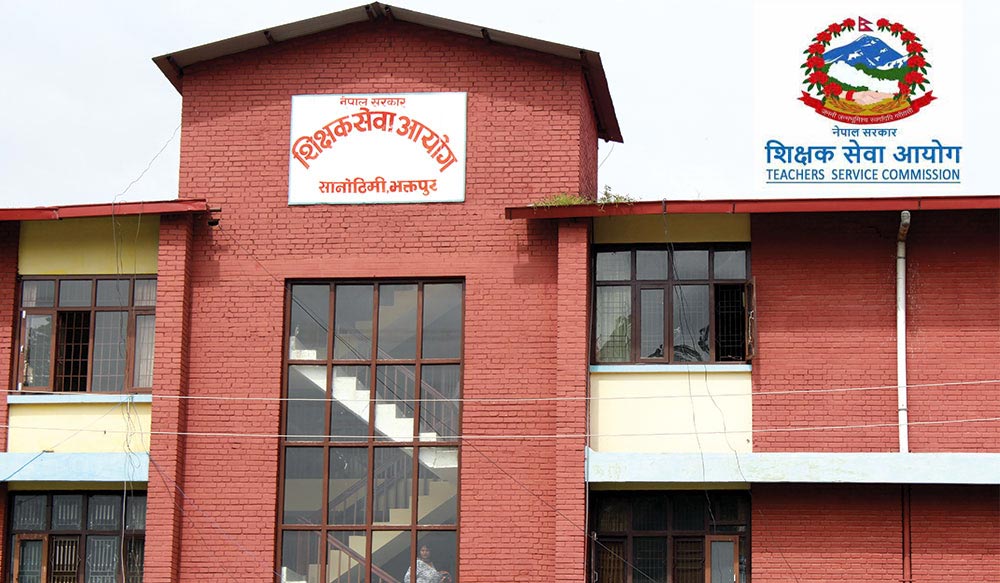
Teacher Service Commission (TSC) Vacancy Details and Recruitment Process
Publishing a teacher vacancy in Nepal’s public service is not merely the publication of a notice; it is a lawful gateway that brings thousands of qualified human resources into the state’s mainstream.
Rule 11 of the Teacher Service Commission Regulations, 2057, provides that vacancies must be advertised for recruitment.
This section presents a research-based discussion of the types of vacancies, eligibility, inclusive quotas, and the fine details of the application process.
The Basis of Vacancy and Demand Collection
The Teacher Service Commission does not publish vacancies on its own initiative. There is a defined administrative process.
-
Demand collection: the Center for Education and Human Resource Development (CEHRD) collects details of vacant teacher positions in community schools across the country.
-
Position mapping: the Center separates the vacant approved positions by district and level (open, women, Indigenous/Nationalities, etc.) and sends them to the Commission.
-
Commission decision: based on the details received from the Center, the Commission meeting decides to publish the vacancy and issues the notice through national newspapers (especially Gorkhapatra) and its website.
Types of Vacancy Advertisements
The Commission mainly publishes three types of vacancies, which candidates must understand clearly.
A) Open Competition
This is for new entrants. Any Nepali citizen who meets the eligibility can compete.
This is further divided into two parts:
-
Open category (55%): all eligible candidates may compete.
-
Inclusive category (45%): seats are reserved for targeted groups.
B) Internal Competition
This is used to regularize temporary or contract teachers working in schools, or to promote serving permanent teachers to a higher category.
However, in recent years, promotion based on performance has become more common.
C) Promotion Based on Performance
This is not an advertisement, but a process in which serving permanent teachers submit their files.
Marks are awarded based on academic qualifications, training, experience, and students’ results.
Level-wise Eligibility and Subject Requirements
Before applying, candidates must align their academic background with the Commission’s requirements.
Secondary Level (Class 9–12)
-
Academic qualification: at least a Bachelor’s degree in the relevant subject.
-
Training: at least a 10-month training in education is mandatory. However, graduates in technical and some special subjects such as science, mathematics, English, accountancy, and computer science may apply without training, but must complete training after becoming permanent.
-
License: a secondary level teaching license is mandatory.
Lower Secondary Level (Class 6–8)
-
Academic qualification: Bachelor’s degree in the relevant subject or equivalent.
-
Training: training in education is mandatory.
-
License: a lower secondary level teaching license is mandatory.
Primary Level (Class 1–5)
-
Academic qualification: completion of secondary education (Grade 12) or equivalent.
-
Training: at least a 10-month training in education, or having studied education as a subject in Grades 11 and 12.
-
License: a primary level teaching license is mandatory.
Decoding Inclusive Quotas
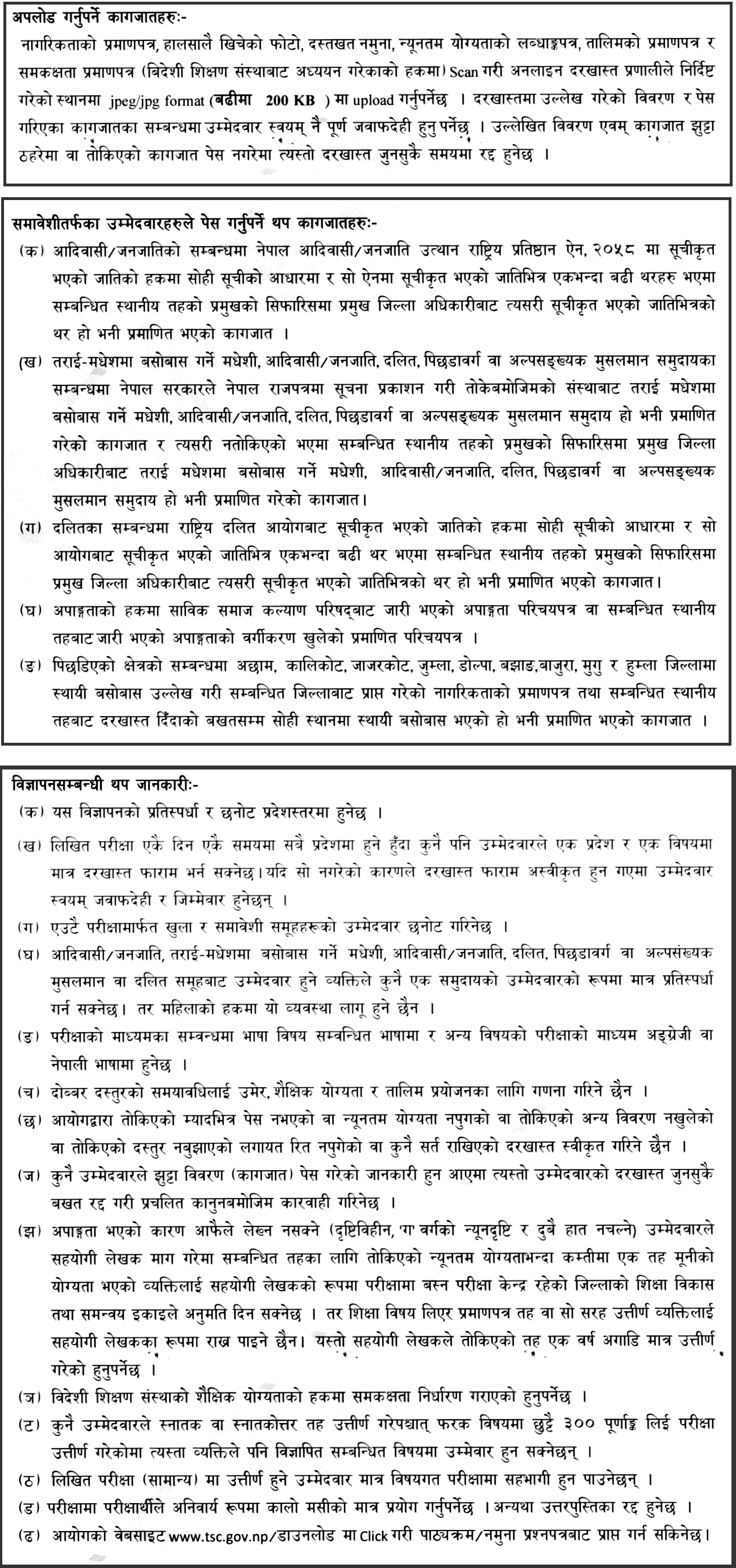
Under Nepal’s Constitution and the Education Act, 45 percent of the total posts allocated to the open side is treated as 100 percent, and is distributed as follows.
Inclusive groups, percentages, and required documents
-
Women: 33%
-
Required document: citizenship certificate (there may be separate sub-quotas for Muslim or Dalit women)
-
-
Indigenous/Nationalities: 27%
-
Required document: official certificate for listed communities
-
-
Madhesi: 22%
-
Required document: certified letter from the local level or District Administration Office (CDO)
-
-
Dalit: 9%
-
Required document: letter from the National Dalit Commission or an official body
-
-
Persons with disabilities: 5%
-
Required document: disability identity card from the Social Welfare Council or the local level
-
-
Backward region: 4%
-
Required document: proof of permanent residence in the specified nine districts
-
Special note: if eligible candidates are not available in any group, there is a legal provision that the seat will be converted to open in the following year.
Fees and Deadlines
Vacancy notices clearly specify the application fees.
-
Secondary level: NPR 1,000 (additional NPR 600 for inclusive group)
-
Lower secondary level: NPR 700 (additional NPR 500 for inclusive group)
-
Primary level: NPR 500 (additional NPR 400 for inclusive group)
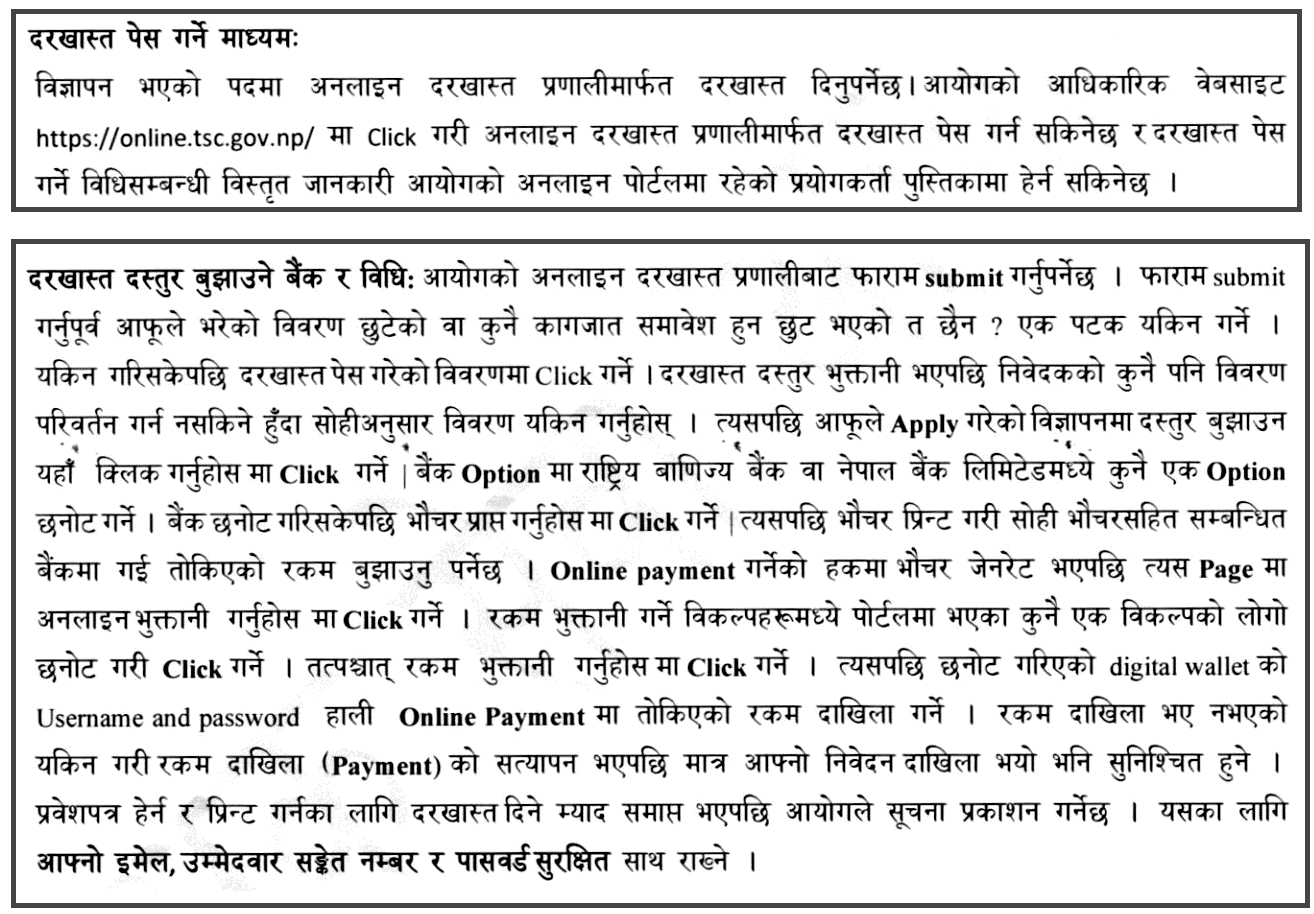
Rule on double fee
After the normal deadline ends, candidates may submit the form within an additional seven days by paying a double fee.
However, this seven-day period is not counted for age, academic qualifications, or training requirements.
This means your eligibility must already be met by the normal deadline date.
Clustering and Provincial Distribution in Vacancies
With federalism, the Teacher Service Commission now publishes vacancies on a provincial basis.
-
Candidates may apply from any one province of their choice.
-
However, under the same advertisement number, applying from more than one province is not permitted.
-
Primary level vacancies are often published on a district-wise or province-wise basis, where the number of posts is typically higher.
Ten Common Mistakes Candidates Make and Fixes
From an administrator’s experience, many qualified candidates are unable to sit for the exam due to small technical mistakes.
-
Scanned documents: do not upload blurry photos or documents taken from a mobile phone. Always use a scanner and upload a clear file.
-
Name and surname: if your name, surname, or date of birth differs between citizenship and academic certificates, obtain a recommendation confirming it is the same person from the relevant authority before applying.
-
Subject code: ensure your major subject and the required subject code in the vacancy match.
-
Training certificate: those who did not study education as a subject but completed training must upload the training certificate mandatorily.
-
Payment confirmation: after bank payment or online payment, follow up for 2–3 days to confirm whether your profile shows “Paid” or “Approved” status.
-
Transcript vs provisional: if possible, always upload the transcript. A provisional certificate may create complications in some cases.
-
Date of inclusive certification: the inclusive certificate should be dated before the vacancy notice is published. A certificate made after publication may not be valid in some cases.
-
Age calculation: by the final date of the notice, you must have completed 18 years and must not exceed 40 years. The age limit does not apply to serving permanent teachers.
-
License level: a lower secondary license cannot be used to compete at the secondary level. Your license level must match the advertised level.
-
Incorrect email/phone number: if you forget your email password or provide an inactive phone number, you may not receive admit card or result notifications later.
Post-Vacancy Flow: Results and Recommendations
After the application process ends, the following stages occur.
-
Data verification: Commission staff verify your form and documents.
-
Admit card publication: admit cards for approved candidates appear in the online portal.
-
Exam conduct: general and subject-based examinations.
-
Results and interview: interview of successful candidates.
-
Recommendation: after success in the interview, the Commission sends a recommendation for appointment to the Education and Coordination Unit on a district basis.
-
Appointment: within 30 days of recommendation, the relevant unit must issue an appointment letter and assign the teacher to a school.
Final Checklist for Candidates
Before filling the form after the vacancy opens, confirm the following.
-
Does the advertised post match your academic subject?
-
Is your teaching license level correct, and is its validity or level appropriate?
-
Do you have a 10-month training certificate, if your subject requires it?
-
If applying under an inclusive group, is your official recommendation ready?
-
Are your transcript and citizenship scans (PDF/JPG) within the specified size?
-
Have you securely noted your online portal username and password in a diary?
Conclusion
Understanding the Teacher Service Commission’s vacancy details means completing half the journey toward success. Many candidates focus only on study preparation but lose opportunities due to procedural errors. This guide helps you avoid those administrative complications. A fact-based, fair, and transparent system is the Commission’s identity.
Therefore, following vacancy conditions exactly is the candidate’s first responsibility. For official and updated information, trust only the Commission’s website and official notice board.
Service Details
- Service TypeService Commissions
- DurationYear
- RecognitionMoEST
-
Offered At
Teachers Service Commission (TSC)
Sanothimi, Bhaktapur
Other Services at Teachers Service Commission (TSC) 5
Reviews
Questions & Discussions
Contact Teachers Service Commission (TSC), Bhaktapur
- AddressSanothimi, Bhaktapur, Nepal
- Phone+977-1-6637873
- Emailadmin@tsc.gov.np
- Websitetsc.gov.np
- Contact personShikshak Sewa Aayog