APF Nepal - Armed Police Force
- Established2001
- Services 4 offered
About APF Nepal - Armed Police Force
Armed Police Force, Nepal (APF Nepal - Sashastra Prahari Bal Nepal / नेपाल सशस्त्र प्रहरी बल) has played a fundamental role in maintaining law and order in the country. APF Nepal has shown the highest level of professionalism in the protection of civilians, disaster management, border security, safeguarding the borders, industrial security and curbing the illegal activities.
The contribution of APF in conducting the different levels of the election in a fearless environment is commendable. The zero-tolerance policy against human rights violations and corruption is highly valued.
Ensuring a nation’s sovereignty, territorial integrity, and the safety of citizens is the state’s primary responsibility. To address Nepal’s geopolitical sensitivities and internal security challenges, the need was felt for a “specialized security force” between the traditional civil police (Nepal Police) and the national army (Nepali Army). This need led to the establishment of the Armed Police Force, Nepal (APF Nepal).
APF Nepal is not merely a group of uniformed personnel. It is the backbone of internal security, border management, and disaster rescue in the country. Although formally established in 2001, the organization, in a short time, succeeded in establishing itself as an indispensable “paramilitary” force of the state.
Many may wonder: “When Nepal Police and the Nepali Army exist, why was the Armed Police Force needed?” The answer lies in its nature of work and operational flexibility. APF’s structure is designed in a way that supports civil administration in maintaining peace and order while also possessing a “special capacity” to confront serious security challenges such as armed rebellion, terrorism, and border crimes.
APF’s strongest aspect is its ability to deliver “high output despite limited resources.” Whether it is saving lives during a devastating earthquake or guarding remote border points 24 hours a day to prevent revenue leakage, the professionalism, courage, and dedication (Dedication and Motivation) demonstrated by APF personnel are widely appreciated at the international level.
APF Nepal’s identity is not limited to being an armed security agency. Its promptness in disaster management and its “humanitarian spirit” have brought it closer to citizens. In addition, its “zero-tolerance policy” against human rights violations and corruption has increased institutional credibility. Providing security to industrial areas and helping strengthen the national economy is another important contribution.
In this detailed article, we will present a factual analysis of the historical background of the Armed Police Force, its legal mandate, organizational structure, and the decisive role it has played in addressing modern Nepal’s security challenges (such as border security, disaster management, and industrial security). This study is fully research-based and will help readers understand the real picture of APF.

Why Was the Armed Police Force Needed?
In state governance, new institutions are established not out of desire, but to address the problems and “security gaps” of the time. The serious national security challenges seen in Nepal in the late 1990s were the main reasons behind the formation of APF.
From the perspective of a researcher and security affairs expert, the key reasons can be explained as follows:
Limitations of Traditional Policing and Escalating Armed Conflict
After 1996 (B.S. 2052), an armed insurgency began in the country. At that time, Nepal Police, responsible for law and order, primarily focused on crime investigation and general law enforcement.
Problem: The weapons available to Nepal Police (such as .303 rifles), training, and manpower were not sufficient to control “guerrilla warfare” or an armed rebellion. As insurgents became equipped with more modern weapons, the Nepal Police had to bear heavy losses.
Need: In such conditions, the need was felt for a “combat force” trained more like the military and capable of operating modern weapons.
Sensitivity of Army Mobilization
In any democratic country, deploying the national army in internal conflict is considered a last resort. The army’s primary duty is to protect the country from external aggression. Mobilizing the army against its own citizens could raise legal complexities and questions related to international standards.
Solution: To bridge the gap between the army and police, the concept of a paramilitary force was developed—operating under the Ministry of Home Affairs, but functioning with “military structure” and “command.”
Lack of a Specialized Security Force
Beyond conflict management, the state lacked a dedicated force to fulfill other critical responsibilities:
- Border security: There was no specialized force to remain deployed 24 hours a day to prevent crimes, revenue leakage, and illegal activities along Nepal’s open borders.
- Disaster management: There was a shortage of trained personnel who could be immediately mobilized for rescue during natural disasters.
- Industrial and special-person security: Nepal Police was under pressure to supply manpower for the security of important institutions and individuals.
Legal and Policy Decision
To address these issues, a policy decision was made on 15 December 1999 to form the Armed Police Force with 25,000 trained personnel. Then, based on the report of a task force formed under the coordination of then Home Secretary Khemraj Regmi, the Armed Police Ordinance, 2001 was issued, giving the organization a legal foundation.
Therefore, the birth of the Armed Police Force came from the compulsory need of that time to transform “conflict into peace”. It is not an alternative to Nepal Police, but a complementary force that fulfills responsibilities in the “gray zone” —from controlling armed rebellion to providing relief and support to citizens in disasters.
Historical Timeline of the Armed Police Force
Based on evidence and sources obtained during research, the establishment of the Armed Police Force did not happen overnight. It was created through a policy-driven and phased process. Its historical development can be explained as follows:
-
15 December 1999: A policy decision was made to form the Armed Police Force with 25,000 trained personnel. This was the seed of APF.
-
31 January 2000: A “Task Force Commission” was formed under the coordination of then Home Secretary Khemraj Regmi for the formation of the Armed Police Force.
-
21 April 2000: The task force submitted its report to the Government of Nepal.
-
21 January 2001: The first Armed Police Ordinance was issued.
-
01 February 2001: Late Krishna Mohan Shrestha was promoted and transferred as the first Inspector General (IGP) of the Armed Police Force. His leadership laid the foundation of the organization.
-
05 February 2001: The APF headquarters office was established at Nepal Police Academy, Maharajgunj.
-
23 February 2001: The Council of Ministers approved 25,000 posts for APF.
-
12 April 2001: The second Armed Police Ordinance was issued and passed with amendments.
-
22 August 2001: Royal Assent was received from the then King, providing full legal recognition.
-
10 September 2001: The Government of Nepal provided the NCCN premises at Halchok for constructing the APF headquarters.
-
23 October 2001: The organization was provided the “Baglamukhi insignia” and “color”, a mark of pride for a military-style organization.
-
18 December 2003: The newly constructed headquarters at Halchok was formally inaugurated.
This timeline makes it clear that APF was established during a highly challenging period, through due legal process, to respond to the state’s urgent needs at that time.
Legal Mandate of APF Nepal
The Armed Police Act assigns clear responsibilities to this organization. From a researcher’s viewpoint, APF’s mandate appears “multi-dimensional.” Its main functions are as follows:
-
Control of armed conflict: To control armed conflict that has occurred or may occur in any part of Nepal.
-
Control of rebellion and separatist activities: To neutralize groups that attempt to fragment the country or conduct armed rebellion.
-
Control of terrorist activities: To take action against terrorist activities occurring in any corner or area.
-
Disaster management: To engage in rescue and relief work for victims during natural disasters or pandemics. (This is one of APF’s most appreciated roles in the present time.)
-
Riot control: To control serious riots and disturbances and maintain peace and order.
-
Control of kidnapping and serious crimes: To control situations where citizens are abducted or serious disturbances are created.
-
Border security: To protect Nepal’s international border and prevent illegal infiltration.
-
Support during external attack: To provide support under the Nepali Army during an external attack.
-
Security of key persons and structures: To provide security for important persons (VVIPs/VIPs), buildings, and places of public importance as designated by the government.
-
Revenue, customs, and industrial security: To provide security for industries and customs points considered the backbone of the national economy.
This mandate provides APF the legal basis to function as “police” during peacetime and as a “combat unit” during war or crisis.

Organizational Structure and the Role of Departments
The success of any organization depends on its internal structure and the effectiveness of its departments. APF Nepal carries out its responsibilities through various departments to achieve its objectives.
Operation Department
This department is the “brain” of the organization. It prepares deployment and strategy for peace and security, disaster management, border security, and the protection of key individuals.
Importance: Its main responsibility is to deploy forces to the right place at the right time and handle operational command. This department has demonstrated high professionalism in protecting citizens’ lives and property and safeguarding national integrity.
Border Security Department
Nepal’s open border is the most sensitive aspect of national security. The Border Security Department:
-
Controls cross-border crimes.
-
Prevents unauthorized entry and exit.
-
Discourages smuggling and illegal activities.
APF’s presence (BOPs) at border points connected to neighboring countries has provided citizens with a sense of security.
Administration Department (Administration Department)
The Administration Department is responsible for managing the entire “Recruitment to Retirement” RtoR cycle. It uses modern information technology to maintain human resource records and ensures smooth daily administrative functioning.
Human Resource Development Department
This department’s duty is to produce manpower capable of facing changing security challenges. It:
-
Updates training curricula according to the times.
-
Prepares “peace ambassadors” for peace missions (UN Peacekeeping).
-
Teaches professionalism, integrity, and humanitarian ethos.
National Armed Police Force Academy
Established on 14 July 2007, this academy’s motto is “Knowledge, Virtue and Leadership”. It provides professional and academic training from basic to higher levels for officers. It is the organization’s “Center of Excellence”, where future leaders are developed.
APF Metropolitan Office
This special office was established considering the security sensitivity of the Kathmandu Valley. Due to increasing population density, urbanization, and the presence of key individuals, the Valley’s security challenges are distinct. This office plays a direct role in disaster management, riot control, and the security of important structures within the Valley.
APF in Disaster Management
From 2010, the Armed Police Force began preparing specialized personnel for disaster management. From a researcher’s perspective,z, this is APF’s most effective “community connect”.
2015 earthquake: During the devastating earthquake, the courage and professionalism shown by APF rescuers were appreciated worldwide. From rescuing survivors from rubble to distributing relief, APF helped people feel the “presence of the state.”
Preparedness: Not only earthquakes, but also floods, landslides, fires, and pandemics—APF often reaches the incident site as a “first responder”. Despite limited resources, their motivation and dedication are notable.
Contribution to Economic Security
From the standpoint of a financial expert, APF’s role is not limited to peace and security; it also contributes directly to the national economy.
Revenue and customs security: By controlling smuggling and regulating import activities at border points, APF has helped increase state revenue.
Industrial security: “Without security, investment is not safe.” By providing security to industries and factories, APF has created an environment where business operations can continue with confidence. This has a direct relationship with industrial progress and productivity growth.
The following section presents detailed information related to the recruitment and vacancy process in the Armed Police Force, Nepal (APF Nepal). This section has been prepared, as an experienced subject expert, based on existing regulations of the Public Service Commission and the Armed Police Force.
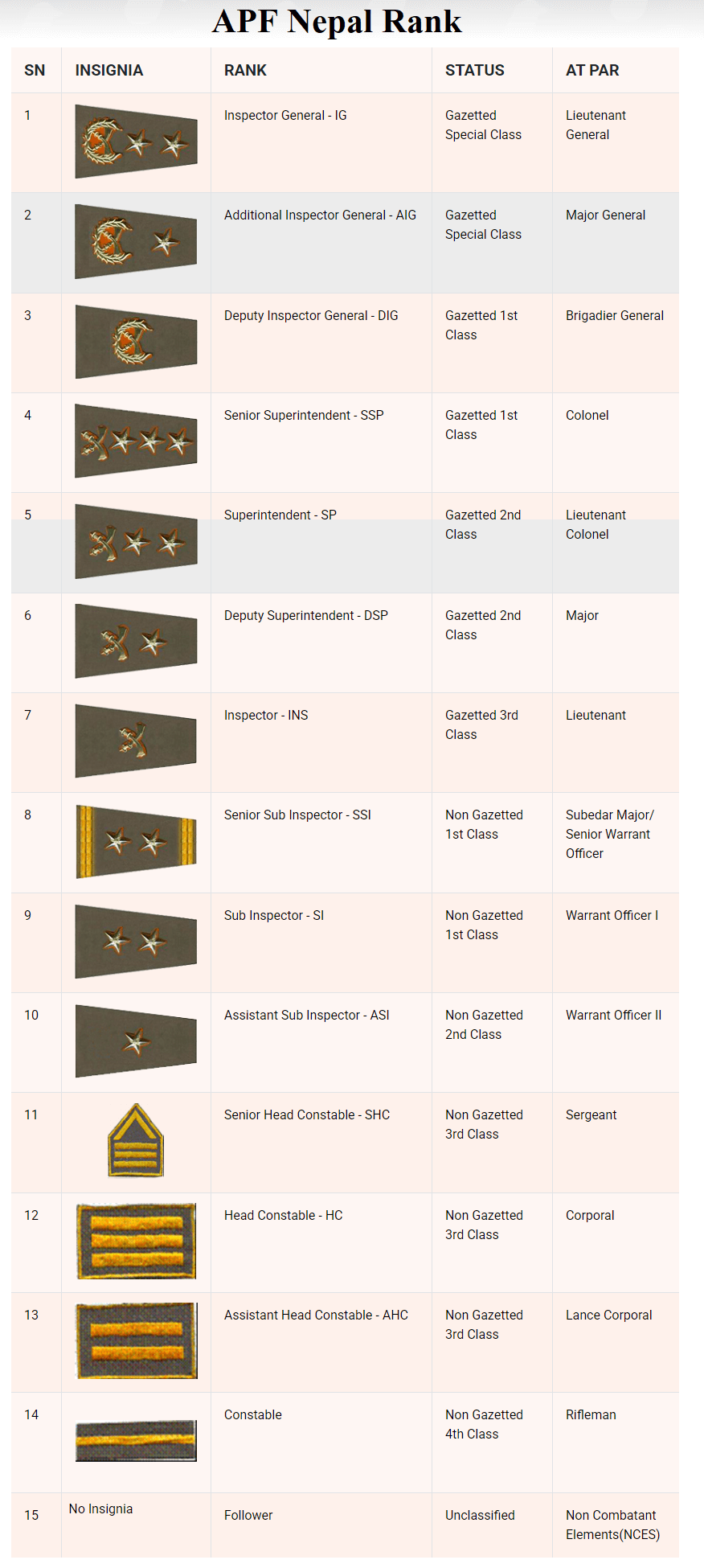
APF Nepal Rank List
- Inspector General (IG) - Gazetted Special Class - Lieutenant General
- Additional Inspector General (AIG) - Gazetted Special Class - Major General
- Deputy Inspector General (DIG) - Gazetted 1st Class - Brigadier General
- Senior Superintendent (SSP) - Gazetted 1st Class - Colonel
- Superintendent (SP) - Gazetted 2nd Class - Lieutenant Colonel
- Deputy Superintendent (DSP) - Gazetted 2nd Class - Major
- Inspector (INS) - Gazetted 3rd Class - Lieutenant
- Senior Sub Inspector (SSI) - Non-Gazetted 1st Class - Subedar Major / Senior Warrant Officer
- Sub Inspector (SI) - Non-Gazetted 1st Class - Warrant Officer I
- Assistant Sub Inspector (ASI) - Non-Gazetted 2nd Class - Warrant Officer II
- Senior Head Constable (SHC) - Non-Gazetted 3rd Class - Sergeant
- Head Constable (HC) - Non-Gazetted 3rd Class - Corporal
- Assistant Head Constable (AHC) - Non-Gazetted 3rd Class - Lance Corporal
- Constable - Non-Gazetted 4th Class - Rifleman
- Follower - Unclassified - Non-Combatant Elements (NCES)
Recruitment Process
Joining the Armed Police Force, Nepal is not merely taking a job; it is the beginning of a proud journey of “national service and discipline.” Recruitment in this organization is fully transparent, impartial, and merit-based. Since the Public Service Commission is directly involved in the recruitment process, there is no room for favoritism or patronage.
Recruitment in the Armed Police Force is mainly conducted through open competition at three levels:
-
Armed Police Inspector (Inspector) – Officer level (Gazetted Officer)
-
Armed Police Assistant Sub-Inspector (Assistant Sub-Inspector - ASI) – Junior officer level
-
Armed Police Jawan (Jawan/Constable) – Non-gazetted/Jawan level
(a) Minimum Eligibility Criteria
Before applying, any candidate must meet the following qualifications:
Armed Police Inspector
-
Age: Completed 21 years and not exceeded 25 years
-
Educational qualification: Bachelor’s Degree passed from a recognized university
-
Height (Male): Minimum 5 feet 2 inches
-
Height (Female): Minimum 5 feet 0 inches
-
Weight: Male: 50 kg, Female: 42 kg
-
Chest (Male only): Unexpanded 31 inches, expanded 33 inches
-
Eyes: Not weaker than ±2
Armed Police Assistant Sub-Inspector (ASI)
-
Age: Completed 18 years and not exceeded 23 years
-
Educational qualification: Plus Two / +2 or equivalent passed
-
Height (Male): Minimum 5 feet 2 inches
-
Height (Female): Minimum 5 feet 0 inches
-
Weight: Male: 50 kg, Female: 42 kg
-
Chest (Male only): Unexpanded 30 inches, expanded 32 inches
-
Eyes: Not weaker than ±2
Armed Police Jawan
-
Age: Completed 18 years and not exceeded 22 years
-
Educational qualification: Class 8 passed
-
Height (Male): Minimum 5 feet 2 inches
-
Height (Female): Minimum 5 feet 0 inches
-
Weight: Male: 50 kg, Female: 42 kg
-
Chest (Male only): Unexpanded 30 inches, expanded 32 inches
-
Eyes: Not weaker than ±2
(Note: Eligibility criteria may differ somewhat for technical positions and Parichar positions.)
(b) Selection Phases
The recruitment process is very strict and step-based. A candidate can proceed to the next stage only after passing the previous one.
Application registration
Initially, the form must be submitted either online or by appearing at the designated office. During this process, an “initial medical checkup” is also conducted, where height, weight, and general disabilities are checked.
Physical endurance test
In this stage, the candidate’s physical fitness is tested. The following events are included:
-
300-meter run: Short-distance sprint
-
Long run (2 miles/3.2 km): Must be completed within the set time
-
Sit-ups and push-ups: Strength test
-
Chin-ups: (For males only)
-
Jump (High Jump / Long Jump): Flexibility test (may vary by post)
Special information: Candidates who fail the physical test are eliminated at that stage.
Detailed medical checkup
Candidates who pass the physical test undergo a detailed medical examination by specialist doctors. This includes tests such as blood, urine, chest X-ray, blood pressure, teeth, ears, and colour blindness. If diseases such as HIV or hepatitis are detected, the candidate is declared ineligible.
Written examination
This is the most important stage and is conducted by the Public Service Commission.
Syllabus: Questions are asked on general knowledge (GK), intellectual test (IQ), Nepali and English language, and service-related matters.
For officer-level positions, knowledge of the Constitution and laws is also required.
Psychological/personality test – (For officer level only)
For the Inspector post, this test is conducted to examine the candidate’s psychological condition, leadership ability, and decision-making capacity.
Special medical checkup
Just before the interview, for some special posts, a re-check of health may be conducted.
Interview
In the final stage, an oral interview is held. This tests the candidate’s personality, speaking style, confidence, and knowledge of contemporary issues.
(c) Inclusion Policy
In line with the spirit of Nepal’s Constitution, the Armed Police Force follows an inclusion quota (Quota System) in recruitment. Besides open competition, seats are reserved for the following groups:
-
Women
-
Indigenous/Janajati
-
Madhesi
-
Dalit
-
Backward region
-
Families of martyr/disabled Armed Police personnel
Although the recruitment process of the Armed Police Force is as hard as “iron-beaten chiura,” for hardworking and capable youth, it is a valuable opportunity. Based on 30 years of experience, if you are physically fit, your written preparation is strong, and you carry the determination to “do something for the country,” you can become a proud member of this organization.
Conclusion
Within a short time of its establishment, the Armed Police Force, Nepal (APF Nepal) has succeeded in becoming an integral part of Nepal’s security architecture. Whether it is establishing peace during conflict or managing borders and disasters during peacetime, the organization has repeatedly proven its rationale.
-
Professionalism: Delivering high output despite limited resources and means is a strong side of the organization.
-
Human rights and zero tolerance: The “zero tolerance” policy against human rights violations and corruption has made it citizen-friendly.
-
The road ahead: To address the changing global environment, cybersecurity challenges, and new dimensions of border crime, APF appears to need greater investment in technology and human resource development.
In the end, the Armed Police Force, Nepal, carrying the motto of “peace, security, and service,” is a reliable and capable security force of the state. Its role in history and its active performance in the present reinforce confidence that this organization is fully capable of facing future challenges.
Institutions Under APF Nepal
| APF Command and Staff College |
| APF Nepal Institute of Health Sciences |
| Nepal APF School Jhalari |
| Nepal APF School, Kathmandu |
Services Offered 4
Latest Updates & Notices
- 19 Aug 26 APF Nepal Orders 9 Absent Personnel to Report in 7 Days
- 19 Jul 26 Armed Police Inspector Accounts Written Exam Result 2083
- 17 Jul 26 APF Nepal Inspector Post Written Exam Result 2083
- 26 Jun 26 APF Nepal Tells Six Out-of-Contact Staff to Report in 7 Days
- 26 May 26 APF Nepal ASI Written Exam Center in Jaleshwar 2083
- 24 May 26 APF Nepal ASI Post Written Exam Center Surkhet 2083
- 24 May 26 APF Nepal ASI Written Exam Center in Butwal 2083
- 22 May 26 APF ASI Written Exam Centers Pokhara 2083
Contact APF Nepal - Armed Police Force, Kathmandu
- AddressAPF Headquarters, Halchowk, Kathmandu, Nepal
- Phone +977-1-5249524
- Email info@apf.gov.np
- Website apf.gov.np
- Contact personHeadquarters