APF Command and Staff College (APFCSC) is the higher learning institution of the Armed Police Force, Nepal, established to strengthen the professional capability and academic depth of its mid-level officers. Located in Mahendra Bhawan, Sano Gaucharan, Gyaneshwor, Kathmandu, Nepal, and affiliated with the Faculty of Humanities and Social Sciences at Tribhuvan University, the college runs the Masters in Security, Development and Peace Studies (MSDPS) alongside the APF Command and Staff Course for selected officers.
The college functions as a link between the operational reality of security work and advanced academic study. It trains officers in staff work, leadership, strategy, and policy analysis while connecting these subjects with wider national, regional, and global security concerns.
Through academic classes, professional exercises, research, internal and foreign study tours, seminars, and conferences, APFCSC supports the Armed Police Force in meeting emerging security challenges and strengthens Nepal’s contribution to national and international security.
Affiliated with Tribhuvan University, Faculty of Humanities and Social Sciences
Runs Masters in Security, Development and Peace Studies (MSDPS) together with the APF Command and Staff Course
Established to build leadership and staff skills of APF officers at mid-level command
Headed by a Deputy Inspector General (DIG) of APF, Nepal, serving as Commandant, with Academic and Professional Wings
MSDPS is a 63-credit, four-semester program with strong focus on security, development, peace, and applied security fields
Nine batches of APF Command and Staff Course completed or ongoing, with more than 100 officers qualifying for the Public Service Commission (PSC) examination through APFCSC
Regular internal and foreign study tours, panel discussions, conferences, and research activities on contemporary security issues
Periodic publication of the Journal of APFCSC focusing on security, peace, and development studies
The main academic program of APF Command and Staff College is the Masters in Security, Development and Peace Studies (MSDPS), affiliated with Tribhuvan University. MSDPS combines theoretical learning with field-oriented applications related to security forces in Nepal and the wider region.
The program:
Extends over four semesters (two academic years)
Carries 63 credit hours
Brings together three pillars: security, development, and peace, along with applied subjects such as industrial security, border security and management, disaster risk reduction, and security laws of Nepal
Key areas in the MSDPS curriculum include:
Strategic thought, regional and global security, and national security
Governance and statecraft, Nepalese economy, and social and cultural dimensions of Nepal
Conflict and peace studies, conflict resolution practices, and disaster risk reduction
Human rights law and international humanitarian law
Border management, industrial security, customs and revenue security, and security laws of Nepal
Research methodology and thesis writing under Tribhuvan University regulations
Each semester combines classroom teaching with research assignments and term papers that relate directly to the professional roles of APF officers. This structure helps officers link their field experience with academic frameworks in security and development.
Alongside MSDPS, the Command and Staff Course focuses on professional subjects needed for mid-level command and staff appointments within APF, Nepal. It covers staff duties, conventional operations, insurgency and counter-insurgency, terrorism and counter-terrorism, public order management, industrial and border security, disaster management, intelligence, administration and logistics, training management, and peacekeeping operations.
The professional curriculum is arranged in three terms and integrates map exercises, campaign planning, disaster management exercises, and simulations on UN peacekeeping, crime control, VIP and vital installation security, and policy planning.
Admission to MSDPS at APFCSC is selective and intended mainly for in-service officers of the Armed Police Force, Nepal. A candidate must:
Hold at least a Bachelor’s degree (10+2+3 or 4) in any discipline from a university recognized by Tribhuvan University
Be an officer of APF, Nepal in the rank of Inspector, Deputy Superintendent, or Superintendent
Meet additional requirements when seats are offered to officers from other national or international security organizations
Candidates are admitted based on performance in an entrance examination administered according to procedures approved by Tribhuvan University and APF Command and Staff College. Merit ranking within the approved intake determines final selection.
Being a professional in-service college, APFCSC follows internal rules of APF, Nepal for nomination of officers, service records, and related administrative screening. Prospective applicants should consult APF Headquarters or official notices for current regulations and intake details.
APF Command and Staff College is led by a Deputy Inspector General of APF, Nepal serving as Commandant. Under the Commandant, the college has two main wings:
Academic Wing, headed by the Academic Program Coordinator
Professional Wing, led by the Chief Instructor and supported by Directing Staff (DS) officers who are Command and Staff Course graduates from Nepal or abroad
Faculty composition includes:
APF officers with advanced qualifications such as MSS, MPA, MA, MBS, LLB, PGD in IHL, and MSDPS
Professors and subject experts from Tribhuvan University and other academic institutions who deliver lectures, seminars, and workshops in their areas of specialization
Professional studies are mainly conducted in syndicates. Directing Staff guide group discussions, planning exercises, and case-based problem solving. Activities include map exercises, campaign planning, intelligence preparation of the battlefield, disaster management exercises, UN peacekeeping simulations, and workshops on emerging security issues. English is used for instruction and written work.
Academic classes run centrally in lecture halls. Teaching methods include:
Lectures with multimedia support
Presentations by student officers
Panel discussions and conferences
Research supervision, term papers, and thesis guidance
This mix of faculty expertise and practice-oriented methodology ensures that learning is closely connected with real command and staff responsibilities.
APF Command and Staff College maintains a compact but functional campus that supports both academic and residential needs of student officers. Key facilities include:
Administrative building
Academic Wing and Professional Wing
Officers’ barracks and separate barracks for student officers (Block A and Block B)
Conference hall for seminars, workshops, and formal events
Lecture halls and syndicate rooms equipped with multimedia teaching aids
The college provides free wireless internet within the premises and an intranet for internal communication, document sharing, and access to organizational references.
Health services are available through a medical room staffed round-the-clock by a nursing assistant. In coordination with APF Hospital, ambulance support is available for cases that need additional care.
Transport facilities are managed for training visits, outdoor exercises, internal and foreign study tours, and official duties. Officers may also bring their personal vehicles as per college rules.
APFCSC operates as a residential, intensive training environment. Student officers balance professional responsibilities with academic commitments throughout the course. Daily life includes:
Scheduled professional and academic classes
Group tasks within syndicates
Individual study for research and thesis work
Physical training and drill as per APF norms
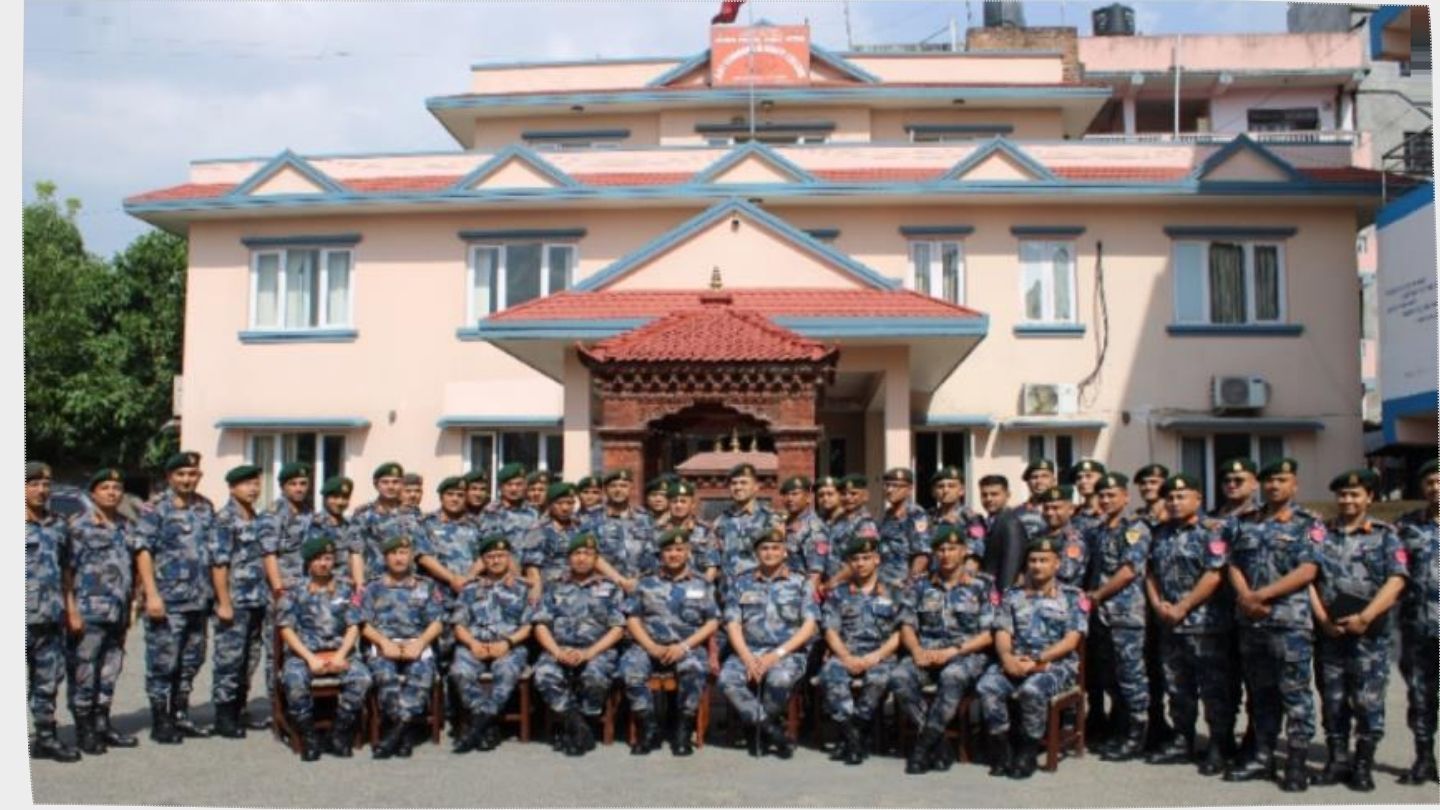
Interaction with senior APF leadership and visiting experts is a regular part of campus life. Photographs and records from official events show student officers engaging with the Inspector General of APF, provincial leaders, and senior military and academic figures in discussions on security policy, disaster governance, and international issues.
The culture of the college encourages disciplined living, mutual respect, and peer learning among officers from different postings and backgrounds within the security sector.
Beyond formal coursework, APF Command and Staff College organizes:
Internal study tours to APF units and districts to observe field operations and administrative practices
Foreign study tours, for example to India, focusing on law enforcement, border management, and related security institutions
Panel discussions on topics such as disaster governance, Russia–Ukraine conflict and its implications for South Asia, security dynamics of the Indo-Pacific region, UN peacekeeping, and national security council practices
Conferences on UN peacekeeping and emerging security issues
These activities help officers connect theoretical perspectives with current events and policy debates and also strengthen professional networking within and beyond Nepal.
APF Command and Staff College functions as an in-service professional institution of the Armed Police Force. Student officers are nominated through official channels, and financial provisions such as salary, allowances, and course-related expenses follow APF Nepal and Government of Nepal rules.
Interested officers and partner organizations should refer to APF Headquarters or formal circulars for the latest information on financial entitlements, study leave provisions, and support for external participants. This approach keeps financial arrangements transparent and aligned with national public service regulations.
APF Command and Staff College has grown steadily since its conceptualization and approval in 2015. Key milestones include:
Endorsement by Tribhuvan University’s Academic Council for MSDPS and approval by the Ministry of Home Affairs for the Command and Staff Course entrance procedures in 2015
Formal announcement of the college by the Inspector General of APF and formation of its management committee in the same year
Completion of eight Command and Staff Course batches and commencement of the ninth batch by 2024, with student numbers ranging from 9 to 20 per batch
More than 100 officers qualifying for Public Service Commission examinations through APFCSC, strengthening the pool of professionally trained leaders in APF and related agencies
Regular academic and policy events, including conferences on UN peacekeeping and interactions with provincial leaders and senior security experts, reflected in the 2082 profile photographs and captions
Launch and periodic publication of the Journal of APFCSC, which documents research on security, development, and peace from officers and academic contributors
These achievements show the college’s evolving role as a hub for security sector learning within Nepal’s broader higher education framework.
For officers of APF, Nepal, and partner security organizations, APFCSC offers several distinct advantages:
Integration of academic and professional learning: MSDPS and the Command and Staff Course run together, allowing officers to earn a master’s degree while deepening professional competence.
Close link with Tribhuvan University: The program follows TU’s academic standards, research requirements, and evaluation methods while staying grounded in security practice.
Experience-based faculty: Directing Staff and senior instructors bring long field experience, while professors from TU and other institutions contribute strong academic perspectives.
Research and publication culture: Officers prepare term papers, thesis projects, and analytical reports that may feed into the Journal of APFCSC and internal policy discussions.
Exposure to national and international security institutions: Internal and foreign study tours, along with frequent panel discussions, introduce officers to practices beyond their home units.
APF Command and Staff College is the main professional and academic institution of the Armed Police Force, Nepal, for developing mid-level leaders. Through the Masters in Security, Development and Peace Studies (MSDPS) and the Command and Staff Course, the college links daily security responsibilities with structured study in the social sciences.
Its academic and professional activities pay close attention to national security, development issues, peace processes, and changes in regional and global security. In this way, the college helps officers strengthen their judgment, analytical ability, and sense of responsibility towards the state and the public they serve.
APFCSC is mainly for in-service officers of the Armed Police Force, Nepal. Applicants must have a recognized bachelor’s degree and hold the rank of Inspector, Deputy Superintendent, or Superintendent. When approved, limited seats may also be made available for officers from other national or international security organizations.
In affiliation with Tribhuvan University, the college offers a Master’s degree in Security, Development and Peace Studies (MSDPS). Student officers follow this academic program while also completing the professional Command and Staff Course.
The Command and Staff Course, which was previously 78 weeks, is now conducted over 60 weeks. It is divided into three terms of 20 weeks each, with a short break between the terms.
The professional course covers staff duties, conventional operations, minor tactics, intelligence, administration and logistics, insurgency and counter-insurgency, terrorism and counter-terrorism, public order management, industrial and border security, disaster risk reduction and management, UN peacekeeping operations, security-related laws, customs and revenue security, VIP and vital installation security, and policy planning.
Yes. The MSDPS program includes research methodology and thesis work under Tribhuvan University rules. Student officers also write term papers on selected themes. In addition, the college brings out the Journal of APFCSC, which includes articles on security, development, and peace.
Student officers take part in foreign study tours to security and law-enforcement institutions in other countries. They also attend conferences and interactions with international experts on topics such as UN peacekeeping, regional security, and major global conflicts.