




You understood the lesson when your teacher explained it. You followed the examples, took notes, and felt confident about the topic. A few days later, you tried answering a question without looking at your notebook, and much of the information was difficult to remember.
Perhaps you reopened your notes and immediately recognized the answer. That made the topic seem familiar again, but it did not explain why you struggled to remember it independently.
This difference between recognizing information and recalling it is one reason reviewing can be frustrating. Spending time with material does not necessarily mean you will remember or use it when needed.
Research in learning and memory offers useful guidance. Studies have found that attempting to retrieve previously learned information, checking responses, and distributing practice across separate sessions can improve long-term retention. These methods are commonly called retrieval practice, active recall, and spaced practice. Their effectiveness depends partly on the material, the learning task, and how they are used.
Whether you are reviewing a school lesson, preparing for university examinations, learning a language, or developing a professional skill, the aim is not to repeat everything you studied. It is to identify what you remember, repair gaps in understanding, and strengthen your ability to use the knowledge later.
Answer Summary: To review what you learned effectively, begin by recalling the material without looking at your notes. Check your response, correct mistakes, and revisit the topic across separate sessions. Use questions for factual knowledge, explanations for concepts, and independent practice for skills. There is no fixed review schedule that suits every learner. Adjust the timing and difficulty of future reviews according to what you can remember, explain, and apply accurately.
Key Takeaways:
-
Recall information before reopening your notes.
-
Check answers and correct misunderstandings.
-
Review across separate sessions rather than concentrating all practice into one sitting.
-
Match review activities to the knowledge or skills you need.
-
Give difficult material more attention without abandoning previously learned topics.
-
Use delayed recall and independent application to assess retention.
1. What Does Reviewing What You Learned Mean?
Reviewing what you learned means returning to previously studied material to check what remains in your memory, strengthen understanding, and practice using the knowledge without relying on the original explanation.
Effective reviewing is not the same as reading the same notes repeatedly.
When you first study something, your attention is usually on understanding new information. During review, the focus changes. You need to establish whether you can remember and use what you previously learned.
For example, suppose you studied the causes of a historical event. During the lesson, you understood the teacher's explanation and copied the main points.
When reviewing, you should be able to describe those causes, distinguish their roles, and explain how they contributed to the event.
If you can recognize the explanation but cannot reconstruct it, you have identified something that requires further attention.
Why familiar information can be misleading
Recognition and recall involve different demands.
Recognition means identifying information when it appears in front of you. Recall means producing information from memory without seeing the complete answer.
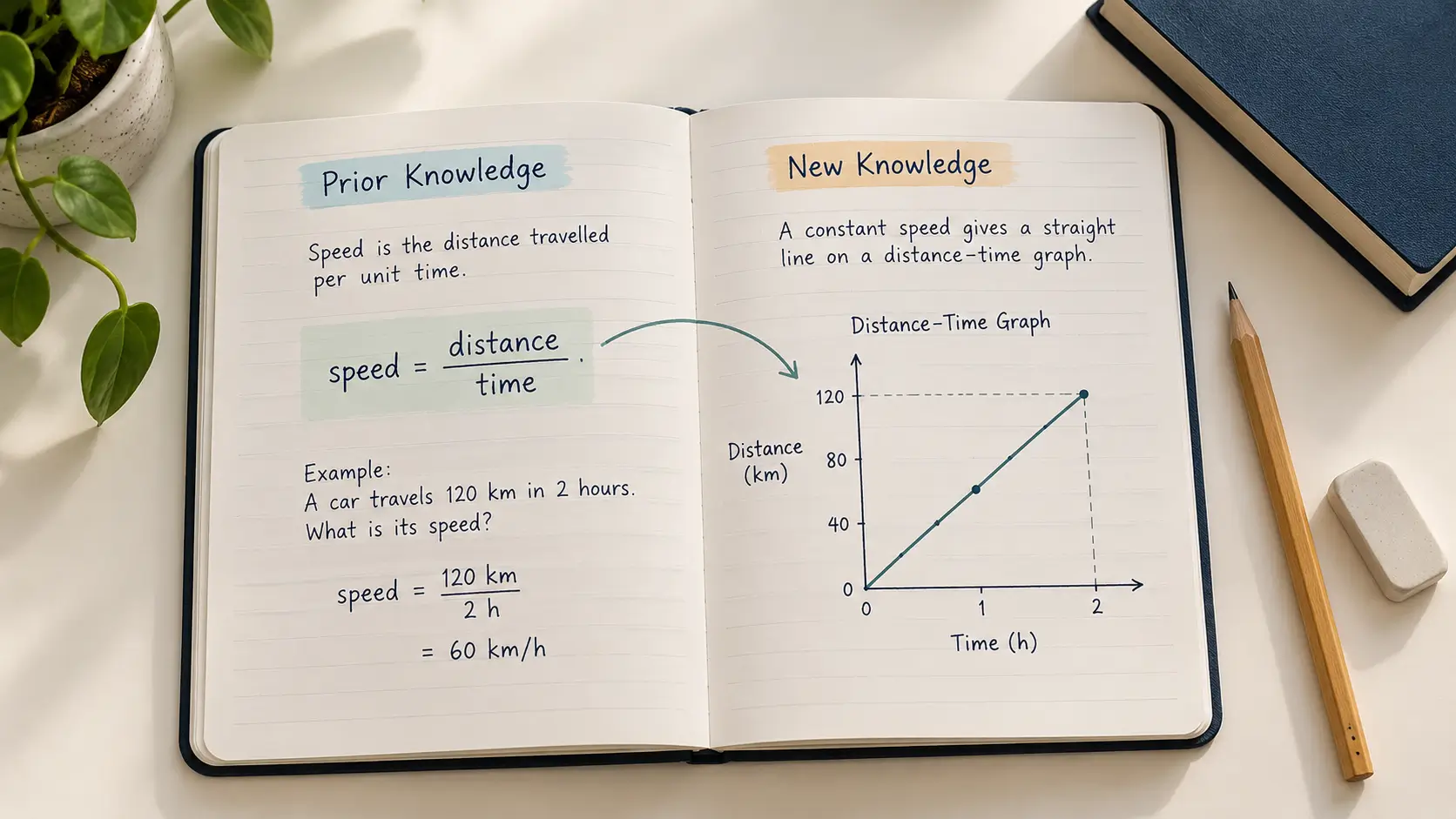
You may recognize a mathematical formula when reading a textbook but struggle to remember it during an examination.
You may understand a scientific explanation while watching a lesson but find it difficult to explain the same process independently.
Researchers Nicholas Soderstrom and Robert Bjork (2015) explain that successful performance during learning does not necessarily establish durable learning. Their review distinguishes what learners can do while information and guidance are available from what they retain and can use later.
This matters because rereading familiar material can make studying feel successful without revealing what remains difficult to remember.
The practical response is to include opportunities to recall information without looking at the source.
2. How to Review a Lesson Effectively
A useful review session begins with an attempt to remember the material, followed by checking, correction, and further practice where needed.
You do not need an elaborate system. A blank page, a few questions, or a practice problem can help you examine what you have retained.
Begin by recalling what you remember
Before opening your notes, try reconstructing the main ideas from the lesson.
Suppose you studied photosynthesis.
Instead of rereading the chapter immediately, write what you remember about the process. Identify the main inputs and outputs, explain the role of light, and describe why the process matters to plants.
When you finish, compare your explanation with the textbook.
You may discover that you remembered the general purpose but confused the inputs and outputs. You now know exactly what needs correction.
This approach is called retrieval practice because you are attempting to bring previously learned information back into memory.
Retrieval practice can take several forms:
-
Answering questions without notes.
-
Writing a short explanation from memory.
-
Reconstructing a diagram or sequence.
-
Recalling definitions before checking them.
-
Solving a previously learned type of problem independently.
In experiments reported by Roediger and Karpicke (2006), students studied prose passages and either restudied the passages or practiced recalling them. Repeated studying supported better performance on an immediate test, but retrieval practice produced stronger retention on delayed tests conducted two days or one week later.
This finding helps explain why retrieving information can be worthwhile even when the task feels harder than reading familiar material.
Check your response before repeating it
Retrieval practice becomes more informative when you examine the accuracy of your answers.
After recalling the material, reopen the textbook or another reliable source.
Identify what was correct, what was missing, and what was misunderstood.
These problems require different responses.
If you forgot a term, review its meaning and attempt to recall it again.
If you confused two concepts, compare their definitions and identify the distinction.
If your explanation was incomplete, study the missing relationship rather than copying the entire paragraph again.
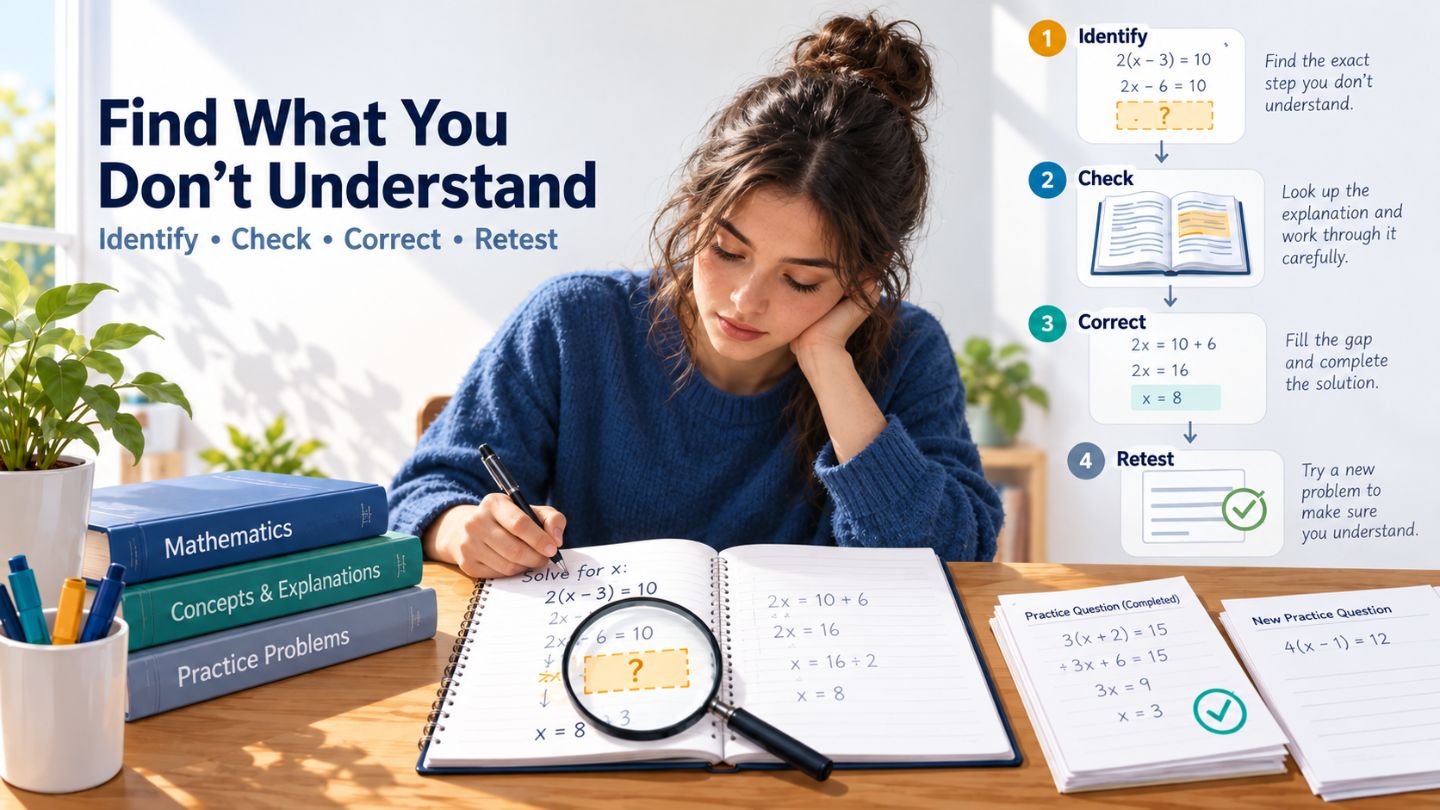
If you made an error while solving a problem, examine the step where your reasoning changed from the correct procedure.
Research by Butler and Roediger (2008) found that feedback following multiple-choice testing improved later accuracy and reduced errors associated with incorrect answer options. The findings demonstrate an important limitation of testing without correction: learners need opportunities to identify and repair inaccurate responses.
A mistake during review can provide useful information. Leaving it unchecked, however, risks carrying that misunderstanding into later practice.
Explain the material in your own words
Remembering a definition is useful, but some topics require understanding relationships rather than recalling isolated facts.
After checking your initial answers, try explaining the topic without copying the original wording.
For example, a student reviewing the water cycle may remember the terms evaporation, condensation, and precipitation.
A stronger explanation describes how these processes are connected, why they occur, and how water moves through the cycle.
Ask whether you can explain the process to someone who has not studied it.
If the explanation becomes unclear at a particular point, return to that section and examine the underlying idea.
Karpicke and Blunt (2011) found that retrieval practice supported comprehension and inference when participants learned scientific texts, including questions requiring more than the repetition of memorized facts. The study provides evidence that retrieval can contribute to meaningful learning under the conditions examined.
The implication is not that explanation replaces studying. It is that reviewing should test whether you understand what the information means, not solely whether you can repeat its wording.
Practice using the knowledge
Some subjects require you to perform a task rather than describe it.
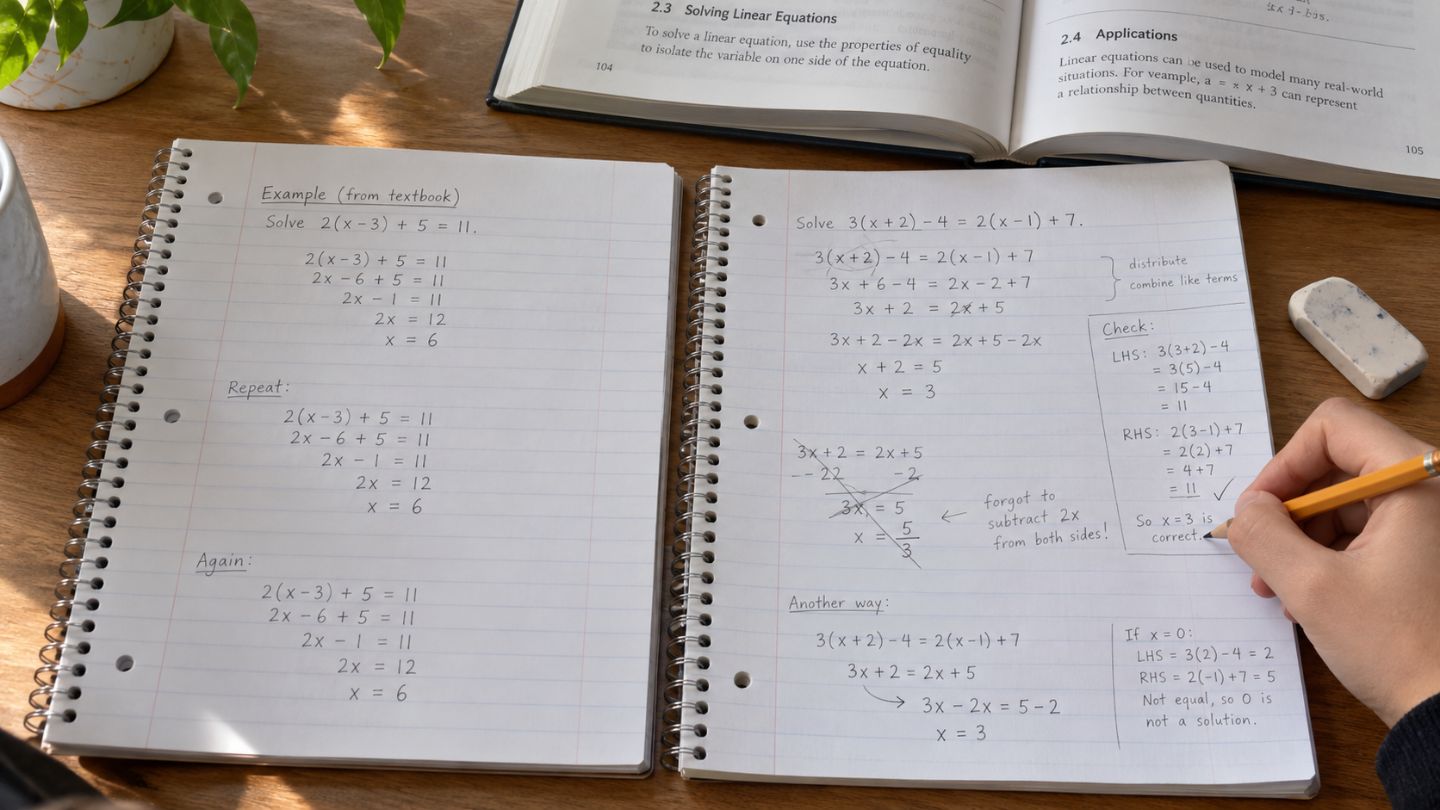
For mathematics, reviewing a solved example is not enough to establish that you can solve another problem independently.
After understanding the worked solution, close it and attempt a similar question.
Check the answer and, importantly, the reasoning used to reach it.
For language learning, practice constructing sentences rather than recalling grammar rules alone.
For computer skills, attempt a relevant task without following every step of a tutorial.
For a subject involving diagrams, try drawing and labeling the structure from memory.
Choose an activity that resembles what you will eventually need to do with the information.
Finish by identifying what needs another review
A review session should leave you with a clearer picture of your learning.
Before moving to another topic, identify:
-
What you recalled accurately.
-
What you understood only after checking.
-
What you still cannot explain or apply.
You do not need to rewrite the entire lesson.
Record the specific questions or concepts that need attention. They can form the starting point for your next review.
3. When and How Often Should You Review?
Reviewing material across separate sessions generally supports longer-term retention better than concentrating equivalent practice into one continuous study period.
This is known as spaced practice or distributed practice.
The spacing between reviews matters, but there is no universal timetable that works equally well for all subjects and learners.
Why reviewing across time helps
When you reread a lesson several times in one sitting, the information remains familiar because you encountered it recently.
Returning to the material later places different demands on memory.
You must attempt to recall information that is no longer immediately available from the previous reading.
Cepeda and colleagues (2006) examined distributed practice across 317 experiments reported in 184 articles. Their analysis found that spacing affects retention and that the interval associated with stronger performance depends partly on how long the information needs to be remembered.
The findings support distributing review opportunities across time, but they do not establish one fixed schedule for every learning objective.
A student preparing for an examination in several days has different timing requirements from someone learning material intended for use months later.
A manageable review schedule
A practical starting arrangement is to review a topic shortly after learning it, return the following day, and revisit it during subsequent study sessions.
The following is an illustrative schedule, not a scientifically prescribed timetable.
|
Review |
Suggested activity |
|---|---|
|
After the initial lesson |
Recall the main ideas and identify unclear points |
|
The following day |
Answer questions without notes and correct errors |
|
Several days later |
Explain important concepts or solve different practice questions |
|
During the following week |
Combine the topic with related material and test recall |
|
During later study |
Revisit the material according to accuracy and future learning needs |
The schedule should change when your performance shows that an adjustment is needed.
If you repeatedly forget an important concept, review it sooner or examine whether you understood it initially.
If you recall the material accurately across separate sessions, you can consider longer intervals.
The goal is not to follow dates regardless of your learning. It is to provide repeated opportunities to retrieve knowledge over the period in which you need to retain it.
What if you miss a review session?
Missing a planned review does not require restarting the entire chapter.
Return to the topic and attempt a short recall exercise.
If you remember the main information, continue with suitable practice.
If substantial information is missing, revisit the relevant explanation before testing yourself again.
A review schedule should help you decide what to study, not become a separate administrative task that consumes the time available for learning.
4. Choose Review Methods According to What You Are Learning
Different subjects require different kinds of knowledge. Reviewing is more useful when the activity matches what you will need to remember, explain, or perform.
Memorizing vocabulary, understanding a scientific process, and solving mathematical problems are not identical learning tasks.
For facts, definitions, and vocabulary
Short-answer questions and flashcards are useful for material requiring accurate factual recall.
Examples include scientific terminology, historical dates, vocabulary, definitions, and the names of structures.
When using flashcards, attempt the answer before turning the card over.
If you recognize the answer only after seeing it, do not treat that as successful independent recall.
A useful flashcard should ask a clear question and provide an accurate answer that you can check.
For complex definitions, also practice explaining what the term means in context.
A student learning the term osmosis, for example, should be able to do more than repeat its definition. Explaining the direction of water movement under relevant conditions provides a stronger check of understanding.
For concepts and explanations
Reviewing conceptual knowledge requires examining connections and distinctions.
Suppose you studied inflation in economics.
You may remember the definition but still need to explain the difference between an increase in the general price level and a change in the price of one product.
A useful review question asks you to explain that distinction using an appropriate example.
For history, compare causes and consequences.
For literature, explain how evidence from a text supports an interpretation.
For science, describe how the components of a process interact.
When a subject requires explanation, use questions that begin with why, how, or what changes when rather than relying exclusively on definitions.
For mathematics and problem-solving
Mathematics review should gradually move from understanding worked examples to selecting and applying methods independently.
Begin with a question similar to one you have learned.
Once you can solve it accurately, try a different question requiring the same principle.
Later, mix it with other previously learned problem types.
This mixed approach is called interleaved practice.
Rohrer and Taylor (2007) investigated mathematics practice and found benefits from spacing problems and mixing different problem types in their experimental conditions. Their research suggests that mixed practice can help learners move beyond repeating a procedure immediately after being shown which procedure to use.
However, introducing several unfamiliar problem types simultaneously is not necessary.
First establish how each procedure works. Mixed practice becomes more useful when you have enough initial understanding to compare methods and decide which one fits a question.
For practical skills
Practical skills require opportunities to perform relevant tasks.
Someone learning spreadsheet software may understand a tutorial but struggle when the data or task changes.
During review, attempting a different spreadsheet problem provides a clearer indication of whether the procedure has been learned.
A language learner can practice producing original sentences or participating in a conversation.
Someone learning to make presentations can apply the same design principle to different content.
When a task involves professional, technical, or safety-related requirements, practice should remain consistent with approved instructions and any necessary supervision.
The central distinction is between knowing the steps and being able to perform them in an appropriate situation.
5. What Should You Do When You Keep Forgetting?
If you repeatedly forget previously studied material, identify the specific difficulty before deciding how to review it again.
Repeatedly reading the entire chapter is not necessarily the appropriate response.
When you cannot recall anything
If a topic produces almost no recall, return to the relevant explanation.
Check whether you understood the material during your initial study.
If the topic was unfamiliar or confusing from the beginning, another retrieval attempt alone may not resolve the problem.
Work through a smaller section, clarify the central idea, and then attempt to explain it without looking.
For example, if you cannot remember the stages of a biological process, establish what happens at each stage before trying to recall the complete sequence.
The purpose is to rebuild sufficient understanding for meaningful retrieval.
When you remember parts but miss important details
Partial recall suggests that some information remains accessible.
Instead of starting again from the beginning, examine what is missing.
Suppose you remember the main argument of an essay but cannot recall the evidence supporting it.
Review the relevant evidence, connect it to the argument, and attempt the explanation again.
Targeting the missing relationship is more useful than treating every part of the topic as equally unfamiliar.
When you confuse similar concepts
Sometimes the problem is not forgetting information but failing to distinguish between related ideas.
For example, students may confuse speed and velocity, mitosis and meiosis, or correlation and causation.
Review the concepts together and identify the feature that separates them.
Then attempt questions requiring you to choose which concept applies.
If you cannot explain the distinction, return to the underlying definitions and examples before continuing.
When you remember the method but cannot apply it
If you can describe the steps of a mathematical procedure but cannot solve a problem, additional factual memorization may offer limited help.
Examine where the difficulty occurs.
Are you unable to identify the appropriate method? Do you misunderstand one step? Are you making calculation errors?
Each difficulty suggests a different practice activity.
For example, choosing the wrong formula requires practice recognizing problem conditions, while repeatedly making the same algebraic error requires examining that operation.
When reviewing feels unnecessarily difficult
Retrieval practice demands more independent effort than reading an answer already provided on the page.
That difficulty is not automatically evidence that the method is ineffective.
However, difficulty alone does not demonstrate learning.
If you cannot answer questions despite several attempts, stop repeating unsuccessful responses and return to the material for clarification.
Checking answers, using suitable guidance, and gradually increasing independence are part of effective review.
Research on retrieval practice supports its benefits across many educational conditions, but not every retrieval attempt produces the same result. Agarwal, Nunes, and Blunt (2021) reviewed 50 classroom experiments and found benefits across varied learning contexts, while also noting limitations in the geographic representation of the research.
This is especially relevant to learners with different educational backgrounds, instructional languages, and access to learning resources. Review methods should be adjusted to the situation rather than treated as rigid rules.
6. Common Mistakes That Make Reviewing Less Effective
The main problem with many review habits is that they measure time spent with material rather than what the learner can remember or do afterward.
Several common practices are useful in limited situations but become less informative when they replace independent recall and application.
Rereading without testing your understanding
Rereading helps when an explanation remains unclear or when you need to verify a detail.
Its limitation appears when you repeatedly read material that already seems familiar without checking whether you can recall it.
Dunlosky and colleagues (2013) evaluated ten learning techniques and rated practice testing and distributed practice highly for their general usefulness. Rereading and highlighting received lower ratings because their benefits were less consistent across the conditions reviewed.
A practical adjustment is to stop reading periodically and attempt a question before continuing.
For a closer comparison, see Active Recall vs Re-Reading.
Spending too much time rewriting notes
Rewriting can be useful when your original notes are disorganized or incomplete.
However, producing another neatly written version of information you already understand does not directly establish that you can recall it.
If you are preparing for an examination, consider whether your available time would be more useful for answering questions, explaining difficult concepts, or practicing problems.
Keep notes accessible for checking rather than making their appearance the main measure of study.
Memorizing answers without understanding questions
Memorizing a response to one question may help you reproduce that response later.
It does not necessarily establish that you can handle the same concept when a question is phrased differently.
After practicing a familiar answer, change the question or apply the idea to another appropriate example.
For instance, after learning a mathematical procedure, attempt a problem where you must identify the method rather than being told which formula to use.
Giving every topic equal review time
Some topics are familiar, while others contain unresolved misunderstandings.
Repeating every chapter in the same order can leave difficult material insufficiently addressed.
Use previous recall attempts to identify which topics require more attention.
However, do not permanently exclude a topic because you answered it correctly once. Later review remains relevant when long-term retention is important.
Treating an exact timetable as a requirement
Spacing research does not establish that every learner must review after identical intervals.
If a timetable becomes difficult to maintain, simplify it.
Prioritize important material, return to topics you struggle to recall, and maintain later checks for knowledge you need over longer periods.
For additional guidance on distributing review sessions, see Spaced Repetition: A Practical Guide to Long-Term Memory.
7. How to Know Whether Your Reviewing Is Working
Reviewing is working when you can recall, explain, or apply previously learned material accurately after an interval, with less dependence on the original source.
Feeling confident immediately after reading is not sufficient evidence.
A better check is to return later and attempt an appropriate task independently.
Use questions that reflect the learning objective
If the goal is factual recall, test whether you remember the required information.
If the goal is conceptual understanding, explain relationships and distinctions.
If the goal is problem-solving, complete relevant questions without worked solutions.
If the goal is a practical skill, perform an appropriate task.
An assessment that measures the wrong ability can create a misleading impression.
For example, remembering the definition of a programming function does not establish that you can use it to solve a programming problem.
Check your performance after time has passed
After a suitable review interval, return to a topic without first reading the answers.
Ask whether you can retrieve the main information and perform the required task.
Compare the result with your earlier attempt.
Look for meaningful changes:
-
Information previously forgotten is now recalled accurately.
-
Explanations include relationships that were previously unclear.
-
Repeated errors occur less often.
-
You can complete familiar tasks without following a worked example.
-
You can apply a learned principle to an appropriate new question.
These observations help identify whether your learning is becoming more independent.
Keep a short record of recurring difficulties
A detailed study diary is not necessary for everyone.
A small record of errors can be enough.
For example:
|
Topic |
Difficulty identified |
Next review activity |
|---|---|---|
|
Photosynthesis |
Confused inputs and outputs |
Explain the process and draw a diagram |
|
Algebra |
Incorrect sign during simplification |
Practice the specific operation |
|
History |
Remembered events but not causal links |
Explain relationships using evidence |
|
Vocabulary |
Recognized words but could not recall them |
Practice retrieving words from meaning |
These are illustrative entries rather than documented learner records.
The value of such a record is that it connects each review session to a specific learning need.
If an error disappears and later recall remains accurate, you have evidence of improvement. If the error continues, change the explanation or practice activity rather than repeatedly using the same unsuccessful approach.
8. How to Make Reviewing Manageable
An effective review system should fit within the time and resources available for learning.
Students often have several subjects to manage. University learners may need to balance lectures, assignments, and examinations. Working professionals may have limited opportunities for formal study.
A review routine does not need to be complicated to be useful.
After a lesson, identify the main ideas and one or two questions worth revisiting.
During the next available study period, attempt those questions without notes.
Check the responses, correct errors, and decide whether the topic needs another review soon.
When preparing for an examination involving several subjects, begin with short recall checks to identify where your attention is needed.
If you have limited time, prioritize material that is important, difficult, or necessary for understanding later topics.
When using online lessons, avoid replaying an entire recording merely because you want to review one concept. First attempt the relevant question or task, then return to the specific explanation you need.
The same principle applies when studying from printed textbooks, digital notes, or handwritten summaries.
Reviewing becomes more purposeful when you use learning materials to answer identified questions rather than repeatedly working through them without knowing what remains difficult.
Conclusion
Reviewing what you learned is not primarily about seeing the same information again. It is about finding out what you can remember, understand, and use after the original lesson has ended.
Research supports retrieval practice and spaced study as useful approaches to long-term retention. Checking answers, correcting misunderstandings, and choosing suitable practice activities make those approaches more meaningful.
The method should also reflect the material. Factual knowledge requires accurate recall, conceptual subjects require explanation, and practical skills require independent performance.
There is no need to adopt a complicated timetable or use every available study technique.
Choose one topic you have already studied. Attempt to recall or apply it without looking at your notes. Check what you got wrong, correct the gaps, and return to the material after an interval.
That process provides a clearer basis for deciding what to review next than familiarity with the page alone.
References
The following eight peer-reviewed publications support the article's discussion of retrieval practice, feedback, distributed study, comprehension, and learning assessment.
1. Dunlosky, J., Rawson, K. A., Marsh, E. J., Nathan, M. J., & Willingham, D. T. (2013). Improving Students' Learning With Effective Learning Techniques: Promising Directions From Cognitive and Educational Psychology. Psychological Science in the Public Interest, 14(1), 4–58.
2. Roediger, H. L., & Karpicke, J. D. (2006). Test-Enhanced Learning: Taking Memory Tests Improves Long-Term Retention. Psychological Science, 17(3), 249–255.
3. Cepeda, N. J., Pashler, H., Vul, E., Wixted, J. T., & Rohrer, D. (2006). Distributed Practice in Verbal Recall Tasks: A Review and Quantitative Synthesis. Psychological Bulletin, 132(3), 354–380.
4. Agarwal, P. K., Nunes, L. D., & Blunt, J. R. (2021). Retrieval Practice Consistently Benefits Student Learning: A Systematic Review of Applied Research in Schools and Classrooms. Educational Psychology Review, 33, 1409–1453.
5. Butler, A. C., & Roediger, H. L. (2008). Feedback Enhances the Positive Effects and Reduces the Negative Effects of Multiple-Choice Testing. Memory & Cognition, 36(3), 604–616.
6. Karpicke, J. D., & Blunt, J. R. (2011). Retrieval Practice Produces More Learning Than Elaborative Studying With Concept Mapping. Science, 331(6018), 772–775.
7. Rohrer, D., & Taylor, K. (2007). The Shuffling of Mathematics Problems Improves Learning. Instructional Science, 35(6), 481–498.
8. Soderstrom, N. C., & Bjork, R. A. (2015). Learning Versus Performance: An Integrative Review. Perspectives on Psychological Science, 10(2), 176–199.




Comments 0
No comments yet. Be the first to start the conversation.