



Many students study by opening their notes, reading the same pages again, and hoping the material will stay in memory. Re-reading feels productive because the page becomes familiar. Headings look obvious, definitions feel recognizable, and examples seem easier after the second or third pass.
Active recall feels different. It asks you to close the book, bring the idea back from memory, answer a question, solve a problem, or explain the concept before checking the source. That effort can feel uncomfortable, but it is often the part of studying that shows what you actually know.
For most exam preparation and long-term learning, active recall is the stronger default. Re-reading still has a useful role, especially when you are first trying to understand a difficult chapter or when you need to check details after a recall attempt. The practical answer is not to stop reading. It is to read with a purpose, recall without looking, check mistakes, and repeat the process over time.
Table of Content
- Quick Verdict
- What Active Recall Means
- What Re-Reading Means
- What the Research Shows
- Active Recall vs Re-Reading: Core Comparison
- Why Re-Reading Feels Better Than It Performs
- When Active Recall Is the Better Choice
- When Re-Reading Still Helps
- A Practical Study Routine That Uses Both
- Common Mistakes to Avoid
- Decision Checklist: Which Should You Use?
- Mini Evidence Case Study: Same Study Time, Different Result
- Final Verdict
Quick Verdict
Active recall is generally better for long-term retention because it trains retrieval. Re-reading is better as a first-pass comprehension tool, a quick check, or a way to repair confusion after testing yourself.
The best routine is not an either-or choice. Read once carefully, turn the material into questions, recall without looking, check the source, correct mistakes, and review again after a delay. Re-reading supports the routine, but it should not replace retrieval practice when the goal is to remember and use information later.
What Active Recall Means
Active recall means deliberately bringing information back from memory. A student can do this by answering a practice question, writing everything remembered from a topic, explaining a concept aloud, using flashcards, solving a problem without checking the solution, or covering notes and reconstructing the main points.
The key rule is simple: try before you look.
Researchers often use related terms such as retrieval practice, practice testing, or the testing effect. These terms do not mean that students must take formal exams every time they study. A flashcard, a short-answer question, a blank-page brain dump, a labeled diagram, or a self-explanation can all become active recall when the learner must produce the answer from memory.
Good active recall also includes feedback. After answering, the student checks the source, corrects errors, and tests the weak point again later. Without feedback, recall practice can leave wrong answers in place, especially when the learner uses multiple-choice questions or shallow flashcards without explanation.

What Re-Reading Means
Re-reading means going back through the same notes, textbook pages, slides, or highlights after an initial reading. It is common because it is easy to start and feels safe. The learner does not need to face a blank page or an unanswered question.
That comfort can be useful when the first reading was rushed, the language is dense, or the concept is new. Re-reading can help a student notice structure, clarify wording, compare explanations, and confirm exact definitions, dates, formulas, or source language.
The problem begins when re-reading becomes the whole study plan. Familiarity is not the same as recall. In an exam, interview, presentation, lab, workplace task, or real problem-solving situation, you usually need to produce an answer without the original page in front of you. Re-reading alone does not directly practice that act of retrieval.
What the Research Shows
Research on retrieval practice gives a clear warning against judging a study method only by how easy it feels during the study session.
In Test-Enhanced Learning, Henry Roediger and Jeffrey Karpicke compared studying and testing using educationally relevant prose passages. Students either restudied passages or took immediate free-recall tests, then completed later retention tests. Repeated studying helped immediate recall after five minutes, but prior testing produced stronger retention after two days and one week.
That finding matters because students often judge learning too soon. Re-reading can feel successful immediately because the material is fresh and familiar. Active recall may feel harder at first, but it gives a better test of whether knowledge can be produced later.
A related study on retrieval and long-term retention found that repeated retrieval improved long-term retention, while repeated studying added little once information could already be recalled. This does not mean reading is useless. It means that after you can recall something, another attempt to retrieve it may be more valuable than another passive pass through the same page.
Dunlosky and colleagues reviewed common learning techniques in Improving Students’ Learning With Effective Learning Techniques. They rated practice testing as high utility because its benefits applied across many learning conditions. Re-reading received a low-utility rating because its benefits were more limited and less consistent than stronger methods such as practice testing and distributed practice.
Soderstrom and Bjork’s review on Learning Versus Performance helps explain the risk. Performance during study is not always a reliable sign of durable learning. A method can feel smooth during practice and still fail to produce strong later recall. That is one reason re-reading can mislead students: it improves the feeling of knowing before it fully tests whether knowledge can be retrieved.
Active Recall vs Re-Reading: Core Comparison
| Factor | Active recall | Re-reading |
|---|---|---|
| Main action | Retrieve an answer, idea, step, or explanation from memory before checking the source. | Look at the same notes, textbook pages, slides, or highlights again. |
| Best use | Long-term retention, exam practice, identifying gaps, problem solving, and application. | First-pass comprehension, dense passages, exact wording, and checking a recalled answer. |
| Main weakness | Can reinforce errors when the learner never checks answers or uses weak prompts. | Can create familiarity without durable recall. |
| Feedback need | High. Check answers after attempting recall and correct mistakes. | Moderate. Compare wording, examples, formulas, and definitions carefully. |
| Best timing | After initial exposure and during spaced review. | Before the first recall attempt or after recall to repair gaps. |
| Practical decision | Use as the main review method when later recall matters. | Use as a support method, not the whole study plan. |
Why Re-Reading Feels Better Than It Performs
The main trap is fluency. When you have already seen the same paragraph several times, your brain processes it more easily. That ease can feel like learning. The page looks familiar, the words move faster, and the topic seems less intimidating.
But the real test is not whether the page looks familiar. The real test is whether you can use the idea later.
If you cannot explain photosynthesis without looking, solve the equation without the worked example, define a legal principle without notes, or compare two historical causes from memory, you have found a study gap. That gap is not failure. It is useful information. Active recall makes the gap visible early enough to fix it.
When Active Recall Is the Better Choice
Use active recall when the goal is to remember material after a delay, prepare for an exam, explain ideas, solve problems, compare concepts, or apply knowledge in a new situation.
It is especially useful for vocabulary, definitions, formulas, historical causes, anatomy terms, legal rules, scientific processes, language learning, and exam-style reasoning. It also works well when the final task has a clear output: short answer, essay outline, problem solving, diagram labeling, oral explanation, or application question.
A biology student can read one section on the immune system, close the book, draw a blank diagram, label what is remembered, then check the textbook. A law student can read a case summary, close the notes, state the rule and reasoning, then compare the answer with the source. A language learner can cover the translation, produce the word from memory, then check spelling and usage. A math student can study one worked example, close the solution, solve a similar problem, and then compare each step.
These examples do not guarantee higher marks. They show practical ways to apply retrieval practice in real study situations.
When Re-Reading Still Helps
Re-reading is not automatically bad. It is useful when you genuinely did not understand the first reading, when the source is dense, when you need exact wording, when you are comparing two explanations, or when you are checking whether your recalled answer was accurate.
It can also help before the first recall attempt because you need some initial understanding before you can retrieve anything meaningful. Testing yourself on a chapter you have never read may produce frustration rather than useful learning.
The problem is relying on re-reading after the material already feels familiar. A useful rule is: if you have read a section twice, the next pass should be a question, a blank-page recall, a practice problem, a self-explanation, or a diagram from memory.
A Practical Study Routine That Uses Both
Use this sequence when you are studying a chapter, lecture, article, or set of notes.
-
Read once for understanding. Slow down enough to identify the main idea, definitions, formulas, examples, exceptions, and relationships. Do not highlight everything.
-
Turn headings into questions. Instead of writing “mitosis stages,” write “What are the stages of mitosis, and what happens in each?” Instead of writing “causes of inflation,” write “What are demand-pull and cost-push inflation, and how are they different?”
-
Close the source and answer from memory. Write short answers, speak aloud, draw the process, label the diagram, or solve the problem without looking.
-
Check and correct. Compare your answer with the source. Mark missing points, wrong links, weak explanations, and careless errors.
-
Re-test the weak part. Do not only read the correct answer. Try to produce it again.
-
Space the next review. Return later the same day, tomorrow, several days later, and again before the exam. This gives your memory more than one chance to rebuild the answer after time has passed.
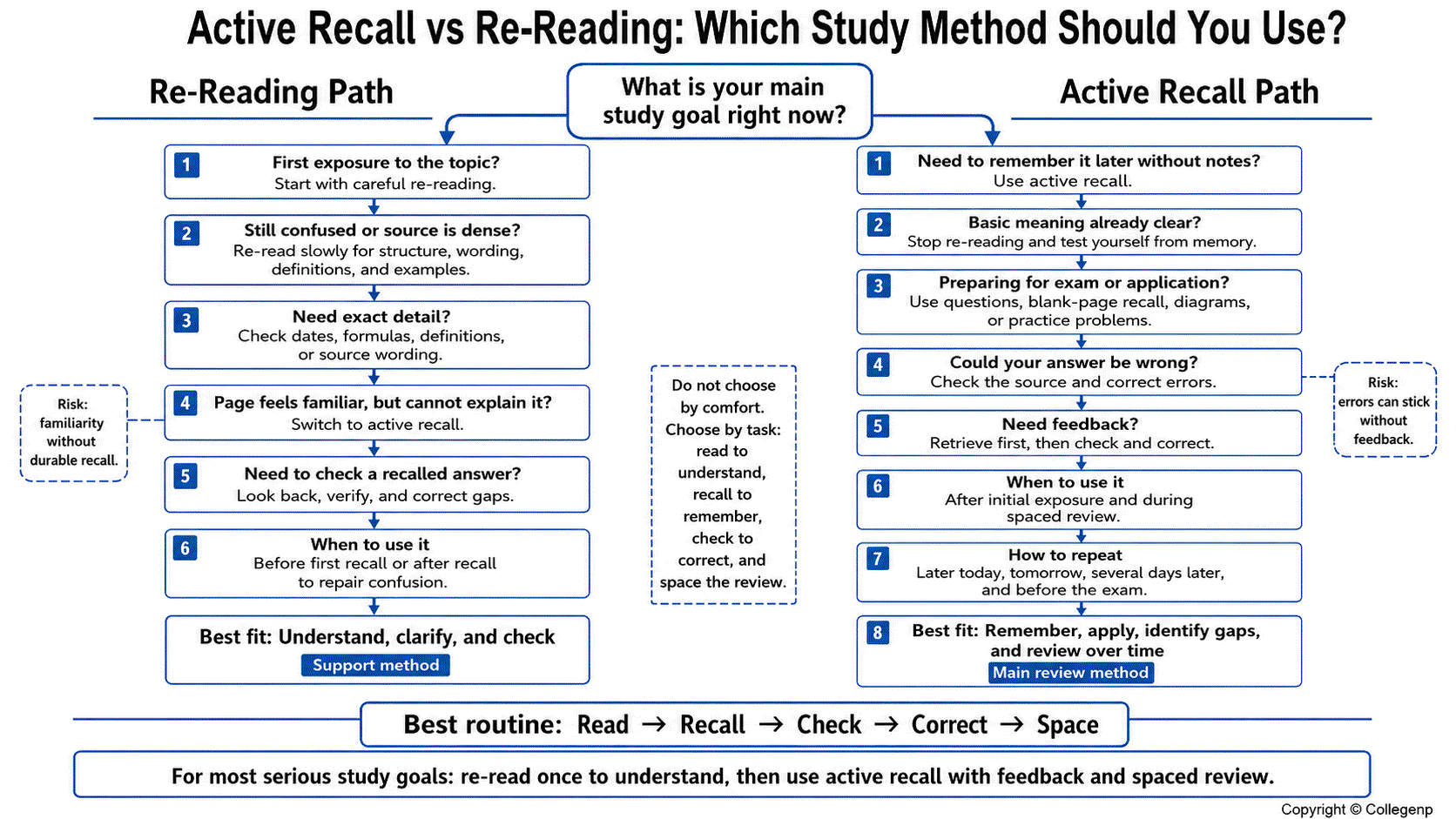
Simple routine: Read -> Recall -> Check -> Correct -> Space.
This routine keeps re-reading in the right role. Reading builds the first map. Recall tests whether the map can be used. Checking repairs the errors. Spacing makes the review less dependent on short-term familiarity.
Common Mistakes to Avoid
| Mistake | Why it weakens study | Better correction |
|---|---|---|
| Turning active recall into recognition | Multiple-choice practice can become pattern recognition if the learner never explains the answer. | Explain why the correct answer is right and why the other options are wrong. |
| Testing too early with no foundation | A blank-page test before any understanding can create confusion rather than useful retrieval. | Read enough to understand the basic structure, then retrieve. |
| Never checking answers | Wrong answers can remain in memory. | Compare with a reliable source, correct the error, and test the weak point again. |
| Making flashcards too shallow | Definition-only cards may not prepare the learner for examples, comparisons, or applications. | Add “why,” “how,” “compare,” “example,” and “apply” prompts. |
| Re-reading because it feels reassuring | Comfort can hide weak recall. | Stop after one or two readings and ask a question from memory. |
| Measuring learning immediately only | A method can feel successful after five minutes but fade after a delay. | Use delayed recall as the stronger test of durable learning. |
Decision Checklist: Which Should You Use?
Use re-reading when you answer yes to one of these questions:
-
Is this my first exposure to the topic?
-
Did I misunderstand the passage?
-
Do I need exact wording, dates, definitions, or source language?
-
Am I checking whether my recalled answer was correct?
Use active recall when you answer yes to one of these questions:
-
Will I need this later without notes?
-
Am I preparing for an exam, interview, presentation, or practical task?
-
Do I need to solve problems, explain ideas, compare concepts, or apply knowledge?
-
Have I already read this once or twice?
For most students, the answer is not either-or. Use re-reading to understand, then active recall to remember and apply.
Mini Evidence Case Study: Same Study Time, Different Result
The Roediger and Karpicke prose-passage study is useful because it compared study and test conditions with educationally relevant reading material rather than only isolated word lists.
In the repeated-study condition, students spent more time seeing the passage again. In the repeated-test condition, students spent more time trying to reconstruct the passage from memory. On the very short five-minute test, extra study looked better. On delayed tests, the pattern changed: testing produced stronger retention than restudying.
The practical lesson is direct. If you judge your method immediately after studying, re-reading may appear successful because the material is fresh and familiar. If you judge the method after a delay, recall practice gives a more meaningful signal. A study plan should be tested by delayed recall, not only by how confident you feel after closing the book.
Final Verdict
Active recall should be the main review method for most exam and long-term learning goals because it practices the skill learners need later: retrieving and using knowledge without the source in front of them. Re-reading is useful, but mainly as a support method.
Read to understand. Recall to remember. Check to correct. Space the process over time. That routine is more demanding than repeated reading, but the demand is what makes it a better test of real learning.




Comments 0
No comments yet. Be the first to start the conversation.