




A study timetable works only when it fits your real routine. It should not be a decorative chart, a punishment list, or a copy of someone else’s “perfect” schedule. A useful timetable helps you know what to study, when to study, how to revise, and when to rest.
Many students make a timetable with good intention but poor planning. They fill every free hour with study time, ignore school, coaching, commute, meals, family duties, tiredness, and sleep, then feel guilty when the plan breaks within a few days.
A better timetable is realistic and flexible. It includes fixed commitments, subject priorities, focused study blocks, revision, breaks, practice, and weekly review. It also gives more attention to weak and urgent topics without ignoring easier subjects.
This guide explains how to make a study timetable step by step for school, SEE, Class 11/12, bachelor-level, and exam-preparation students. Use it as a practical method, not as a fixed rule.
Table of Content
- Quick Answer: How Do You Make a Study Timetable?
- What Is a Study Timetable?
- What a Good Study Timetable Should Do
- What to Prepare Before Making a Study Timetable
- Step 1: Put Fixed Commitments First
- Step 2: Set Weekly Goals, Not Only Daily Hours
- Step 3: Prioritize Subjects with a Simple Rule
- Step 4: Create Focused Study Blocks
- Step 5: Add Revision and Practice from the Beginning
- Step 6: Include Breaks, Meals, Sleep, and Buffer Time
- Step 7: Make Different Timetables for Different Situations
- Sample Daily Study Timetable for Students
- Weekly Study Timetable Structure
- How to Divide Subjects in Your Timetable
- How Many Hours Should a Student Study Daily?
- Morning Study or Night Study: Which Is Better?
- How to Make a Timetable for Exam Preparation
- How to Follow Your Study Timetable Consistently
- Common Mistakes to Avoid While Making a Study Timetable
- A Simple Study Timetable Template
- Checklist: Your Timetable Is Ready If It Includes These
- Final Thought
Quick Answer: How Do You Make a Study Timetable?
To make a study timetable, first write your fixed daily commitments such as school, college, sleep, meals, tuition, commute, and family duties. Then list your subjects, mark difficult and urgent topics, divide your week into realistic study blocks, add revision and practice time, include breaks, and review the timetable every week.
A simple process looks like this:
-
Block fixed commitments first.
-
List all subjects and topics.
-
Mark weak, urgent, and high-priority areas.
-
Divide available time into focused study blocks.
-
Add revision, self-testing, writing practice, numerical practice, or past-paper work.
-
Keep buffer time for unfinished work and unexpected tasks.
-
Review your timetable once a week and adjust it.
 What Is a Study Timetable?
A study timetable is a planned schedule that shows when you will study, what subject you will study, and what task you will complete during each session.
It is different from a general study plan. A study plan may say, “complete the science syllabus this month.” A timetable turns that plan into real time blocks, such as “Monday evening: revise human biology diagrams and answer five short questions.”
A strong timetable should answer three questions before every study session:
-
What subject will I study?
-
Which topic or task will I complete?
-
How will I check whether I understood it?
Without these details, a timetable becomes only a list of subjects. With these details, it becomes a working study system.
What a Good Study Timetable Should Do
A good study timetable should reduce daily confusion. When study time starts, you should not waste time deciding what to open. The timetable should already tell you the subject, topic, and task.
It should also protect your energy. Studying longer is not always the same as studying better. A plan that ignores sleep, meals, movement, and breaks may look impressive but often becomes difficult to follow.
A useful timetable should do four things:
-
Organize your available time.
-
Prioritize difficult, urgent, and important subjects.
-
Include regular revision and practice.
-
Help you review whether your method is working.
The goal is not to create a perfect-looking chart. The goal is to create a routine you can follow honestly.
What to Prepare Before Making a Study Timetable
Before writing subjects into boxes, collect the basic information that will shape your routine.
Your Fixed Routine
Write the hours you cannot move. This includes school or college time, coaching classes, commute, meals, household duties, part-time work, prayer, family responsibilities, and sleep.
Many timetables fail because students ignore fixed responsibilities. For example, writing “study from 5 pm to 9 pm” may look good, but it may not work if the student reaches home at 5:30 pm, needs rest, has dinner, and has household duties.
Your Subject List
Write every subject or paper you need to study. For each subject, note what type of work it requires. Some subjects need reading and memorization. Others need numerical practice, diagrams, writing, coding, lab work, case analysis, or past-paper practice.
This matters because one hour of reading is not the same as one hour of solving problems or writing answers.
Your Weak Areas
Mark the topics you avoid, forget, or cannot explain clearly. These topics need planned attention, not random last-minute study.
Weak topics should not always be placed at the end of the day. If a subject is difficult, place it in a time slot when your focus is stronger.
Your Deadlines and Exam Dates
Add class tests, assignments, projects, practical exams, viva, internal assessments, and board or entrance exam dates if they apply.
For SEE, NEB, university, or entrance-exam planning, use the latest official routine before finalizing your revision order. Do not build a timetable around guessed exam dates.
Your Best Focus Time
Notice when your mind is clearest. Some students focus better in the morning. Others work better in the evening or at night because of school, coaching, travel, or family responsibilities.
The best time is not the same for everyone. Put difficult tasks in your strongest focus window when possible.
Step 1: Put Fixed Commitments First
Do not begin with subjects. Begin with the time that is already taken.
Block your class hours, coaching time, commute, meals, rest, sleep, and other regular responsibilities. Once these are visible, you can see your real study windows.
For some students, the available time may be two evening blocks. For others, it may be one morning block and one short night review. Both can work if the tasks are clear and realistic.
A timetable should not fight your real day. It should work with it.
Step 2: Set Weekly Goals, Not Only Daily Hours
A timetable based only on hours can become misleading. A student may sit with a book for two hours and still not complete anything important.
Instead of writing only “Math – 2 hours,” write a clear task such as:
-
Solve 20 algebra questions and review mistakes.
-
Revise one biology diagram and answer five short questions.
-
Write one English essay outline and correct grammar errors.
-
Read one chapter and prepare a five-point summary.
-
Attempt one past-paper section under timed conditions.
This makes the timetable more useful because it shows what progress looks like. Time still matters, but the task should guide the session.
Step 3: Prioritize Subjects with a Simple Rule
Not every subject needs equal time every day. Use a simple priority system.
| Priority Level | Use This For | Timetable Action |
|---|---|---|
| High priority | Weak topics, upcoming tests, difficult chapters, heavy-practice subjects | Place in your best focus time and repeat during the week |
| Medium priority | Topics you partly understand but need revision or practice | Schedule shorter blocks and weekly review |
| Low priority | Easy topics, already revised chapters, light reading | Use lower-energy slots or quick review time |
This does not mean you ignore easier subjects. It means difficult and urgent work should not always be pushed to the end of the day when you are already tired.
A balanced timetable gives enough time to weak subjects while keeping all subjects active.
Step 4: Create Focused Study Blocks
A study block is a fixed period for one clear task. It is better to write “revise photosynthesis diagrams and answer five questions” than simply “Science.”
A useful study block usually has three parts:
-
Start: Open the correct book, notes, or question set.
-
Focus: Complete one clear task.
-
Check: Test whether you understood or remembered it.
The check can be simple. You may close the book and explain the topic aloud, write a blank-page summary, solve a few questions, review mistakes, or mark doubts for your teacher.
The length of each block depends on the subject and your attention span. A writing task may need a longer block. A formula review may need a shorter one. If you lose focus quickly, start with shorter blocks and increase gradually.
Step 5: Add Revision and Practice from the Beginning
A timetable that only says “read chapter” is incomplete. Reading helps you understand, but exams usually require recall, explanation, calculation, writing, comparison, or application.
Your timetable should include active revision and practice. After studying a topic, add a short review block on the same day or the next day. Then revisit it again after a few days.
Use this simple study loop:
-
Learn the topic.
-
Close the book.
-
Recall the main points.
-
Answer questions.
-
Check mistakes.
-
Schedule the next review.
This approach is more useful than leaving all revision for the final week. Regular review reduces last-minute pressure and helps you notice weak areas earlier.
Step 6: Include Breaks, Meals, Sleep, and Buffer Time
Breaks are not a waste of time. A timetable without breaks may look strict, but it often becomes difficult to follow.
Include short pauses between demanding sessions. Keep meals and sleep visible in the schedule. A tired student may spend hours looking at a page without processing it properly.
Also keep buffer time. A buffer is an empty or flexible slot for unfinished work, unexpected homework, illness, family duties, travel delay, or a topic that takes longer than expected.
If your timetable has no buffer, one missed session can disturb the whole week. If it has buffer time, you can recover without abandoning the plan.
Step 7: Make Different Timetables for Different Situations
Your regular school-week timetable should not be the same as your exam-week timetable. You may also need a different version for holidays, study leave, entrance exam preparation, or days with coaching classes.
For a normal weekday, focus on consistency. For exam preparation, increase revision, practice questions, and mistake correction. For holidays, you may use longer blocks, but avoid filling the whole day with one subject.
A timetable is a planning tool, not a prison. Change it when your routine changes.
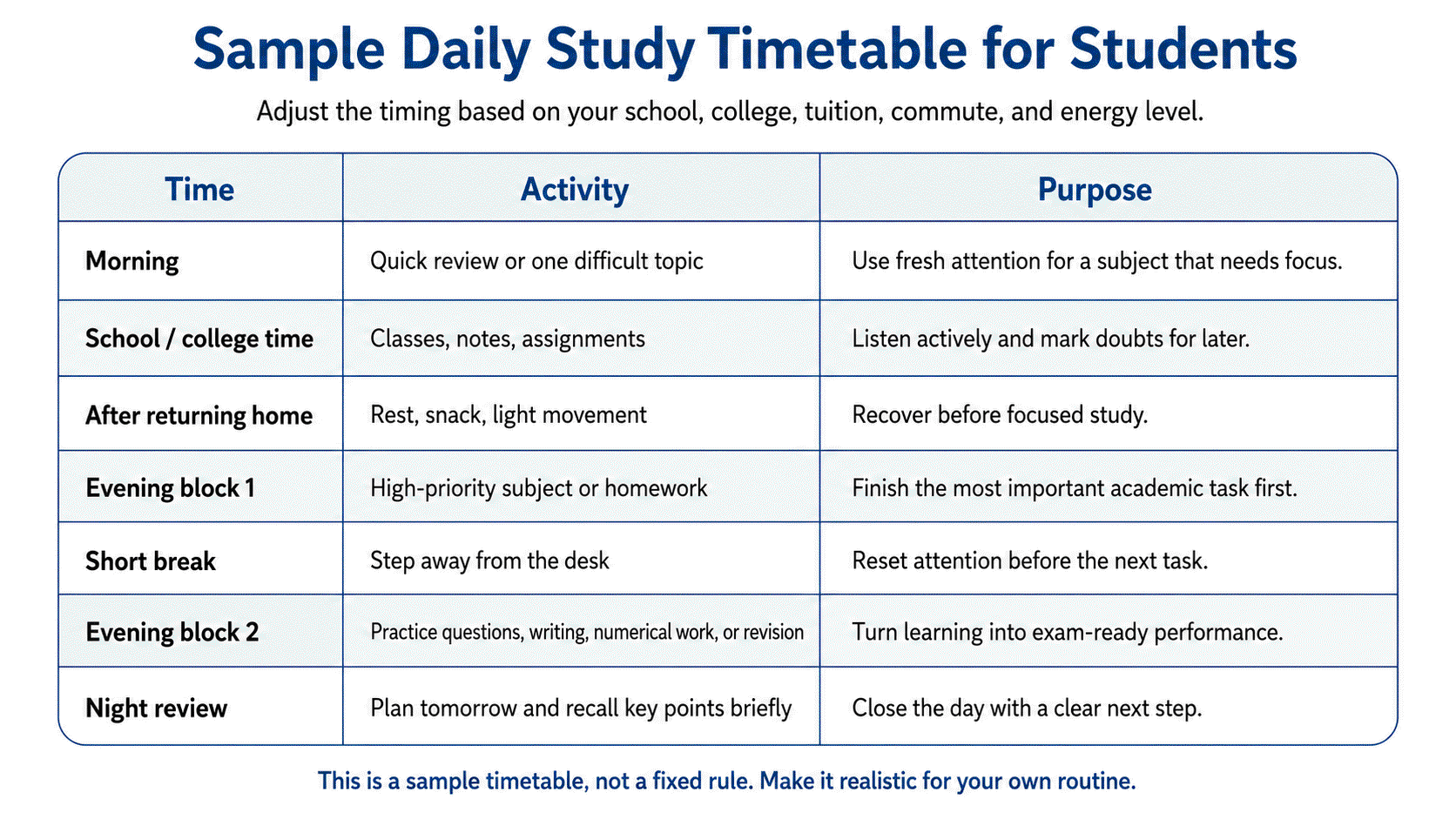
Sample Daily Study Timetable for Students
The sample below is only a model. Adjust the timing based on your school, college, tuition, commute, household responsibilities, and energy level.
| Time | Activity | Purpose |
|---|---|---|
| Morning | Quick review or one difficult topic | Use fresh attention for a subject that needs focus |
| School/college time | Classes, notes, assignments | Listen actively and mark doubts for later |
| After returning home | Rest, snack, light movement | Recover before focused study |
| Evening block 1 | High-priority subject or homework | Finish the most important academic task first |
| Short break | Step away from the desk | Reset attention before the next task |
| Evening block 2 | Practice questions, writing, numerical work, or revision | Turn learning into exam-ready performance |
| Night review | Plan tomorrow and recall key points briefly | Close the day with a clear next step |
If you study better at night, move the difficult block later. If you feel tired after school, keep the first evening block lighter and do the hardest work in the morning. The best timetable is the one you can follow consistently.
Weekly Study Timetable Structure
Planning every day from zero can waste time. A weekly pattern is easier to follow.
| Day Type | Suggested Focus |
|---|---|
| Monday to Friday | One main subject block, one practice or revision block, and quick planning for the next day |
| Saturday | Longer practice set, difficult-topic review, pending homework, or assignment work |
| Sunday or weekly review day | Check what was completed, move unfinished tasks, organize notes, and plan the next week |
A weekly timetable also helps you avoid studying only one or two subjects repeatedly. You can see whether all important subjects are getting enough attention.
How to Divide Subjects in Your Timetable
The right subject order depends on your course, exam pattern, and personal difficulty level. However, a balanced timetable usually mixes heavy and lighter tasks.
Avoid placing three difficult subjects back to back unless you know you can handle it. Also avoid studying only your favorite subject. A common reason students fall behind is that they spend more time on what feels comfortable and delay the topics that need practice.
A useful rule is to combine one demanding task with one reinforcement task.
Examples:
-
Math problem solving followed by science diagram revision.
-
Accountancy practice followed by theory recall.
-
English writing followed by vocabulary review.
-
Physics numerical practice followed by formula revision.
-
Social studies long-answer practice followed by short factual recall.
This keeps the timetable balanced without making every session equally heavy.
How Many Hours Should a Student Study Daily?
There is no single correct number of study hours for every student. A student who attends school all day, travels far, and has household responsibilities cannot follow the same timetable as a student on study leave.
A better question is: how many focused study blocks can you complete consistently without harming sleep, health, or regular classes?
On busy weekdays, even one or two clear study blocks can be useful if the tasks are specific. During exam preparation or holidays, you may add more blocks, but breaks and review time should still be included.
Do not judge your timetable only by total hours. Judge it by completed tasks, remembered concepts, solved questions, corrected mistakes, and reduced last-minute pressure.
Morning Study or Night Study: Which Is Better?
Morning study may suit students who wake up alert and have a quiet environment. Night study may suit students who return late from school, college, coaching, or work.
Neither is automatically better for everyone.
Choose the time when you can focus with fewer distractions. Put your most difficult subject in your strongest focus window. Use lower-energy time for lighter tasks such as organizing notes, revising formulas, reading summaries, or planning the next day.
The main rule is consistency. A simple routine followed most days is better than a perfect routine followed only once.
How to Make a Timetable for Exam Preparation
During exam preparation, your timetable should shift from only learning chapters to testing yourself.
This means more:
-
Past questions
-
Sample questions
-
Writing practice
-
Formula recall
-
Diagram practice
-
Definitions
-
Timed practice
-
Mistake correction
-
Short revision notes
Start by listing the full syllabus or chapter list. Mark each topic as:
-
Not started
-
Partly done
-
Revised
-
Exam-ready
Give more time to weak and important topics. If your syllabus, teacher, or official exam pattern clearly shows higher-weight areas, use that information carefully. Do not guess marks weight without a reliable source.
Do not spend the entire final week only reading notes. Include active recall, timed practice, and revision of mistakes. Also keep sleep stable as much as possible. A tired mind may read pages without understanding them well.
Example Exam-Week Adjustment
A normal week may include one main study block and one revision block per day. During exam preparation, the pattern can shift like this:
| Study Area | Normal Week | Exam Preparation Week |
|---|---|---|
| New chapters | Moderate focus | Only unfinished or essential topics |
| Revision | Short daily review | More frequent review blocks |
| Practice questions | A few times per week | Daily practice where possible |
| Mistake correction | Weekly | After every practice session |
| Sleep and meals | Fixed | Still fixed; do not remove them |
| Buffer time | Weekly | Daily or every alternate day |
This adjustment keeps the timetable practical while increasing exam readiness.
How to Follow Your Study Timetable Consistently
Making a timetable is easier than following it. The real test is whether the plan survives a normal week.
Start with One Week
Do not create a three-month timetable on the first day and expect it to be perfect. Make a one-week plan, test it, and improve it.
Keep the First Five Minutes Easy
Write the first action clearly. For example:
-
Open the notebook.
-
Solve question 1.
-
Revise page 12.
-
Write five definitions.
-
Review yesterday’s mistakes.
A clear start reduces delay.
Use a Visible Tracker
Tick completed blocks. A simple notebook tracker is enough. Tracking shows whether the plan is realistic.
Prepare the Desk Before Study Time
Keep books, notes, pens, calculator, water, and question sets ready before the session starts. A messy start often leads to distraction.
Control Phone Distractions
Keep the phone away during focused blocks unless it is required for study. If you use online material, decide the exact resource before starting. Do not begin with an open search because it can easily turn into unrelated browsing.
Plan Recovery, Not Guilt
If you miss a session, move it to a buffer slot or reduce the next task. Do not abandon the whole timetable.
A missed block is not failure. It is information. Use it to adjust the next version of your timetable.
Common Mistakes to Avoid While Making a Study Timetable
| Mistake | Why It Fails | Better Choice |
|---|---|---|
| Copying someone else’s routine | Their class time, energy, subjects, and responsibilities may be different | Use examples only as templates and adjust them |
| Writing only “study” in the timetable | It does not tell you what to do when the session starts | Write subject, topic, and task |
| Planning too many hours | The schedule becomes hard to follow and creates guilt | Start realistic and increase gradually |
| Ignoring revision | You may understand once but forget later | Add repeat review and self-testing |
| Studying only favorite subjects | Weak subjects remain weak | Give difficult and urgent topics fixed slots |
| No breaks or sleep time | Tiredness reduces consistency and focus | Schedule breaks, meals, and sleep clearly |
| No weekly review | The same weak plan continues even when it is not working | Review completion and adjust every week |
A Simple Study Timetable Template
You can copy this structure into a notebook, Excel sheet, Google Sheet, or wall chart.
| Day | Time | Subject | Topic/Task | Method | Done? |
|---|---|---|---|---|---|
| Monday | ____ | ____ | ____ | Read / recall / solve / write / revise | □ |
| Tuesday | ____ | ____ | ____ | Read / recall / solve / write / revise | □ |
| Wednesday | ____ | ____ | ____ | Read / recall / solve / write / revise | □ |
| Thursday | ____ | ____ | ____ | Read / recall / solve / write / revise | □ |
| Friday | ____ | ____ | ____ | Read / recall / solve / write / revise | □ |
| Saturday | ____ | ____ | ____ | Practice set / revision / pending work | □ |
| Sunday | ____ | Weekly review | Move unfinished tasks and plan next week | Review | □ |
You can add more columns if needed, such as deadline, difficulty level, exam date, or teacher feedback.
Checklist: Your Timetable Is Ready If It Includes These
Your study timetable is ready if:
-
Fixed commitments are already blocked.
-
Sleep, meals, breaks, and travel are visible.
-
Each study block has a subject and specific task.
-
Difficult subjects get better focus time.
-
Revision and practice are included.
-
There is buffer time for missed or unfinished work.
-
The timetable covers all important subjects across the week.
-
You have a weekly review day.
-
The plan is realistic enough to follow.
-
It can be adjusted when your routine changes.
Final Thought
A good study timetable is not the strictest timetable. It is the one that helps you study with clarity, revise on time, protect your energy, and adjust when life changes.
Start with one realistic week. Block your fixed routine, choose clear study tasks, add revision and breaks, and review your progress. After one week, improve the timetable based on what actually worked. That is how a timetable becomes useful instead of becoming another chart on the wall.
You can also read - 10 Effective Time Management Strategies for a Successful Daily Study Routine






Comments 0
No comments yet. Be the first to start the conversation.