




Being behind does not mean you should study everything harder. It means you need to choose better.
The fastest useful move is not opening the first unread chapter or trying to finish every old task in order. The first move is to compare what matters, what is due soon, what affects future lessons, and what can realistically be finished with the time you have.
Table of Content
- Quick Answer
- Quick Comparison: What Kind of Behind Are You?
- First: Stop Trying to Catch Up on Everything Equally
- Use the Four-Question Triage Filter
- Compare Your Catch-Up Options
- Strategy 1: Use a Catch-Up Sprint When the Deadline Is Close
- A Simple 3-Day Catch-Up Plan
- Strategy 2: Use a 7-Day Recovery Plan for a Bigger Backlog
- Strategy 3: Use Active Recall Instead of Passive Rereading
- Strategy 4: Use Spaced Review When You Have More Than One Day
- Strategy 5: Ask for Help Before the Backlog Becomes Invisible
- How to Study Missed Lectures
- How to Handle Overdue Assignments
- How to Study When You Do Not Understand the Basics
- What Should You Skip, Skim, or Study Deeply?
- Do Not Use an All-Nighter as Your Main Plan
- A Practical Catch-Up Plan You Can Start Today
- Reader Scenario: Behind Before a Math Test
- Final Comparison: Which Strategy Should You Choose?
- Bottom Line
- Editorial Accuracy Note
Quick Answer
When you are behind on studying, make a full backlog list, rank each task by deadline, grade value, prerequisite value, and effort, then study the highest-value items first. Use active recall, practice questions, and spaced review where time allows. Use cramming only for short-term emergency recovery before a test, not as your regular study method.
A good catch-up plan does three things:
-
Stops the backlog from growing.
-
Protects the most important current work.
-
Uses study methods that show what you can actually remember and apply.
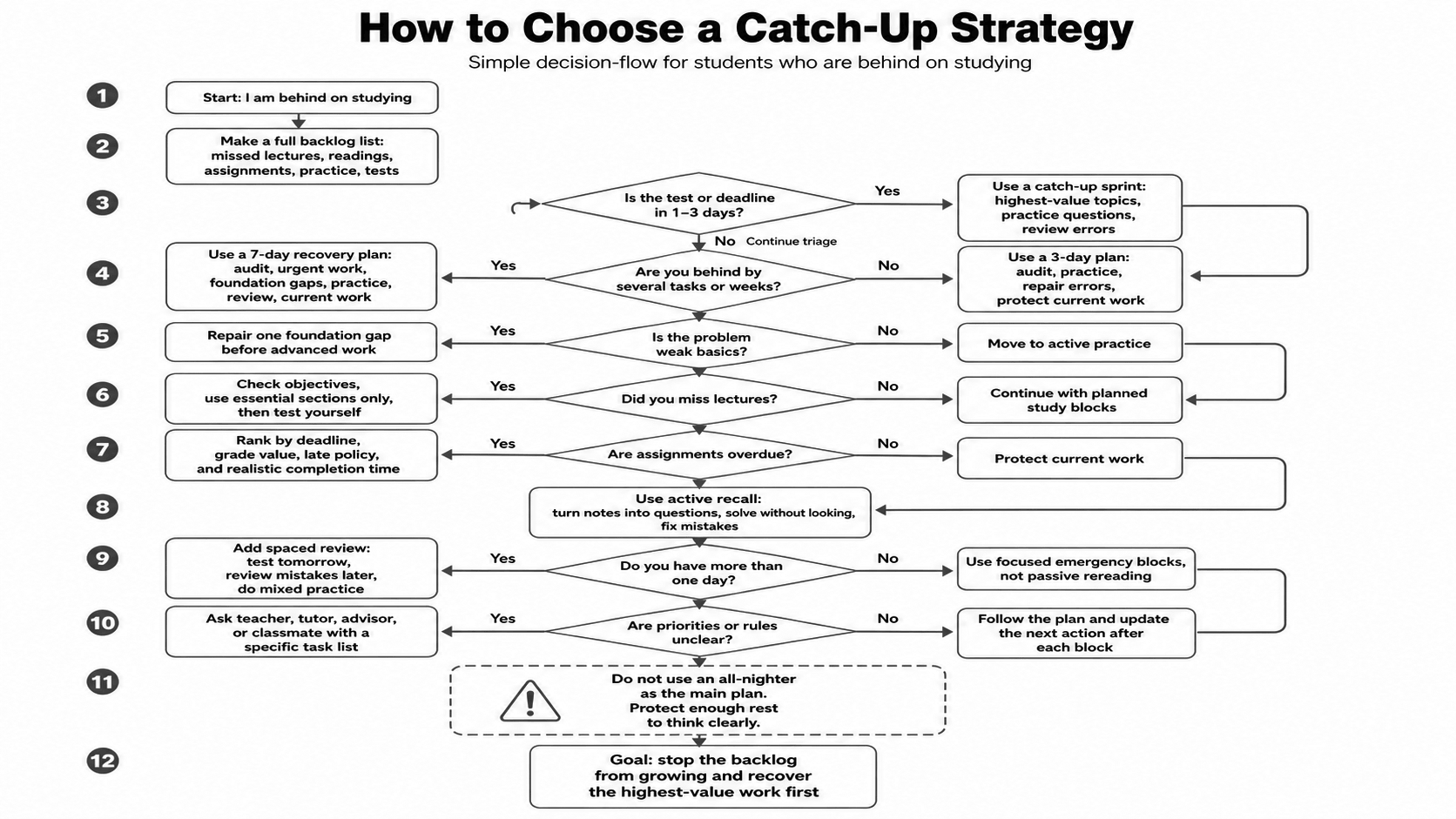
Quick Comparison: What Kind of Behind Are You?
| Your situation | Best first move | Avoid |
|---|---|---|
| Exam is in 1–3 days | Prioritize likely test topics, practice questions, and error review | Trying to relearn the entire course from the start |
| Many assignments are overdue | Rank by deadline, grade weight, and whether late submission is accepted | Spending hours perfecting low-value tasks |
| You missed lectures | Get notes, watch only essential sections, then test yourself | Passively replaying every recording without questions |
| You do not understand the basics | Fix prerequisite gaps before advanced work | Rushing into harder material to feel productive |
| You are behind in several subjects | Protect current work first, then rotate backlog blocks | Catching up in one subject while falling behind in all others |
First: Stop Trying to Catch Up on Everything Equally
Students often say, “I am behind,” but that can mean different problems. You may be behind on assignments, behind on understanding, behind on revision, or behind because you missed classes. Each problem needs a different response.
Treating every missed task as equally urgent is one reason catch-up plans fail.
Before you study, write every unfinished item in one place. Include missed lectures, unread chapters, quizzes, assignments, practice problems, notes to rewrite, and upcoming tests. Then mark each item as one of four types:
-
Urgent deadline
-
High grade value
-
Foundation knowledge
-
Low-value backlog
This turns panic into a decision list. It also helps you stop making decisions based only on stress.
Use the Four-Question Triage Filter
When everything feels urgent, use this filter:
-
Is it due soon?
-
Is it worth many marks, credits, or course requirements?
-
Do I need it to understand the next topic?
-
Can I finish it in the time available?
If the answer is yes to several questions, the task moves up. If the answer is no to most questions, it waits.
This is not an excuse to ignore responsibilities. It is a practical order of work. A student who is behind cannot give equal time to every missed page, worksheet, video, and note. The goal is to protect learning, grades, and future progress without pretending that unlimited time exists.
Compare Your Catch-Up Options
| Strategy | Best when | Main risk | First action |
|---|---|---|---|
| Catch-up sprint | A deadline or test is very close | Short-term memory and fatigue | Pick only the highest-value topics |
| 3-day rescue plan | You have a few days, not weeks | Spending too long planning | Divide time into urgent, practice, and review blocks |
| 7-day recovery plan | The backlog is large but manageable | Overplanning without action | Audit tasks and protect current work |
| Active recall | You need to remember or apply material | Feels harder than rereading | Turn notes into questions |
| Spaced review | You have several days or weeks | Skipping small review sessions | Schedule short repeat practice |
| Help-seeking | You cannot judge priorities or rules | Waiting too long | Send a specific message with your task list |
Strategy 1: Use a Catch-Up Sprint When the Deadline Is Close
A catch-up sprint is a short, focused push over one to three days. It is useful when the deadline is close and you need to recover enough to submit work, sit an exam, or rejoin the class.
The sprint is not a lifestyle. It is a temporary emergency method.
Use this strategy when the work is urgent and limited. For example, if a quiz is tomorrow and you missed two lessons, you might spend one block reviewing the teacher’s objectives, one block solving practice questions, and one block checking mistakes. That is more useful than reading every page slowly and hoping the important parts stay in memory.
The weakness of a sprint is that it can create the illusion of progress. You may finish tasks but not remember much later. That is why each sprint block should end with retrieval practice:
-
Close the notes and answer questions.
-
Solve a problem without looking.
-
Explain the concept aloud.
-
Write a short summary from memory.
-
Mark the exact point where you got stuck.
If you cannot retrieve it, you have found the gap.
A Simple 3-Day Catch-Up Plan
Use this when you are behind but still have two or three days before a test, submission, or class deadline.
Day 1: Audit and Triage
List all missed and upcoming work. Mark each task by deadline, grade value, foundation value, and effort. Choose the top three. Do not start with the easiest task unless it also matters.
For an exam, check the syllabus, teacher objectives, past questions, practice sheets, or topic list. For assignments, check the exact instructions and whether late submission is accepted.
Day 2: Practice the Highest-Value Work
Use practice questions, sample problems, flashcards, blank-page recall, or short written answers. Do not spend the whole day rereading.
A useful block is:
-
15 minutes: review the topic
-
25 minutes: answer questions or solve problems
-
10 minutes: mark errors and write the next action
The next action might be “redo problems 3 and 4,” “review formula use,” or “ask teacher about chapter 6 example.”
Day 3: Repair Errors and Protect Current Work
Review your mistakes first. Then do mixed practice. Mixed practice is useful because exams and assignments rarely tell you which method to use before each question.
End the day by completing at least one current task. This prevents the same cycle from starting again.
Strategy 2: Use a 7-Day Recovery Plan for a Bigger Backlog
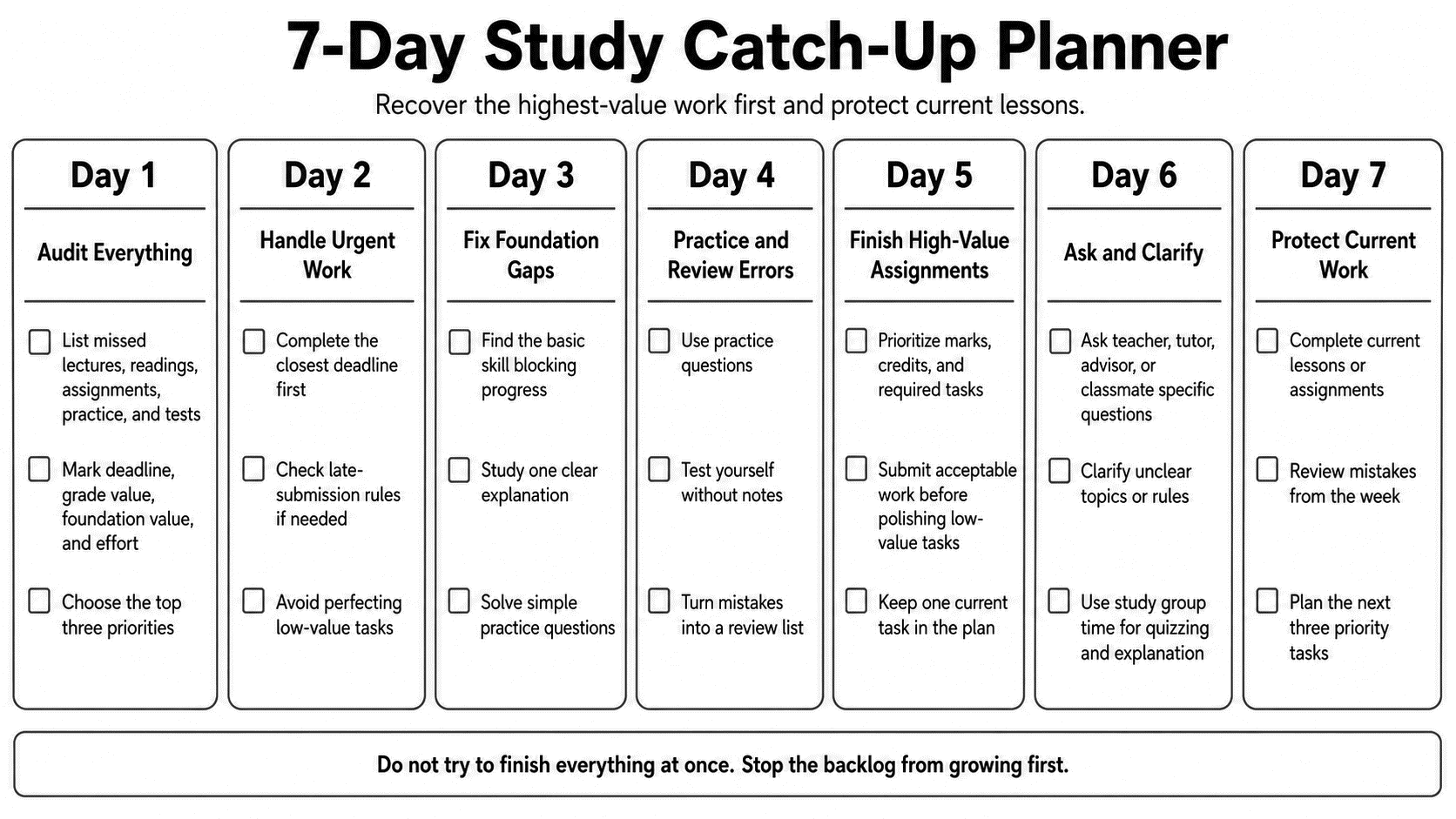
If you are behind by more than a few tasks, a seven-day recovery plan is usually better than a one-night rescue attempt. The goal is not to erase the entire backlog instantly. The goal is to stop the backlog from growing while you steadily remove the most important old work.
A practical 7-day plan can look like this:
| Day | Main focus |
|---|---|
| Day 1 | Full backlog audit and priority ranking |
| Day 2 | Most urgent deadline or assignment |
| Day 3 | Foundation gaps that block current lessons |
| Day 4 | Practice questions and error review |
| Day 5 | High-value assignments or required submissions |
| Day 6 | Teacher questions, study group, or clarification |
| Day 7 | Current work and next-week planning |
This works because it separates old work from current work. Many students make the mistake of spending all week catching up, then becoming behind again because new tasks kept arriving. A good recovery plan always protects current lessons, even if some low-value old work receives less attention.
Strategy 3: Use Active Recall Instead of Passive Rereading
When time is limited, your study method matters more.
Rereading can feel comfortable because the material looks familiar. Familiarity is not the same as being able to use the information in a test, assignment, or discussion.
Active recall is different. It asks you to pull information from memory before checking the answer. Research reviews on learning techniques have rated practice testing and distributed practice as high-utility methods, while rereading and highlighting are usually weaker as stand-alone strategies.
Use active recall by:
-
Turning headings into questions
-
Covering examples and solving them yourself
-
Making flashcards for definitions or formulas
-
Writing what you remember after a lecture
-
Teaching a concept in simple words
-
Recreating a diagram from memory
-
Solving practice questions without notes
A useful rule: if you are behind, do not spend a whole study block only consuming information. Divide the block. Use part of it to learn, part to retrieve, and part to correct mistakes.
For a 45-minute block, that might mean:
-
15 minutes reviewing
-
20 minutes answering questions
-
10 minutes fixing errors
This feels harder than rereading, but that difficulty is useful. It shows whether you can actually use the material.
Strategy 4: Use Spaced Review When You Have More Than One Day
Spaced review means you come back to material after time has passed. It is the opposite of forcing everything into one long session.
Spacing is not always possible when a test is tomorrow, but even small spacing can help when you have several days. The Australian Education Research Organisation explains spacing and retrieval practice as approaches that help learners revisit and recall material over time.
A simple version is:
-
Learn today.
-
Test yourself tomorrow.
-
Review mistakes two days later.
-
Do mixed practice before the exam.
The point is not to make a perfect schedule. The point is to give your memory more than one chance to retrieve the material.
Spaced review is especially useful for:
-
Formulas
-
Vocabulary
-
Definitions
-
Diagrams
-
Processes
-
Problem types
-
Dates and events
-
Grammar rules
-
Coding syntax
-
Accounting steps
Cramming may help you recognize information for a short time, but spaced retrieval is usually the better choice when the goal is to remember and apply knowledge later.
So the comparison is not “cramming is always bad.” The more accurate comparison is this: cramming is for immediate damage control; spaced active practice is for learning that lasts.
Strategy 5: Ask for Help Before the Backlog Becomes Invisible
Asking for help is not a last resort after everything fails. It is a study strategy when the problem is unclear, too large, or connected to rules you do not control.
Teachers, tutors, classmates, academic advisors, or study groups can help you identify what to prioritize. They may also clarify whether late work is accepted, which topics are most important, or which missed activities cannot be recreated alone.
Use a specific message.
Example:
“Hello [Teacher/Professor Name], I am behind on weeks 4 and 5 because I missed class. I have listed the tasks and I can study two hours today and three hours tomorrow. Which two items should I prioritize first so I do not fall further behind?”
This is better than saying, “I do not understand anything,” because it gives the other person a clear way to help.
A study group can also help, but only if it stays active. Do not use group study to sit beside friends while everyone rereads silently. Use it to compare answers, explain problems, quiz each other, and find gaps.
How to Study Missed Lectures
Do not automatically watch every missed lecture from start to finish. That may be necessary in some courses, but it is not always the fastest useful method.
Use this order:
-
Check the lesson title, objectives, slides, or teacher notes.
-
Ask a classmate what was emphasized.
-
Watch only the sections connected to test topics, assignments, or foundation skills.
-
Pause and write questions.
-
Test yourself after each major section.
For online classes, the backlog can become large because videos feel easy to postpone. Treat each recording as a learning task, not background noise. Watching while scrolling or multitasking is usually low-value study.
How to Handle Overdue Assignments
First, check whether late submission is accepted. Do not guess. If the rule is unclear, ask.
Then divide assignments into three groups:
-
Must submit because they carry marks or credits
-
Useful to complete because they build exam knowledge
-
Low-value or no-longer-accepted tasks that should wait
If several assignments are overdue, do not perfect the smallest one just because it feels manageable. Start with the task that has the best combination of deadline, grade value, and realistic completion time.
A completed acceptable assignment is often more useful than a perfect low-value task that consumes the whole evening.
How to Study When You Do Not Understand the Basics
If you are behind because the basics are weak, rushing into advanced material often wastes time.
Find the prerequisite skill that keeps blocking you. In math, it may be algebra, formulas, signs, or graph interpretation. In science, it may be definitions, diagrams, units, or process steps. In language, it may be grammar, vocabulary, sentence structure, or comprehension.
Then repair that one foundation gap before moving forward.
A foundation repair block can be short:
-
10 minutes: identify the exact missing skill
-
20 minutes: study one clear explanation
-
20 minutes: solve basic practice questions
-
10 minutes: correct errors and repeat the weakest point
You do not need to relearn the entire subject before continuing. You need to fix the gap that is blocking the next task.
For students catching up in math, the fastest repair is active practice on the exact skill that keeps breaking, not another pass through old lecture videos. Brilliant offers visual, interactive lessons that cover the complete math curriculum from 5th grade through college calculus, including the algebra, functions, and graph-reading skills that most often block progress.
Brilliant's online math tutor, Koji, is like an expert sitting right next to each student. When they get stuck, Koji sees what is on the screen and can respond with a guiding question, by breaking down the problem into more manageable pieces, or by sketching a visual hint right on the screen to work through the missed step instead of handing over the answer. A parent dashboard makes it easy to follow along with what kids are learning, where they're excelling, and where they still need practice.
What Should You Skip, Skim, or Study Deeply?
When you are behind, the hard truth is that not everything deserves equal attention.
Study deeply when a topic is:
-
A foundation for future lessons
-
Likely to appear on an exam
-
Heavily weighted
-
Required for an assignment
-
A repeated source of mistakes
Skim when the material gives background but is not central. Skimming can include reading headings, summaries, bold terms, examples, diagrams, and teacher notes.
Skip temporarily when a task is low value, no longer accepted, or less urgent than work that protects your grade and understanding. “Temporarily” matters. This is not academic avoidance. It is sequencing.
Do Not Use an All-Nighter as Your Main Plan
An all-nighter can feel like commitment, but it often reduces the quality of the next day’s thinking.
That does not mean you should ignore an urgent deadline and simply sleep. It means your plan should protect enough rest to think clearly. Cornell Learning Strategies Center advises students to plan basic needs such as sleep, meals, and breaks when creating a study schedule.
If you have three hours tonight, two focused blocks and sleep are usually better than six distracted hours that leave you unable to remember, write, or solve problems tomorrow.
A safer emergency evening plan is:
-
Choose one or two high-value tasks only.
-
Work in focused blocks.
-
Stop passive rereading.
-
Test yourself.
-
Prepare what you need for tomorrow.
-
Protect enough sleep to function.
For teen students, sleep is not a reward after study. It is part of learning quality. CDC guidance based on American Academy of Sleep Medicine recommendations says students aged 13–18 should generally get 8–10 hours of sleep per 24 hours.
A Practical Catch-Up Plan You Can Start Today
Start with a 20-minute audit. Write the backlog without judging yourself.
Then choose the top three tasks using:
-
Deadline
-
Grade value
-
Foundation value
-
Effort
Put one current task into the plan so you do not fall further behind. Next, create two or three focused blocks. During each block, use one learning task and one retrieval task.
Example block:
-
Review one missed lecture outline for 15 minutes.
-
Answer five questions or solve three problems for 25 minutes.
-
Mark mistakes for 10 minutes.
-
Write the next action before stopping.
The next action matters because it prevents you from restarting from confusion every time you sit down.
Reader Scenario: Behind Before a Math Test
This is a realistic example, not a reported case study.
A student has two days before a math test and is three lessons behind. A weak plan would be watching every missed video from start to finish. A stronger plan would be checking the test topics, identifying the problem types, watching only the parts that explain those problem types, then solving practice questions without notes.
Mistakes become the review list. If one prerequisite skill keeps causing errors, that skill gets a focused repair block.
The same logic works for science, accounting, grammar, coding, and other skill-based subjects. Practice reveals gaps faster than passive review. The goal is not to feel caught up. The goal is to perform the task you will actually be asked to perform.
Final Comparison: Which Strategy Should You Choose?
| Situation | Best strategy |
|---|---|
| Test tomorrow | Catch-up sprint with likely topics and practice questions |
| Test in 3 days | 3-day rescue plan with active recall and error review |
| Behind by several weeks | 7-day recovery plan plus teacher clarification |
| Missed lectures | Essential sections first, then self-testing |
| Weak basics | Foundation repair before advanced material |
| Too many assignments | Triage by deadline, grade value, and late policy |
| Feeling overwhelmed | Audit the backlog and ask for specific help |
Bottom Line
When you are behind, the best strategy is not the most intense one. It is the one that matches your situation.
Use a sprint for urgent deadlines, a three-day plan when you have a little time, a seven-day plan for larger backlogs, active recall for learning, spaced review for retention, and help-seeking when priorities or rules are unclear.
You may not finish everything at once. But you can stop the slide, recover the highest-value work, and rebuild a study rhythm that lasts.
Editorial Accuracy Note
This article does not include local school, college, exam-board, grading, late-submission, or extension-policy rules. Those details vary by institution and should be checked directly with the relevant teacher, department, school, college, or official notice before making a final academic decision.




Comments 0
No comments yet. Be the first to start the conversation.