



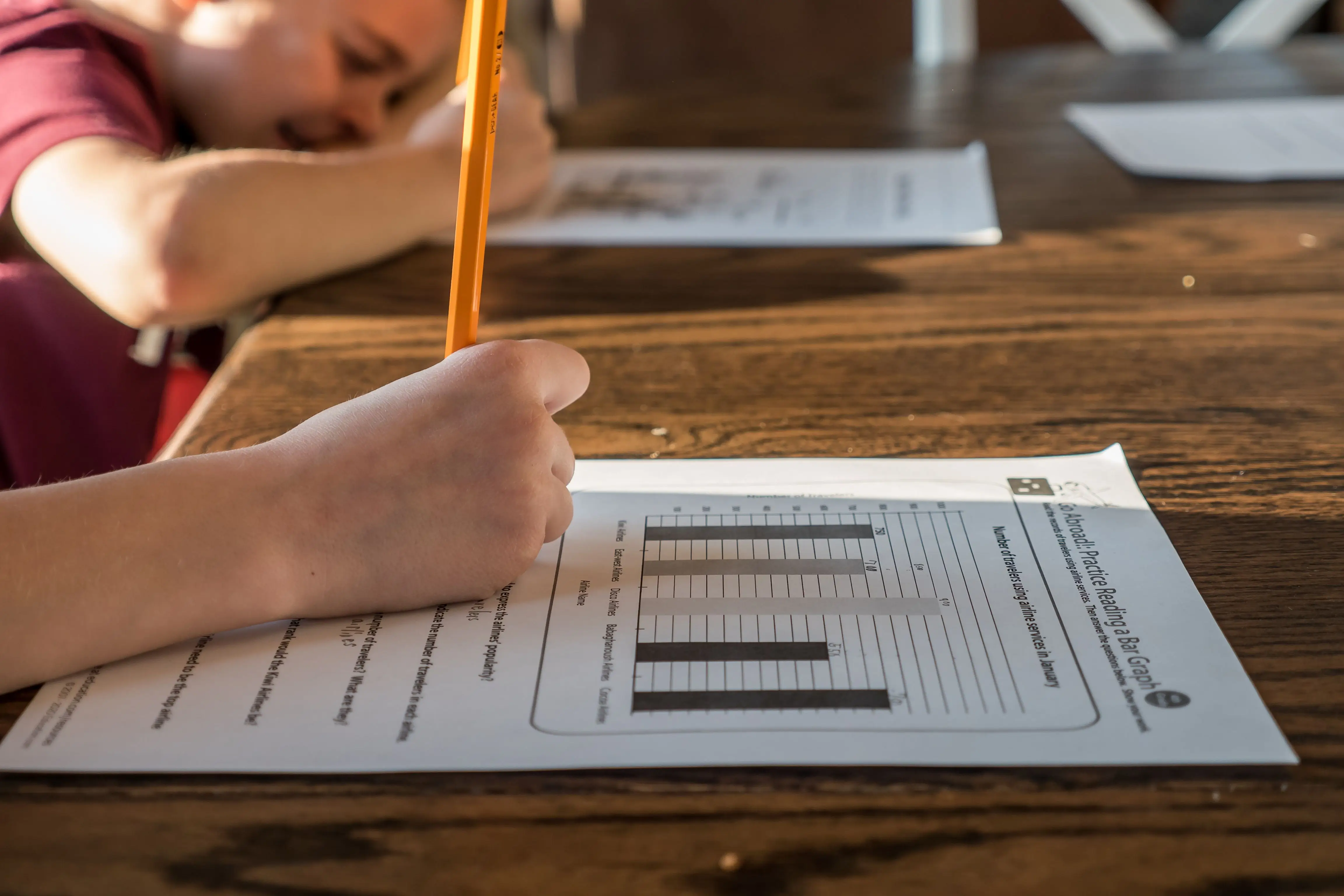
You finish studying a chapter and feel confident about what you have learned. The explanations made sense, the examples were clear, and the information looked familiar. But when you attempt a question without your notes, you struggle to remember an important point or decide how to begin.
This is an important distinction in learning: understanding information while looking at it is not necessarily the same as recalling or using it independently.
Practice questions help you examine that difference. They require you to remember information, explain concepts, select methods, or apply knowledge. The attempt can contribute to learning while showing which parts of your understanding need further attention.
Research on retrieval practice, also called practice testing, shows that recalling previously studied information can improve later retention. Classroom research supports using questions as learning activities, rather than treating them solely as tools for measuring achievement.
However, completing more questions does not automatically mean learning more. Question quality, prior understanding, accurate feedback, and opportunities to revisit material all matter.
Answer Summary: Practice questions are important because they require learners to retrieve previously studied information or apply knowledge independently. Research shows that retrieval practice can strengthen later retention under many conditions. Questions also help learners recognize gaps in recall, reasoning, and understanding when answers are checked carefully. Their value increases when mistakes are corrected and important material is revisited. Practice questions support learning, but they cannot replace necessary instruction or guarantee examination results.
Key Takeaways:
-
Practice questions can strengthen memory through active retrieval.
-
Answering without notes provides a clearer check of recall than recognizing familiar information.
-
Reviewing the reasoning behind an answer helps identify specific learning gaps.
-
Different question types serve different learning purposes.
-
Corrective feedback and later review make practice more useful.
-
Repeating familiar questions does not necessarily establish the ability to solve unfamiliar problems.
What Counts as a Practice Question?
A practice question is a question or task used to rehearse, retrieve, explain, or apply knowledge.
It may come from a textbook, teacher, previous examination, online learning resource, or a learner's own notes.
Examples include recalling a definition, explaining why a scientific process occurs, solving a mathematical problem, or deciding which principle applies to a new situation.
Not every practice question requires the same kind of thinking.
A factual question asks you to remember information. An explanation question examines relationships between ideas. A problem-solving question may require choosing a method and applying it correctly.
There is also an important difference between answering a question and reading its solution.
When you look at a completed answer, the information is already available. When you attempt an answer before checking the solution, you must produce or select the relevant knowledge yourself.
If that process involves recalling previously learned information, it is called retrieval practice.
Researchers use the term testing effect to describe improvements in later learning or retention that can result from retrieving information during testing.
A practice question does not need to be part of a formal examination to produce this learning opportunity. A self-made question or short classroom quiz can serve the same general purpose.
Why Practice Questions Help You Learn
Practice questions support learning in several ways, but the benefits are not identical. Some concern memory retention, while others involve checking understanding, identifying errors, or applying knowledge.
1. They Help You Remember Information Later
One reason practice questions matter is that retrieving information can strengthen later retention.
In a 2006 study, researchers Henry Roediger and Jeffrey Karpicke compared students who repeatedly studied prose passages with students who practised recalling the material.
Students were tested after five minutes, two days, or one week.
Repeated studying produced better recall on the test given five minutes later. However, students who had practised retrieval retained more information on the delayed tests.
This distinction matters because a study activity that produces strong immediate performance does not necessarily produce equally strong retention later.
The findings have also been examined in classroom settings.
A 2021 meta-analysis by Chunliang Yang and colleagues reviewed 222 independent studies involving 48,478 students. It found that quizzing had a positive average effect on classroom learning, although benefits varied with factors such as question format and feedback.
For a learner, the implication is practical.
After studying a section, try answering a relevant question without looking at the explanation. Whether you can retrieve the information provides a different learning opportunity from reading the same passage again.
2. They Reveal What You Can Recall Independently
Practice questions can expose the difference between recognizing information and producing it without help.
Consider studying a scientific process through a diagram.
While looking at the diagram, you may recognize the labels and understand the explanation. When asked to describe the process without the diagram, you may discover that you have forgotten part of the sequence.
That difficulty does not necessarily mean you failed to understand the entire lesson. It identifies something more specific: your independent recall is incomplete.
The next useful action is to determine which part is missing.
You may need to review a term, reconstruct the sequence, or explain how one stage relates to another.
An attempted answer is useful evidence of current performance, but it should not be treated as a complete diagnosis of learning.
A single incorrect response can result from forgotten information, misunderstood wording, an unsuitable method, or a simple procedural error.
3. They Help You Check Understanding, Not Only Memory
Remembering a correct answer is valuable, but understanding often requires knowing why that answer is appropriate.
A student may remember a mathematical formula but struggle to recognize when it should be used.
Similarly, a student studying history may recall the date of an event but find it difficult to explain the circumstances that contributed to it.
Questions beginning with why, how, or under what conditions encourage learners to examine relationships rather than reproduce isolated facts.
The U.S. Institute of Education Sciences' practice guide Organizing Instruction and Study to Improve Student Learning recommends asking deep explanatory questions to support understanding of taught material.
The distinction is useful when deciding what to review.
If you cannot remember a definition, focused recall practice may be appropriate. If you remember the definition but cannot explain the concept, repeating the same definition may not address the difficulty.
You may need a clearer explanation, another example, or an opportunity to discuss the concept before attempting a new question.
4. They Can Support Applying Knowledge in Different Situations
Practice questions can help learners examine whether they understand an idea well enough to use it beyond a familiar example.
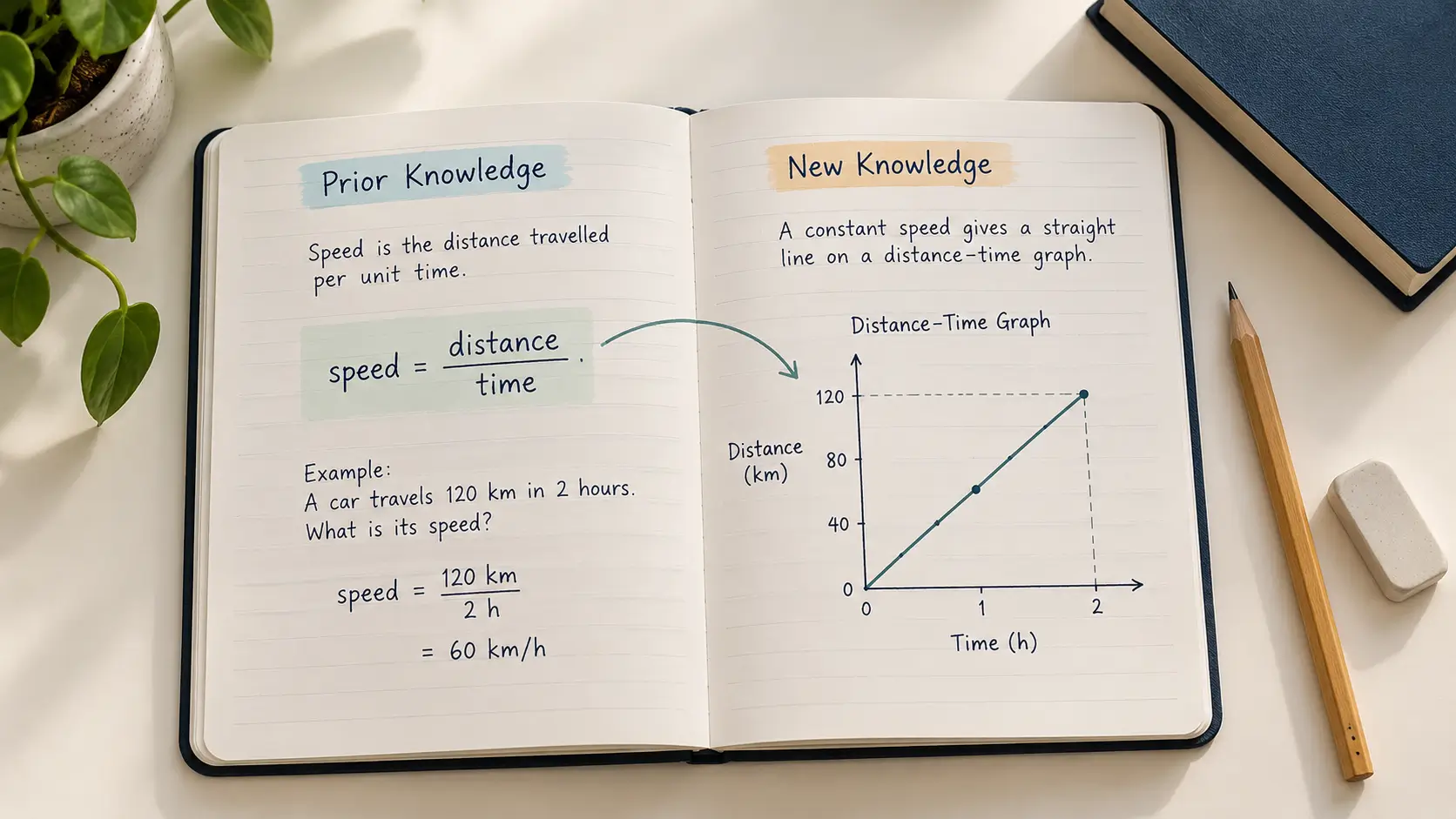
Suppose you have learned to solve a particular mathematical problem. After practising it several times, the steps become familiar.
A question that uses different wording or requires you to select the method independently creates another challenge.
You must recognize which knowledge is relevant rather than follow an already familiar sequence.
Researchers describe the application of learning in a different context as transfer of learning.
A 2018 meta-analysis by Steven Pan and Timothy Rickard found that retrieval practice can support transfer under certain conditions. However, the size and likelihood of the benefit varied across tasks and depended on factors including initial retrieval performance and the relationship between practice and later questions.
This means that solving a familiar question repeatedly does not establish that you can solve every unfamiliar variation.
Changed questions are useful because they allow you to examine whether you understand the underlying principle and recognize when it applies.
Why Rereading Can Feel Easier Than Practice Questions
Rereading often feels easier because the material provides reminders while you study.
A definition may look familiar when you see it again. A worked example may seem straightforward because each step is visible.
With a practice question, those reminders may be absent.
You must identify what the question requires and retrieve the relevant information or method.
This difference helps explain why independent questions can feel difficult even after a productive reading session.
Research on retrieval practice shows that the effort of recalling previously studied material can contribute to later retention. However, it does not follow that rereading is useless.
Reading explanations and studying examples remain necessary when you are learning unfamiliar material or correcting misunderstandings.
A 2025 systematic review and meta-analysis by Gonçalves, Muniz, and Jaeger compared retrieval practice with other effective learning activities, including approaches that encourage learners to elaborate on information.
The review found a small overall advantage for retrieval practice. However, that advantage depended significantly on corrective feedback, and retrieval was not consistently superior to every alternative learning activity examined.
The practical distinction is between reading to acquire or repair understanding and using questions to retrieve or apply what has been learned.
For a more detailed comparison, see active recall versus rereading.
Which Practice Questions Should You Choose?
The usefulness of a question depends partly on whether it matches your learning objective.
A short factual question is appropriate when you need to remember terminology. A question requiring an explanation is more suitable when your goal is to understand relationships. Solving a problem independently is necessary when you need to practise selecting and carrying out a procedure.
|
Learning goal |
Suitable question |
What to check |
|---|---|---|
|
Remember information |
Short-answer question or flashcard |
Can you recall the answer without seeing it? |
|
Explain a concept |
Why or how question |
Is the explanation accurate and logically connected? |
|
Apply a procedure |
Independent problem-solving question |
Are the method, steps, and result correct? |
|
Choose a method |
Problem that does not identify the required procedure |
Can you explain why the method applies? |
|
Apply knowledge differently |
Question with changed conditions or wording |
Can you identify the relevant principle and its limits? |
These categories are a practical way to select questions, not a ranking of question types.
Multiple-choice questions can be useful when learners need to distinguish among alternatives. Short-answer questions require learners to produce more of the response themselves.
Longer explanations and problems can examine reasoning that a factual question would not reveal.
No single format is appropriate for every subject or learning objective.
If your assessment requires written explanations, practising recognition questions alone may leave an important skill untested. If you need to recognize correct terminology, a well-constructed multiple-choice question may serve that purpose.
The question should resemble the thinking you need to develop, not merely the format you find easiest.
How to Get More Learning Value From Practice Questions
The most useful practice involves attempting questions, examining responses, correcting misunderstandings, and returning to important material later.
Attempt the Answer Before Looking at the Solution
When you want to practise retrieval, try answering independently.
Read the question carefully and identify what it asks. Then attempt the response using what you already know.
For a factual question, avoid looking at the notes before recalling the information. For a familiar mathematical procedure, attempt the solution before consulting the worked example.
An independent attempt helps distinguish what you can produce from what you recognize when it is visible.
However, attempting questions without sufficient background knowledge is not necessarily productive.
If you cannot understand what a question asks or have not learned the underlying concept, return to an explanation or worked example.
The purpose is to practise learning, not to continue struggling without access to the knowledge required.
Check the Reasoning, Not Only the Final Answer
A correct answer does not necessarily mean the reasoning was correct.
For example, a learner may reach the correct numerical result through an unsuitable method or choose the correct multiple-choice option by guessing.
Likewise, an incorrect answer does not necessarily mean the underlying concept is misunderstood.
A calculation error may produce a wrong result even when the chosen method is appropriate.
When reviewing an answer, examine where your reasoning agrees or differs from the explanation.
For factual questions, check accuracy and completeness. For mathematical problems, examine the steps. For explanation questions, check whether the main relationships are correct.
Accurate corrective feedback is particularly important when an answer contains a misunderstanding.
The 2025 review by Gonçalves and colleagues found that feedback substantially affected the relative benefits of retrieval practice compared with other effective learning methods.
If an answer key is unclear or appears inconsistent with reliable material, verify the explanation rather than memorizing a questionable response.
Work Out Why You Got a Question Wrong
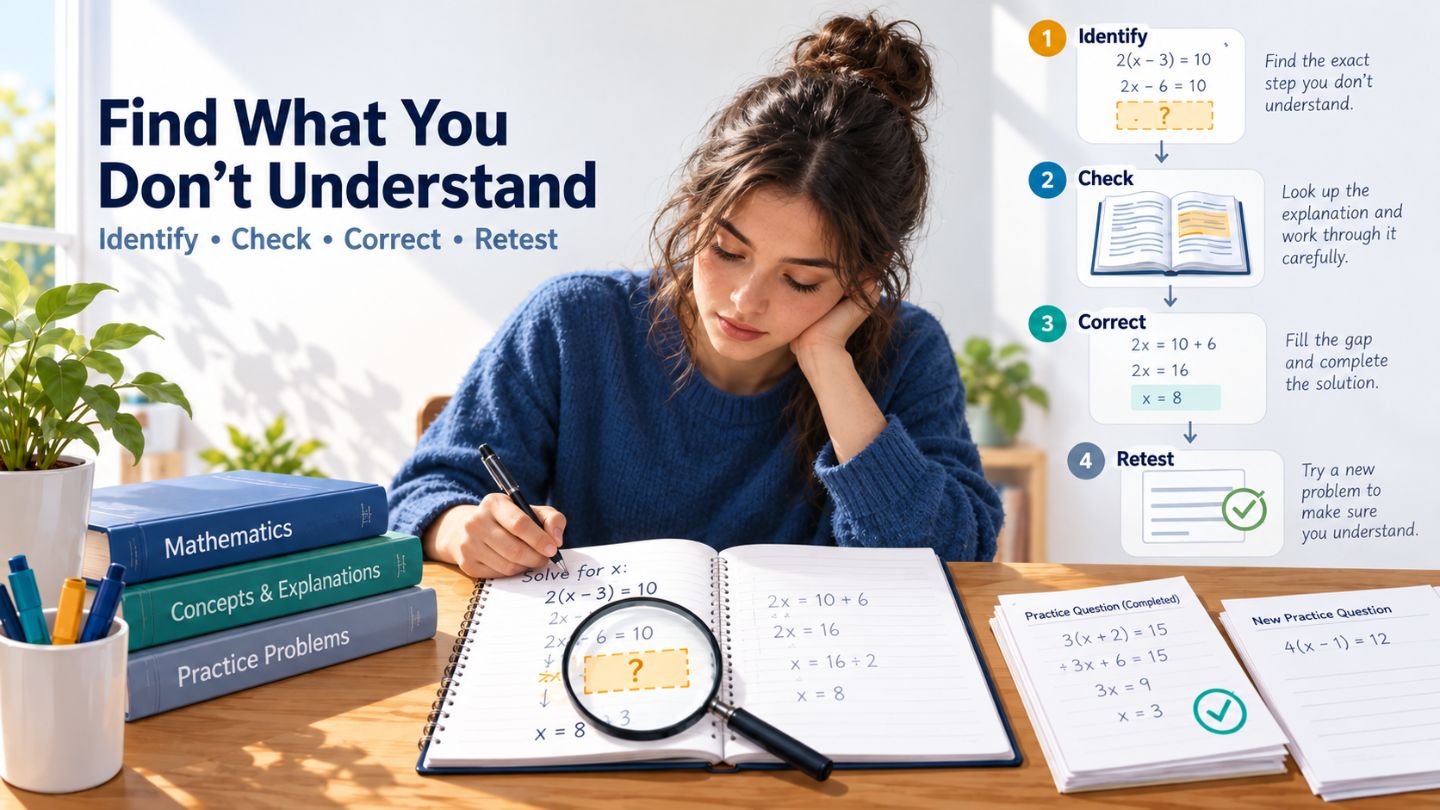
A wrong answer is most informative when you identify the source of the error.
Suppose you cannot answer a question about a scientific process.
If you have forgotten a term, revisiting the term and recalling it again may be sufficient.
If you understand the terminology but cannot explain the relationship between stages, you need to examine that relationship.
If you know the concept but fail to recognize that it applies to the question, comparing similar problems with different requirements may be useful.
The appropriate next action depends on what went wrong.
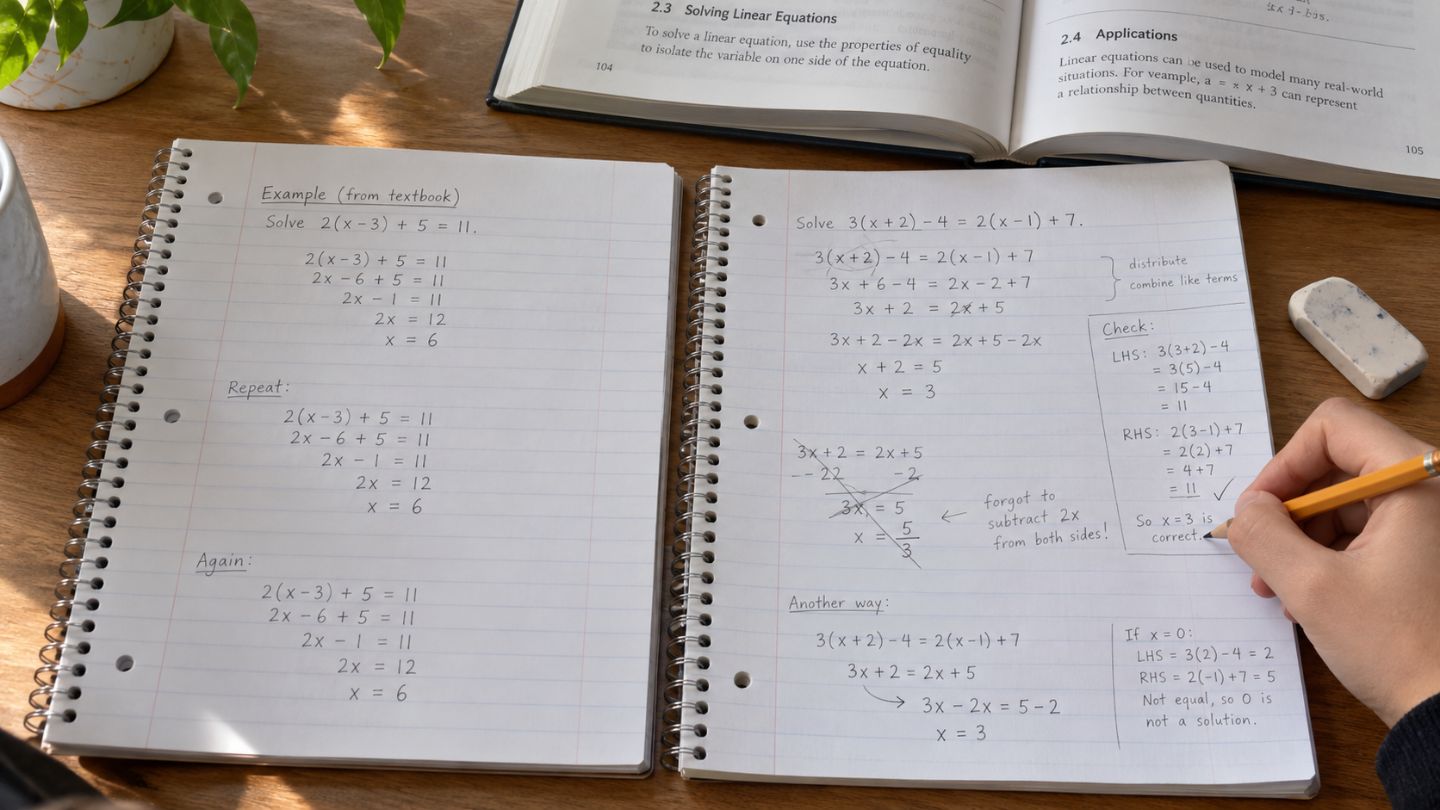
Repeatedly attempting the same question without addressing the underlying difficulty may produce familiarity with the answer rather than broader understanding.
For errors that recur across study sessions, an exam mistake log can help you record the problem and the correction required.
Try Again After Correcting the Problem
After reviewing an incorrect response, attempt another suitable question.
This checks whether you can use the correction independently.
For a calculation error, solve another problem that requires the same procedure. For a conceptual misunderstanding, explain the corrected idea without copying the source.
You can return to the original question, but be careful about interpreting success.
If you remember the solution because you have recently read it, that is not the same as independently solving an unfamiliar variation.
When your learning goal involves application, include questions that require you to recognize and use the principle in a different form.
Revisit Important Material After a Delay
Answering correctly immediately after checking a solution provides limited evidence about what you will remember later.
Return to important questions after time has passed.
This creates another opportunity to retrieve the information and examine whether the earlier correction has been retained.
A 2013 review by John Dunlosky and colleagues rated practice testing and distributed practice—spreading learning activities across time—as high-utility techniques based on the available evidence.
There is no single review interval that suits every learner, subject, and retention goal.
Consider the difficulty of the material, how accurately you recalled it, and when you need to use it again.
If you want more detail about scheduling repeated review, see spaced repetition for long-term memory.
What to Do When Practice Questions Are Not Helping
Completing questions without noticeable improvement can happen for different reasons. The useful response depends on where the difficulty occurs.
If you cannot begin most questions, examine whether you have learned the necessary concepts and prerequisite knowledge. More attempts may not solve a problem caused by missing instruction.
If you understand an explanation but repeatedly fail to use it independently, practise the relevant step or concept with appropriate questions.
If you answer familiar questions correctly but struggle when the wording changes, examine how the questions differ. Determine which principle applies and why.
If you continue making the same mistake, stop repeating the question and revisit the incorrect reasoning. A clearer explanation or feedback from a teacher may be more useful than further repetition.
If a question does not match what you need to learn, replace it with one that does. Memorizing definitions cannot establish the same skills as constructing an explanation or solving a problem.
Question quality also matters. Poorly written questions, ambiguous wording, and unreliable answer keys can make independent study less informative.
Limited time creates another practical constraint. When you cannot attempt every available question, select those that cover important learning objectives and areas of uncertainty. Allow time to review the answers.
Finishing a large question set without examining errors may provide less useful information about your learning than carefully reviewing a smaller selection.
Should You Use Untimed Questions or Mock Exams?
Untimed questions and mock examinations can both support preparation, but they serve different purposes.
Untimed practice is suitable when you are learning a procedure, examining an explanation, or correcting mistakes.
It allows you to concentrate on understanding what a question requires and why a particular answer is correct.
A timed mock examination introduces additional demands. You must work within a specified period, interpret the paper's structure, and manage the resources permitted during the assessment.
These demands matter when the real examination includes them.
However, speed should not dominate every practice session.
If you have not yet understood a concept, rushing through questions may leave insufficient time to examine the reasoning.
Similarly, finishing a mock examination quickly does not establish that your answers are correct or that your understanding is secure.
Use untimed practice when learning and correction are the priority. Use representative mock conditions when you need to practise the demands of a particular examination.
For teachers, short, low-stakes quizzes can provide another way to incorporate retrieval into instruction. The purpose and feedback should remain clear to learners, rather than making every question feel like a high-stakes assessment.
What Research Does Not Promise About Practice Questions
Research supports retrieval practice across numerous learning conditions, but it does not establish that every question works equally well for every learner.
The results depend on prior knowledge, learning material, question format, feedback, and what learners are expected to remember or do later.
Some evidence also has limitations for a global audience.
A systematic review by Agarwal, Nunes, and Blunt examined 50 classroom experiments involving 5,374 participants. It found benefits across varied educational settings but reported that relatively few experiments came from countries outside those classified as Western, educated, industrialized, rich, and democratic.
This limits how confidently findings can be generalized to every educational context.
Practice questions cannot guarantee grades, eliminate examination pressure, or ensure that knowledge transfers to every new problem.
They also cannot replace instruction when learners lack the knowledge needed to answer meaningfully.
The strongest practical conclusion is narrower and more useful: well-chosen questions can contribute to retention and provide information about learning, particularly when followed by sound feedback and further study.
Conclusion
Practice questions are important because they require learners to move beyond recognizing information and attempt to recall, explain, or use it independently.
Their learning value is not measured solely by the number completed or the score achieved.
An effective practice question gives you an opportunity to retrieve relevant knowledge. A careful review of the answer helps identify what needs correction. Returning to the material later helps you examine what has been retained.
Choose questions that reflect what you need to learn, attempt them independently when appropriate, and pay attention to the reasons behind correct and incorrect responses.
The goal is not to answer every available question. It is to use the questions you attempt to develop and assess knowledge that remains useful beyond the immediate practice session.
Reference
Roediger, H. L., and Karpicke, J. D. (2006). Test-Enhanced Learning: Taking Memory Tests Improves Long-Term Retention. Psychological Science, 17(3), 249–255.
Yang, C., Luo, L., Vadillo, M. A., Yu, R., and Shanks, D. R. (2021). Testing (Quizzing) Boosts Classroom Learning: A Systematic and Meta-Analytic Review. Psychological Bulletin, 147(4), 399–435.
Pan, S. C., and Rickard, T. C. (2018). Transfer of Test-Enhanced Learning: Meta-Analytic Review and Synthesis. Psychological Bulletin, 144(7), 710–756.
Gonçalves, A. O., Muniz, B. F. B., and Jaeger, A. (2025). Retrieval Practice Versus Elaborative Encoding: A Systematic and Meta-analytic Review. Educational Psychology Review, 37, Article 100.
Dunlosky, J., Rawson, K. A., Marsh, E. J., Nathan, M. J., and Willingham, D. T. (2013). Improving Students' Learning With Effective Learning Techniques: Promising Directions From Cognitive and Educational Psychology. Psychological Science in the Public Interest, 14(1), 4–58.
Agarwal, P. K., Nunes, L. D., and Blunt, J. R. (2021). Retrieval Practice Consistently Benefits Student Learning: A Systematic Review of Applied Research in Schools and Classrooms. Educational Psychology Review, 33, 1409–1453.
Pashler, H., and colleagues (2007). Organizing Instruction and Study to Improve Student Learning. Institute of Education Sciences, U.S. Department of Education.




Comments 0
No comments yet. Be the first to start the conversation.