



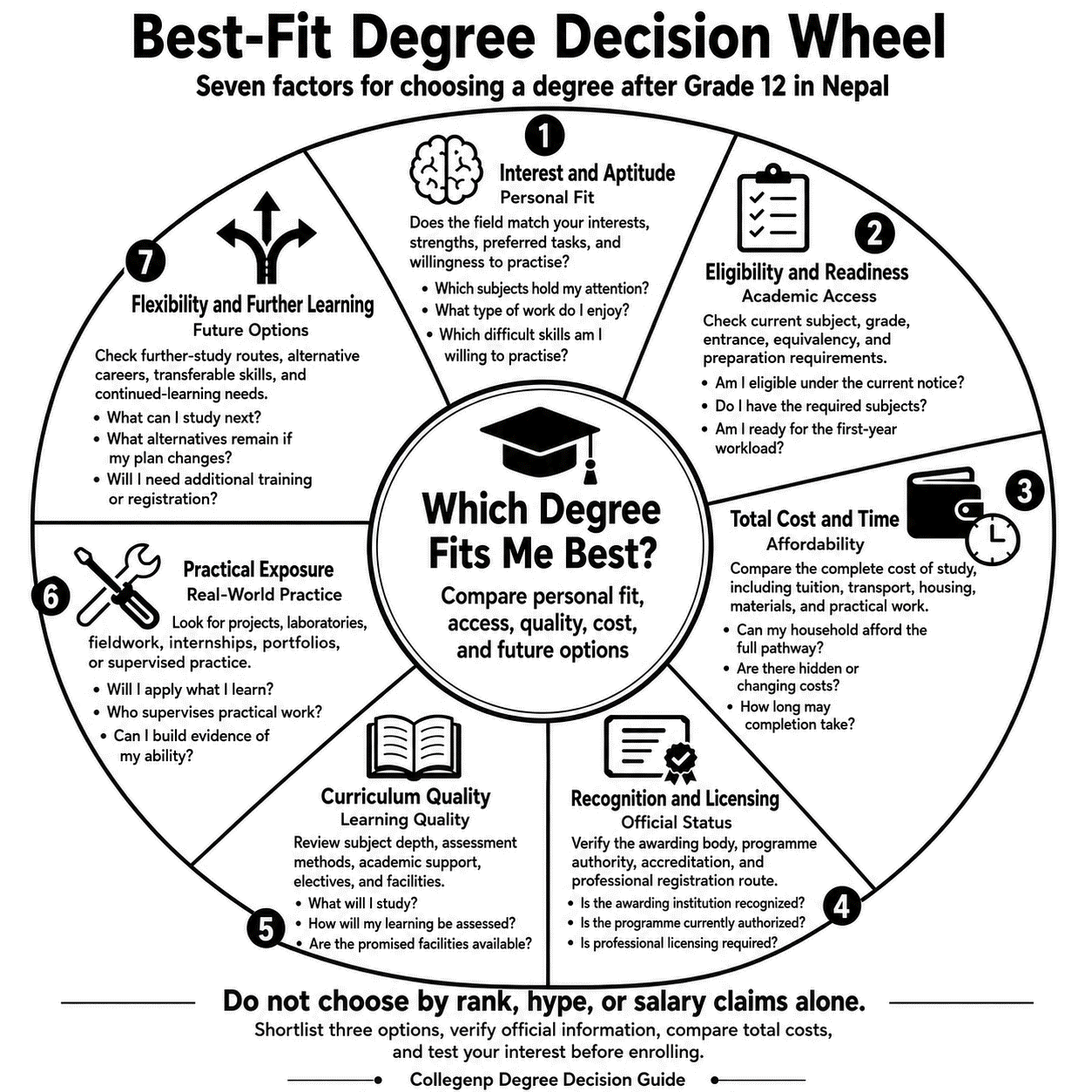
There is no single degree that is best for every Grade 12 student in Nepal. A suitable choice is one that matches the student’s interests and abilities, meets current entry requirements, remains affordable through completion, carries the necessary academic or professional recognition, and provides credible learning and practical experience.
Students often use the word “scope” when asking about a degree. They may be thinking about employment, income, further study, professional status, or long-term stability. A degree title alone cannot answer all of those questions. Outcomes also depend on programme quality, practical competence, communication, professional registration, location, economic conditions, and continued learning.
Nepal’s Ministry of Education and Sports describes career guidance as a process that helps students identify their interests and abilities, examine subjects and institutions, understand available opportunities, and choose a suitable occupation. Its Career Guidance System also provides self-assessment and student information resources.
This article does not rank degrees by salary, popularity, or social status. It explains how to compare bachelor’s degrees, professional qualifications, and technical or vocational routes while checking eligibility, cost, curriculum, practical learning, recognition, and long-term flexibility.
Answer Summary: The best degree after 12th in Nepal is the option that offers the strongest verified fit for your interests, academic preparation, budget, preferred work, and later opportunities. Shortlist three realistic pathways, check current entry and recognition rules through official sources, examine the curriculum and facilities, calculate the full cost, and test your interest through a small task or a conversation with people familiar with the field.
Table of Content
- What Does “Best for the Future” Mean?
- Which Seven Factors Matter Most?
- Replace “Scope” With Better Questions
- How Do Degrees, Diplomas, TVET, and Professional Routes Differ?
- How Do Stream, Marks, Budget, and Location Affect the Choice?
- Which Broad Study Pathways Can Students Compare?
- What Can a Qualification Do—and Not Do?
- Which Skills Matter Alongside Formal Study?
- How Can Students Use a Weighted Decision Matrix?
- How Can Students Verify a Programme in Nepal?
- What Can Students Check in 30 Days?
- How Can Parents and Guardians Help?
- Which Common Mistakes Should Students Avoid?
- What Does This Article Not Claim?
- What Should Students Do Next?
Key Takeaways:
-
No degree assures employment, income, admission, or career stability.
-
“Best” should mean best fit, not highest rank.
-
Eligibility, affordability, and recognition can be non-negotiable limits.
-
Quality Assurance and Accreditation status is not professional recognition for every programme.
-
Regulated fields require checks with the relevant commission or council.
-
Practical work, communication, projects, and continued learning matter alongside formal study.
-
Check current official notices before applying or paying fees.
What Does “Best for the Future” Mean?
“Best for the future” should describe a pathway that fits the student and remains credible under real academic, financial, and professional conditions. It should not be treated as a prediction that one course will produce the highest income or remain unaffected by changes in work.
A sound choice combines:
-
Personal fit
-
Academic access
-
Financial feasibility
-
Programme quality
-
Recognition
-
Practical preparation
-
Flexibility
The Ministry’s Career Guidance System supports this fit-based approach by asking students to consider their interests and abilities alongside subjects, institutions, occupations, and available opportunities.
Which Seven Factors Matter Most?
Seven factors provide a practical way to compare study pathways. Some are personal, while others require documentary checks through official institutions and regulators.
Interest and Aptitude
Interest affects whether you are willing to continue when the work becomes demanding. Aptitude reflects the tasks for which you currently have stronger preparation or ability. Neither should be treated as a fixed label.
Ask:
-
Which subjects or projects hold my attention?
-
Do I prefer calculation, writing, design, laboratory work, fieldwork, care work, organization, or practical construction?
-
Do I enjoy working mainly with people, data, systems, machines, ideas, living things, or visual material?
-
Which difficult skills am I willing to practise repeatedly?
-
What kind of daily work would I find meaningful or manageable?
An assessment can help identify patterns, but it cannot select a degree on its own. The Ministry’s student career resources present self-assessment as one part of a wider guidance process that also includes career information, counselling, and higher-education resources.
Eligibility and Academic Readiness
Formal eligibility and academic readiness are different questions.
First, confirm whether the current official notice allows you to apply. Universities and programmes may set subject, grade, entrance, equivalency, or document requirements. These conditions can vary by institution, programme, and intake.
Next, consider whether you are prepared for the first-year workload. Read the curriculum and identify whether it depends heavily on mathematics, science, writing, research, language, computing, studio practice, or another foundation area.
Meeting the minimum admission requirement means you may be eligible to apply. It does not mean the programme will be easy or suitable.
Total Cost and Time
Compare the cost through completion, not only the first tuition payment.
Include:
-
Tuition and admission charges
-
Examination and registration charges
-
Books and learning materials
-
Laboratory, workshop, studio, field, or clinical expenses
-
Equipment, software, uniforms, or internet access
-
Entrance preparation
-
Transport
-
Housing and food
-
Possible retakes or extended study
-
Other compulsory charges
Ask the institution for a written fee schedule. Check which costs are fixed, which can change, and what refund conditions apply.
A programme near home may reduce housing costs. A programme with lower tuition may become more expensive after travel, accommodation, equipment, and delays are included. Compare the full pathway rather than the advertised starting fee.
Recognition and Licensing
The word “recognized” can refer to several separate matters:
-
Recognition of the university or awarding institution
-
Authority or affiliation to deliver a specific programme
-
Institutional quality-assurance status
-
Acceptance by a professional council
-
Eligibility for registration or licensing
-
Acceptance for further study or equivalency
The University Grants Commission Nepal publishes a list of higher education institutions that have received Quality Assurance and Accreditation. The list includes institutional details, university affiliation, accreditation periods, and current status.
Use the UGC Nepal QAA list as an institutional quality-assurance reference. Do not treat it as proof that every programme at the institution meets a separate professional regulator’s requirements.
Engineering, medical and health education, nursing, and chartered accountancy involve additional official bodies. Check those requirements separately.
Curriculum Quality
A degree title does not show everything a student will study. Programmes with similar names can differ in subject depth, assessment, electives, faculty support, practical work, research, and academic standards.
Read the official curriculum where available and ask:
-
What is taught during the first two years?
-
How is learning assessed?
-
How much of the programme is theoretical and how much is applied?
-
Are there projects, laboratories, fieldwork, studios, or supervised practice?
-
Are the facilities described by the institution available to current students?
-
What happens when practical placements are unavailable?
-
What academic support is provided when students struggle?
A programme name should not replace curriculum review.
Practical Exposure
Practical exposure connects formal study with actual tasks.
Depending on the field, it may include:
-
Software or data projects
-
Engineering design and laboratory work
-
Clinical or community practice
-
Teaching practice
-
Agricultural fieldwork
-
Business projects
-
Legal research
-
Social research
-
Media production
-
Design portfolios
-
Workshops or supervised technical practice
Do not treat the word “internship” as sufficient evidence. Ask who arranges the placement, who supervises it, how it is assessed, and whether current students receive the stated opportunity.
The OECD’s Career Readiness work examines associations between career-development activities during adolescence and later employment outcomes. Its resources cover workplace experience, job shadowing, career conversations, and other forms of exploration. The findings support informed exposure, but they do not establish that one activity or one degree causes a particular career result.
Flexibility and Further Study
Some qualifications lead towards a regulated profession. Others provide broader academic preparation that can support several roles or postgraduate routes.
A specialized route may offer a clearer professional sequence, but it may also include stricter admission, progression, and registration requirements. A broader degree may leave more directions open while requiring the student to build a clearer profile through electives, projects, experience, or later study.
Check:
-
What further-study routes are officially available?
-
Is professional registration required?
-
Are bridge, transfer, or equivalency arrangements documented?
-
What alternatives remain if your first career plan changes?
-
Would changing direction require substantial additional study?
Do not assume that credit transfer or international recognition happens automatically.
Continued Learning
No qualification removes the need to keep learning.
The World Economic Forum’s Future of Jobs Report 2025 states that employers in its global survey expected 39% of workers’ core skills to change by 2030. The level of expected change varies across economies and industries. This is an international employer-expectation finding, not a Nepal occupation-level forecast and not a promise about any individual career.
The relevant lesson is limited but useful: students should expect tools, standards, and skill requirements to change during and after formal study.
Replace “Scope” With Better Questions
“Scope” is too vague to guide a major decision. Replace it with questions that can be checked.
Ask:
-
Which roles require or commonly accept this qualification?
-
Does the intended work require licensing, registration, further study, or a portfolio?
-
What practical evidence will I be able to build during the programme?
-
What other directions remain available if my first plan changes?
-
Which employment or income claims are supported by current Nepal-specific evidence?
-
What are the main academic, financial, and regulatory risks?
These questions give students a clearer basis for comparison than broad claims about a course having “good scope.”
How Do Degrees, Diplomas, TVET, and Professional Routes Differ?
Degrees, diplomas, certificates, technical and vocational education and training, and professional qualifications serve different purposes. They should not be treated as interchangeable.
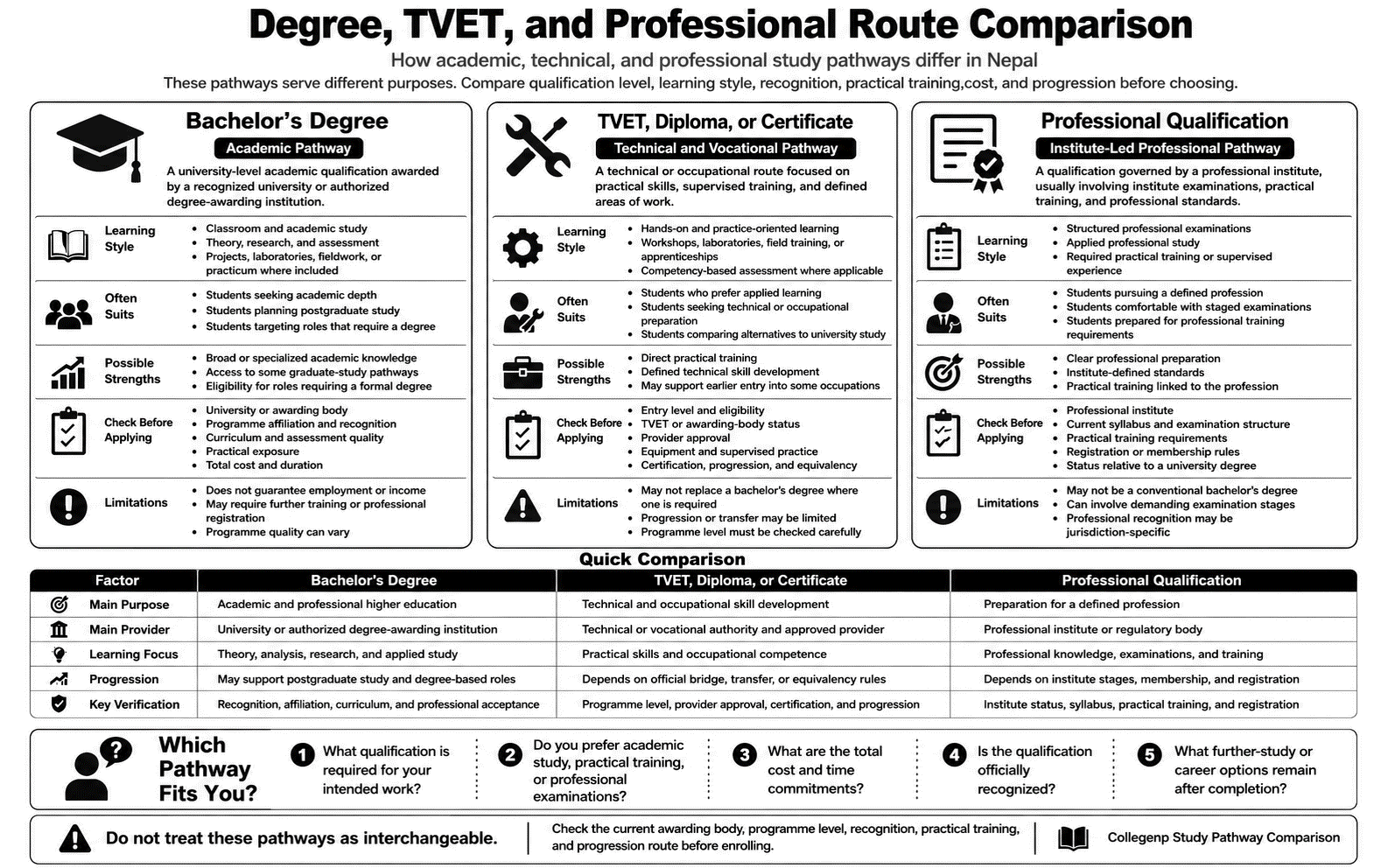
| Pathway | Main purpose | Possible strength | What to check |
|---|---|---|---|
| Bachelor’s degree | Broad or specialized university-level study | Academic depth, further study, and access to roles requiring a degree | Awarding body, curriculum, recognition, cost, and practical exposure |
| Diploma | Focused academic, technical, or occupational preparation | Narrower and often more applied learning | Qualification level, progression, transfer, and regulator acceptance |
| Certificate or short course | Development of a defined skill or introductory competence | Focused learning with limited scope | Awarding body, level, relevance, and whether it meets formal requirements |
| TVET route | Technical and vocational preparation linked to occupational skills | Applied training and technical practice | Entry level, provider status, equipment, certification, and progression |
| Professional qualification | Education and assessment governed by a professional institute | Structured preparation for a defined profession | Examinations, practical training, registration, cost, and status relative to a degree |
Bachelor’s Degree
A bachelor’s degree is an academic qualification awarded by a university or another authorized degree-awarding institution.
It may be broad, specialized, academic, applied, or professionally oriented. Its value depends on the awarding body, programme quality, assessment, practical learning, recognition, and the student’s actual competence.
Diploma and Certificate
A diploma or certificate usually covers a defined academic, technical, or occupational level. Its meaning varies by awarding body.
Before enrolling, confirm:
-
Who awards the qualification?
-
What level does the awarding body assign to it?
-
Does it support the work or further study you expect?
-
Is a bridge or transfer route officially documented?
-
Does a professional body accept it where relevant?
A short certificate may support a skill, but it should not be described as equivalent to a degree unless the responsible authority states that equivalence.
Technical and Vocational Education and Training
Technical and vocational education and training focuses on occupational and technical learning.
The Council for Technical Education and Vocational Training’s current programme page lists three-year certificate or diploma programmes in fields including agriculture, engineering, health sciences, hospitality, social work, and forestry. It states that SEE passed is the entry requirement for these certificate or diploma programmes.
These programmes should not automatically be presented as qualifications that academically follow Grade 12. Students who have completed Grade 12 should compare the qualification level, time commitment, recognition, and progression route before choosing one.
CTEVT also publishes separate curriculum pages for:
Check the current programme and provider rather than relying on a general course list.
Professional Qualification
A professional qualification is governed by a professional institute and may not be a university bachelor’s degree.
The Institute of Chartered Accountants of Nepal states that its Chartered Accountancy route includes institute education, examinations, and practical training. ICAN launched a new CA syllabus on May 13, 2025, with implementation arranged across examination sessions.
Students considering CA should use the current ICAN CA education information and related notices. CA should be compared as a professional pathway with its own examination and training structure.
How Do Stream, Marks, Budget, and Location Affect the Choice?
A student’s Grade 12 background affects eligibility and preparation, but it should not be treated as a permanent judgment about ability or future potential.
Science Background
Science subjects may satisfy prerequisites for programmes that require mathematics, biology, chemistry, physics, or other specified foundations.
Eligibility does not establish suitability. A student who can apply for engineering or health education should still examine the actual work, curriculum, cost, professional rules, and personal interest.
Management Background
Management students may consider business, accounting, economics, finance, administration, information systems, social sciences, media, and other programmes where current rules permit entry.
Review the quantitative content carefully. Management-related degrees can differ substantially in accounting, mathematics, economics, research, presentations, and internship requirements.
Humanities and Other Backgrounds
Humanities and related backgrounds can support pathways connected with languages, education, social sciences, law, media, design, public policy, research, and development work.
These routes can require substantial reading, writing, analysis, communication, creative work, teaching practice, or field research. They should not be treated as academically weaker by default.
Programmes That Accept Several Streams
There is no permanent list that safely covers every university and intake.
Some programmes accept applicants from several Grade 12 backgrounds. Others require specific subjects or entrance conditions. Use the current official programme notice as the controlling source.
Marks or Entrance Results That Limit the First Choice
One result may affect one programme or intake without closing every route.
Possible responses include:
-
Checking related programmes with different entry rules
-
Comparing other institutions or locations
-
Strengthening an academic foundation before applying again
-
Examining a technical or professional route
-
Considering a related field
-
Reviewing official reapplication or improvement provisions
Do not rely on a representative’s promise that a formal requirement can be ignored.
Budget as the Main Constraint
Compare:
-
Study near home versus relocation
-
Full-time study versus a route compatible with work
-
University study versus technical or professional options
-
Scholarships listed in current official notices
-
Public, community, constituent, and private providers where available
-
Total cost rather than tuition alone
The lowest advertised fee does not establish programme quality or affordability through completion.
Studying Outside Kathmandu
Students outside Kathmandu should check:
-
Whether the complete programme is delivered locally
-
Whether laboratories and practical facilities operate
-
Where fieldwork, internships, or clinical placements take place
-
How much travel is required
-
Whether teachers are available throughout the academic schedule
-
The total housing and transport cost
-
Whether another nearby pathway has stronger delivery
A Kathmandu location does not prove quality, and a local location does not prove that resources are sufficient.
Nepal or Abroad
Choose the field and qualification before choosing the destination.
The two decisions are separate:
-
Which type of learning and qualification fits the student?
-
Which institution and country can provide it credibly and affordably?
Overseas study also raises separate questions about recognition, equivalency, visas, costs, and professional registration. Those matters require country- and programme-specific checks.
Which Broad Study Pathways Can Students Compare?
The following table is an orientation tool, not a ranking or an eligibility guide.
| Pathway family | May suit students interested in | Main checks |
|---|---|---|
| Computing and information technology | Logic, coding, systems, data, and digital products | Curriculum focus, mathematics, projects, laboratories, assessment, and awarding body |
| Engineering and built environment | Mathematics, science, design, structures, machines, and infrastructure | Entry requirements, NEC recognition, laboratories, fieldwork, and registration route |
| Medicine, nursing, and health sciences | Science, care, clinical responsibility, teamwork, and service | MEC notices where applicable, council requirements, placements, supervision, licensing, and cost |
| Business, management, accounting, and economics | Organizations, finance, markets, decisions, and communication | Quantitative content, research, specialization, internships, and professional pathways |
| Humanities, social sciences, education, law, media, and design | Society, language, policy, teaching, research, communication, and creative work | Writing, research, portfolios, teaching practice, fieldwork, licensing, and further study |
| Agriculture, environment, food, and applied sciences | Biological systems, land, food, environment, laboratories, and field application | Farms, laboratories, field sites, practicum, equipment, location, and programme status |
| TVET and professional routes | Applied technical work or structured professional preparation | Entry level, provider status, equipment, supervised practice, certification, and professional rules |
Computing and Information Technology
Computing may suit students who enjoy logical problem-solving and repeated practice.
Programme titles can represent different academic emphases, such as computer science, software development, information systems, networking, data, business computing, or hardware. Review the syllabus rather than assuming that every IT-related degree teaches the same content.
Try a small coding, website, database, or data task before applying. The aim is not to prove ability in advance. It is to observe whether the process holds your interest.
Engineering and Built-Environment Fields
Engineering programmes generally combine scientific and mathematical study with design, analysis, laboratories, projects, or field-based work. The balance varies by discipline and institution.
The Nepal Engineering Council registration portal states that candidates applying for the General Registered Engineer Registration Examination must have completed a bachelor’s degree in engineering from a university recognized by NEC. It also directs candidates to check the recognized-university list and contact the council when a university is not listed.
Students should examine recognition before enrolment rather than wait until graduation.
Medicine, Nursing, and Health Sciences
Health pathways involve scientific study, responsibility, communication, supervised practice, ethical obligations, and professional regulation.
The Medical Education Commission entrance portal publishes bachelor-level entrance information. Its registration instructions tell applicants to check the eligibility criteria in the detailed notice before depositing the application fee.
The Nepal Nursing Council lists registration and licensing examinations, licence renewal, and institution inspection among its services.
Students considering these pathways should check the current official admission notice and the relevant professional council before enrolling.
Business, Management, Accounting, and Economics
These fields may suit students interested in organizations, markets, finance, accounting, administration, policy, communication, or entrepreneurship.
Compare:
-
Mathematics and statistics
-
Accounting or economics depth
-
Writing and research
-
Presentations and group work
-
Internship arrangements
-
Specialization options
-
Professional qualifications linked with the field
A business degree and CA are different types of qualification and should be evaluated separately.
Humanities, Social Sciences, Education, Law, Media, and Design
These pathways may involve:
-
Language and communication
-
Social or policy analysis
-
Teaching
-
Legal reasoning
-
Research
-
Fieldwork
-
Creative production
-
Media work
-
Design portfolios
Check the assessment structure and the evidence students are expected to produce. Also verify licensing, practicum, or postgraduate requirements for the intended profession.
Agriculture, Environment, Food, and Applied Sciences
These fields may suit students interested in biological systems, food, land, environment, production, laboratory work, and field application.
Programme quality can depend heavily on access to laboratories, farms, equipment, field sites, and research supervision. Ask how often current students use those resources and how practical work is assessed.
TVET and Professional Routes
A technical, vocational, or professional route may suit students who prefer applied learning or a defined professional structure.
The main issue is the level and purpose of the qualification. CTEVT’s listed three-year certificate and diploma programmes use SEE passed as the entry requirement, while a professional qualification such as CA follows an institute-led examination and practical-training route.
Neither should be treated as identical to a bachelor’s degree.
What Can a Qualification Do—and Not Do?
A qualification can provide:
-
Structured learning
-
Academic or technical foundations
-
Access to some recruitment or further-study routes
-
Preparation towards professional registration
-
Opportunities to produce projects, research, or practical work
A qualification does not assure:
-
Employment
-
A particular income
-
Promotion
-
International recognition
-
Professional registration
-
Admission to further study
-
Protection from changes in tools or employer expectations
Some roles require a specified academic or professional credential. Other recruitment processes also examine experience, portfolios, communication, technical competence, registration, or further training.
Career outcomes depend on the interaction of:
-
Programme quality
-
Actual learning and performance
-
Practical experience
-
Professional registration
-
Communication and teamwork
-
Location
-
Access to opportunities
-
Economic conditions
-
Continued learning
Which Skills Matter Alongside Formal Study?
Formal study provides structure, but students also need evidence that they can apply what they learn.
Academic and Technical Foundations
Learn the concepts, methods, and standards that define the field. A collection of unrelated short courses should not replace the foundations required for the qualification or profession.
Practical Evidence
Build work that demonstrates application.
This may include:
-
Projects
-
Portfolios
-
Laboratory records
-
Field reports
-
Research
-
Teaching practice
-
Internships
-
Clinical practice
-
Technical work
-
Case analysis
Transferable Skills
Useful abilities across many fields include:
-
Clear writing
-
Speaking and presentation
-
Teamwork
-
Problem-solving
-
Digital fluency
-
Information evaluation
-
Project management
-
Ethical judgment
-
Learning from feedback
Continued Learning
Add further learning when it addresses a real gap. The aim is not to collect the largest number of certificates. It is to develop knowledge and evidence relevant to the field.
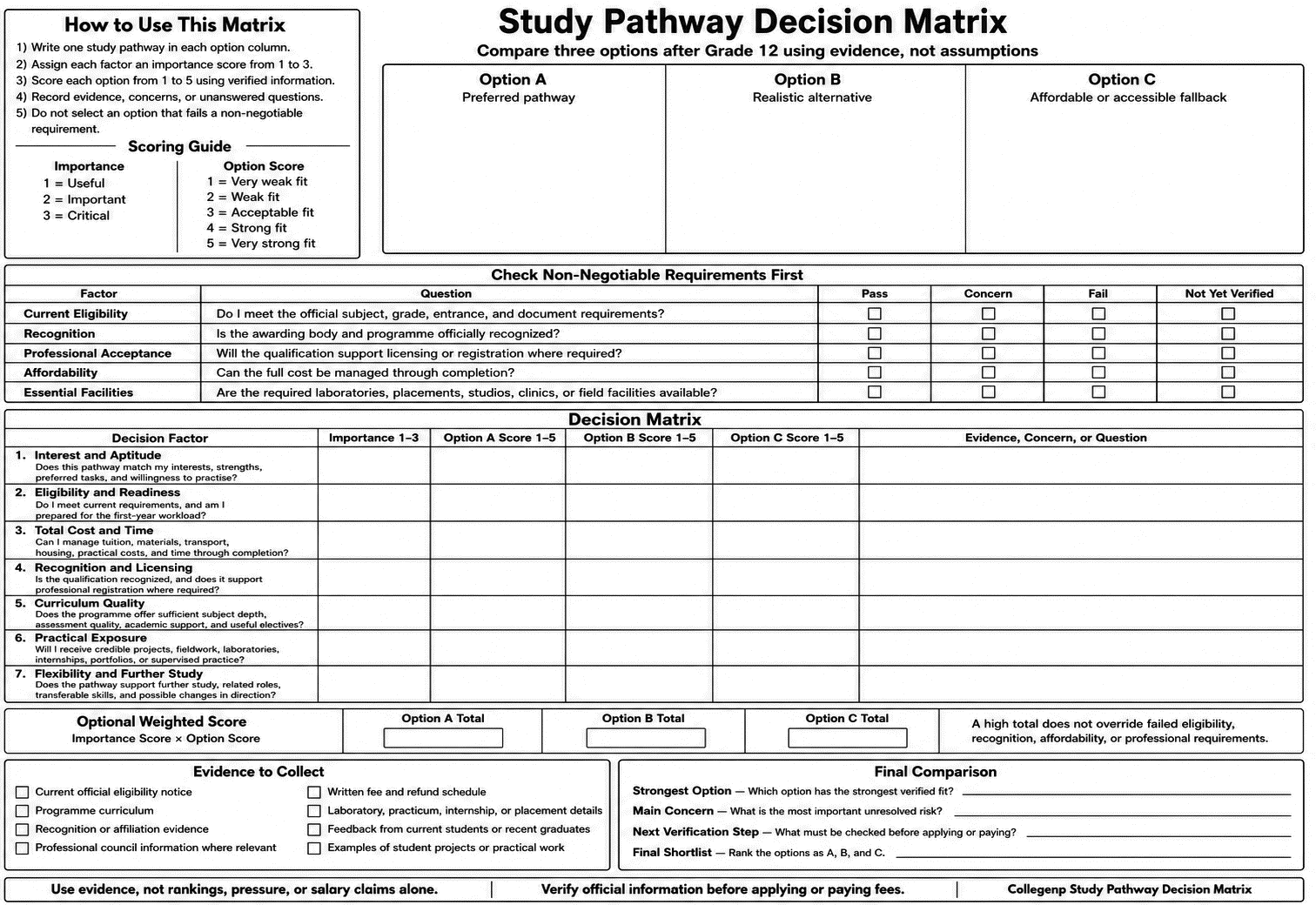
How Can Students Use a Weighted Decision Matrix?
A decision matrix helps students compare trade-offs without pretending that a numerical total can make the decision for them.
Step 1: Choose Three Options
Use:
-
Option A: preferred pathway
-
Option B: realistic alternative
-
Option C: affordable or accessible fallback
Step 2: Mark Non-Negotiable Gates
Possible gates include:
-
Current eligibility
-
Recognition
-
Professional acceptance
-
Affordable total cost
-
Essential laboratories or placements
An option that fails a gate should not be selected because it scores well elsewhere.
Step 3: Assign Importance
Use:
-
1 = useful
-
2 = important
-
3 = critical
Step 4: Score Each Option
Score each pathway from 1 to 5 and record the evidence.
| Factor | Importance 1–3 | Option A 1–5 | Option B 1–5 | Option C 1–5 | Evidence or concern |
|---|---|---|---|---|---|
| Interest and aptitude | |||||
| Eligibility and readiness | |||||
| Total cost and time | |||||
| Recognition and licensing | |||||
| Curriculum quality | |||||
| Practical exposure | |||||
| Flexibility and further study |
Multiplying the importance number by the score can help organize the comparison, but the written evidence matters more than the total.
Step 5: Use Exposure as a Tie-Breaker
When two options are close:
-
Review student work
-
Attend a sample class where available
-
Visit the facilities
-
Speak with current students
-
Speak with recent graduates
-
Try a small task from the field
-
Recheck the total cost
Students who need a deeper self-assessment process can read Collegenp’s guide on how to choose the right career after Class 12. The link is included for related guidance, not as evidence for regulatory or admission claims.
How Can Students Verify a Programme in Nepal?
Verification should happen before application payments and enrolment commitments.
Check the Awarding Body
Confirm which university, institution, council, or professional body awards the qualification.
Do not rely only on a logo, brochure, social-media post, or verbal claim.
Check the Institution’s Authority to Offer the Programme
Confirm the current relationship between the institution and the awarding body for the programme and intake concerned.
Use the official university, faculty, regulator, or awarding-body page. An old affiliation document may not describe the current position.
Use UGC QAA Information Correctly
UGC Nepal’s QAA list is a source for institutional accreditation status. It does not replace checks for:
-
Current programme authority
-
Professional recognition
-
Licensing eligibility
-
Admission rules
-
Equivalency
Check the Relevant Professional Body
| Pathway | Official body to check | Main purpose |
|---|---|---|
| Engineering | Nepal Engineering Council | University recognition and registration-examination requirements |
| Applicable medical and health bachelor admissions | Medical Education Commission | Current entrance notices and eligibility instructions |
| Nursing | Nepal Nursing Council | Registration, licensing, renewal, and institution-inspection information |
| Chartered Accountancy | Institute of Chartered Accountants of Nepal | Professional education, examinations, practical training, and syllabus information |
| Technical and vocational programmes | CTEVT | Programme categories, curricula, and entry-level information |
Examine the Learning Environment
Ask to see:
-
Current curriculum
-
Class schedule
-
Assessment rules
-
Faculty information
-
Laboratories, studios, workshops, farms, clinics, or field sites
-
Project requirements
-
Internship or practicum arrangements
-
Academic-support procedures
Evidence connected with current students is more useful than a general promise.
Request a Written Cost Sheet
Confirm:
-
Tuition
-
Admission and registration charges
-
Examination charges
-
Materials and equipment
-
Field, laboratory, studio, or clinical expenses
-
Payment schedule
-
Refund conditions
-
Other compulsory charges
Speak With Students and Graduates
Ask:
-
What does a normal study week involve?
-
Which facilities do students use?
-
How are practical tasks assessed?
-
Which costs were not obvious at admission?
-
What academic difficulties are common?
-
What did the programme prepare you to do?
-
What did you have to learn separately?
One person’s experience does not establish overall programme quality. Repeated concerns can identify matters that need further checking.
What Can Students Check in 30 Days?
This 30-day plan is a decision tool, not an admission schedule.
Week 1: Understand the Fit
-
Write down your interests, strengths, disliked tasks, values, and preferred work settings.
-
Choose three pathway families.
-
Read the first-year curriculum of one programme in each family.
-
Try one small task connected with each field.
Week 2: Complete Official Checks
-
Check current eligibility.
-
Confirm the awarding body.
-
Confirm the relationship between the programme and provider.
-
Check UGC QAA information where relevant.
-
Check the professional body for regulated routes.
-
Save each source and record the date checked.
Week 3: Test the Learning Environment
-
Visit the provider where possible.
-
Inspect relevant facilities.
-
Review examples of student work.
-
Ask about internships, fieldwork, or placements.
-
Speak with a current student and a recent graduate.
Week 4: Compare Cost and Decide
-
Complete the weighted matrix.
-
Prepare the full-cost worksheet.
-
Mark the options A, B, and C.
-
Discuss the evidence with a parent, guardian, teacher, or counsellor.
-
Recheck the official notice before making a payment.
The aim is not absolute certainty. It is a decision tested against personal fit, official information, cost, and actual learning conditions.
How Can Parents and Guardians Help?
Parents and guardians can support the quality of the decision without taking control of it.
Useful support includes:
-
Discussing the household budget honestly
-
Helping check official sources
-
Visiting institutions with a written question list
-
Comparing transport, housing, safety, and completion costs
-
Supporting more than one realistic option
-
Listening to the student’s interests and concerns
-
Separating social status from programme suitability
Avoid:
-
Comparing the student with relatives or classmates
-
Treating one entrance result as a judgment of personal worth
-
Choosing only by perceived prestige
-
Relying on unverified salary claims
-
Pressuring the student into a field they have not examined
-
Assuming one Grade 12 stream has a stronger future than all others
Which Common Mistakes Should Students Avoid?
Choosing by Salary Claims
A salary figure is weak evidence when it has no clear source, date, role, experience level, sector, or location.
Following a Trend Without Testing the Work
A field can attract attention without fitting the student’s preferred tasks or learning style.
Treating Science as the Only Strong Stream
Science supports access to some subject-specific routes. It does not make Management, Humanities, technical, creative, or professional routes inferior.
Confusing QAA With Professional Recognition
UGC institutional accreditation and professional council requirements answer different questions.
Treating CA as a Bachelor’s Degree
CA is an institute-led professional qualification involving examinations and practical training. It should be compared separately from a university bachelor’s degree.
Assuming a Degree Alone Is Sufficient
A formal qualification may be required, but practical evidence, registration, communication, portfolios, or further study may also matter.
Ignoring the Full Cost
Housing, transport, equipment, materials, examinations, practical work, and delays can materially affect affordability.
Believing One Result Ends Every Route
One result may affect one programme or intake. It does not establish that every academic, professional, or technical route is closed.
Choosing an Institution Before Choosing the Field
Decide what learning and qualification you need before comparing providers.
What Does This Article Not Claim?
This guide does not provide:
-
A ranking of highest-paying degrees
-
A list of assured-demand careers
-
A universal eligibility table
-
Exact fees, seats, deadlines, or scholarship amounts
-
A promise of employment, income, migration, licensing, or admission
-
A claim that QAA confirms professional recognition of every programme
-
A Nepal labour-market forecast based on a global employer survey
-
A conclusion that one Grade 12 stream is superior
Those questions require current programme-, regulator-, institution-, or labour-market-specific evidence.
What Should Students Do Next?
A suitable degree or pathway after 12th in Nepal should pass three tests.
First, it should fit the student’s interests, abilities, values, and preferred work. Second, it should fit the practical limits of eligibility, cost, location, and time. Third, it should pass external checks for recognition, curriculum quality, practical learning, and progression.
Before making a payment:
-
Keep three realistic options.
-
Complete the recognition and cost checks.
-
Take one real exposure step in the preferred field.
A carefully verified alternative is safer than an impressive-sounding option supported only by marketing.







Comments 0
No comments yet. Be the first to start the conversation.