




Choosing a career after Class 12 is not only about selecting a course. It is a practical decision about what kind of study, training, work exposure, entrance preparation, or skill-building should come next. A good decision should match your interests, strengths, academic background, eligibility, budget, family situation, learning style, and long-term goals.
For Nepali students, this decision often comes with pressure. Friends may already be applying to colleges. Parents may have expectations. Colleges and consultancies may promote different routes. Entrance notices, scholarship updates, and admission deadlines can also make the process feel urgent. That is why students should separate career guidance from admission pressure.
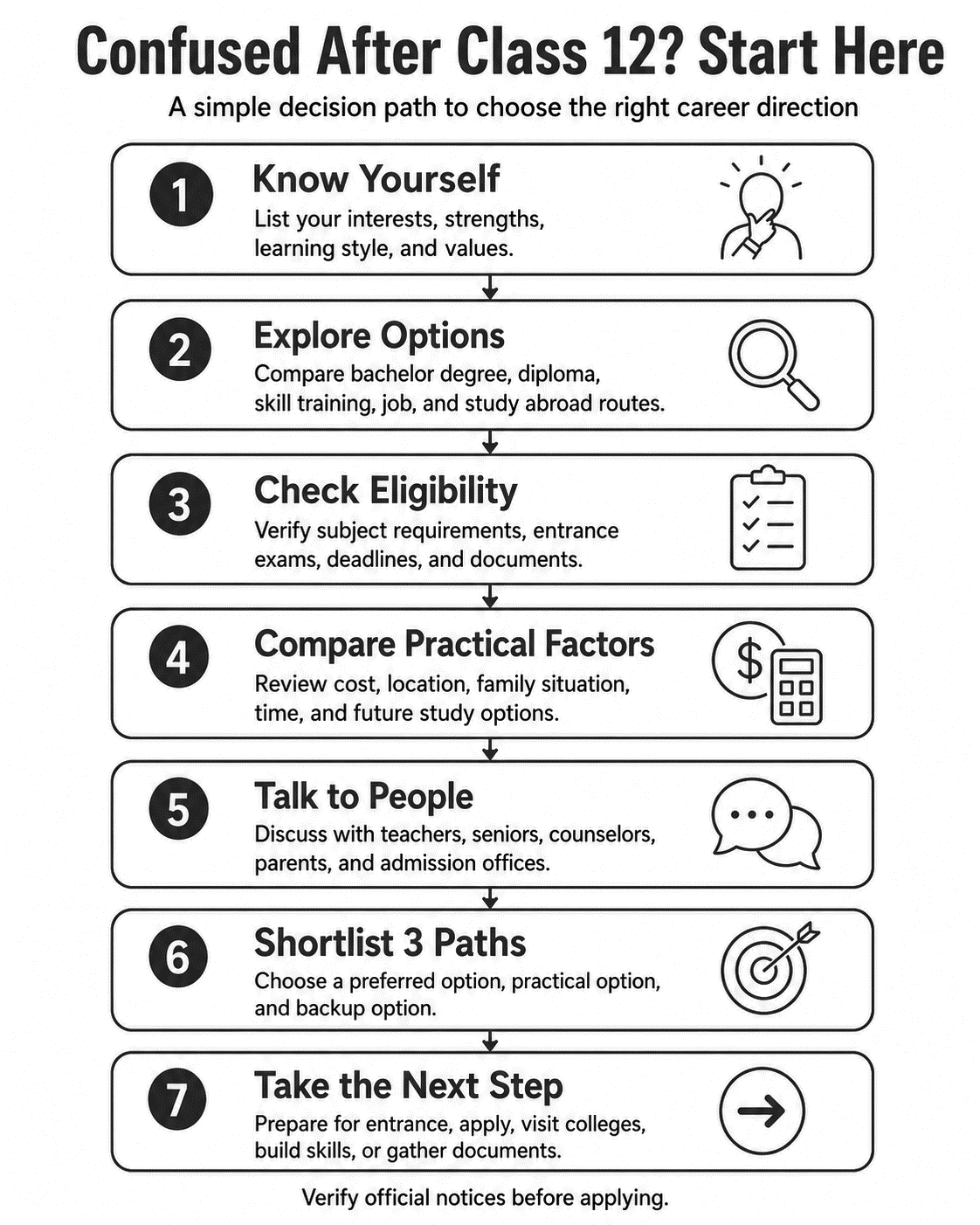
This guide explains how to choose career after Class 12 using a step-by-step decision method. It covers bachelor degrees, technical and vocational education, skill training, internships, entrance preparation, job exposure, and study abroad. It also shows what students should verify from official sources before making a final decision.
Answer Summary:
Students should choose a career after Class 12 by understanding their interests, strengths, academic background, budget, eligibility, and long-term goals. They should compare possible routes, verify admission and entrance details from official sources, talk to teachers, seniors, counselors, and parents, then shortlist three options: preferred, practical, and backup. The right choice is not one universal course; it is the path that fits the student’s ability, situation, and verified opportunities.
Key Takeaways:
-
There is no single best career after Class 12 for every student.
-
A strong choice balances interest, ability, eligibility, budget, and long-term fit.
-
Official notices matter for admission, entrance exams, fees, scholarships, and recognition.
-
A bachelor degree is not the only route after +2.
-
Technical education, skills, internships, and planned work exposure can also support career growth.
-
Students should shortlist a preferred option, a practical option, and a backup option.
-
Parents and counselors should guide the decision without forcing one path too early.
Table of Content
- What Does Choosing a Career After Class 12 Mean?
- Why Career Choice After Class 12 Feels Confusing
- Step 1: Understand Yourself Before Selecting a Course
- Step 2: Match Your Stream With Realistic Pathways
- Step 3: Compare Degree, Diploma, Skill, Job, and Study Abroad Routes
- Step 4: Verify Eligibility, Entrance Exams, Fees, and Notices
- Step 5: Shortlist Three Career Paths
- Step 6: Talk to Mentors, Seniors, Counselors, and Parents
- Step 7: Make a 30-Day Career Decision Plan
- Common Mistakes to Avoid After Class 12
- Career Decision Checklist for Class 12 Students
- Conclusion
 What Does Choosing a Career After Class 12 Mean?
Choosing a career after Class 12 means selecting a realistic direction for further study, training, work exposure, or professional preparation. It is both a short-term and long-term decision.
A short-term decision answers: What should I do next? A long-term decision answers: What kind of work, learning, lifestyle, and growth path am I preparing for?
Career choice is more than course selection
Many students begin by asking, “Which course is best?” A better question is, “Which route fits my interests, strengths, eligibility, budget, and future goals?”
A course is only one part of career planning. Two students may study the same bachelor program but build different careers depending on skills, internships, projects, communication ability, location, further study, and work habits.
For example, a student interested in healthcare may first think only of MBBS. But health-related routes may also include nursing, pharmacy, public health, laboratory technology, and other regulated programs, depending on current eligibility and admission rules. Students considering medical education should check the Medical Education Commission’s official entrance portal and notices before relying on informal information.
A student interested in technology may compare computer science, information technology, electronics, data, networking, design, business technology, or short skill-based training. The right choice depends on interest, ability, discipline, and the willingness to keep learning.
Certificate, diploma, and degree: what students should know
A certificate usually shows completion of a shorter course, training, or skill program. Its value depends on the provider, curriculum, assessment, practical work, and whether employers or institutions recognize it.
A diploma is usually more structured than a short certificate and may focus on technical or vocational preparation. In Nepal, the Council for Technical Education and Vocational Training is the national apex body for technical and vocational education and training.
A bachelor degree is a university-level academic program. It may be required for many professional, academic, government-service, teaching, research, and higher-study goals. Students should verify admission requirements through the relevant university, faculty, school, council, or college notice.
Before choosing any route, students should check quality signals such as recognition, curriculum depth, assessment standards, practical exposure, faculty strength, student support, transparent fees, internship opportunities, and pathways for further study.
Why Career Choice After Class 12 Feels Confusing
Career choice feels confusing because students face many options at the same time. Advice from parents, friends, teachers, seniors, social media, colleges, consultancies, and relatives may not point in the same direction.
Too many options and mixed advice
After +2, students may hear about Science, Management, Humanities, IT, engineering, health science, business, law, social work, hospitality, technical education, Lok Sewa, study abroad, freelancing, and short courses all at once.
The problem is not only lack of information. It is also unfiltered information. Students need a way to compare options using personal fit, eligibility, affordability, recognition, and long-term learning value.
A student should not choose a course only because it is trending. A field that looks popular online may require subjects, habits, costs, or work conditions that do not fit the student. A calmer decision process reduces the risk of rushing into a course without understanding it.
Marks, entrance exams, cost, and family pressure
Marks matter for eligibility, entrance preparation, scholarships, and some competitive routes. But marks alone should not decide a career. A student with high marks may still feel unhappy in a field that does not match their interests or work style. A student with average marks may build a strong career through practical skills, discipline, and a realistic study route.
Cost is another major factor. Students should think beyond tuition. Transport, rent, meals, study materials, digital devices, entrance preparation, exam forms, and living expenses can affect the total burden on a family.
Scholarship information should be checked from official sources when available. University Grants Commission Nepal publishes higher education notices, including scholarship-related notices and renewal updates. The education ministry website also lists scholarship, education information, career guidance, and NOC-related service links.
Family pressure can make students rush. Parents may value stability, safety, social respect, or income security. Students may value interest, independence, creativity, or a different field. The best discussion should compare facts, not only emotions.
Step 1: Understand Yourself Before Selecting a Course
Students should begin by understanding their interests, strengths, learning habits, and values. A career choice becomes stronger when it matches the person, not only the market trend.
Interests, strengths, and learning style
Start with honest self-assessment. Ask yourself:
-
Which subjects did I enjoy in Class 11 and 12?
-
Which subjects did I avoid even when I had time?
-
Do I prefer numbers, writing, design, people, machines, research, business, teaching, field work, or practical tasks?
-
Do I learn better through theory, practice, discussion, projects, or problem-solving?
-
Can I stay disciplined in this field for several years?
Interest alone is not enough. Strength matters too. A student may like a field but need stronger preparation before entering it. Another student may be good at a subject but may not want to work in that area long term.
The OECD’s career-readiness work highlights the value of career exploration, guidance activities, encounters with people from the world of work, and first-hand workplace experience during secondary education. This supports a practical point: students should not decide only by imagination. They should read syllabi, talk to seniors, try beginner projects, attend counseling sessions, and compare real requirements.
Values, lifestyle, and work environment
A career should also fit your values and preferred work environment. Some students want stability and structured employment. Some want entrepreneurship. Some prefer creative work, field work, technology, research, teaching, public service, or community work.
Ask yourself:
-
Do I want a people-facing role or a technical role?
-
Do I prefer predictable routines or changing tasks?
-
Am I comfortable with competitive entrance exams?
-
Do I want to study near home or away from home?
-
How much financial pressure can my family handle?
-
Would I continue this field when it becomes difficult?
These questions do not give an instant answer, but they reduce random choices.
Step 2: Match Your Stream With Realistic Pathways
Your Class 12 stream can guide your options, but it should not make you feel trapped. Many pathways depend on exact eligibility rules, so students should verify current requirements before applying.
| Class 12 Background | Possible Pathways | May Suit Students Who | Important Caution |
|---|---|---|---|
| Science | Health sciences, engineering, IT, agriculture, forestry, pure science, management, interdisciplinary courses | Enjoy science, problem-solving, healthcare, technology, research, or environment-related study | Entrance requirements and eligibility vary by program and institution. |
| Management | BBS, BBA, BBM, BIM or BIT-type programs where eligible, accounting, finance, hotel management, economics, entrepreneurship | Enjoy business, finance, accounting, communication, hospitality, or management | Compare course content, affiliation, cost, internship exposure, and skill requirements. |
| Humanities / Social Science | BA, BSW, law, journalism, education, public administration, languages, social development | Enjoy society, communication, law, teaching, writing, media, or public service | Outcomes depend on skills, specialization, practical exposure, and further study. |
| Technical / Vocational Route | CTEVT or other technical/vocational programs, skill training, apprenticeships | Prefer hands-on learning, practical skills, or job-oriented technical training | Verify recognition, level, duration, institution approval, and future upgrade pathways. |
| Job / Internship / Skill Route | Entry-level work, internships, freelancing skills, short courses, portfolio building | Need work exposure, income support, or time to clarify direction | Continue learning through skills, certification, or future study planning. |
Science students
Science students may consider health sciences, engineering, agriculture, forestry, pure science, IT, data-related fields, environmental studies, management, or interdisciplinary programs.
This route may suit students who enjoy science, problem-solving, lab work, mathematics, technical systems, healthcare, environment, or research. Some routes require competitive entrance exams and strict eligibility checks. Students considering medical education should verify current notices through the Medical Education Commission.
Management students
Management students may consider BBS, BBA, BBM, BIM or IT-related management programs where eligible, accounting, finance, entrepreneurship, hotel management, economics, business analytics, sales, marketing, and CA or ACCA-related routes.
This route may suit students who enjoy business, accounting, planning, communication, leadership, finance, market systems, hospitality, or entrepreneurship. Students should compare course structure, affiliation, internship exposure, cost, and long-term skill needs before choosing.
Humanities and social science students
Humanities and social science students may consider BA, BSW, law, journalism, education, public administration, psychology-related study where available, languages, social development, media, and public service preparation.
This route may suit students interested in society, communication, teaching, policy, writing, law, development, public service, or human behavior. Students should avoid assuming that Humanities has limited scope. Outcomes depend on skill, specialization, language ability, practical exposure, and further study.
Technical and vocational learners
Technical and vocational routes may suit students who prefer hands-on learning, job-oriented skills, and practical training. UNESCO-UNEVOC describes technical and vocational education and training as learning that supports skills, knowledge, and values for work and life.
In Nepal, students interested in technical and vocational education should verify program level, duration, institution approval, admission rules, recognition, and upgrade pathways through official CTEVT sources where relevant.
Step 3: Compare Degree, Diploma, Skill, Job, and Study Abroad Routes
Students should compare different routes instead of assuming that only one path is respectable. The right route depends on purpose, eligibility, cost, time, readiness, and long-term growth.
| Option | What It Means | May Suit | Verify Before Choosing |
|---|---|---|---|
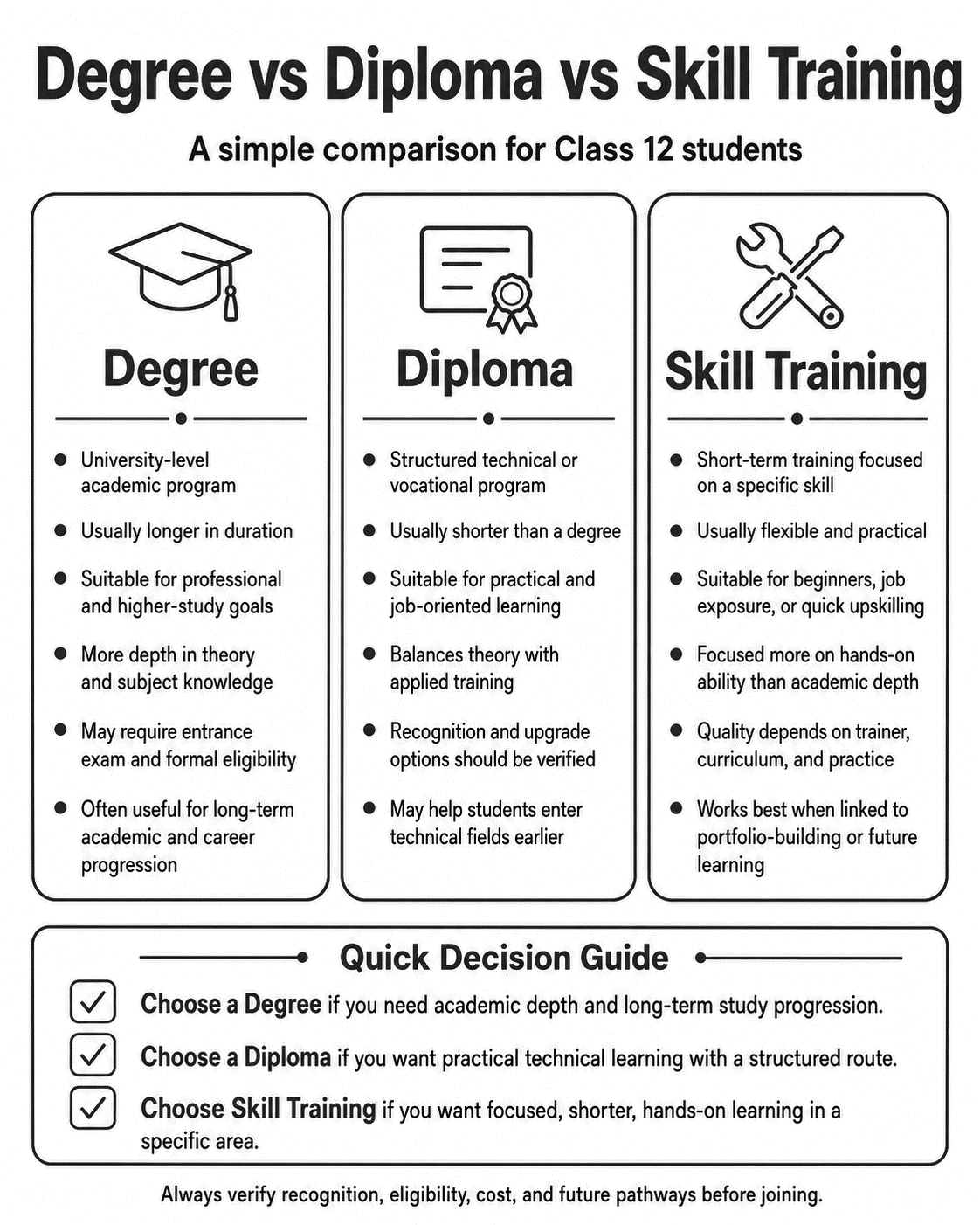
| Bachelor Degree | Structured university-level academic route | Students who need a degree for professional, academic, public service, or higher-study goals | Eligibility, entrance exam, affiliation, recognition, fees, and course quality |
| Technical / Vocational Education | Practical and skill-based education linked to specific occupations | Students who prefer hands-on learning and applied skills | Program approval, level, duration, future study options, and practical training quality |
| Skill Training / Internship | Shorter route focused on specific skills or work exposure | Students exploring IT, design, media, hospitality, office skills, sales, or freelancing | Training quality, mentorship, portfolio value, and connection with future goals |
| Job / Work Exposure | Entry-level work after Class 12, often combined with learning | Students needing income support or real workplace exposure | Work conditions, learning value, time for further study, and long-term progression |
| Study Abroad | Academic route in another country | Students with academic, financial, language, documentation, and family readiness | Total cost, visa rules, institution credibility, work limits, scholarship rules, and long-term plans |
Bachelor degree route
A bachelor degree may suit students who need a recognized academic qualification for professional practice, higher study, public service, teaching, research, or structured career growth.
The strength of this route is academic depth. The limitation is that it takes time, money, and consistent effort. Students should verify affiliation, eligibility, entrance requirements, credit structure, recognition, faculty, facilities, internships, and exam systems before joining.
Technical or vocational route
A technical or vocational route may suit students who prefer practical training and earlier skill application. It can be useful for students interested in agriculture, health-related technical fields, engineering trades, hospitality, construction, lab work, repair, and other applied areas, depending on available programs and eligibility.
The strength of this route is practical skill development. The limitation is that recognition, future study options, and job pathways vary by program. Students should not choose a program until they verify its status, level, and progression route from official sources.
Skill training, internship, or job route
Skill training, internships, and entry-level jobs may help students who need work exposure, income support, or time to understand their direction. This may include office skills, digital skills, design, communication, hospitality, sales, content, coding basics, repair skills, or customer service.
This route should not become a reason to stop learning. Students who work after Class 12 should still build a plan for further study, certification, portfolio, or career progression.
Study abroad route
Study abroad may suit students who have academic readiness, financial planning, documentation, family support, language preparation, and a clear purpose. It should not be chosen only because others are going.
Students should verify institution credibility, visa rules, total cost, work rules, scholarship conditions, academic progression, and long-term plans. Nepal’s education ministry website includes links for NOC-related services and student-facing education resources, which students should check when considering foreign study.
Step 4: Verify Eligibility, Entrance Exams, Fees, and Notices
Students should verify official information before applying. This step can prevent missed deadlines, wrong applications, unrecognized programs, and unexpected costs.
| What to Verify | Where to Verify | Why It Matters |
|---|---|---|
| Eligibility | Official university, council, faculty, or college admission notice | A small eligibility difference can decide whether you can apply. |
| Entrance Exam | Official entrance portal, faculty notice, council notice, or institution notice | Dates, forms, formats, and results can change. |
| Fees and Payment Rules | Official college or institution office/notice | Fees should not be assumed from old posts or informal claims. |
| Scholarships | Official scholarship notice or authorized body | Scholarship rules, quotas, and deadlines can change. |
| Program Recognition | Official university, council, CTEVT, or regulatory body | Recognition affects further study, licensing, and employment pathways. |
| Documents Required | Admission notice or official admission office | Missing documents can delay or block admission. |
What to verify
Before choosing a course or institution, verify:
-
Eligibility requirements
-
Entrance exam dates and format
-
Application deadline
-
Required documents
-
Fee structure and payment rules
-
Scholarship rules
-
Program recognition
-
Institution approval
-
Further study pathway
-
Licensing or council requirements, where relevant
Do not rely only on old social media posts, friends, advertisements, or unofficial summaries. They can help you discover options, but official sources should guide final decisions.
Where to verify
For Class 12 exam and result-related matters, check the National Examination Board.
For higher education notices, quality-related higher education information, grants, and scholarship-related updates, check University Grants Commission Nepal where relevant.
For technical and vocational education, check CTEVT.
For medical education entrance notices, seat-related notices, and eligibility instructions, check the Medical Education Commission’s official systems.
For university-specific programs, check the relevant university, faculty, school, or admission portal.
For government-service pathways, check Public Service Commission notices and application information.
Step 5: Shortlist Three Career Paths
Students should not force themselves to select one perfect option immediately. A three-option shortlist gives structure and reduces panic.
Preferred option
Your preferred option is the path you are most interested in and willing to work for. It may be competitive, costly, or difficult, but it should still be realistic enough to prepare for.
Example: A Science student interested in healthcare may keep a health-science entrance route as the preferred option after checking eligibility and preparation needs.
Practical option
Your practical option fits your current marks, budget, location, family situation, eligibility, and preparation level. It may not be your first dream, but it should still be respectable and useful.
Example: A student interested in business may compare BBA, BBS, entrepreneurship, accounting, and skill-based business training before deciding what fits the family budget and study goals.
Backup option
Your backup option is not failure. It is a planned alternative if entrance results, cost, seat limits, health, family situation, or location make the first choice difficult.
Example: A student targeting one competitive program may also prepare for a related bachelor degree, technical diploma, or skill route that keeps future options open.
Career decision matrix
Use this matrix after shortlisting your options. Score each factor from 1 to 5. The score is not the final decision, but it helps you compare options more clearly.
| Decision Factor | Question to Ask | Score 1–5 |
|---|---|---|
| Interest | Do I genuinely want to learn this field for several years? | |
| Strength | Do my abilities and habits fit this field? | |
| Eligibility | Do I meet the current requirements, or can I prepare realistically? | |
| Affordability | Can my family and I manage tuition, living cost, materials, and preparation cost? | |
| Access | Is the course available in a suitable location or format? | |
| Skill Growth | Will this path help me build useful skills? | |
| Long-Term Fit | Can I see myself growing in this direction? | |
| Backup Possibility | Can I shift, specialize, or continue if the first plan changes? |
Step 6: Talk to Mentors, Seniors, Counselors, and Parents
Career decisions improve when students speak with people who understand the course, profession, and student’s situation. Good advice should make the decision clearer, not more pressured.
Questions to ask seniors and counselors
Ask seniors:
-
What do you study in this course?
-
Which subjects are difficult?
-
What skills should I build early?
-
What did you misunderstand before joining?
-
How did you verify admission and eligibility?
Ask teachers or counselors:
-
Which options fit my strengths and habits?
-
Which options may be risky for me right now?
-
What should I verify from official sources?
-
How can I compare two courses fairly?
-
What backup option makes sense?
OECD career-readiness work supports structured career exploration, conversations, and workplace-related exposure during secondary education. For students, this means career clarity often improves through real conversations and small experiences, not only thinking alone.
How parents can support without pressure
Parents can support students by listening before advising. A helpful family discussion should include interest, ability, total cost, distance, safety, admission rules, future study, and employment uncertainty.
Students should also listen to parents’ practical concerns. Budget, living arrangements, location, transport, and family responsibilities are real factors. The strongest decisions usually come from honest discussion, not silent pressure.
Step 7: Make a 30-Day Career Decision Plan
A 30-day plan helps students move from confusion to action. The goal is not to rush; the goal is to gather enough reliable information to make a better decision.
| Timeframe | Action |
|---|---|
| Days 1–5 | List your interests, strengths, subjects you enjoyed, subjects you struggled with, and careers you are curious about. |
| Days 6–10 | Research five to seven possible courses or pathways. Note what each course teaches, where it is available, and what it may lead to. |
| Days 11–15 | Check eligibility, entrance exams, fees, scholarships, documents, and deadlines from official or institutional sources. |
| Days 16–20 | Talk to seniors, one teacher or counselor, and your parents or guardians. |
| Days 21–25 | Shortlist three options: preferred, practical, and backup. Use the decision matrix to compare them. |
| Days 26–30 | Prepare your next action: entrance preparation, application documents, college visits, scholarship search, or skill-building plan. |
Research, compare, verify, and act
During this 30-day process, keep notes in one place. Write down the official source, deadline, contact office, required documents, total cost estimate, and next step for each option.
The plan does not force you to decide in one month. It helps you replace worry with action. Even if your final choice changes later, the information you collect will make your decision stronger.
Common Mistakes to Avoid After Class 12
Students should avoid decisions based only on pressure, popularity, or unsupported claims. A weak decision process can create more confusion than a difficult course.
Avoid these mistakes:
-
Choosing a course only because friends are joining it.
-
Choosing only because a field sounds high-paying.
-
Ignoring eligibility, entrance dates, documents, or official notices.
-
Believing job or salary claims without evidence.
-
Choosing a college only from advertisements.
-
Ignoring total cost.
-
Rejecting technical or vocational routes without understanding them.
-
Taking a gap year without a plan.
-
Thinking one imperfect decision ends the future.
Career outcomes depend on learning, skills, performance, experience, location, market conditions, and continued effort. No article, college, consultancy, or training provider should promise a guaranteed result.
Career Decision Checklist for Class 12 Students
Before finalizing your choice, answer these questions:
-
Do I understand what this course teaches?
-
Do I meet the current eligibility requirements?
-
Is there an entrance exam?
-
Do I know the official deadline?
-
Can my family and I manage the full cost?
-
Have I checked scholarship options?
-
Have I spoken with seniors or teachers?
-
Do I know what skills I need to build?
-
Do I have a backup option?
-
Have I verified important details from official sources?
-
Am I choosing this because it fits me, not only because of pressure?
When several answers are unclear, pause and verify more before applying. A few extra days of careful checking can prevent years of confusion.
Conclusion
Choosing the right career after Class 12 is not about finding one perfect course. It is about making a careful, verified, and realistic decision.
Start with yourself: interests, strengths, habits, values, and limits. Then compare available routes: bachelor degree, diploma, technical education, skill training, entrance preparation, job exposure, or study abroad. Verify official information before applying. Talk to seniors, teachers, counselors, parents, and admission offices. Shortlist a preferred option, a practical option, and a backup option.
A good career decision should reduce confusion, not increase pressure. The right path is the one you understand, can prepare for, can afford or support through verified options, and can continue with discipline.







Comments 0
No comments yet. Be the first to start the conversation.