




Choosing between computer engineering and software engineering is not only a choice between two similar degree names. It is a decision about the kind of technology work you want to do, the subjects you can handle, and the career path you want to build.
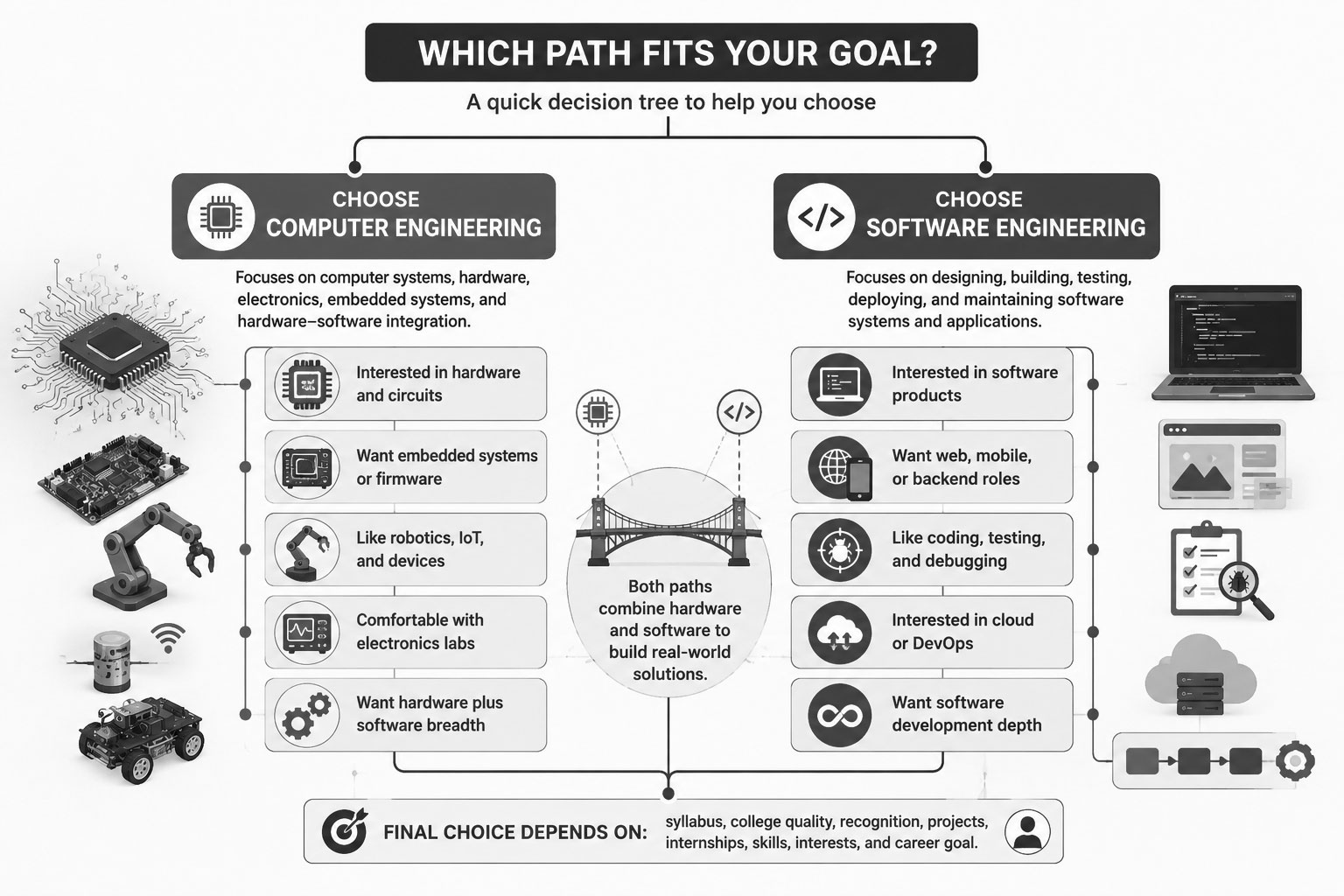
Computer engineering is closer to the machine. It connects computing with electronics, hardware, embedded systems, microprocessors, computer architecture, robotics, IoT, firmware, and hardware-software integration.
Software engineering is closer to the product. It focuses on designing, building, testing, securing, deploying, and maintaining software systems such as web apps, mobile apps, backend platforms, enterprise software, QA systems, cloud services, DevOps workflows, and AI-supported applications.
The honest answer is conditional: software engineering is usually better for students who mainly want software development careers, while computer engineering is usually better for students who want both hardware and software options. Neither degree is automatically better for everyone.
Quick Answer
Choose software engineering if your main goal is to become a software developer or work in web, mobile, backend, QA, DevOps, cloud, or product engineering.
Choose computer engineering if you want to work closer to hardware, embedded systems, firmware, robotics, IoT, digital systems, computer architecture, or device-level computing.
A simple rule works for most students: choose computer engineering if you want to understand and build systems close to the machine; choose software engineering if you want to build reliable software that runs on machines.
Table of Content
- Anatomy of the Issue
- Comparison Methodology
- Evidence Snapshot
- Computer Engineering vs Software Engineering Comparison Table
- What Is Computer Engineering?
- What Is Software Engineering?
- Curriculum and Skills
- Career Scope and Job Market
- Nepal Context: BE Computer vs BE Software
- Which Is Harder?
- Can You Switch From One to the Other?
- What About AI?
- Personal and Social Factors
- Who Should Choose Computer Engineering?
- Who Should Choose Software Engineering?
- Who Should Avoid Each Option?
- Common Mistakes
- What Would Change the Verdict?
- Final Decision Checklist
- Final Verdict
Anatomy of the Issue
The real question is not only “which degree is better?” The deeper question is: which path gives you the better match between your interest, learning style, institution quality, and target career?
Many students get confused because both degrees include programming. That overlap is real, but it does not make the degrees identical. Computer engineering normally includes more hardware, electronics, circuits, microprocessors, and device-level systems. Software engineering normally includes more requirements analysis, software design, testing, deployment, maintenance, teamwork, and product development.
The decision should not be based only on salary claims, social media opinions, or which title sounds more prestigious. A strong degree title cannot compensate for weak teaching, poor labs, limited projects, unclear recognition, or no internship support.
Comparison Methodology
This comparison uses practical decision criteria rather than a forced winner. The main criteria are academic focus, curriculum, hands-on learning, career path, salary and outlook limits, Nepal/global relevance, difficulty, switching flexibility, and risk.
The goal is to identify which option is better for which type of student, under which conditions, and why.
Evidence Snapshot
| Evidence Area | What It Means |
|---|---|
| Verified | Computer engineering is more hardware-and-systems oriented; software engineering is more software-lifecycle oriented. |
| Needs verification | Current fees, seats, entrance rules, scholarships, recognition, and placement evidence in Nepal. |
| Depends on context | Salary, job access, internship quality, teaching quality, and career outcomes. |
| Should not be assumed | A degree name alone does not guarantee employment, high salary, or better scope. |
| Editorial judgment | The better degree depends on fit between curriculum, institution quality, and career goal. |
Computer Engineering vs Software Engineering Comparison Table
| Criteria | Computer Engineering | Software Engineering | Editorial Judgment |
|---|---|---|---|
| Core focus | Hardware, computer systems, embedded devices, electronics, and hardware-software integration | Software systems, applications, requirements, design, testing, deployment, and maintenance | Computer engineering is broader across hardware and software; software engineering is more direct for software product careers. |
| Typical subjects | Digital logic, circuits, microprocessors, computer architecture, embedded systems, operating systems, networking, programming | Programming, databases, software design, requirements engineering, QA, testing, security, project management, DevOps | Choose based on the subjects you are willing to study deeply. |
| Practical work | Hardware labs, microcontrollers, device projects, and system integration | Coding projects, version control, testing, deployment, and team-based software development | Check actual labs and projects, not only the brochure. |
| Best-fit roles | Embedded engineer, firmware engineer, systems engineer, robotics/IoT engineer, hardware-adjacent engineer | Software developer, backend/frontend/mobile engineer, QA engineer, DevOps/cloud engineer, software product engineer | Both can lead to technology careers, but the direct path is different. |
| Main risk | Too hardware-heavy for students who only want app or web development | Too software-focused for students who want electronics or device-level systems | Poor fit creates more risk than the degree name itself. |
 What Is Computer Engineering?
Computer engineering combines computing with electrical and electronics engineering. Students usually study programming along with digital logic, circuits, microprocessors, computer architecture, embedded systems, operating systems, networking, and hardware-software interaction.
This makes computer engineering useful for careers where software works directly with physical systems. Examples include embedded systems, firmware, robotics, IoT devices, automation systems, hardware testing, and low-level systems programming.
Computer engineering can also lead to software jobs, but students who want that route must build strong coding skills, software projects, internships, and a portfolio. The degree alone is not enough.
What Is Software Engineering?
Software engineering is the structured development of software systems. It is not only about writing code.
A good software engineering program teaches students how to understand requirements, design systems, write maintainable code, test software, manage bugs, improve security, deploy applications, and maintain products over time.
This makes software engineering a direct fit for software developer, backend engineer, frontend engineer, mobile app developer, QA engineer, DevOps engineer, cloud engineer, and software product roles.
Curriculum and Skills
Computer engineering gives more space to hardware, electronics, circuits, embedded systems, and computer architecture. It suits students who want to understand how devices, processors, sensors, and systems work together.
Software engineering gives more space to software design, databases, testing, QA, security, project workflows, deployment, and long-term maintenance. It suits students who want to build usable and reliable software products.
Both require programming and problem-solving. The difference is depth. Computer engineering goes deeper into hardware-software systems. Software engineering goes deeper into the software development lifecycle.
Career Scope and Job Market
For pure software jobs, software engineering usually provides the clearer academic route. Its curriculum is built around software development, testing, deployment, and product delivery.
For hardware-connected technology work, computer engineering usually provides the stronger foundation. Embedded systems, firmware, IoT, robotics, hardware testing, and computer architecture often require knowledge that software engineering students may need to learn separately.
U.S. labor data can help show broad occupation trends, but it should not be treated as a global salary or employment promise. Salary and job access depend on country, company, role, skill level, experience, portfolio, internship history, and specialization.
For Nepal-based students, U.S. salary figures should not be used as local salary expectations. Current local vacancies, internships, employer demand, alumni outcomes, and college placement records should be checked separately.
Nepal Context: BE Computer vs BE Software
For students in Nepal, the decision should include local academic reality. BE Computer may fit students who want broader hardware-software systems depth. BE Software may fit students who want a focused software development path, especially if the college has strong project culture, programming support, internships, and industry exposure.
Before choosing, verify university affiliation, professional recognition status where applicable, current seats, fees, scholarships, entrance requirements, updated syllabus, labs, faculty strength, internship access, and recent placement evidence.
Do not choose only because one title sounds more established. In Nepal, the better choice may be the program with stronger delivery, not simply the more familiar name.
Which Is Harder?
Computer engineering may feel harder if you dislike electronics, circuits, physics-related labs, microprocessors, and lower-level systems.
Software engineering may feel harder if you dislike long coding projects, debugging, testing, documentation, changing requirements, teamwork, and continuous tool learning.
The better question is: which difficulty are you more willing to handle for four years and continue learning after graduation?
Can You Switch From One to the Other?
A computer engineering graduate can become a software engineer, but not automatically. They need programming depth, software projects, data structures, databases, testing knowledge, Git, internships, and interview preparation.
A software engineering graduate can move toward embedded systems or IoT, but the path is less direct. They may need C/C++, microcontrollers, electronics basics, operating systems, sensors, communication protocols, and hardware debugging.
Switching is possible, but it requires evidence of skill. Employers usually care about what the candidate can build, test, debug, and maintain.
What About AI?
Software engineering is still relevant, but the skill bar is rising. AI tools can help with coding tasks, but employers still need people who can define problems, design systems, test outputs, review security, understand users, and maintain products.
The risky path is becoming only a syntax-level coder. The stronger path is learning software architecture, debugging, testing, security, cloud, product thinking, and communication.
Computer engineering students should also take software seriously because modern hardware products often depend on firmware, apps, cloud services, and connected systems.
Personal and Social Factors
This decision often involves family expectations, cost, peer pressure, location, and fear of choosing the wrong course. These pressures are real, but they should not replace evidence.
A student should ask: Can I handle the syllabus? Does the college have proper labs and projects? Can my family manage the total cost? Is the program recognized for my future plan? Am I choosing from interest, or only because others say it has scope?
Prestige is not a reliable decision tool. Fit, quality, and verified opportunity matter more.
Who Should Choose Computer Engineering?
Choose computer engineering if you enjoy hardware, circuits, robotics, IoT, microcontrollers, embedded systems, computer architecture, and systems-level work.
It is also a better fit if you want a broader engineering path that connects software with physical devices and computer systems.
Who Should Choose Software Engineering?
Choose software engineering if you want to build software products, web apps, mobile apps, APIs, backend systems, QA systems, cloud platforms, or DevOps workflows.
It is also a better fit if you want a more direct route into software development and are ready for coding, testing, debugging, teamwork, and continuous learning.
Who Should Avoid Each Option?
Avoid computer engineering if you only want app or web development and strongly dislike electronics, circuits, hardware labs, or device-level systems.
Avoid software engineering if your real interest is hardware design, embedded devices, firmware, robotics hardware, or electronics-heavy engineering.
Avoid both options if you are choosing only because of salary expectations, peer pressure, or the belief that any technology degree automatically guarantees a job.
Common Mistakes
Common mistakes include choosing only by salary claims, following friends, ignoring the syllabus, trusting promotional placement claims, assuming one degree is always better, treating U.S. salary data as local salary expectation, and believing a tech degree guarantees employment.
Another mistake is ignoring college quality. A well-delivered program with strong projects can be more valuable than a better-sounding degree delivered poorly.
What Would Change the Verdict?
The verdict changes with college quality. A strong software engineering program may be better than a weak computer engineering program for a software-focused student. A strong computer engineering program may be better for a student who wants broad systems knowledge.
Cost, location, scholarship, recognition, faculty, labs, internships, and long-term study plans can also change the better choice.
Final Decision Checklist
Before admission, confirm:
-
Updated syllabus
-
University affiliation
-
Recognition status where applicable
-
Current fees and hidden costs
-
Scholarship options
-
Entrance requirements
-
Lab quality
-
Project work
-
Internship access
-
Placement evidence
-
Faculty strength
-
Career fit
-
Family budget
-
Location practicality
Final Verdict
Computer engineering vs software engineering does not have one fixed winner.
Software engineering is better if your main goal is software development, including web, mobile, backend, QA, cloud, DevOps, and product engineering. Its strongest advantage is direct alignment with software careers. Its main limitation is weaker preparation for hardware-heavy roles.
Computer engineering is better if you want hardware-plus-software breadth, especially embedded systems, firmware, robotics, IoT, digital systems, and computer architecture. Its strongest advantage is systems depth. Its main limitation is that hardware-heavy subjects may not suit students who only want software product development.
For Nepal-based students, verify current program details before deciding. The most practical takeaway is this: choose the degree that matches the work you actually want to do, then choose the institution that can genuinely support that path.







Comments 0
No comments yet. Be the first to start the conversation.