



The degree vs experience debate is often treated as if every employer uses the same hiring rule. They do not. A hospital, law firm, construction contractor, software company, sales team, and design agency may all judge candidates through different evidence.
The real question is not whether a degree or experience is better in general. The better question is: what does the target job use as its gatekeeper?
Some jobs require formal education, approved training, licensing, or professional registration. Other jobs can be judged through work samples, apprenticeships, technical tests, client results, sales performance, portfolios, references, or previous job outcomes.
For most job seekers, the strongest position is not degree only or experience only. It is relevant education supported by practical evidence, or strong experience supported by clear proof of skill. The right choice depends on the role, industry, country, employer policy, career stage, cost, and long-term goal.
Quick Answer
A degree matters more when the job is regulated, licensed, academically specialized, or filtered by employer policy. Experience matters more when the employer can directly judge whether you can do the work through results, samples, client outcomes, apprenticeships, technical tests, or previous job performance.
For many competitive roles, both matter. A degree can help open the door, but experience shows whether you can apply what you know. Experience can outweigh a degree in some fields, but it cannot replace a legally required qualification, license, or approved education pathway.
Table of Content
- Anatomy of the Issue: Why This Comparison Is Often Misleading
- Comparison Methodology
- Evidence Snapshot
- Degree vs Experience: Comparison Table
- Where a Degree Matters More
- Where Experience Matters More
- Detailed Comparison by Job Type
- What Current Hiring Evidence Says
- Mini Case Study 1: Degree Inflation in Production Supervisor Jobs
- Mini Case Study 2: Electricians Show an Experience-Centered Path
- Mini Case Study 3: Software Development Is a Mixed Signal
- If You Have a Degree but Little Experience
- If You Have Experience but No Degree
- Personal and Social Factors
- Reader-Specific Recommendation
- What Would Change the Verdict?
- Who Should Avoid Relying Only on a Degree?
- Who Should Avoid Relying Only on Experience?
- Decision Checklist
- Common Mistakes
- Final Verdict: Degree vs Experience
Anatomy of the Issue: Why This Comparison Is Often Misleading
The phrase “degree vs experience” sounds simple, but readers usually bring different concerns to the question.
A student may be asking whether to study first or work first. A recent graduate may be asking why a degree has not led to a job. A skilled worker without a degree may be trying to pass employer filters. A career changer may be deciding between returning to school, earning a certification, building a portfolio, or accepting an entry-level role.
The confusion comes from broad claims such as:
-
“Degrees are no longer needed.”
-
“Experience always wins.”
-
“Employers only care about skills.”
-
“A degree guarantees better jobs.”
-
“Certificates can replace college.”
Each claim may be true in some situations and false in others. A lawyer, registered nurse, electrician, software developer, salesperson, and operations manager do not enter the job market through the same pathway.
The root issue is hiring risk. Employers want evidence that a person can do the job safely, legally, reliably, and productively. A degree, license, apprenticeship, internship, portfolio, certification, reference, or previous result matters only because it reduces uncertainty.
Comparison Methodology
This comparison uses seven practical criteria.
| Criteria | Why it matters |
|---|---|
| Legal or licensing requirement | Some jobs cannot be entered through experience alone. |
| Employer screening | A degree may still be used as a filter even when the work is skill-based. |
| Proof of skill | Experience is stronger when the candidate can show measurable results. |
| Career stage | Early-career applicants often need signals; mid-career applicants can lean more on outcomes. |
| Industry type | Regulated, trade-based, technical, creative, and business roles weigh evidence differently. |
| Cost and opportunity cost | Full-time study can delay income; working without credentials can limit access. |
| Long-term mobility | Some promotions, graduate programs, public-sector roles, and international pathways may require formal credentials. |
This article does not use a fixed score because no single score can fairly compare all careers. The stronger option changes by role, country, employer, and reader goal.
Evidence Snapshot
Verified facts: U.S. Bureau of Labor Statistics education data shows that higher education is associated with higher median earnings and lower unemployment at the broad population level. NACE employer resume evidence also shows that hiring decisions depend on applied abilities such as problem-solving, teamwork, communication, initiative, work ethic, and technical skills.
Role-specific facts: Some careers, including many legal, healthcare, teaching, engineering, accounting, and public-safety roles, may require formal education, approved training, licensing, or professional registration. Exact requirements vary by country, state, profession, and employer.
What needs verification: Local licensing rules, country-specific credential recognition, current job posting requirements, tuition costs, salary claims, and employer policies.
What should not be assumed: A degree does not guarantee employment. Experience does not automatically replace formal credentials. Skills-first hiring does not mean every employer has stopped valuing degrees.
Degree vs Experience: Comparison Table
| Criteria | Degree | Experience | Editorial judgment |
|---|---|---|---|
| Legal entry | Essential where formal education or licensing is required | Cannot replace required education or license | Degree wins where law or professional regulation creates the gate. |
| Employer screening | Helps pass degree filters | May be missed if systems screen for education first | A degree can matter even when equivalent experience may be enough to perform the work. |
| Job readiness | Provides foundation, theory, and structured learning | Shows applied judgment, workplace behavior, and real results | Experience is stronger evidence of actual performance. |
| Early career | Gives an initial signal when work history is limited | Internships, part-time work, projects, and volunteering bridge the gap | Degree plus practical exposure is stronger than degree alone. |
| Mid-career | Helps with promotion filters and specialist tracks | Results, responsibility, and leadership often carry more weight | Experience often becomes more persuasive with time. |
| Skilled trades | Technical instruction and licensing may apply | Apprenticeship and on-the-job training are central | Structured experience is usually the main pathway. |
| Creative and portfolio roles | Helps with fundamentals | Work samples and outcomes often decide credibility | Portfolio and experience often carry more practical weight. |
| Long-term mobility | Can support graduate study, licensing, public-sector roles, and formal promotion tracks | Supports credibility, references, and proven outcomes | Many careers eventually reward both. |
Where a Degree Matters More
A degree matters more when the job has a formal gate that experience alone cannot pass.
This includes many licensed or regulated professions. Examples may include law, nursing, medicine, teaching, engineering, accounting, and healthcare-related roles, depending on the country and the specific job. The exact rules must be checked with the relevant professional body, government agency, employer, or licensing board.
A degree also matters when employers use it as a screening requirement. Some organizations still require a bachelor’s degree for roles where equivalent experience may be enough in practice. This can affect applicants before a recruiter reviews their work history.
For early-career applicants, a relevant degree can also act as an initial signal. When a candidate has limited work history, education can show foundation, discipline, and exposure to core concepts. It does not prove job readiness by itself, but it can help the candidate enter the hiring process.
A degree may also support long-term mobility. Some promotions, graduate programs, public-sector roles, international pathways, and specialist positions may require formal credentials even if the daily work also depends heavily on experience.
Where Experience Matters More
Experience matters more when the employer’s main question is direct: can this person already do the work well?
This is common in skilled trades, sales, business development, operations, design, writing, content, marketing, customer success, and many technical roles where output can be tested or reviewed.
Experience is powerful because it shows performance under real conditions. It can prove that a person has handled deadlines, customers, tools, budgets, safety standards, team communication, reporting pressure, or measurable targets.
However, experience must be presented clearly. “Five years of experience” is weaker than evidence of what was done during those five years. Employers need to see responsibility, scale, tools used, problems solved, and outcomes achieved.
For example, a salesperson with documented revenue results, client retention, and industry knowledge may be more persuasive than a fresh graduate with no sales exposure. A designer with a strong portfolio and client work may be more convincing than someone with a design degree but no usable samples.
Detailed Comparison by Job Type
| Job type | Degree role | Experience role | Likely verdict |
|---|---|---|---|
| Lawyer | Usually requires an approved legal education pathway and licensing in many jurisdictions | Builds specialization, judgment, and client trust | Degree/ license is the gate; experience builds career strength. |
| Registered nurse | Approved education and licensing are required in many systems | Clinical practice and supervised experience are essential | Both matter, but credential and license come first. |
| Electrician | Technical instruction and licensing may apply | Apprenticeship and paid on-the-job training are central | Structured work-based training matters more than a general degree. |
| Software developer | Degree may help with theory, internships, and employer filters | Projects, code quality, tools, problem-solving, and collaboration matter strongly | Both can matter; proof of skill is critical. |
| Sales | Degree may help in some companies | Results, communication, pipeline, negotiation, and client handling often matter more | Experience often wins when outcomes are clear. |
| Marketing, content, and design | Degree may support fundamentals | Portfolio, campaigns, analytics, samples, and results matter heavily | Experience and portfolio often carry more weight. |
| Operations manager | Degree may help with corporate filters | Team leadership, process improvement, budgets, systems, and measurable outcomes matter | Mid-career experience can outweigh the original degree. |
What Current Hiring Evidence Says
Education still has measurable labor-market value at the broad population level. U.S. Bureau of Labor Statistics data for 2024 shows that workers age 25 and older with a bachelor’s degree had median usual weekly earnings of $1,543 and an unemployment rate of 2.5%. Workers with only a high school diploma had median usual weekly earnings of $930 and an unemployment rate of 4.2%.
That data is useful, but it should not be overread. It shows an association between education level, earnings, and unemployment. It does not guarantee that one person’s degree will produce a better job outcome than another person’s experience. Field of study, debt, location, internships, labor demand, network, and timing all matter.
Employer evidence also points beyond credentials. NACE’s Job Outlook 2025 resume findings show that employers reviewing student resumes strongly value evidence of problem-solving, teamwork, written communication, initiative, work ethic, and technical skills. These qualities are not automatically proven by a degree. They must be demonstrated through projects, internships, work experience, portfolios, references, or interviews.
The World Economic Forum’s Future of Jobs Report 2025 adds another reason to avoid fixed advice: employers expect skills needs to keep changing across the 2025–2030 period. This makes current, demonstrable ability important even for candidates who already hold formal credentials.
Skills-first hiring is relevant, but it should not be exaggerated. Burning Glass Institute and Harvard Business School research warns that many employers have announced the removal of degree requirements without producing equally strong changes in actual hiring outcomes.
The practical conclusion is balanced: degree requirements are being questioned in some fields, but degrees still matter in many hiring systems. Experience is gaining importance where performance can be verified, but it does not erase licensing, formal education, or employer screening.
Mini Case Study 1: Degree Inflation in Production Supervisor Jobs
Harvard Business School’s reporting on degree inflation gives a useful example. In 2015, 67% of production supervisor job postings asked for a college degree, while only 16% of employed production supervisors had one.
That gap matters because degree requirements can sometimes operate as screening shortcuts rather than true job necessities. The lesson is not that degrees are useless. The lesson is that some employers may require degrees even when relevant experience could be a better performance signal.
For experienced workers without degrees, job targeting becomes important. They should look for employers that explicitly accept equivalent experience, skills-based assessment, apprenticeships, internal promotion, or portfolio evidence.
Mini Case Study 2: Electricians Show an Experience-Centered Path
Electrician training is a clear example of a work-based pathway. In many systems, the route may involve apprenticeship, technical instruction, supervised work, and licensing.
For this type of career, asking whether a four-year degree or experience matters more can miss the real pathway. The better question is: what apprenticeship, licensing, technical instruction, and supervised work does the location require?
For students or career changers considering trades, experience should not mean informal trial and error. It usually means structured work-based learning through an approved or recognized route.
Mini Case Study 3: Software Development Is a Mixed Signal
Software development is neither purely degree-based nor purely experience-based. A degree can help with computer science foundations, internships, employer filters, and long-term technical understanding. But employers also care about projects, code quality, system design, collaboration, problem-solving, and current tools.
A computer science degree without practical work can be weaker than expected. A no-degree candidate with strong projects may still face filters at some employers, but can compete better where hiring tests, portfolios, and demonstrated ability matter.
The realistic verdict is that software candidates should build proof of skill whether or not they have a degree.
If You Have a Degree but Little Experience
Your main task is to convert education into job evidence. Employers should not have to guess whether you can apply what you studied.
Practical steps include:
-
Complete internships, co-op work, field placements, freelance projects, or volunteering.
-
Turn coursework into proof by explaining the problem, tool, process, and result.
-
Build a portfolio for roles where samples matter.
-
Use a resume summary that connects the degree to the target job.
-
Prepare interview examples showing teamwork, problem-solving, communication, and judgment.
-
Apply to roles where your degree is relevant, not only where it is generally accepted.
A degree becomes stronger when it is connected to practical output.
If You Have Experience but No Degree
Your main task is to reduce employer risk and get past filters. Do not describe experience only by years. Show responsibility, scale, tools, outcomes, and verification.
Practical steps include:
-
Target postings that say “degree or equivalent experience,” “degree preferred,” or list skills instead of strict education requirements.
-
Show measurable achievements such as revenue, time saved, error reduction, customer outcomes, team size, systems improved, or projects completed.
-
Build a portfolio where work samples matter.
-
Collect references from supervisors, clients, or colleagues.
-
Use certifications carefully, only when they are recognized in the target role.
-
Consider part-time, online, employer-sponsored, or prior-learning-credit pathways if a degree is blocking advancement.
Experience becomes more persuasive when it is specific, current, and verifiable.
Personal and Social Factors
The degree vs experience decision is not only academic. Cost, family expectations, confidence, location, social perception, and timing can affect the right choice.
Some students choose a degree because family expectations or social perception make it feel safer. That can be reasonable when the degree is relevant, recognized, and financially manageable. It becomes risky when the student has little interest in the field, the cost is too high, or the program lacks practical exposure.
Some workers avoid degrees because they already earn, support family members, or cannot pause work. That can be practical when their field rewards experience. It becomes limiting if they are blocked from licensing, promotion, or formal career mobility.
Before deciding, ask:
-
Can I afford the education without unmanageable pressure?
-
Does the job legally require a credential?
-
Can I gain experience while studying?
-
Can I study while working?
-
Does my local job market reward the degree?
-
Can I prove skill without formal education?
-
Am I choosing based on evidence or pressure?
Reader-Specific Recommendation
Choose a degree first if:
-
Your target profession requires approved education, licensing, or professional registration.
-
Most serious job postings in your target role require a degree.
-
You are early in your career and have limited work evidence.
-
You want graduate study, public-sector roles, regulated professions, or formal promotion tracks.
-
The degree is relevant, recognized, and financially manageable.
Choose experience first if:
-
The job is judged mainly by output, results, samples, or technical ability.
-
Employers accept equivalent experience.
-
You can enter through apprenticeship, trainee roles, junior roles, freelance work, or portfolio-based hiring.
-
You already have access to real work opportunities.
-
Studying full-time would create high opportunity cost without clear benefit.
Build both if:
-
The field is competitive.
-
You need formal education but also practical proof.
-
You are studying in a field where internships, projects, labs, placements, or portfolios are expected.
-
You want long-term mobility and immediate employability.
-
Your current weakness is not only education or experience, but lack of connected evidence.
What Would Change the Verdict?
The verdict changes when the role, country, employer, or career stage changes.
A degree becomes more important if:
-
The profession is licensed or regulated.
-
Employers strictly require a degree.
-
The role requires advanced theory, research, or specialist knowledge.
-
You want graduate study, public-sector work, immigration pathways, or formal promotion tracks.
-
You are early career and lack other proof.
Experience becomes more important if:
-
The job is performance-based.
-
Employers accept equivalent experience.
-
A portfolio or technical test can prove ability.
-
You already have measurable results.
-
Studying would create high opportunity cost without clear benefit.
Both become necessary when the role is complex, competitive, and requires both foundation and execution.
Who Should Avoid Relying Only on a Degree?
Do not rely only on a degree if:
-
Your target role expects portfolios, internships, or practical work.
-
Your field changes quickly and requires current tools.
-
You cannot explain how your education applies to the job.
-
The degree is expensive but weakly connected to employment goals.
-
You are ignoring experience because you assume the credential is enough.
A degree without applied proof can leave employers uncertain.
Who Should Avoid Relying Only on Experience?
Do not rely only on experience if:
-
Your target profession requires a license or approved education.
-
Job postings consistently use hard degree filters.
-
You want roles that require graduate study or formal credentials.
-
Your experience is outdated or difficult to verify.
-
You cannot show outcomes, references, samples, or measurable responsibility.
Experience is strong only when employers can recognize and trust it.
Decision Checklist
Before choosing degree, experience, or both, verify:
-
Does the target job legally require a degree, approved program, exam, or license?
-
Do current job postings require a degree or accept equivalent experience?
-
Can you prove your skill through work samples, projects, tests, references, or outcomes?
-
What is the total cost of studying, including time away from income?
-
Does the degree support long-term mobility?
-
Can you gain internships, apprenticeships, or practical exposure while studying?
-
Are local employers actually hiring people through the path you are considering?
-
Is the credential recognized by relevant employers or licensing bodies?
-
Are salary or job claims supported by reliable data?
-
Does the decision fit your financial, family, location, and support realities?
Common Mistakes
The biggest mistake is treating all jobs as one market. A regulated healthcare role and a portfolio-based design role do not use the same hiring evidence.
Other common mistakes include:
-
Assuming a degree guarantees employment.
-
Assuming experience can replace legally required education.
-
Choosing a degree without checking job postings.
-
Working for years without documenting results.
-
Paying for certificates that employers do not recognize.
-
Following trends instead of target-role evidence.
-
Ignoring internships, apprenticeships, and practical projects.
-
Confusing popularity with suitability.
-
Believing salary claims without checking reliable data.
Final Verdict: Degree vs Experience
In the degree vs experience comparison, the better choice depends on the job gatekeeper.
If the role is regulated, licensed, academically specialized, or filtered by employer policy, the degree or approved qualification matters more first. Experience still matters, but it usually comes after the credential gate.
If the role is judged by output, trade skill, portfolio, sales results, technical performance, operations outcomes, or client work, experience can matter more. In these fields, employers want proof that you can already perform.
For most competitive careers, the strongest path is both: enough education or training to show foundation, and enough experience to prove execution.
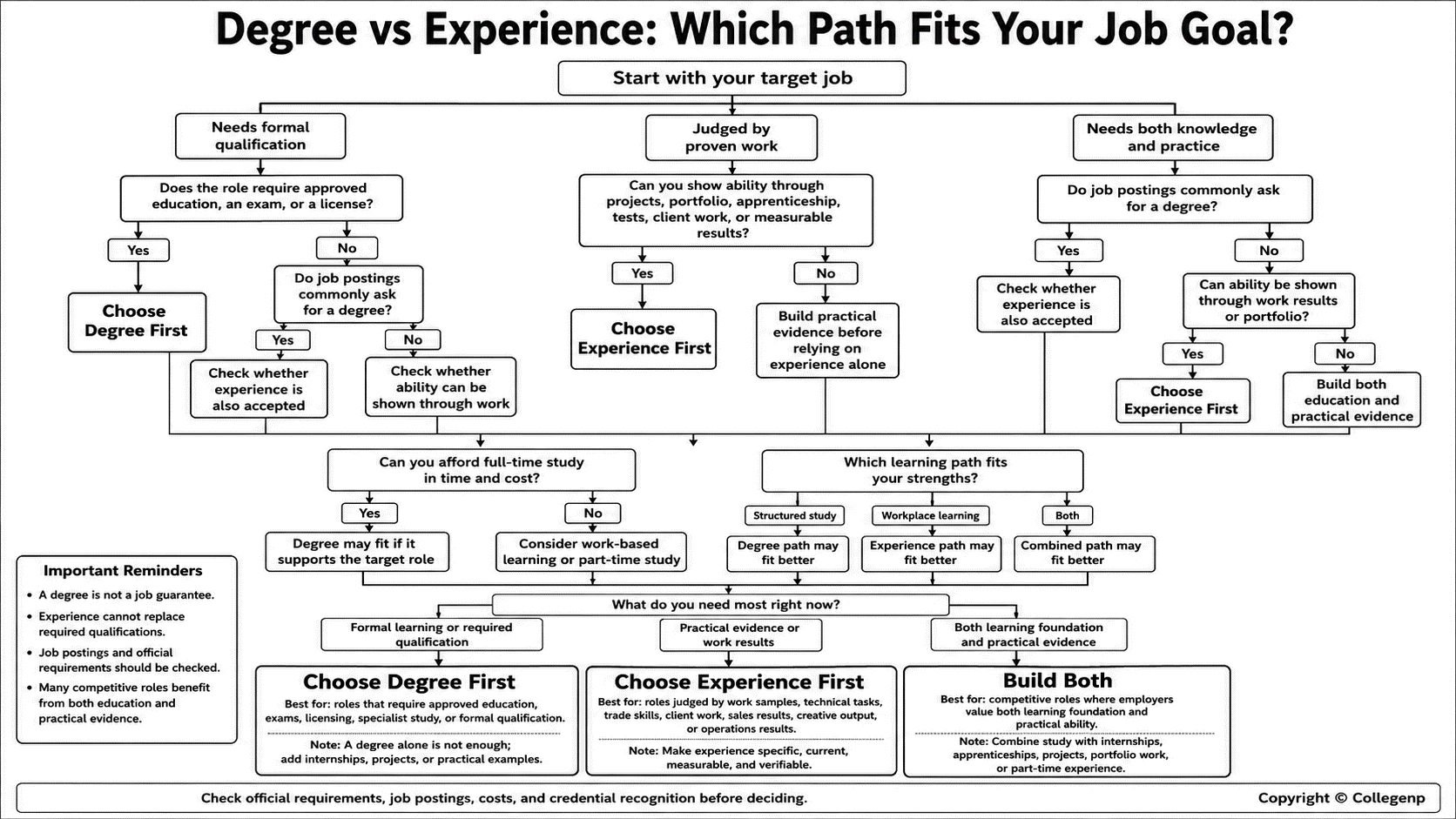
The practical takeaway is clear. Do not choose based on slogans. Start with the job you want, study real job postings, verify licensing rules, calculate cost and time, and identify the weakest part of your evidence. If the barrier is credential-based, get the required education. If the barrier is proof-based, build experience. If the barrier is both, combine study with internships, apprenticeships, projects, or work-based learning.
You can also read - Degree vs Skills: Which Is More Important for Career Success?







Comments 0
No comments yet. Be the first to start the conversation.