Santwona College—also known as Santwona Memorial Campus—is a Tribhuvan University (TU)–affiliated college in Shantinagar, Kathmandu. It offers BBS, BASW/BSW, and MA in Sociology and Anthropology. Through its sister institution—Santwona Memorial Academy Secondary School—it also runs +2 (Management, Humanities, Education). A CIMA pathway is available for students aiming for professional accounting and finance.
Established in 2003, Santwona College runs undergraduate and postgraduate programs under TU. The college blends classroom study with field exposure, especially in Social Work, and supports balanced growth through extracurricular activities, educational tours, and community links.
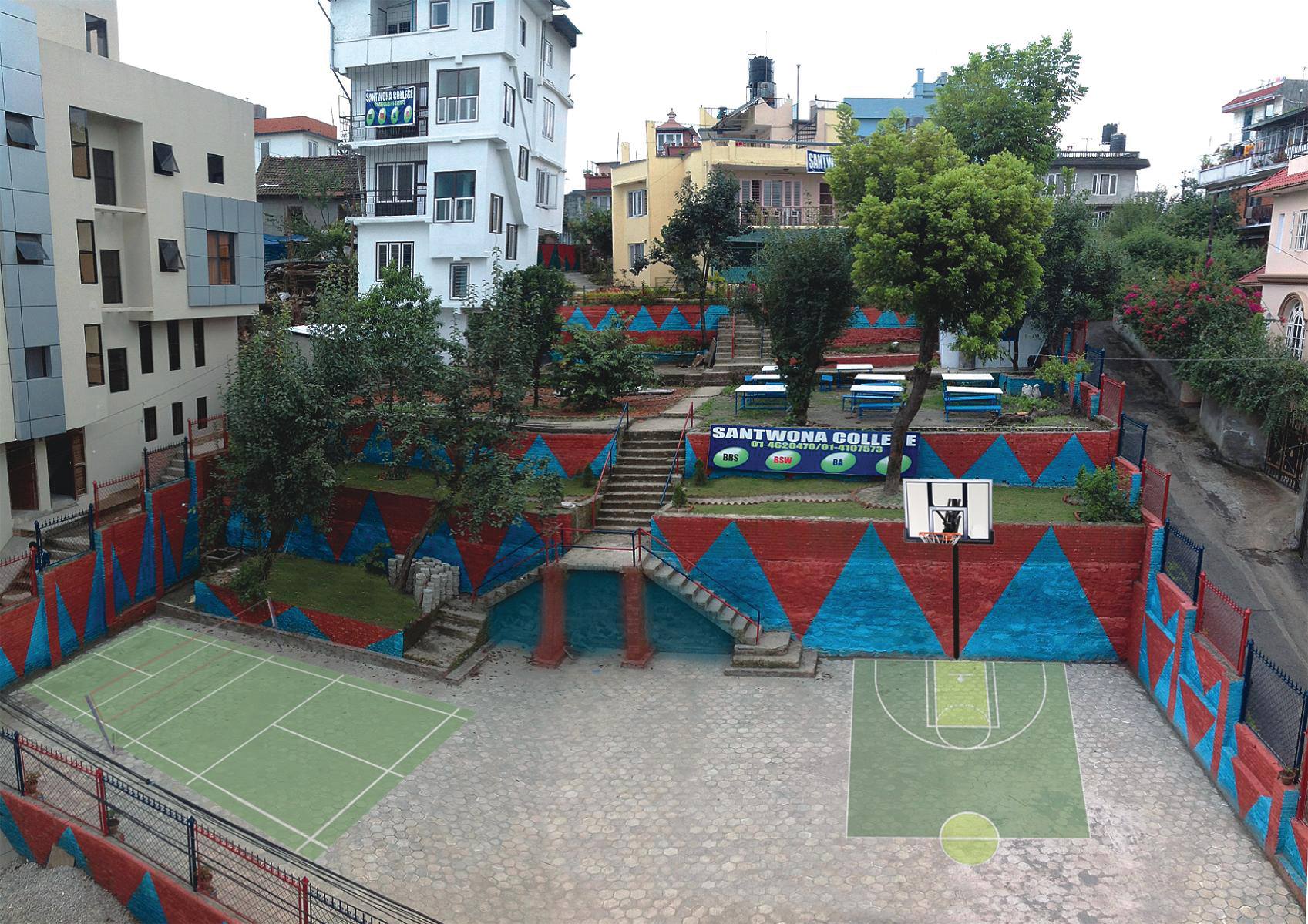
The campus sits in an accessible part of Kathmandu, convenient for daily commuters. Teaching focuses on clarity, accountability, and steady academic progress.
Students learn in a structured setting with morning classes, experienced faculty, and supportive facilities—computer labs with internet, a resourceful library, and quiet study areas. The culture values respect, punctuality, and regular reading and writing.
Year of establishment: 2003; location: Shantinagar, Kathmandu
Affiliation: Tribhuvan University (TU), NEB
Programs: BBS, BASW/BSW, MA in Sociology, MA in Anthropology
Sister institution: Santwona Memorial Academy Secondary School (+2 Management, Humanities, Education)
Professional pathway: CIMA (Chartered Institute of Management Accountants)
Learning support: library with updated editions, computer lab with internet, multimedia-enabled classes
Student services: basic medical care, hygienic canteen, English-speaking academic setting
Activities: educational tours, sports, debate, volunteering, Social Work field practicum
Typical teaching shift: morning classes (e.g., 6:15–9:45 AM; subject to updates)
Campus focus: steady academic progress, ethical conduct, and community connection
BBS is a four-year program covering management, accounting, finance, and marketing. Students build analytical thinking through classroom instruction, projects, and presentations.
Curriculum focus (indicative): Principles of Management, Economics, Statistics, Accounting, Finance, Marketing, Business Environment, and specialization courses as outlined by TU’s Faculty of Management.
Learning outcomes:
Understand core business functions and how they connect.
Apply quantitative and qualitative tools in coursework and projects.
Write and present with clarity in academic and practical contexts.
Study timing: Morning shift is common, which helps those balancing study and work.
BASW/BSW prepares students for roles in development, community outreach, and social services. Fieldwork sits at the center of learning and complements classroom study.
Academic coverage (indicative): Social Work theory and practice, research methods, community organization, social policy, and college-offered options (e.g., journalism, English, rural development) within TU norms.
Field practice:
Supervised placements with NGOs/INGOs or community agencies.
Reflection sessions with reporting and evaluation.
Graduate pathways: Program officer, community mobilizer, case worker, outreach coordinator, or further study in Social Work, Sociology, Public Health, or Development Studies.
MA (Sociology) and MA (Anthropology) guide learners through advanced theory, research methods, and Nepal-focused inquiry. These programs suit graduates heading toward research, policy, teaching, or development roles.
Core areas (indicative):
Sociological and anthropological theory
Qualitative and quantitative research methods
Social change, development, identity, inequality, migration, health, education
Electives aligned with TU’s semester syllabus
Thesis or research project in the final phase
Graduate outcomes: Skills in research design, data analysis, policy understanding, and reporting for academia, NGOs, government projects, and independent research.
Santwona Memorial Academy Secondary School runs the +2 stream (NEB) in:
Management
Humanities
Education
These courses build a clear bridge to TU bachelor studies at Santwona College or other universities in Nepal and abroad.
CIMA builds competence in finance and management accounting. Learners move across three pillars—Enterprise, Performance, Financial—through Operational, Management, and Strategic levels.
Who should consider CIMA:
Students aiming for roles in corporate finance, business analysis, planning, budgeting, or leadership across sectors.
Learners seeking an international accounting qualification with practical exposure.
Entry: 10+2 or equivalent in any stream. Progression depends on staged assessments and required practical experience.
1) Check eligibility
Bachelor’s (BBS/BASW/BSW): NEB Grade 12 passed or equivalent as per TU rules. Minimum subject thresholds (e.g., D+ in each subject) or TU-stated CGPA benchmarks may apply for the current intake.
Master’s (MA Sociology/Anthropology): Bachelor’s degree from a recognized institution in a relevant or accepted field, as per TU criteria.
CIMA: 10+2 or equivalent from any stream.
2) Prepare documents
Academic transcripts and character certificates (Grade 10 onward)
Citizenship or passport copy (as applicable)
Recent passport-size photos
Equivalence certificate for foreign qualifications, if required
3) Submit application
Collect or download the application form from the college or its official channel.
Pay the application fee at the stated bank/account or at the college office.
Submit within the deadline.
4) Selection and enrollment
Shortlisting may weigh grades, subject background, and, where relevant, interviews or counseling.
After selection, complete fee formalities, register for classes, and attend orientation.
Note: TU/NEB policies change by year. Confirm the latest criteria during admission.
Faculty members have steady academic backgrounds and field experience, especially in Social Work. Teaching follows a planned schedule with assignments and periodic assessments.
Learning approach:
Lectures supported by presentations and board work
Field exposure and case discussions where relevant
Tutorials and remedial support on request
Regular feedback on writing and reporting
Academic conduct:
Timely attendance and assignment submission
Ethical citation and research practices
Respectful classroom interaction
Classrooms: Clean, well-furnished, and suitable for focused study.
Multimedia support: Projectors or screens for lectures.
Computer lab: Internet access for assignments and presentations.
Library: Updated course books, references, journals, and quiet reading zones.
Canteen: Hygienic meal and snack options for morning and day scholars.
Medical care: Basic first-aid on campus.
Language setting: English-speaking academic environment to strengthen communication.
Students experience a calm, respectful atmosphere built on punctuality and teamwork. The morning routine helps early starters and part-time workers keep balance.
Study groups, reading circles, and guided sessions strengthen reading, writing, and data handling. Learners keep study logs, follow deadlines, and seek timely support from faculty.
Sports and fitness: Games and team events during the year
Clubs and forums: Debate, literature, and subject circles
Volunteering: Community visits and outreach, especially for BASW/BSW
Educational tours: Field trips linked to coursework and observation
Events: Seminars, guest talks, and student-led presentations
These activities build confidence, time management, and social responsibility while keeping academics at the center.
The college aims to keep fees reasonable for a Kathmandu campus. Students may access:
Internal concessions: Merit-based or need-sensitive support, as per college policy and availability
Government/external schemes: Guidance for eligible national or external scholarships
Installment options: Available under college rules and timelines
Check with the administration for current policies, documents, and dates.
Service since 2003: Two decades of continuous academic work in Kathmandu
Social Work field practice: Longstanding placements and community assignments
Alumni footprint: Graduates active in business roles, NGOs, community work, and further study in Nepal and abroad
Program continuity: Steady delivery of BBS, BASW/BSW, and postgraduate studies aligned with TU curricula
The college focuses on measurable academic habits, responsible field practice, and clear assessment.
TU affiliation with urban access: Recognized degrees in a reachable Kathmandu location
Balanced routine: Morning classes support study, work, and family needs
Field-linked Social Work learning: Supervised placements connect study with practice
Library and lab support: Resources for coursework, presentations, and data tasks
Clear expectations: Attendance, timely submission, and ethical work are standard
+2 to Master’s pathway: Sister school for +2 and campus programs for Bachelor’s and Master’s
CIMA route: An established path for accounting and finance careers
Santwona College offers a clear academic path in management, social sciences, and professional accounting under TU. The environment rewards discipline, steady growth, and a respectful classroom culture—well-suited for students planning long-term goals in Kathmandu.
1) Where is Santwona College located?
Shantinagar, Kathmandu. The location suits students commuting from across the valley.
2) Which programs are offered under TU?
BBS, BASW/BSW, and MA in Sociology and Anthropology. The +2 streams (Management, Humanities, Education) run at Santwona Memorial Academy Secondary School.
3) Does the college run morning classes?
Yes. Morning timing such as 6:15–9:45 AM is common. Exact schedules are announced each term.
4) What is the basic eligibility for BBS and BASW/BSW?
NEB Grade 12 or equivalent meeting TU’s minimum subject and grade requirements for the admission year. Confirm current rules during application.
5) What are the entry criteria for MA in Sociology/Anthropology?
A recognized Bachelor’s degree in a relevant or accepted field, as per TU guidelines. Selection may involve document screening and counseling.
6) Is CIMA open to any stream at +2?
Yes. CIMA accepts 10+2 or equivalent in any stream. Progression depends on staged exams and practical experience.
7) Are scholarships available?
Internal concessions may be available based on merit or need, subject to policy and seats. Students may also seek national or external scholarships.
8) How is Social Work field exposure organized?
BASW/BSW students complete supervised fieldwork with agencies or community partners. Reporting and evaluation are part of the process.
9) What facilities support learning?
Classrooms with multimedia support, a computer lab with internet, a library with recent editions, a hygienic canteen, and basic medical care.
10) Can +2 graduates from Santwona Memorial Academy continue at the college?
Yes. Many +2 graduates progress to TU Bachelor’s programs at Santwona College, subject to eligibility and timelines.