



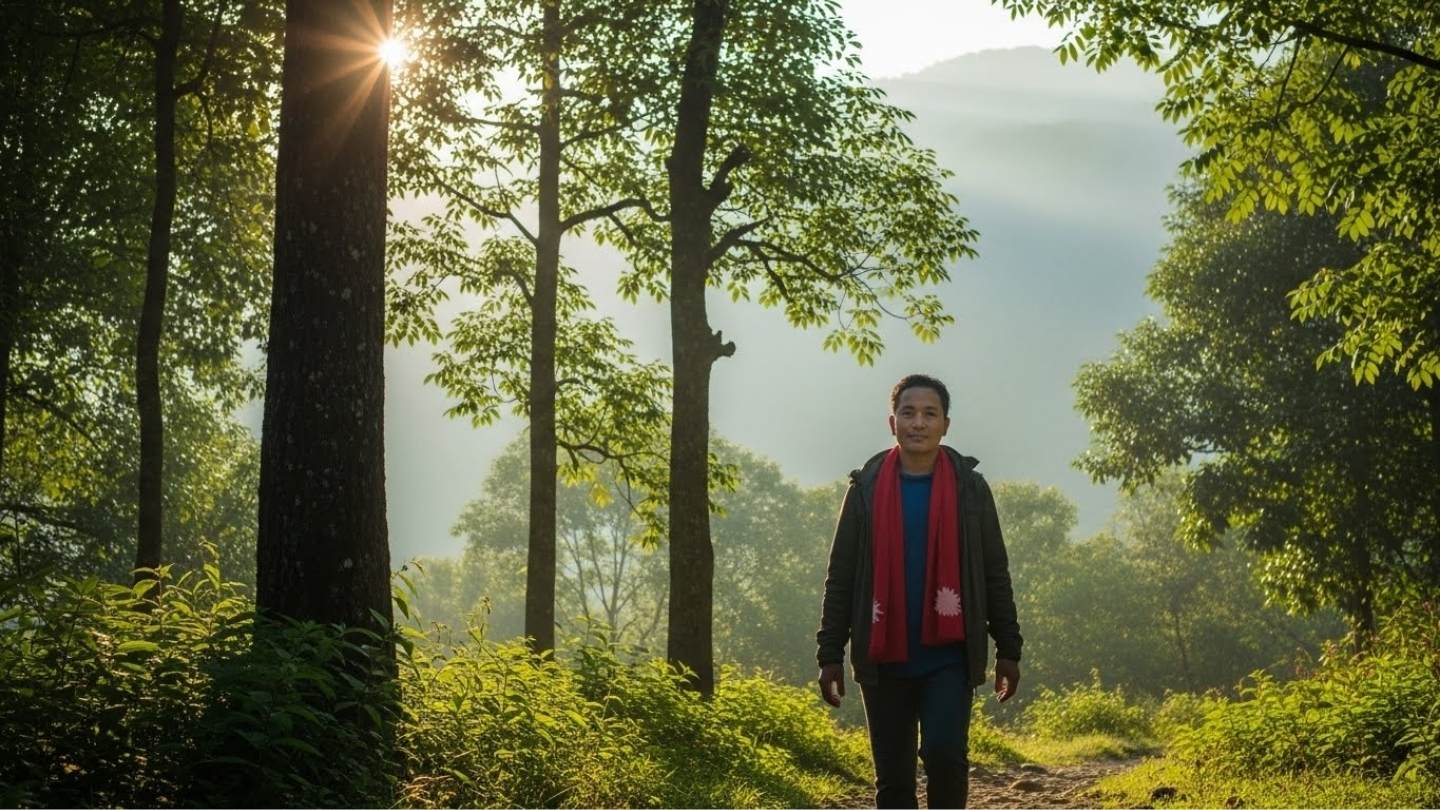
Introduction: What Are We Missing?
My 20 years of experience in research, teaching, and studying human behavior has led me to a serious conclusion: in the name of modernity, we have been cut off from our “roots.” Look at today’s Kathmandu, Pokhara, or any other urban life. We are getting lost in a concrete jungle where it has become difficult to see anything besides dust, smoke, and digital screens.
I have observed a shared problem among thousands of my students and clients, something science calls “Nature Deficit Disorder.” This is not a medical disease, but a condition of modern lifestyle in which people are becoming physically and mentally weaker as they grow distant from nature.
You might think, “I’m not sick, I’m fine.” But have you ever wondered why irritation rises even over small things these days? Why sleep does not feel restful? Why fatigue feels constant? The answer is not in medicine, but in the lap of nature.
Today I am not sharing vague claims. Based on science, our Eastern philosophy and संस्कार (Sanskar), and my three decades of experience, I am presenting five solid reasons to reconnect with nature. I am confident that after reading this article, your perspective on life will change.
Reason 1: Mental Peace and Stress Reduction
Problem
In today’s rush, “stress” has become like a companion. Kathmandu’s traffic, office deadlines, and financial pressure are pushing the level of the stress hormone “cortisol” to extremes. Long-term high cortisol invites high blood pressure, heart disease, and anxiety.
Scientific Evidence
A famous Japanese study on “Shinrin-yoku” (Forest Bathing) or “van snan” has shown that spending just 20 minutes in a forest environment can reduce blood cortisol by up to 16%. Trees release chemicals called “phytoncides,” which activate our “parasympathetic nervous system.” This shifts the body from “Fight or Flight” mode to “Rest and Digest” mode.
Context
Why do you think our ancestors built temples near forests or on hills? When you go to Swayambhu, Pashupati, or Dakshinkali, you may have noticed that the mind feels calm as soon as you arrive. This is not only faith in God, but also the effect of the environment there. Our sages did not write the “Aranyakas” (texts composed in forests) without reason.
Practical Solutions
-
Take a “nature walk” once a week. Spend at least two hours in places like Shivapuri, Nagarjun, or Godavari with your phone on silent.
-
If going to the forest is not possible, visit a nearby park. Sit quietly under a tree for five minutes.
Reason 2: Boosts Immune System
Problem
These days, we fall ill with even small changes in weather. Our immunity has weakened. We take vitamin tablets, but we do not use the free “booster” nature provides.
Scientific Evidence
The “phytoncides” mentioned above, released by trees to protect themselves from insects, are like nectar for humans. When we breathe forest air, these chemicals increase the number and activity of “natural killer cells” (NK Cells). These NK cells fight viruses and cancer cells in our body. Research shows that a single day of forest travel can increase NK cell activity for up to 30 days.
Context
Ayurveda places great importance on “dinacharya” and “ritucharya.” There are scientific reasons behind worshipping plants like tulsi, neem, and peepal. Tulsi provides high oxygen and purifies the air. Breathing near the tulsi platform immediately after waking up is a kind of lung “detox.” The stories of our “Ban Jhakri” also point toward the herbs and healing power found in forests.
Practical Solutions
-
Start greenery at home. Begin rooftop gardening. Plant at least tulsi, ghyu kumari (Aloe Vera), and some flowers.
-
Keep windows open in the morning to change the indoor air (ventilation). Place air-purifying plants like the “snake plant” inside your home too.
Reason 3: Focus and Creativity

Problem
Do you find it difficult to concentrate on work? Do you feel “brain fog”? This is “attention fatigue.” City noise, horns, and mobile notifications have broken our focus into fragments.
Scientific Evidence
Psychology includes a theory called “Attention Restoration Theory (ART).” According to this, natural scenes (such as flowing water or rustling leaves) give our mind “soft fascination.”
This re-energizes a tired mind and improves “cognitive function.” One study found that after spending four days in nature, a person’s creativity increased by 50%.
Context
Many of Nepal’s writers, artists, and ractitioners created their best works in the lap of nature. Bhanubhakta is said to have found inspiration to write the Ramayan after hearing the story of the grass-cutter, on a forest path itself. When we are close to nature, the brain’s background noise quiets down and new ideas begin to arise.
Practical Solutions
-
Try a digital detox. While working or studying, every hour take five minutes to look out the window at the sky or trees.
-
If you cannot find a solution to a problem, do not sit in the room. Step outside and walk for ten minutes.
Reason 4: Emotional Balance and Happiness
Problem
Depression and loneliness have begun to feel like a global pandemic. In Nepal too, this problem is becoming severe among the younger generation. We are connected to thousands of friends on social media, yet in reality we are alone.
Scientific Evidence
Soil contains a bacterium called “Mycobacterium vaccae.” When we work in fields or handle soil, this bacterium helps our brain produce “serotonin.” Serotonin is called the “happiness hormone.” In addition, deficiency of Vitamin D from sunlight directly contributes to depression.
Context
Our festivals—Nag Panchami, Tihar (Kukur Tihar, Kag Tihar), Chhath—are all connected with nature and animals. When we worship animals during Tihar, we learn empathy and compassion toward other living beings. Traditions like playing Deuda, enjoying the rote ping, or going on banbhoj (picnics) connected us to society and nature together, strengthening mental health.
Practical Solutions
-
Touch soil. Spend some time in the garden each week. Do not hesitate to touch soil with bare hands while repotting plants.
-
Sit in the sun for 10–15 minutes in the morning, not only in winter but throughout the year.
Reason 5: Spiritual Grounding and Perspective
Problem
We consider ourselves the center of the universe. Even small failures unsettle us. We have forgotten the vastness of our existence. This can also be called a problem of “ego.”
Scientific Evidence
As astronomer Carl Sagan noted, when we observe nature we experience “awe.” Seeing vast mountains, an endless sky, or a great tree makes the brain feel, “I am small.” Science calls this the concept of the “small self.” It reduces arrogance, makes us humble, and inspires kindness toward others.
Context
We Nepalis are fortunate to live in the lap of the Himalayas. Our ancestors regarded the mountains as deities and rivers as mothers (Bagmati, Gandaki).
This was not only blind belief; it was gratitude toward nature. When we witness nature’s vast form, our daily small problems (such as traffic jams and office irritations) begin to feel trivial. This gives perspective on life.
Practical Solutions
-
Try stargazing. Once a month, go to your rooftop and look at the sky and stars.
-
Build a habit of watching sunrise or sunset. This can give positive energy at the start and end of the day.
Conclusion: Way Forward
After 20 years of experience, what I can say is this: reconnecting with nature is not a “luxury,” it is a “necessity” if we want to live healthy and happy lives. This does not mean we must leave the city and live in the forest. But we must make space for “green” in our daily life.
Three promises you can make starting today:
-
I will leave the screen (mobile/TV) and spend 20 minutes a day in the open air.
-
I will keep at least one living plant in my room or office.
-
I will go into nature away from the city’s noise once a month.
Remember, “Nature does not hurry, yet everything is accomplished.” We also need to learn patience and balance from nature.
Writer: Ramesh Thapa







Comments 0
No comments yet. Be the first to start the conversation.