



The School of Environmental Science and Management (SchEMS) was established in 1999 and is located at Kritimarg-32, Koteshwor, Kathmandu, Nepal. The college began with environmental education and has gradually expanded its academic scope to include management, computer applications, and information technology.
Environmental studies remain central to the institution's academic identity. SchEMS started the B.Sc. in Environmental Science and Management in 1999 and added the M.Sc. in Environmental Science and Management in 2000. The Bachelor of Business Administration (BBA) was introduced in 2008, followed by the Bachelor of Computer Application (BCA) in 2018 and the Master of Computer System and Information Technology (MCSIT) in 2025.
SchEMS is affiliated with Pokhara University. Its current academic portfolio includes undergraduate and graduate programs in environmental studies, business administration, computer applications, and computer system and information technology.
| Category | Details |
|---|---|
| Institution | School of Environmental Science and Management (SchEMS) |
| Established | 1999 |
| Location | Kritimarg-32, Koteshwor, Kathmandu, Nepal |
| Affiliation | Pokhara University |
| Academic areas | Environmental studies, management, computer applications, information technology |
| Programs | BSc, MSc, BBA, BCA, MCSIT |
| First program | B.Sc. in Environmental Science and Management |
| Latest listed program | MCSIT, introduced in 2025 |
The development of SchEMS reflects a gradual extension from environmental education into business and computing. Its academic structure now brings together three broad areas: environmental science and management, business administration, and computer and information technology.
SchEMS began its academic activities in 1999 with the B.Sc. in Environmental Science and Management. The M.Sc. in Environmental Science and Management followed in 2000, giving the college undergraduate and postgraduate environmental programs from an early stage.
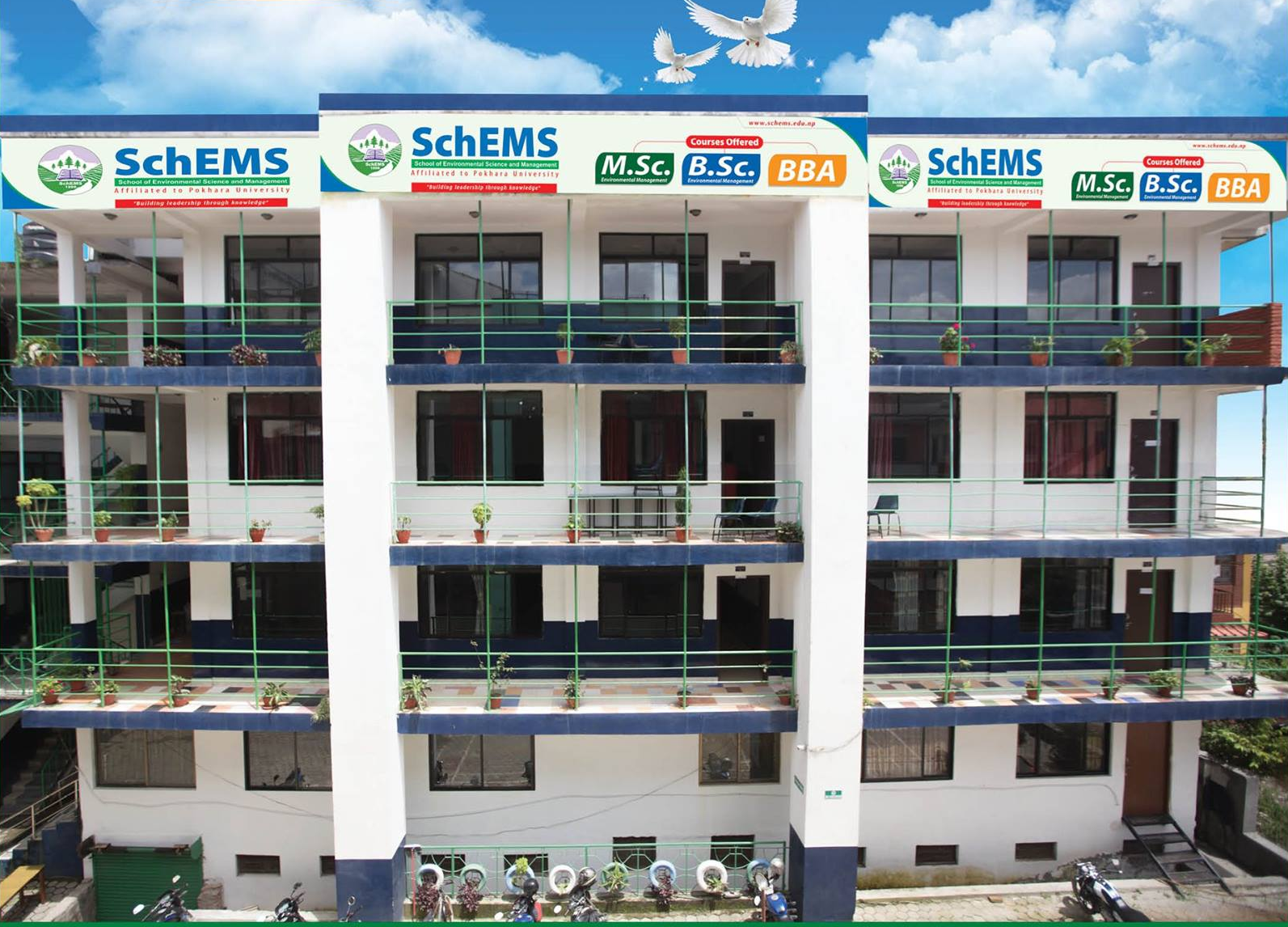
The Bachelor of Business Administration was introduced in 2008. This addition extended the institution beyond its original environmental focus and created a separate management education pathway.
The Bachelor of Computer Application was added in 2018. With BCA, SchEMS established an undergraduate computing stream covering programming, software, databases, networks, web technologies, data-related subjects, projects, and other areas included in the Pokhara University curriculum.
The Master of Computer System and Information Technology was introduced in 2025. MCSIT added a graduate-level information technology program to an academic portfolio that already included BCA.
The college's current programs therefore represent three areas of study:
environmental science and environmental management;
business and management;
computer applications and information technology.
SchEMS offers five programs with the following stated seat capacities:
| Program | Introduced | Seats |
|---|---|---|
| Master of Computer System and Information Technology (MCSIT) | 2025 | 33 |
| Bachelor of Business Administration (BBA) | 2008 | 96 |
| BSc in Environmental Management | 1999 | 96 |
| Bachelor of Computer Application (BCA) | 2018 | 48 |
| MSc in Environmental Science and Management | 2000 | 90 |
The programs range from undergraduate study in environmental management, business administration, and computer applications to graduate study in environmental science and management and computer system and information technology.
The BSc in Environmental Management at SchEMS represents the college's earliest academic area. The program has been offered since 1999 and has a stated capacity of 96 seats.
Environmental study at SchEMS is supported by an Environmental Monitoring & Research Laboratory. The laboratory provides a setting for practical environmental work connected with air, water, and soil quality assessment. It also supports vegetation and faunal analysis, environmental experimentation, and data-related activities.
The college's environmental work extends into technical and research areas that include Environmental Impact Assessment (EIA), Strategic Environmental Assessment (SEA), environmental baseline studies, GIS and remote sensing, climate adaptation studies, data analysis and management, and environmental and climate considerations in development projects.
For BSc students, this institutional setting connects environmental study with laboratory observation, environmental monitoring, research methods, and the use of environmental information.
The MSc in Environmental Science and Management at SchEMS has been offered since 2000 and has 90 seats.
The curriculum was updated in 2023 and provides two specialization areas:
Environmental Science
Climate Change
The specialization structure creates two defined directions within the graduate environmental program. Environmental Science continues the broader environmental study pathway, while Climate Change provides a separate focus within an area also reflected in the college's research and technical work.
SchEMS identifies several climate-related areas within its professional and research activities. These include climate finance, climate change loss and damage, climate adaptation studies, and climate mainstreaming in development projects.
The MSc program also operates within the same environmental academic setting as the Environmental Monitoring & Research Laboratory. Practical environmental activities associated with the laboratory include air, water, and soil assessment as well as vegetation and faunal analysis.
The relationship between graduate study, laboratory resources, and environmental research gives the MSc program a clear place within the institution's longer history in environmental education.
The Bachelor of Business Administration (BBA) at SchEMS has been offered since 2008 and has 96 seats.
The Pokhara University BBA curriculum follows an eight-semester structure. The initial semesters cover subjects in English, mathematics, information technology, behavioral science, management, business communication, microeconomics, organizational behavior, and financial accounting.
The middle semesters include business statistics, macroeconomics, cost and management accounting, finance, marketing, data analysis and modeling, business and society, business research methods, human resource management, and financial management.
Later study incorporates entrepreneurship and innovation, operations management, management information systems, project management, e-business, international business, concentration courses, electives, strategic management, business law, business environment, project activities, and internship.
Practical and project-based components appearing within the curriculum include:
Software Skills Practicum;
Soft Skills Practicum;
Digital Marketing Practicum;
Fintech Practicum;
Academic Writing;
Project Work;
Business Development Project;
Community Engagement Project;
Internship.
The curriculum therefore combines management subjects with quantitative study, communication, technology, practical assignments, projects, and applied business activities.
BBA students at SchEMS also have access to the college's IT laboratory and campus Wi-Fi. These resources can support computer-based coursework, research, assignment preparation, reports, presentations, and collaborative academic tasks.
The Bachelor of Computer Application at SchEMS was introduced in 2018 and has 48 seats.
The Pokhara University BCA curriculum is organized across eight semesters and carries a total of 126 credits. It combines programming, mathematics, computing fundamentals, software development, databases, web technologies, networking, data-related subjects, management components, electives, projects, and internship.
The first semester includes English for IT Professionals, Mathematics I, Digital Logic System, Computer Fundamental and Application, Programming Logic and Technique, and Computer Application Workshop.
The second semester continues with Business and Technical Communication, Mathematics II, Financial Accounting, Programming in C, Microprocessor and Computer Architecture, and Project I.
As students progress through the program, the curriculum covers subjects such as:
Object Oriented Programming using Java;
Data Structure and Algorithms;
Systems Analysis and Project Management;
Web Technology I and II;
Operating Systems;
Software Engineering;
Database Management System;
Computer Graphics and Multimedia Technology;
Probability and Statistics;
Numerical Methods;
DotNet Technology;
Data Communication and Computer Network;
Research Methodology;
Mathematical Foundation in Computer Application.
Later semesters include Data Science and Analytics, Management Information Systems, Simulation and Modeling, Organization Management, Cyber Law and Professional Ethics, Mobile Application Development Technology, Applied Economics, Cloud Computing, Digital Economy, internship, electives, and project work.
Projects are distributed across different stages of the curriculum, beginning with Project I and continuing through Project IV. An internship is included in Semester VII.
The elective structure provides additional subject choices across computing and related areas. The overall curriculum gives BCA students exposure to programming, systems, web development, data handling, networking, software, computing infrastructure, professional issues, and project work.
SchEMS's IT laboratory is directly relevant to this type of program. It provides computer access, software, internet connectivity, and a space for research, assignments, reports, presentations, and collaborative work. Campus-wide Wi-Fi gives students access to online resources beyond the laboratory.
The Master of Computer System and Information Technology (MCSIT) at SchEMS was introduced in 2025 and has 33 seats.
MCSIT is the newest program in the college's academic portfolio. Its introduction created a graduate computing pathway alongside BCA and expanded SchEMS's information technology offerings beyond the undergraduate level.
Within the institution, the program is supported by an academic setting that already includes computer-based learning facilities, an IT laboratory, internet connectivity, and experience in delivering a computer application program.
The addition of MCSIT also changes the overall balance of the college's program structure. SchEMS now has two environmental programs, two computing and information technology programs, and one business administration program.
Research and technical environmental work form a substantial part of the wider SchEMS setting.
The college is involved in areas including:
Environmental Impact Assessment;
Strategic Environmental Assessment;
climate finance;
climate change loss and damage;
environmental and climate mainstreaming in development projects;
climate adaptation studies;
environmental baseline studies;
GIS and remote sensing;
data analysis and management.
These activities cover environmental assessment, climate-related study, spatial analysis, baseline research, and information management.
The climate-related areas also correspond with the Climate Change specialization within the MSc in Environmental Science and Management. GIS, remote sensing, environmental assessment, and baseline studies connect with the institution's broader work in environmental research and monitoring.
The Environmental Monitoring & Research Laboratory supports environmental education at both undergraduate and graduate levels.
Its practical areas include:
air-quality assessment;
water-quality assessment;
soil-quality assessment;
vegetation analysis;
faunal analysis;
environmental experimentation;
environmental data analysis.
The laboratory gives environmental students a dedicated place for work that requires observation, measurement, scientific instruments, and analysis. These activities complement theoretical study by allowing environmental concepts to be examined through practical academic work.
The facility is particularly relevant to the BSc and MSc environmental programs, which form the longest-running part of SchEMS's academic history.
SchEMS maintains an IT laboratory for computer-based academic activities. The facility includes computers, hardware and software resources, and high-speed internet access.
Students can use the laboratory for academic research, working with online resources, preparing assignments, developing reports and presentations, and completing collaborative tasks.
The college also provides campus-wide Wi-Fi. This allows students to connect to online academic resources from different areas of the campus rather than depending entirely on laboratory access.
The IT facility supports the computing requirements of BCA and MCSIT and is also relevant to technology-based coursework within BBA.
The SchEMS library contains textbooks and reference materials covering the academic disciplines represented within the college.
The range of programs means that students work across substantially different subject areas. Environmental students require scientific and management references, BBA students work with business, accounting, economics, management, and quantitative subjects, while BCA and MCSIT students require computing, mathematics, programming, systems, and information technology materials.
The library, environmental laboratory, IT laboratory, and internet access together form the main academic resource structure identified for students at SchEMS.
SchEMS expresses its strategic vision through the idea of fostering skilled graduates and professionals for national development.
Several areas form part of this direction. The college places attention on human capital development, academic and training programs, research, knowledge sharing, practical academic work, institutional capacity, and professional development.
Its stated priorities include:
developing professional knowledge and competencies;
maintaining relevant academic and training programs;
generating and sharing knowledge through research;
supporting research-oriented and problem-solving work;
strengthening practical components within academic programs;
developing institutional and professional capabilities.
This direction is visible across different parts of the college. Environmental programs are connected with laboratory and research activities, the BCA curriculum includes several projects and an internship, and BBA combines academic subjects with practicums, projects, and internship.
Admission requirements at SchEMS depend on the particular Pokhara University program.
The college offers programs from different academic levels and disciplines, so one admission standard does not apply across all five programs. BBA, BCA, BSc in Environmental Management, MSc in Environmental Science and Management, and MCSIT each belong to separate academic pathways with their own university requirements.
Pokhara University undergraduate admission processes can include academic eligibility, entrance assessment, merit-based selection, and enrollment procedures according to the relevant program. Graduate applicants follow the admission requirements applicable to the corresponding postgraduate program.
Students considering SchEMS therefore need to assess admission requirements in relation to the specific program they intend to study.
Pokhara University has scholarship provisions covering undergraduate and graduate education. Its scholarship framework includes full and partial scholarship categories and considers academic merit, financial need, and inclusion-related criteria.
Scholarship selection is separate from the ordinary academic seat capacity of a program. The seat figures for SchEMS indicate the stated intake capacity of its courses, while scholarship allocation follows the applicable Pokhara University process and criteria.
SchEMS began as an institution centered on environmental science and management, and those subjects continue to form an important part of its academic and research work. The BSc program dates from 1999 and the MSc program from 2000, supported by environmental laboratory facilities and work in assessment, monitoring, climate studies, GIS, remote sensing, and data analysis.
The addition of BBA in 2008, BCA in 2018, and MCSIT in 2025 broadened the institution into management and computing. Its current academic structure therefore combines five programs across three distinct areas.
For prospective students, the most useful way to understand SchEMS is through that combination. Environmental programs are linked with laboratory and research work, BBA follows a curriculum combining management study with practical components, and BCA includes programming, software, networks, data subjects, projects, electives, and internship. MCSIT extends the computing stream to the graduate level.
SchEMS is a college located at Kritimarg-32, Koteshwor, Kathmandu, Nepal. Established in 1999, it offers undergraduate and graduate programs in environmental studies, business administration, computer applications, and information technology.
SchEMS is affiliated with Pokhara University. Its academic programs follow the applicable curriculum and academic requirements of Pokhara University.
SchEMS offers five programs:
Bachelor of Science in Environmental Management
Master of Science in Environmental Science and Management
Bachelor of Business Administration (BBA)
Bachelor of Computer Application (BCA)
Master of Computer System and Information Technology (MCSIT)
The stated seat capacities are 96 seats for BSc in Environmental Management, 90 seats for MSc in Environmental Science and Management, 96 seats for BBA, 48 seats for BCA, and 33 seats for MCSIT.
SchEMS was established in 1999. The B.Sc. in Environmental Science and Management also began in 1999, followed by the M.Sc. in Environmental Science and Management in 2000.
Yes. The MSc curriculum was updated in 2023 and includes two specialization areas: Environmental Science and Climate Change.
Yes. SchEMS has an Environmental Monitoring & Research Laboratory that supports activities related to air, water, and soil quality assessment, vegetation analysis, faunal analysis, environmental experimentation, and data analysis.
Yes. The college has an IT laboratory with computers, software resources, and internet access for academic work. Campus-wide Wi-Fi is also available.
The Pokhara University BCA curriculum includes project work across several semesters and an internship in Semester VII. It also covers programming, databases, web technologies, networking, software engineering, data science, cloud computing, and related computing subjects.
The Pokhara University BBA curriculum includes Software Skills Practicum, Soft Skills Practicum, Digital Marketing Practicum, Fintech Practicum, Academic Writing, Project Work, Business Development Project, Community Engagement Project, and Internship.
The college's environmental activities include Environmental Impact Assessment, Strategic Environmental Assessment, climate finance, climate change loss and damage, climate adaptation studies, environmental baseline studies, GIS and remote sensing, and data analysis and management.
Yes. The college has a library with textbooks and reference materials related to the academic disciplines offered at SchEMS, including environmental studies, management, and computing.
