



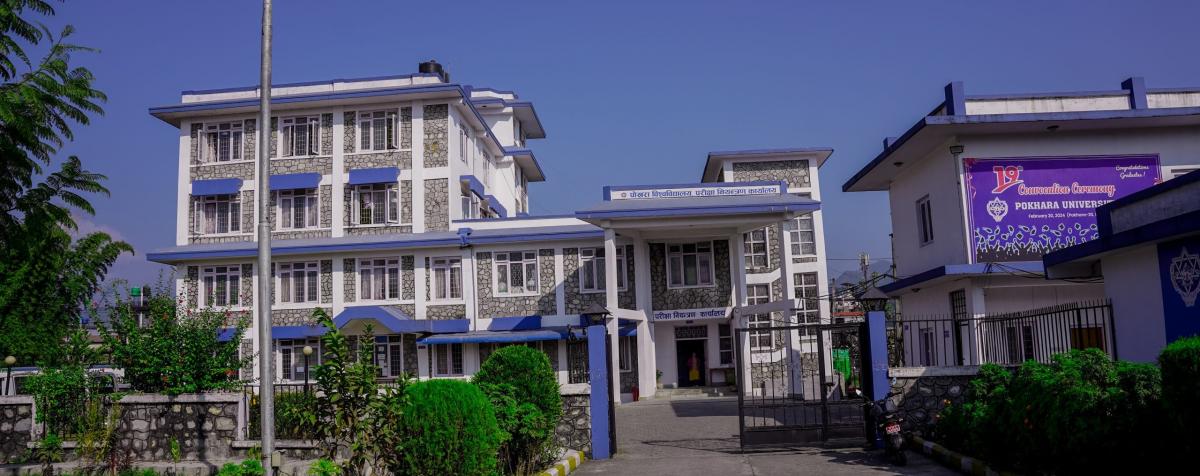
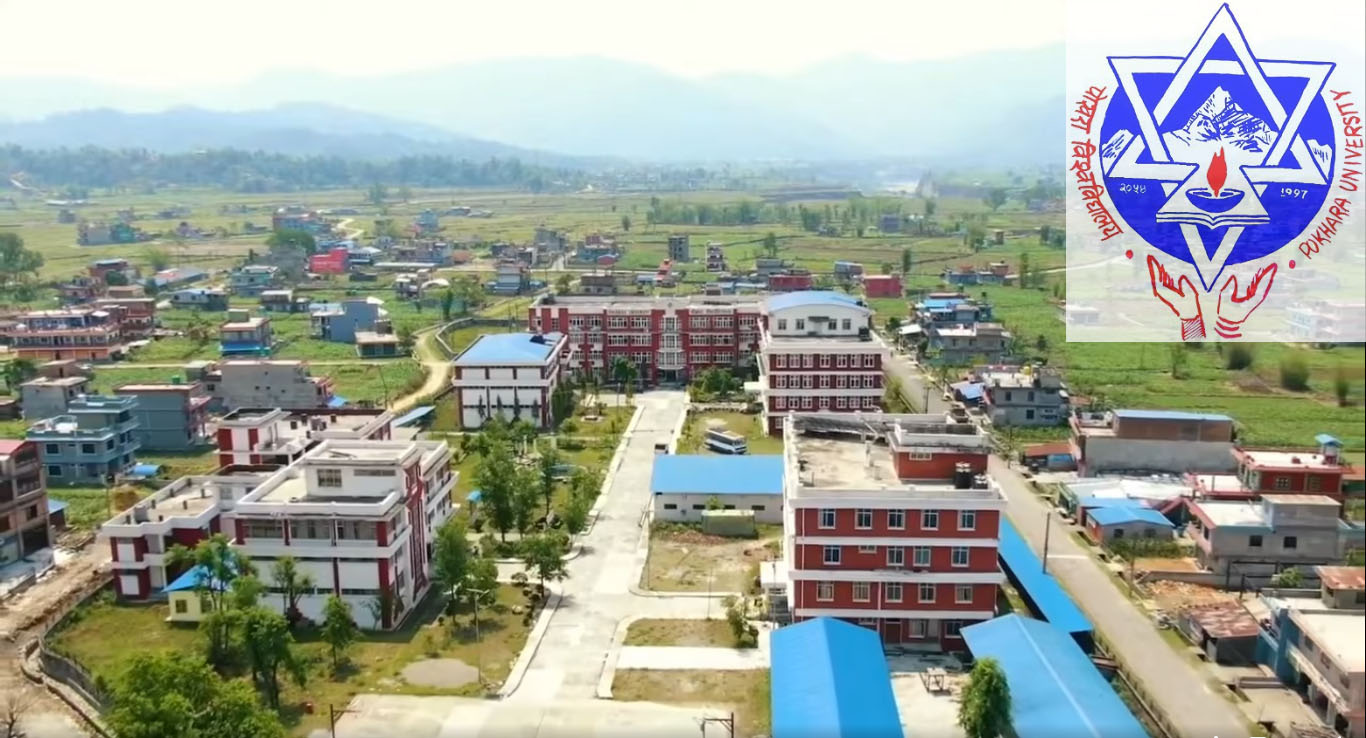
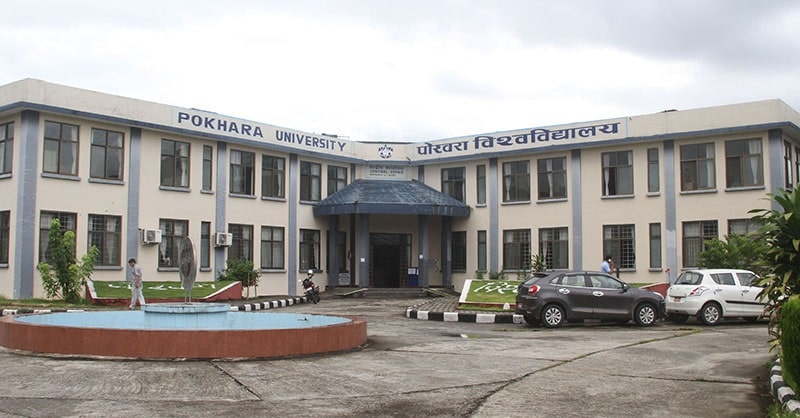
Pokhara University is an autonomous, non-profit university in Nepal established in 1997 under the Pokhara University Act, 1997. Its central office is located in Pokhara Metropolitan City-30, Kaski. The University Grants Commission (UGC) Nepal includes Pokhara University among Nepal’s public universities.
The university operates through four academic faculties and a network of constituent, joint constituent, and affiliated colleges. Its academic offerings cover management, science and technology, health sciences, humanities, and social sciences, with study categories extending from undergraduate and graduate education to MPhil and PhD programs. Students may study a Pokhara University program at a university-run school, a joint constituent college, or an independently managed affiliated college, depending on the program and institution.
| Item | Details |
|---|---|
| University | Pokhara University (पाेखरा विश्वविद्यालय) |
| Established | 1997 |
| Legal basis | Pokhara University Act, 1997 |
| Institutional status | Autonomous and non-profit; listed as a public university by UGC Nepal |
| Central office | Pokhara Metropolitan City-30, Kaski, Nepal |
| Faculties | 4 |
| Constituent colleges | 5 |
| Joint constituent colleges | 3 |
| Affiliated colleges | 58 |
| Study categories | Undergraduate, graduate, MPhil and PhD |
| Central telephone | +977 61 504046 |
| P.O. Box | 427 |
| info@pu.edu.np |
Nepal adopted the multi-university concept in 1983, and the idea of Pokhara University was conceived in 1986. The university was formally established in 1997 under the Pokhara University Act, 1997.
Pokhara University operates as an autonomous, non-profit institution within Nepal’s higher-education system. Its establishment formed part of the country’s development of a multi-university structure.
From its early development, the university combined university-run academic units with a wider structure involving other institutions. This approach remains central to the way Pokhara University functions.
Pokhara University serves both as an academic and administrative authority and as the university under which a larger network of colleges operates. A student enrolled in a Pokhara University degree may study at a constituent school in Kaski, a joint constituent college established in collaboration with another organization, or an affiliated college elsewhere in Nepal.
The university manages its finances through government grants and revenue from students and affiliated institutions. Government funding has particular importance for capital expenditure and infrastructure development.
Pokhara University places higher education, teaching, learning, research, human-resource development, and community service within its institutional purpose.
Its objectives include developing human resources in science and technology, management, humanities, and related academic areas. The university also seeks participation from the private sector in higher education and links institutional activities with broader social and economic development.
Research and scholarship form part of its academic direction. The university’s long-term goals include strengthening academic research, supporting curriculum development, preserving and generating knowledge, and maintaining a university system capable of responding to changing educational needs.
The university also gives attention to community service, academic interaction, and access to higher education.
These goals define the institution’s academic and administrative direction. For prospective students, the practical considerations remain the specific program, the college where it is taught, the applicable admission requirements, and the academic structure of the chosen course.
Pokhara University operates through a governance structure headed by the Chancellor, Pro-Chancellor, Vice-Chancellor, and Registrar.
The incumbent Prime Minister of Nepal serves as Chancellor, while the federal minister responsible for education serves as Pro-Chancellor. The Vice-Chancellor is the university’s principal executive officer. The Registrar supports financial management and general administration.
The University Senate is the principal policy-level decision-making body of Pokhara University. Its responsibilities include matters related to university policy, budget, rules, and regulations.
The governance structure includes representatives from university authorities and different educational, public, professional, and community sectors.
The Chancellor chairs the Senate. The education minister may chair a Senate meeting in the Chancellor’s absence, while the Vice-Chancellor may take the chair in the minister’s absence. The Registrar serves as member secretary.
The Academic Council is chaired by the Vice-Chancellor and deals with academic matters.
Its membership includes senior university authorities and officials connected with faculties, curriculum, research, examinations, and subject-level academic activities.
The Council deals with academic policies and practices related to curricula, teaching, examinations, and university programs.
This role is especially significant because Pokhara University programs are delivered through constituent, joint constituent, and affiliated institutions rather than through a single campus system.
The Executive Council carries out decisions taken by the University Senate and is chaired by the Vice-Chancellor.
The Registrar serves as member secretary. The Council forms part of the university’s administrative and implementation structure.
Faculty Boards, Subject Committees, and the Examination Committee support academic planning, program design, examinations, and implementation.
Pokhara University has subject committees covering areas such as civil and architectural engineering, computer and information technology, development and social engineering, electrical and communication fields, English, law, management, health sciences, mechanical engineering, and economics.
The university’s wider structure also includes the University Service Commission, Curriculum Development Center, Planning and Program Division, Research Center, examination administration, finance and general administration, student welfare, and library functions.
Pokhara University has four academic faculties:
Faculty of Management Studies
Faculty of Science and Technology
Faculty of Health Sciences
The Faculty of Management Studies and Faculty of Science and Technology were established in 1997. The Faculty of Humanities and Social Sciences was established in 2004, while the Faculty of Health Sciences was established in 2016.
Each faculty covers a distinct academic area, while constituent and affiliated institutions may deliver approved programs under the relevant faculty.
The Faculty of Management Studies covers management, business, hospitality, health-care management, and information-system-related education.
The School of Business in Pokhara Metropolitan City-30, Kaski, is a constituent school associated with this faculty.
Undergraduate program titles include:
Bachelor of Business Administration
Bachelor of Business Administration in Finance
Bachelor of Business Administration-Travel and Tourism
Bachelor of Computer Systems and Information Technology
Bachelor of Hotel Management
Bachelor in Health Care Management
The academic portfolio also includes Post Graduate Diploma in Health Care Management.
Graduate-level programs include:
Master of Business Administration
Master of Business Administration (Finance)
Master of Business Administration (Global Business)
Master of Business Administration (Executive)
Master of Health Care Management
Master of Computer Information System
The faculty also includes MPhil in Management and Doctor of Philosophy in Management.
Some program titles have changed over time. Bachelor of Business Administration in Finance replaced an earlier Banking and Insurance title, while Bachelor of Computer Systems and Information Technology replaced the earlier Bachelor of Computer Information System program.
The Faculty of Science and Technology was established in 1997.
Its academic coverage includes engineering, architecture, computing, information technology, environmental studies, natural-resource management, construction, water resources, transportation, and related technical fields.
Undergraduate programs include:
Bachelor of Civil Engineering
Bachelor of Civil & Rural Engineering
Bachelor of Civil Engineering for Diploma Holders
Bachelor of Electrical and Electronics Engineering
Bachelor of Information and Communication Engineering
Bachelor of Computer Engineering
Bachelor of Engineering in Information Technology
Bachelor of Software Engineering
Bachelor of Architecture
Bachelor of Science in Environmental Science and Management
Bachelor of Computer Application
Graduate programs include:
Master of Science in Environmental Management
Master of Science in Computer Science
Master of Science in Natural Resources Management
Master of Science in Construction Management
Master of Science in Interdisciplinary Water Resource Management
Master of Science in Transportation Engineering & Management
Master of Science in Computer Engineering
Master of Science in Structural Engineering
Master of Science in Electrical Engineering in Power System
Master of Science in Bioinformatics
Master of Science in Sanitary Engineering
PhD in Engineering is also included in the faculty’s higher-level academic structure.
The School of Engineering in Pokhara Metropolitan City-30, Khudi, Dhungepatan, Kaski, is one of Pokhara University’s constituent schools.
Health-science programs were part of Pokhara University before the Faculty of Health Sciences was formally established in 2016.
The School of Health and Allied Sciences is the university’s constituent school for this academic area.
The faculty covers pharmaceutical sciences, public health, nursing, medical laboratory technology, medical imaging, optometry, physiotherapy, health informatics, medical biochemistry, medical microbiology, and related fields.
Undergraduate program titles include:
Bachelor of Science in Medical Imaging Technology
Bachelor of Pharmaceutical Science
Bachelor of Science in Medical Laboratory Technology
Bachelor of Public Health
Bachelor of Science in Nursing
Bachelor of Nursing Sciences (Oncology)
Bachelor of Optometry
Bachelor of Physiotherapy
Graduate programs include:
Master of Pharmaceutical Sciences in Pharmaceutics
Master of Pharmaceutical Sciences in Clinical Pharmacy
Master of Pharmaceutical Sciences in Natural Product Chemistry
Master of Health Informatics
Master of Public Health in Health Promotion Education
Master of Public Health in Public Health Service Management
Master of Science in Medical Biochemistry
Master of Science in Medical Microbiology
Master of Optometry
PhD in Health Sciences is also part of the faculty’s academic structure.
Admission to relevant health-science programs is connected with Medical Education Commission requirements. Entrance and matching procedures applicable to health education may determine admission arrangements for individual programs and academic years.
The Faculty of Humanities and Social Sciences was established in 2004.
Its academic work covers social, economic, cultural, governance, development, and humanities-related fields.
The School of Development and Social Engineering is the constituent school associated with the faculty.
Graduate programs include:
Master in Population, Gender and Development
Master of Development Studies
Master of Arts in English
The faculty also covers development and social engineering, research, public service, training, publications, and interdisciplinary study.
Its academic scope includes social and development questions examined through humanities and social-science perspectives, with attention to research, analysis, policy, communication, and development studies.
A constituent college forms part of Pokhara University’s own institutional structure.
Pokhara University has five constituent colleges:
The first four schools are associated with the university’s main academic structure in Pokhara Metropolitan City-30 or Dhungepatan, Kaski.
Shramik Shanti Campus was established as a constituent campus in 2025.
A constituent school is administratively different from an affiliated college. Constituent institutions are part of the university’s own structure, while affiliated colleges have separate institutional management.
Joint constituent colleges operate through collaborative institutional arrangements and are distinct from both constituent schools and affiliated colleges.
Pokhara University has three joint constituent colleges:
B.P. Koirala Memorial Cancer Hospital Nursing College, Bharatpur, Chitwan
Himalaya Eye Institute, Gharipatan, Pokhara
This category helps students understand who operates an institution, where teaching takes place, and how the college fits within the university’s administrative structure.
An affiliated college is independently managed while offering approved academic programs under Pokhara University affiliation.
Pokhara University has 58 affiliated colleges.
These institutions are located in different parts of Nepal. The network includes colleges in Kathmandu Valley, Kaski, Chitwan, Rupandehi, Banke, Kailali, Kanchanpur, Dang, and other districts.
Academic fields represented across affiliated institutions include management, engineering, computing, environmental studies, health sciences, and other university programs.
Affiliation does not mean that every affiliated college offers every Pokhara University program. Individual colleges may offer selected programs under university approval.
An affiliated college is also not the same as a university-owned branch campus. Its management remains institutionally separate while its approved academic programs operate under Pokhara University affiliation.
Pokhara University has undergraduate, graduate, MPhil, and PhD study categories distributed across its faculties.
At undergraduate level, programs cover areas including business and management, hospitality, information systems, engineering, architecture, computing, environmental studies, pharmacy, nursing, public health, medical laboratory technology, optometry, and physiotherapy.
Graduate study includes MBA and specialist management degrees, engineering and applied-science master’s programs, public health and pharmaceutical sciences, medical and health-science subjects, development studies, population and gender studies, and English.
MPhil in Management is included in the university’s higher-level academic structure.
PhD study includes areas such as Management, Engineering, and Health Sciences.
Program availability depends on the faculty, institution, academic session, and current intake.
Students therefore need to identify both the degree and the institution offering it. A Pokhara University program may be delivered through a constituent school, a joint constituent college, or an affiliated college depending on the course.
The Curriculum Development Center operates under Section 19 of the Pokhara University Act 2053.
Its functions include curriculum design and development, teaching approaches, evaluation tools, orientation and refresher activities related to teaching and learning, development of books and reference materials, small-scale research connected with higher studies, review of existing curricula, and academic training, workshops, and seminars.
Curriculum development is only one part of the university’s academic administration.
The Academic Council, Faculty Boards, Subject Committees, Examination Committee, and other academic units also take part in decisions related to programs, teaching, examinations, and academic standards.
The Planning and Program Division works under the Office of the Vice-Chancellor.
Its functions include monitoring constituent and affiliated colleges, maintaining information about academic programs and infrastructure, examining institutional operations in relation to university policies and directives, and making recommendations concerning affiliation and additional programs.
This administrative structure is significant because Pokhara University oversees academic activities across a substantial network of institutions in different locations.
English is the medium of instruction, learning, assessment, and examination for Pokhara University academic programs unless an approved curriculum or academic regulation specifies otherwise.
This provision applies within the university’s academic framework, including programs taught through constituent schools and affiliated colleges.
Where a curriculum or academic regulation provides a different arrangement, that approved provision applies.
Admission requirements differ by faculty, program, academic level, and intake.
There is no single eligibility rule that applies to every bachelor’s, master’s, MPhil, and PhD program at Pokhara University.
Several master’s programs under the Faculty of Science and Technology require a relevant bachelor’s degree together with specified minimum academic performance.
Management programs follow their own academic requirements, while the Executive MBA includes a work-experience requirement.
Humanities and Social Sciences graduate programs also have program-specific academic criteria.
Health-science admissions require separate attention because relevant programs fall under Medical Education Commission requirements. Entrance examination and matching procedures applicable to health education may determine eligibility and admission arrangements.
Entrance tests are also used for other graduate programs where required.
Application dates, examination schedules, required documents, fees, selection procedures, and other admission conditions depend on the relevant program and academic cycle.
Students considering admission should therefore use the rules applicable to the exact program and intake they intend to join rather than relying on requirements from a different course or earlier academic session.
Pokhara University has a scholarship structure covering constituent and affiliated institutions.
Current information states that scholarship allocation is equivalent to 10 percent of approved quotas in affiliated colleges and 20 percent in constituent colleges.
Scholarships are associated with competitive selection and include provisions for open and reserved categories.
The scholarship structure has also included requirements connected with public-school study and a Scholarship Selection Entrance Examination for relevant bachelor-level scholarship quotas.
Health-science scholarship and admission arrangements operate within the wider regulatory framework that applies to medical education.
Students should also distinguish between Pokhara University scholarship arrangements and any separate financial support offered by an individual college. These are not automatically the same scheme.
Pokhara University’s administrative structure includes student welfare and library functions.
Its constituent-school facilities also include a girls’ hostel for female students enrolled in programs at the constituent schools.
The hostel is situated near the academic complex and operates under a hostel warden. A Hostel Management Committee is responsible for policy and overall management.
Accommodation does not apply uniformly to every Pokhara University student because the university includes institutions in different parts of Nepal.
Students studying at affiliated or joint constituent colleges depend on the services and facilities available at the institution where they are enrolled.
The same distinction applies to other campus resources. University-level student welfare and library functions do not mean that every affiliated or joint constituent college has identical facilities or service arrangements.
Examinations form part of Pokhara University’s central academic structure.
The university’s governance system includes an Examination Board, Examination Committee, and Controller of Examinations. The Academic Council also deals with policies connected with examinations and academic programs.
Examination routines, results, academic calendars, and related notices are linked to the relevant program, semester or year, and institution.
The university’s English-medium provision also applies to assessment and examination unless an approved curriculum or academic regulation provides otherwise.
Pokhara University’s central office is located in Pokhara Metropolitan City-30, Kaski, Gandaki Province of Nepal.
Contact: +977 61 504046
P.O. Box: 427
Email: info@pu.edu.np
Students seeking information about a particular academic program may also need to contact the relevant faculty, constituent school, affiliated college, or admission office because programs and administrative responsibilities are distributed across the wider university network.
The university name is one part of a student’s academic choice. The exact course, faculty, institution, location, admission requirements, and institutional category are also important.
This distinction is particularly relevant at Pokhara University because programs are delivered through different institutional arrangements.
Studying for a Pokhara University degree does not necessarily mean studying at a university-run school in Pokhara. A program may be offered at a constituent school, joint constituent college, or affiliated college elsewhere in Nepal.
Program status may also change over time. New academic programs may be introduced, older titles may be replaced, and colleges may hold approval for selected courses rather than the complete university portfolio.
Health-science applicants have an additional regulatory layer because the Medical Education Commission is involved in admission and matching for relevant programs.
Other faculties follow their respective academic and admission arrangements.
Students comparing study options should therefore consider the university, academic program, and institution as related but separate parts of the decision.
Pokhara University was established in 1997 and operates through four faculties and a network of constituent, joint constituent and affiliated colleges. Current official university pages list five constituent colleges, three joint constituent colleges and 58 affiliated colleges.
The university’s structure gives students access to programs through different institutions, but it also makes verification important. A program offered by one Pokhara University college is not automatically offered by every college in the network.
Students assessing Pokhara University should identify the intended program first, confirm the institution that offers it, and then check the current admission, fee, scholarship and academic information issued for that program.
Pokhara University is an autonomous, non-profit university established in Nepal in 1997 under the Pokhara University Act, 1997. UGC Nepal lists it among the country’s public universities. Its central office is in Pokhara Metropolitan City-30, Kaski.
Pokhara University was established in 1997. Its official history states that the idea for the university was conceived in 1986 before it was established under the Pokhara University Act, 1997.
Pokhara University has four faculties: Management Studies, Science and Technology, Health Sciences, and Humanities and Social Sciences.
Pokhara University currently lists five constituent colleges: School of Business, School of Health and Allied Sciences, School of Engineering, School of Development and Social Engineering, and Shramik Shanti Campus.
The current official Pokhara University affiliated-college page states that there are 58 affiliated colleges. Because college status can change, this figure should be checked again when the profile is updated.
Pokhara University currently lists three joint constituent colleges: B.P. Koirala Memorial Cancer Hospital Nursing College, Himalaya Eye Institute and Madan Bhandari Memorial Academy Nepal.
The university’s current course resources include undergraduate, graduate, MPhil and PhD study. Programs span areas such as management, engineering, computing, health sciences, humanities, social sciences and environmental studies. Exact program availability should be checked for the intended college and intake.
Yes. The current official scholarship page states that scholarships cover 10% of seats in affiliated colleges and 20% in constituent schools. Applicants should verify the latest scholarship notice for current eligibility, application procedures and dates.
Pokhara University has an Office of the Controller of Examination with separate examination services and contact details. Students should use the current official examination resources for routines, results and examination-related notices.
The central office of Pokhara University is in Pokhara Metropolitan City-30, Kaski, Nepal. The official central telephone number is +977-61-504046.
