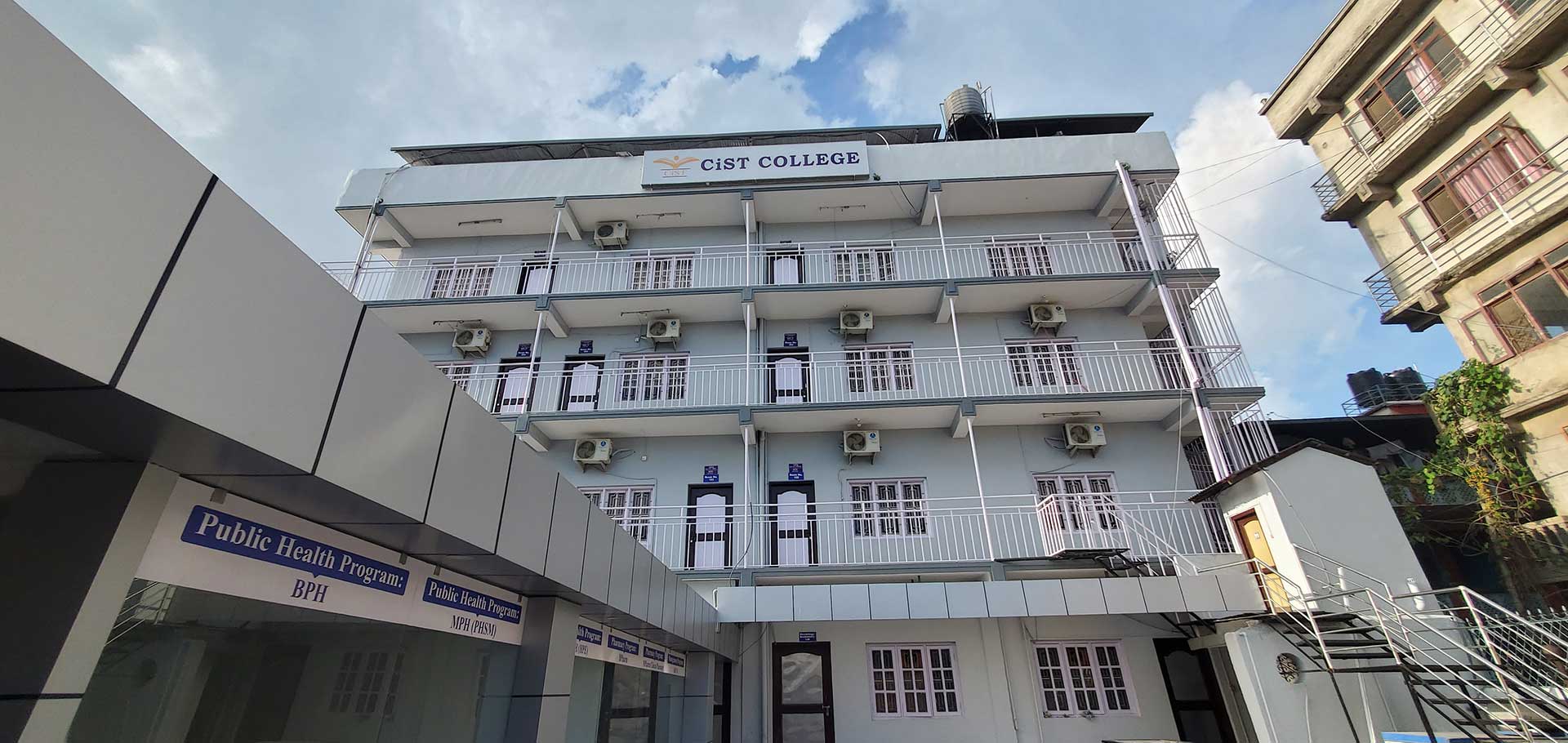
Central Institute of Science and Technology College, commonly known as CIST College, was established in 2009 AD and is located at Sangam Chowk, New Baneshwor, Kathmandu. The college offers bachelor's and master's programs in health sciences, pharmacy, public health, and health care management under Pokhara University.
Its academic setting combines classroom instruction with laboratory work, field-based learning, research, and professional preparation. The college's institutional direction covers health, science and technology, management, research, professional ethics, and the preparation of graduates for responsibilities within their respective disciplines.
| Particular | Details |
|---|---|
| Institution | Central Institute of Science and Technology College (CIST College) |
| Established | 2009 AD |
| Location | Sangam Chowk, New Baneshwor, Kathmandu |
| Affiliation | Pokhara University |
| Academic Areas | Health sciences, pharmacy, public health, health care management |
| Program Levels | Bachelor's and master's |
| Learning Components | Classroom, laboratory, field, research, and practical learning |
CIST College focuses its institutional vision on academic and research development in health, science and technology, and management. It aims to contribute to these areas through higher education, research, professional preparation, and academic collaboration.
Its mission centers on providing higher education that develops skilled professionals while connecting academic learning with social and national needs. Professional ethics, responsibility, and practical competence form part of this educational direction.
The college's academic objectives include:
Preparing competent human resources at different professional levels in health, science and technology, and management.
Supporting research and academic activities related to these disciplines.
Building relationships with national and international academic institutions.
Developing ethical and responsible professionals.
Strengthening leadership, teamwork, management, and problem-solving abilities.
Supporting continuing education, faculty development, consultation, and research.
Connecting theoretical learning with practical responsibilities.
This approach is particularly relevant to pharmacy and public health education, where laboratory work, community learning, field practice, research, and professional responsibilities are integral parts of the academic process.
CIST College is affiliated with Pokhara University. Its academic programs operate within the university's degree, curriculum, examination, and academic framework.
The college offers programs across health sciences and management-related study. Bachelor in Health Care Management is positioned within the management area, while B Pharm, BPH, MPH, and M Pharm in Clinical Pharmacy are associated with health and pharmaceutical education.
For students, the distinction between the college and the university is important. Teaching, practical activities, academic support, and day-to-day study take place through CIST College, while the degree programs follow the applicable Pokhara University academic structure and relevant national regulatory requirements.
CIST College offers five bachelor's and master's programs. Seat numbers for regulated health programs are subject to the applicable annual determination and admission framework.
| Program | Seats | Level / Area |
|---|---|---|
| Bachelor of Health Care Management (BHCM) | 48 | Bachelor's / Health care management |
| Master of Public Health (MPH) | 10 | Master's / Public health |
| Bachelor of Public Health (BPH) | 40 | Bachelor's / Public health |
| M Pharm in Clinical Pharmacy | 6 | Master's / Clinical pharmacy |
| Bachelor of Pharmacy (B Pharm) | 40 | Bachelor's / Pharmacy |
Bachelor of Health Care Management (BHCM) combines health-sector context with management education. The program is suited to the administrative and management side of health organizations rather than clinical professional practice.
The stated intake at CIST College is 48 seats.
Admission follows the applicable Pokhara University requirements for management-level study. Candidates must meet the academic eligibility and entrance requirements applicable to the relevant admission cycle.
Bachelor of Pharmacy is a four-year program structured over eight semesters. The course combines pharmaceutical science with health science and covers the safe production, storage, preparation, and use of medicines.
Its academic coverage includes:
Pharmaceutics
Pharmaceutical chemistry
Anatomy and physiology
Biochemistry
Molecular cell biology
Pharmacognosy
Pharmaceutical microbiology
Immunology
Pharmacology
Medicinal chemistry
Hospital pharmacy
Clinical pharmacy
Pharmacy practice
Pharmacoeconomics
Management
Pharmaceutical jurisprudence
Laboratory work is included throughout the program. Pharmacy practice and project work are also part of the academic structure. The full B Pharm curriculum carries 166 credit hours across eight semesters.
CIST College has a stated B Pharm intake of 40 seats, subject to the seat determination applicable to the relevant admission year.
Bachelor of Public Health is a four-year, eight-semester undergraduate program carrying 145 credit hours.
The curriculum combines basic health sciences with public health sciences, analytical methods, health intervention, public health management, laboratory work, community learning, and research.
Major areas of study include:
Anatomy and physiology
Biochemistry
Environmental science
Epidemiology
Public health statistics
Health education
Public health laws
Public health management
Nutrition
Community diagnosis
Field practice
Research methods
The program includes practical and community-based learning through integrated field practices, community diagnosis, organizational work, residential field practice, and comprehensive health management activities.
Research methods and scientific writing also form part of the academic preparation.
The stated intake at CIST College is 40 seats, subject to the applicable admission and seat-allocation framework.
Master of Public Health is a two-year postgraduate program spread over four semesters. The curriculum contains 75 credit hours covering course work, practical work, seminars, and research.
CIST College offers MPH study in:
Public Health Service Management focuses on the management and administration of public health services. Health Promotion and Education concentrates on health promotion, education, communication, and related public health practice.
The program incorporates classroom discussion, presentations, group work, case-based academic activities, practical skill-development work, and research. Students are also required to complete thesis work in their specialization area.
The stated MPH intake at CIST College is 10 seats.
M Pharm in Clinical Pharmacy is a two-year postgraduate pharmacy program completed over four semesters, including thesis research.
The curriculum covers areas such as:
Instrumental analysis
Regulatory affairs and quality assurance
Research methodology and applied statistics
Biopharmaceutics and pharmacokinetics
Applied therapeutics
Clinical pharmacokinetics
Clinical skills for pharmacists
Hospital and community pharmacy
Pharmacoeconomics
Pharmacoepidemiology
Clinical research
Drug information
Pharmacovigilance
Health system pharmacy
The academic structure also includes laboratory work, seminars, pharmaceutical research, clinical clerkships, community field practice, case study work, and thesis research. The fourth semester includes a nine-credit thesis.
The stated intake for M Pharm in Clinical Pharmacy is 6 seats.
Admission to programs covered by Nepal's medical education framework follows the prevailing rules of the Medical Education Commission (MEC), Nepal.
For applicable bachelor's-level medical and health education programs, admission is based on MECEE-BL and the rules in force for the relevant admission cycle. B Pharm and BPH fall within this entrance framework.
For applicable master's-level medical and health education programs, admission follows MECEE-PG and the prevailing postgraduate admission procedures.
Candidates need to follow the applicable MEC provisions concerning:
Academic eligibility
Entrance examination qualification
Merit and matching
Seat allocation
Scholarship provisions
Fee structure
Admission schedule
Required admission procedures
Examination-related rules and instructions
The MEC framework applies to programs within its regulatory scope and should not be treated as one admission rule for every academic program at CIST College.
Seats for regulated programs are determined under the applicable MEC process and may vary from one academic year to another. The stated figures of 40 seats for B Pharm, 40 seats for BPH, 10 seats for MPH, and 6 seats for M Pharm in Clinical Pharmacy should therefore be understood within the annual seat determination applicable to the relevant intake.
Fees, scholarships, examination guidelines, seat distribution, and admission procedures are also subject to revision according to MEC decisions and the official MEC calendar.
Completion of an academic degree and eligibility to practise a regulated health profession are separate requirements.
Graduates of programs requiring professional registration must meet the licensing examination and registration requirements of the appropriate professional council before entering regulated professional practice.
For public health and other relevant health professions, registration requirements may fall under the Nepal Health Professional Council (NHPC), according to the profession and applicable rules.
Pharmacy graduates come under the professional registration and licensing framework of the Nepal Pharmacy Council.
Students entering regulated health professions therefore need to distinguish among three stages:
Completing the academic degree.
Meeting the university's academic requirements.
Passing the applicable professional licensing or registration process.
CIST College provides academic facilities intended to support theoretical, practical, laboratory, and field-based learning.
Available academic and student facilities include:
Faculty members with academic and professional experience.
A library with books, journals, reports, and electronic resources.
Computer facilities.
Pharmacy laboratories.
Public health laboratories and practical spaces.
Classrooms with audio-visual teaching aids.
A standby generator.
Access to public transportation in the New Baneshwor area.
A physical environment with natural light and ventilation.
Cafeteria services.
Sports and cultural activities.
Scholarship opportunities.
Girls' and boys' hostel options around the college area.
The laboratory facilities cover several specialized disciplines, including Pharmacognosy, Microbiology, Biochemistry, Pharmaceutics, General Chemistry, Industrial Pharmacy, Pharmacology, Instrumental Analysis, Public Health, Anatomy, Physiology, First Aid, Nutrition, Environmental Health, and Health Education and Communication.
These laboratory areas correspond with the practical requirements of pharmacy and public health study, where students move from basic sciences into discipline-specific practical work, field exposure, community learning, clinical components, and research.
The college library supports study and reference work through books, journals, reports, and electronic resources.
These resources are relevant to programs that require regular engagement with scientific literature, research methods, therapeutics, epidemiology, public health management, health policy, and thesis work.
Laboratories and library resources serve different academic purposes. The library supports conceptual learning, assignments, reference work, and research, while subject-specific laboratories provide practical settings for pharmaceutical preparation, analysis, microbiology, anatomy, physiology, biochemistry, public health practice, and related academic activities.
Practical learning differs by program but forms a substantial part of several CIST courses.
B Pharm includes repeated laboratory courses and later progresses into areas such as hospital pharmacy, clinical pharmacy, pharmacy practice, and project work.
BPH has a strong community component through integrated concurrent field practices, community diagnosis, organizational work, and residential field practice. These activities connect classroom subjects with public health situations in community settings.
At postgraduate level, MPH combines classroom study with practical skill-development activities and thesis research.
M Pharm in Clinical Pharmacy includes laboratory work, clinical clerkships, community field practice, pharmaceutical research, case study work, and thesis preparation.
The academic structure therefore uses different forms of practical learning depending on the discipline: laboratory practice in pharmacy, community and field work in public health, clinical exposure in clinical pharmacy, and research components at postgraduate level.
CIST College provides scholarship opportunities to deserving students according to applicable government rules and regulations.
The college also has a provision for a cash prize for students who achieve the highest scores in university examinations.
For MEC-regulated programs, scholarship arrangements operate within the prevailing Medical Education Commission provisions on scholarships, seat allocation, fees, and admission procedures. Scholarship conditions and seat distribution may therefore vary between admission cycles.
CIST College includes sports and cultural activities alongside its academic programs.
Sports activities are organized with student participation, and an annual sports week includes indoor and outdoor events. Cultural programs are also part of student activities.
The college cafeteria operates during the academic day and serves meals and snacks to students and staff.
Girls' and boys' hostel facilities are available around the college area. The location at Sangam Chowk, New Baneshwor, is connected with Kathmandu Valley's public transportation system, providing access for students travelling from different parts of the city.
| Contact | Details |
|---|---|
| Location | Sangam Chowk, New Baneshwor, Kathmandu, Nepal |
| Phone | +977-1-4485307, +977-1-4473934 |
| info@cist.edu.np, askcist@gmail.com |
CIST College has an academic concentration in health care management, public health, pharmacy, and postgraduate clinical pharmacy.
The five programs differ in academic orientation. BHCM focuses on the management side of health care. BPH and MPH cover population health, public health management, health promotion, research, and community practice at different academic levels. B Pharm builds an undergraduate foundation in pharmaceutical sciences and pharmacy practice, while M Pharm in Clinical Pharmacy advances into clinical, therapeutic, research, and patient-oriented pharmacy study.
The regulatory requirements also differ according to program. Pokhara University provides the academic degree framework, the Medical Education Commission governs admission and seat-related matters for programs within its scope, and professional councils regulate licensing or registration where required for professional practice.
Students considering a program at CIST College should therefore examine the academic curriculum together with the admission requirements applicable to the relevant intake. Seat allocation, scholarships, fees, MEC matching procedures, and professional licensing requirements may be governed by different authorities and may change according to the rules in force for a particular academic year.
CIST College is located at Sangam Chowk, New Baneshwor, Kathmandu, Nepal.
Central Institute of Science and Technology College (CIST College) was established in 2009 AD.
CIST College is affiliated with Pokhara University. Its academic programs follow the applicable curriculum, examination, and degree framework of Pokhara University.
CIST College offers the following bachelor's and master's programs:
Bachelor of Health Care Management (BHCM)
Bachelor of Pharmacy (B Pharm)
Bachelor of Public Health (BPH)
Master of Public Health (MPH)
M Pharm in Clinical Pharmacy
The MPH program includes Public Health Service Management and Health Promotion and Education specializations.
The stated program-wise seat numbers are:
| Program | Seats |
|---|---|
| Bachelor of Health Care Management (BHCM) | 48 |
| Bachelor of Pharmacy (B Pharm) | 40 |
| Bachelor of Public Health (BPH) | 40 |
| Master of Public Health (MPH) | 10 |
| M Pharm in Clinical Pharmacy | 6 |
Seats for programs regulated by the Medical Education Commission are subject to the seat determination applicable to each admission year and may change.
Yes. Admission to applicable bachelor's-level health science programs such as B Pharm and BPH follows the Medical Education Commission's MECEE-BL framework and the rules in force for the relevant admission cycle.
Applicable master's-level medical and health education programs follow MECEE-PG and the prevailing postgraduate admission procedures of the Medical Education Commission.
For programs regulated by the Medical Education Commission, fees, scholarship provisions, seat allocation, and admission procedures are governed by the prevailing MEC rules and may be revised for different admission cycles.
Graduates entering regulated health professions must meet the licensing or registration requirements of the relevant professional council before professional practice. Pharmacy graduates fall under the Nepal Pharmacy Council, while applicable public health and other health professions may come under the Nepal Health Professional Council.
CIST College has a library with books, journals, reports, and electronic resources; computer facilities; subject-specific laboratories; classrooms with audio-visual teaching aids; a standby generator; cafeteria services; and facilities supporting sports and cultural activities.
The college also has laboratory facilities related to pharmacy, public health, microbiology, biochemistry, anatomy, physiology, pharmacology, pharmaceutics, pharmacognosy, instrumental analysis, nutrition, environmental health, and health education and communication.
Yes. Practical learning varies by program. B Pharm includes laboratory and pharmacy-practice components, BPH includes community and field-based activities, MPH includes practical and research work, and M Pharm in Clinical Pharmacy includes laboratory work, clinical clerkships, community field practice, research, and thesis work.
Girls' and boys' hostel options are available around the college area. The college is located in New Baneshwor, which is connected with Kathmandu Valley's public transportation network.
CIST College provides scholarship opportunities according to applicable government rules and regulations. For MEC-regulated programs, scholarship arrangements follow the prevailing Medical Education Commission provisions for the relevant admission cycle.