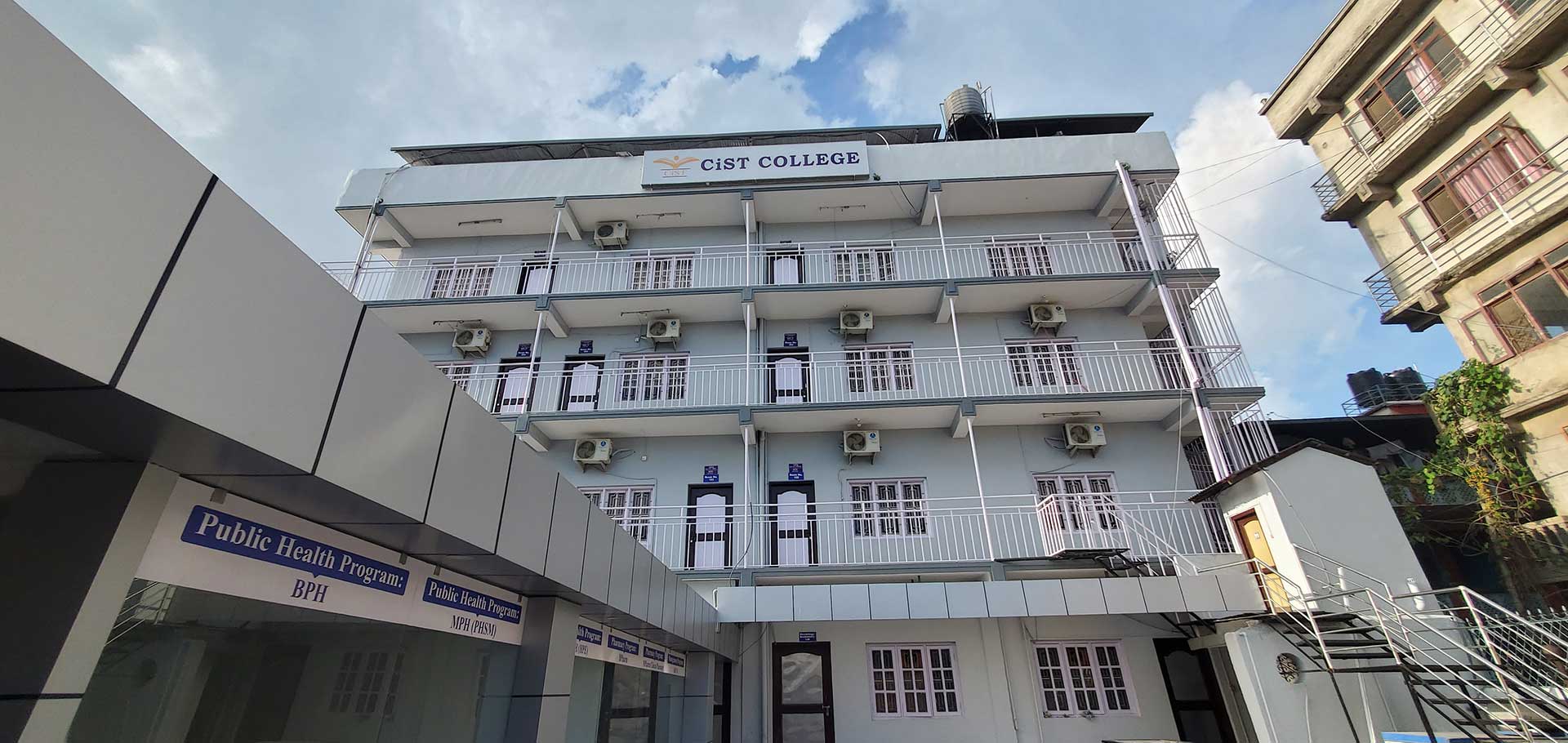
Master of Public Health (Health Promotion and Education) is a postgraduate public health program offered at Central Institute of Science and Technology College (CIST College), Sangam Chowk, New Baneshwor, Kathmandu. The program is affiliated with Pokhara University and is delivered within the university's Faculty of Health Science academic framework.
The specialization concentrates on health promotion, health education, health behavior, communication, program planning, applied practice, and research. Students first complete a common public health foundation before moving into specialization courses during the third and fourth semesters.
| Particular | Details |
|---|---|
| Course | Master of Public Health (Health Promotion and Education) |
| Level | Master's |
| Institution | CIST College |
| Location | Sangam Chowk, New Baneshwor, Kathmandu |
| Affiliation | Pokhara University |
| Faculty | Faculty of Health Science |
| Duration | 2 years / 4 semesters |
| Total Credit Hours | 75 |
| Specialization Credits | 35 |
| Thesis | 9 credit hours |
The MPH program requires 75 credit hours: 40 credits of common public health courses and 35 credits within the selected specialization. The regular duration is 24 months over four semesters.
Health Promotion and Education goes beyond general public health awareness. The specialization examines how health behavior develops, how health education interventions are planned, how communication influences health decisions, and how health promotion programs can be designed and assessed in different settings.
The specialization gives particular attention to:
Health behavior theories and principles
Health promotion concepts and applications
Health education methods and planning
Health communication
Behavioral change and communication approaches
Program planning, implementation, and evaluation
Health promotion and education management in Nepal
Practical work with organizations and communities
Public health research methods
Thesis research in health promotion and education
The academic design combines theory with practical skill-development work, seminars, field-oriented assignments, presentations, project activities, and research.
Eligibility: For the Health Promotion and Education specialization, applicants are academically eligible with one of the following qualifications from a recognized university or institution:
Bachelor of Public Health (BPH)
Post Basic Bachelor of Nursing (PBN)
Bachelor of Science in Nursing (BSc Nursing) with community nursing specialization
Post Graduate Diploma in Health Education completed after a bachelor's degree
Applicants must also have obtained at least 45% marks or a minimum CGPA of 2.0 at the required bachelor's level.
The Pokhara University curriculum further requires at least one year of work experience after completion of the bachelor's degree in an applicable health-related setting, including government health organizations, research organizations, NGOs/INGOs, recognized health service organizations, recognized health science teaching institutions, or teaching within the relevant public health, health promotion/education, nursing, or general health field.
Admission to master's-level medical and health education programs follows the prevailing rules of the Medical Education Commission (MEC), Nepal, including the applicable MECEE-PG admission framework.
Admission for the relevant intake is governed by MEC provisions concerning:
MECEE-PG
Eligibility
Merit and matching
Seat allocation
Scholarship provisions
Fee structure
Admission procedures
Code of conduct
Examination-related requirements
Official admission calendar
These provisions may be revised between admission cycles according to MEC decisions.
CIST College has a stated overall MPH intake of 10 seats. Seat distribution for the relevant intake remains subject to the applicable MEC determination.
The MPH curriculum identifies the following admission documents:
Completed and signed application form showing the intended specialization
Academic transcript or mark sheet
Transfer certificate
Character certificate
Citizenship certificate or passport
Experience letter
Properly attested copies of academic degree certificates
Enrollment is completed after fulfilling the applicable admission formalities.
The first two semesters provide the common public health foundation used across the MPH specializations. The third and fourth semesters concentrate on Health Promotion and Education.
| Course | Credit Hours |
|---|---|
| Advanced Concept of Public Health | 3 |
| Advanced Concept of Epidemiology | 3 |
| Advanced Public Health Statistics | 3 |
| Environmental and Occupational Health | 3 |
| Demography, Reproductive Health and Nutrition | 3 |
| Practical courses corresponding to the five subjects | 5 |
| Total | 20 |
| Course | Credit Hours |
|---|---|
| Epidemiology of Diseases and Health Problems | 3 |
| Public Health and Behavioral Sciences | 3 |
| Health Promotion and Education | 3 |
| Advanced Public Health Research | 3 |
| Public Health Service Management | 3 |
| Practical courses corresponding to the five subjects | 5 |
| Total | 20 |
The first two semesters therefore build competence across epidemiology, statistics, environmental and occupational health, demography, reproductive health, nutrition, behavioral science, public health research, health promotion, and health service management.
The third semester moves fully into the specialization.
| Course | Credit Hours |
|---|---|
| Theories and Principle of Health Behavior, Promotion, Education and Communication | 3 |
| Applied Health Promotion | 3 |
| Applied Health Education | 3 |
| Applied Health Communication | 3 |
| Analysis of Health Promotion, Education and Communication Management in Nepal | 3 |
| Five corresponding practical courses | 5 |
| Total | 20 |
The specialization covers the theories and principles behind health behavior and examines their practical use in health promotion, education, and communication.
Applied Health Promotion addresses the planning, execution, and evaluation of health promotion activities in population settings. Applied Health Education develops understanding of educational approaches, intervention planning, community participation, training, and program evaluation.
Applied Health Communication examines communication strategies, behavioral change communication, social marketing concepts, interpersonal and group communication, mass communication, media selection, and communication planning.
| Course | Credit Hours |
|---|---|
| Seminar and Practicum | 3 (1+2) |
| Health Promotion and Education Research Methods | 3 |
| Thesis on Health Promotion and Education | 9 |
| Total | 15 |
The final semester shifts substantially toward applied work and research.
The Seminar and Practicum includes work connected with health promotion, education, and communication in organizational or community settings. Activities may include reviewing ongoing programs, working with organizations, preparing and implementing a mini-project, documenting experiences, and presenting outcomes.
Health Promotion and Education Research Methods prepares students to identify research problems, examine research literature, apply research methods to HPEC issues, use statistical and computer-based approaches, and prepare a research proposal.
The nine-credit HPE 691 Thesis on Health Promotion and Education is a major component of the final semester.
Students undertake supervised research on an issue related to health promotion, health education, or health communication. The research process includes:
Identifying a researchable issue
Reviewing relevant literature
Preparing and finalizing a proposal
Conducting supervised field research
Collecting and processing information or data
Analyzing findings
Preparing the research report
Presenting and defending the thesis
The thesis is completed under faculty supervision and forms part of the requirements for the Master of Public Health (Health Promotion and Education) degree.
The MPH curriculum uses both classroom and practical learning. Academic activities include:
Classroom discussions
Presentations
Group work
Case-based activities
Guest lectures
Practical for Skill Development (PSD)
Field-oriented assignments
Seminar work
Research activities
One theory credit is equivalent to 16 teaching hours, while one practical or PSD credit corresponds to 48 hours of clinical, laboratory, or field activity.
At CIST College, students have access to a library with books, journals, reports and electronic resources, classrooms with audio-visual teaching aids, computer facilities, and public health-related practical facilities.
Students are required to maintain at least 80% attendance in each course. Failure to meet the attendance requirement results in NOT QUALIFIED (NQ) status for the concerned course.
Academic performance is evaluated through:
Internal evaluation: 60%
External semester-end examination: 40%
Students must separately meet the pass requirement in both internal and external evaluation.
Internal evaluation may include project work, quizzes, presentations, written examinations, reflection notes, assignments, and similar academic work.
The thesis carries separate internal and external assessment.
| Component | Weight |
|---|---|
| Internal Evaluation | 60% |
| External Evaluation | 40% |
Internal assessment includes proposal preparation and defense, thesis report, and thesis defense. External assessment covers the thesis report and presentation/viva.
To receive the MPH degree, students must:
Earn at least a C grade in every required course.
Complete all course work, practical work, and thesis requirements.
Obtain a final CGPA of at least 3.0 on Pokhara University's 4.0 scale.
Complete the academic requirements within the permitted study period.
Clear outstanding financial obligations to the university.
After successful completion, the degree title is Master of Public Health (Health Promotion and Education).
Graduates entering a regulated public health profession must meet the applicable professional registration and licensing requirements. For professions under its jurisdiction, the relevant professional body is the Nepal Health Professional Council (NHPC).
Academic graduation and professional registration are separate requirements, and prevailing council rules apply when entering professional practice.
It is a two-year postgraduate public health specialization covering health behavior, health promotion, health education, health communication, applied practice, and research.
Duration: Two years divided into four semesters. The program carries 75 credit hours.
Eligible academic backgrounds include BPH, PBN, BSc Nursing with community nursing specialization, or a Post Graduate Diploma in Health Education completed after a bachelor's degree. Applicants must also meet the stated academic and experience requirements.
Yes. Practical for Skill Development courses are included throughout the first three semesters, while the fourth semester includes Seminar and Practicum along with research and thesis work.
Yes. Thesis on Health Promotion and Education carries 9 credit hours in the fourth semester.
The stated overall MPH intake at CIST College is 10 seats. The applicable seat allocation for an admission year follows the prevailing MEC determination.



.png)