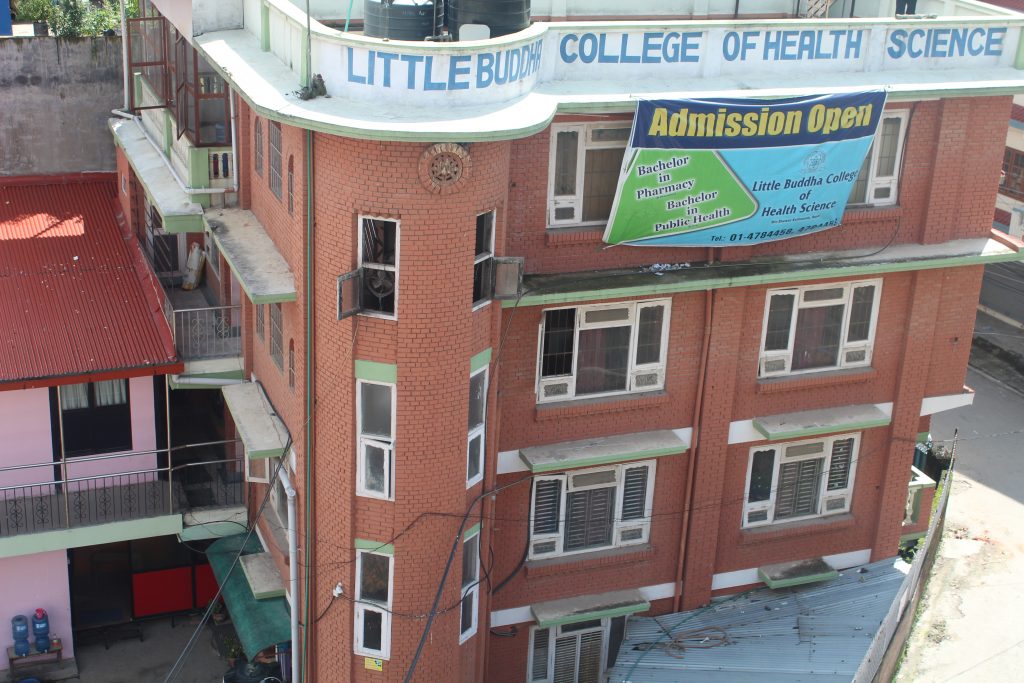
Little Buddha College of Health Science is a health science college in Kathmandu offering education in public health and pharmacy. Its bachelor-level programs in Bachelor of Public Health and Bachelor of Pharmacy are affiliated with Purbanchal University, while the Diploma in Pharmacy follows the CTEVT academic framework.
The college's academic areas connect population health, community-based health services and pharmaceutical education. Public health study covers subjects related to community health, epidemiology, health planning, research and management. Pharmacy education covers medicines, pharmaceutical sciences, pharmacy practice, production, quality control and the safe and rational use of medicines.
| Area | Details |
|---|---|
| Location | Kathmandu, Nepal |
| Main academic fields | Public Health and Pharmacy |
| University affiliation | Purbanchal University for BPH and B.Pharm |
| Diploma framework | CTEVT for Diploma in Pharmacy |
| Bachelor structure | BPH: 8 semesters; B.Pharm: 4 years, 8 semesters |
| Diploma structure | Diploma in Pharmacy: 3 years, yearly system |
| Learning facilities | Classrooms, library, laboratories, computer facilities, sports facilities and cafeteria |
Little Buddha College of Health Science concentrates on public health and pharmacy education.
The public health program covers population and community health, disease prevention, epidemiology, health education, planning, research and management. Students study the health needs of individuals and communities alongside the organization and management of public health services.
Pharmacy education approaches medicines from scientific, clinical, community and production perspectives. Students work with pharmaceutical science, medicine use, laboratory practice, pharmaceutical production, pharmacy management and related professional areas.
| Program | Academic body | Duration and structure |
|---|---|---|
| Bachelor of Public Health (BPH) | Purbanchal University | 8 semesters |
| Bachelor of Pharmacy (B.Pharm) | Purbanchal University | 4 years, 8 semesters |
| Diploma in Pharmacy | CTEVT | 3 years, yearly system |
The Bachelor of Public Health program is organized across eight semesters. It is designed around the knowledge and practical skills required for public health planning, program management, health education, research and community-based health activities.
The curriculum begins with subjects such as Introduction to Public Health, Anatomy, Physiology and Patho-physiology, Public Health Microbiology, Public Health Biochemistry and Applied Professional English.
As students progress, the program covers public health pharmacy, pharmacology and toxicology, epidemiology, family health, nutrition, environmental health and demography. Later study includes reproductive health and gender, epidemiology of non-communicable diseases and mental health, sociology and anthropology in public health, rural and international health, public health statistics, community organization, disaster management and health education.
Laboratory and field-based components accompany classroom study. Concurrent field-based practice is also incorporated into several areas of the curriculum.
The program prepares students to work with public health problems through planning, assessment, research, communication and program management. Its academic scope includes social, environmental, behavioral and managerial dimensions of population health.
The Bachelor of Pharmacy program runs for four years across eight semesters. The Purbanchal University curriculum carries 168 credits, consisting of theory, practical work, seminar, project work and professional internship.
The curriculum combines basic sciences, basic medical sciences and pharmaceutical sciences. Major academic areas include pharmaceutical chemistry, pharmaceutics, pharmacognosy, natural products, pharmacology, pharmacotherapeutics, hospital and clinical pharmacy, community pharmacy and dosage-form design.
Students also study pharmaceutical care, medicine distribution and control systems, drug information, pharmaceutical manufacturing and pharmacy management. Laboratory work forms an important part of the program, while project work and professional internship are included in the academic structure.
The program is relevant to work associated with hospital and community pharmacy, pharmaceutical production, quality control and quality assurance, drug information and pharmaceutical research, subject to the applicable professional licensing requirements.
The Diploma in Pharmacy is a three-year program under a yearly system. It combines academic study with laboratory, clinical, community and workplace-based learning.
The first year establishes the core academic foundation. Pharmacy-specific subjects become more prominent in the second year, while the third year combines advanced pharmacy subjects with professional and field-based practice.
The curriculum covers Pharmaceutics, Pharmacology, Pharmaceutical Chemistry, Pharmacognosy, Biochemistry and Microbiology, Pharmacotherapeutics, Pharmaceutical Management and Public Health Pharmacy.
Third-year study includes Hospital and Clinical Pharmacy, Pharmaceutical Jurisprudence and Community Pharmacy Practice, advanced pharmacotherapeutics and comprehensive professional field practice.
The program prepares students for middle-level pharmacy responsibilities associated with hospital and community pharmacy services and pharmaceutical production settings.
Admission to applicable bachelor-level health professional programs follows the prevailing requirements of the Medical Education Commission (MEC), Nepal.
Admission is based on MECEE-BL and is governed by the prevailing MEC rules, guidelines, code of conduct, scholarship provisions, seat allocation system, fee structure and admission procedures.
Seats, scholarships, fees and examination-related provisions may change according to MEC decisions and the official MEC calendar. Seat numbers determined for one academic year should therefore not be treated as permanent allocations.
For Bachelor of Pharmacy, the stated academic routes include 10+2 Science in the Biology Group or equivalent study under the prescribed requirements. Certain Health Science Proficiency Certificate Level programs also form part of the admission routes, subject to the applicable academic and professional registration conditions.
Bachelor of Public Health likewise includes 10+2 Science in the Biology Group or equivalent study and specified health science proficiency certificate or diploma pathways under the prescribed academic requirements.
Admission for each intake remains subject to the prevailing MEC and university provisions.
Academic completion and professional licensing are separate stages for regulated health professions.
Public health graduates come under the professional framework of the Nepal Health Professional Council (NHPC), while pharmacy graduates come under the Nepal Pharmacy Council.
After completing the relevant course, graduates must pass the respective professional council licensing examination before entering regulated professional practice.
The college has classroom, library and practical facilities supporting its health science programs.
Facilities and student learning resources include:
Classrooms with whiteboards, seating arrangements and multimedia presentation equipment
A library containing books, journals and magazines across academic and supporting subject areas
Computer facilities supporting study and academic work
Laboratories for Physics, Chemistry, Biology and Computer Science
Sports facilities for basketball, badminton and table tennis
A cafeteria
Activities involving public speaking, group discussions, quizzes and exhibitions
Educational and industrial visits connected with practical exposure
These facilities complement programs that already contain laboratory, field, internship and practice-based components.
Students are encouraged to participate in activities outside regular classroom study, including public speaking, group discussions, quizzes and exhibitions.
The college also organizes visits to manufacturing, commercial and service establishments. Such activities give students opportunities to observe organizational and practical settings related to their studies.
The college identifies Dr. Janak Thapa, Ph.D., as Campus Chief.
Its teaching team includes faculty members associated with Public Health, Bachelor of Pharmacy and Diploma in Pharmacy programs. The listed academic backgrounds include public health, pharmacy, statistics, environmental studies, biochemistry, medicine, physiotherapy and entomology.
The college also has administrative, finance and executive committee personnel supporting institutional operations.
BPH graduates are academically prepared for responsibilities connected with public health programs, community health, health education, research, planning and management. Relevant working settings may include government and non-government health agencies, hospitals, educational institutions and community-level health activities.
B.Pharm graduates study areas connected with hospital pharmacy, community pharmacy, pharmaceutical production, quality control, quality assurance, medicine information and research.
Diploma in Pharmacy students receive training for middle-level pharmacy responsibilities, including work associated with hospital and community pharmacy services and pharmaceutical production.
Professional practice in regulated roles depends on completing the applicable professional council licensing process.
Little Buddha College of Health Science is located in Kathmandu, Nepal.
Its Bachelor of Public Health and Bachelor of Pharmacy programs are affiliated with Purbanchal University.
The programs covered are Bachelor of Public Health, Bachelor of Pharmacy and Diploma in Pharmacy.
Bachelor of Pharmacy is a four-year program divided into eight semesters.
The Bachelor of Public Health curriculum is organized across eight semesters.
Diploma in Pharmacy runs for three years under a yearly system.
Admission follows MECEE-BL and the prevailing Medical Education Commission requirements, including applicable rules concerning admission, scholarships, seat allocation and fees.
No permanent seat figure should be assumed. MEC determines seats for the relevant academic intake, and the allocation may vary from one year to another.
Graduates must pass the applicable professional council licensing examination before entering regulated professional practice.