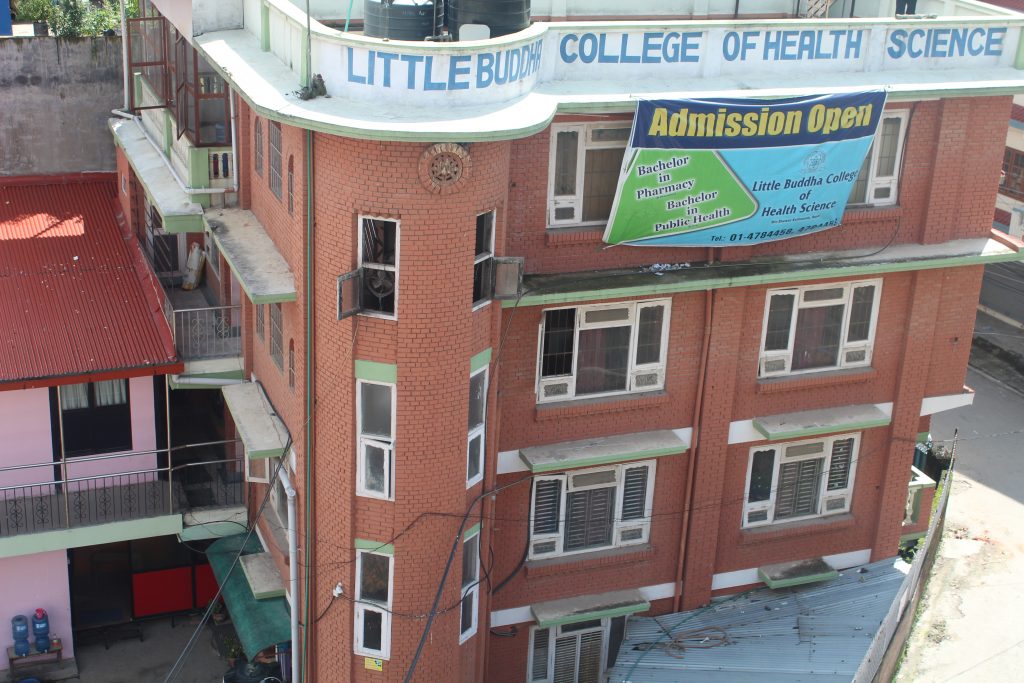
The Bachelor of Pharmacy (B.Pharm) at Little Buddha College of Health Science, Kathmandu, is a four-year undergraduate pharmacy program affiliated with Purbanchal University. The course runs across eight semesters and combines pharmaceutical sciences, basic medical sciences, laboratory work, seminars, research, project work and professional internship.
The program covers the scientific study of medicines alongside their formulation, production, quality assessment and use in hospital and community settings. Students move from chemistry and basic sciences in the early semesters to pharmacology, pharmaceutical technology, pharmacotherapeutics, hospital pharmacy and clinical pharmacy in the later stages.
| Area | Details |
|---|---|
| Course | Bachelor of Pharmacy (B.Pharm) |
| College | Little Buddha College of Health Science |
| Location | Kathmandu, Nepal |
| Affiliation | Purbanchal University |
| Level | Bachelor's degree |
| Duration | 4 years |
| Academic structure | 8 semesters |
| Total credits | 168 |
| Admission entrance | MECEE-BL |
| Professional council | Nepal Pharmacy Council |
The B.Pharm program carries 168 credits. These include 122 theory credits, 32 practical credits, 2 seminar credits, 6 credits of project work and 6 credits of professional internship. Each semester has a minimum instructional period of 16 weeks.
The semester-wise credit load is 20 credits in each of the first four semesters, 22 in the fifth semester, 20 in the sixth, 21 in the seventh and 25 in the eighth.
The academic content is organized across three broad areas: basic sciences, basic medical sciences and pharmaceutical sciences. Pharmaceutical study includes chemistry and instrumental analysis, pharmacognosy and natural products, pharmacology and pharmacotherapeutics, hospital and clinical pharmacy, community pharmacy, physical pharmacy, pharmaceutics and dosage-form design.
The first semester begins with Pharmaceutical Inorganic Chemistry, Pharmacognosy-I, Physical Chemistry, Mathematics, Basic Computer Applications and Communication Skill, supported by practical components in several subjects. The second semester moves into Pharmaceutical Organic Chemistry-I, Pharmacognosy-II, Physical Pharmacy, Pharmaceutical Analysis-I and Anatomy & Physiology-I.
During the second year, students study Pharmaceutical Organic Chemistry-II, Pharmacognosy-III, Pharmaceutical Analysis-II, Pharmaceutical Engineering-I and Anatomy & Physiology-II. Fourth-semester subjects include Biochemistry, Chemistry of Natural Products, Pharmaceutical Engineering-II, Pharmaceutical Microbiology and Pharmacology-I. Practical laboratory work accompanies these areas.
The fifth semester includes Medicinal Chemistry-I, Pharmaceutical Technology-I, Pharmaceutical Biotechnology, Pharmacology-II, Public Health Pharmacy and Pathophysiology. The sixth semester advances into Medicinal Chemistry-II, Pharmaceutical Technology-II, Pharmacology-III, Biopharmaceutics & Pharmacokinetics and Biostatistics. Seminar work is also included during these semesters.
By the seventh semester, the program covers Dosage Form Design, Pharmaceutical Management, Pharmacotherapeutics, Research Methodology, Forensic Pharmacy and Dispensing and Community Pharmacy. The eighth semester focuses on Hospital Pharmacy, Drug Delivery System, Instrumental Analysis and Clinical Pharmacy, alongside project work and professional internship.
Laboratory learning runs throughout the course, particularly in chemistry, pharmacognosy, pharmaceutical analysis, engineering, microbiology, pharmacology, pharmaceutical technology and pharmacy practice.
The program also incorporates visits and observations in hospitals, pharmaceutical industries, drug regulatory bodies, research laboratories, community pharmacies and drug-distribution settings.
During the eighth semester, students complete a six-credit project. The project involves literature review, research, report preparation and project defence under academic supervision.
A six-credit professional internship is also compulsory. The curriculum specifies six weeks and two days of internship in areas such as pharmaceutical industry, quality assurance or quality control laboratories, hospital pharmacy or community pharmacy.
Admission to B.Pharm follows the prevailing requirements of the Medical Education Commission (MEC), Nepal and is based on MECEE-BL.
The academic eligibility routes include:
10+2 Science in the Biology Group or equivalent with at least 50% separately in Physics, Chemistry and Biology and 50% aggregate; or the corresponding prescribed grade requirements, including at least C+ separately in Physics, Chemistry and Biology, at least C in the remaining individual subjects and GPA 2.4.
An equivalent certificate-level qualification such as A-Level meeting the corresponding academic standard.
Specified Health Science Proficiency Certificate Level backgrounds, including General Medicine, Medical Lab Technology, Ophthalmic Science, Dental Science and Pharmacy, with at least 50% aggregate, together with registration in the relevant professional council as applicable.
Admission procedures, scholarship provisions, seat allocation, fees and related requirements follow the prevailing MEC rules, guidelines, code of conduct and official admission calendar. Seat numbers are determined for each admission cycle and may vary from one academic year to another.
Student evaluation includes internal assessment and end-semester examinations. The curriculum requires at least 80% attendance in theory and practical classes. Students are required to obtain the prescribed pass marks separately in theory and practical subjects.
Assessment also extends to practical work, seminars, project work and professional internship. Project evaluation considers the report, presentation and viva, while internship evaluation includes report submission and presentation or viva.
Through theory, laboratory work and professional practice, students work on competencies connected with:
pharmaceutical formulation and dosage-form design
medicine analysis and quality assessment
pharmacology and pharmacotherapeutics
hospital and community pharmacy practice
pharmaceutical manufacturing and production processes
medication distribution and control systems
drug information and rational medicine use
research, scientific reporting and project work
pharmaceutical management
These areas reflect the program's combination of laboratory science, medicine-related study and pharmacy practice.
Completing the B.Pharm degree does not by itself complete the professional entry process.
Graduates must pass the applicable licensing examination under the Nepal Pharmacy Council before entering regulated pharmacy practice.
B.Pharm graduates may pursue work related to hospital pharmacy, community pharmacy, pharmaceutical manufacturing, production, quality control and quality assurance. The course also provides academic preparation relevant to drug information, pharmaceutical research and teaching-related settings, subject to the requirements of the position.
Career outcomes depend on professional licensing, qualifications, individual competence, experience, recruitment requirements and available positions.
B.Pharm students study within the college's health science setting in Kathmandu. Relevant facilities include classrooms, a library, computer-supported study and laboratories. Educational visits and student activities also form part of the broader academic environment.
For pharmacy students, these institutional resources sit alongside a curriculum that already requires practical laboratory work, pharmaceutical-industry observation, research, project work and professional internship.





.png)