NAMS College Kathmandu, formally known as the National Academy for Medical Sciences (NAMS), is a health education college established in 2001 A.D. (2058 B.S.). It was established through the initiative of medical and health professionals with a focus on preparing human resources for Nepal's health sector.
The college offers bachelor and diploma/PCL-level health programs. Its bachelor programs are affiliated with Purbanchal University, while its technical diploma and certificate-level programs operate under CTEVT. The academic areas represented at NAMS include public health, nursing, pharmacy, and general medicine.
Its institutional objectives connect academic preparation with technical competence, professional ethics, social responsibility, analytical ability, planning, decision-making, and problem-solving.
Established in 2001 A.D. (2058 B.S.) with a focus on health science education.
Offers bachelor, diploma, and PCL-level programs in Public Health, Nursing, Pharmacy, and General Medicine.
Bachelor-level programs are affiliated with Purbanchal University.
PCL in General Medicine and Diploma in Pharmacy operate under CTEVT.
Academic programs combine classroom study with laboratory, clinical, field, community, research, internship, or professional practice components according to the curriculum.
Public Health and General Medicine are associated with the Nepal Health Professional Council, Nursing with the Nepal Nursing Council, and Pharmacy with the Nepal Pharmacy Council.
Medical and nursing education covered by the national admission system follows MECEE-BL and prevailing Medical Education Commission rules.
MEC-determined seats, fees, scholarships, and related admission provisions may change between academic intakes.
Graduates of regulated health programs must meet the licensing requirements of the respective professional council before entering professional practice.
Academic support includes a library, e-library, laboratories, multimedia-enabled classrooms, counseling and guidance, and a Center for Teaching, Learning, and Evaluation.
Practical exposure includes clinical, hospital, community, and field-based learning according to the requirements of each program.
NAMS began its academic activities in 2001 with the Proficiency Certificate Level in General Medicine, commonly known as the Health Assistant program.
The Diploma in Pharmacy was introduced in 2004. In 2005, the college expanded into bachelor-level health education with Nursing and Public Health programs.
NAMS currently offers five health science programs covering public health, nursing, pharmacy, and general medicine. These programs are delivered through university-affiliated bachelor education and CTEVT technical education.
Bachelor-level programs at NAMS are affiliated with Purbanchal University (PU). The Bachelor of Public Health, Bachelor of Science in Nursing, and Bachelor of Pharmacy programs include theoretical learning along with practical, laboratory, field, clinical, research, or internship components according to the requirements of each discipline.
The PCL in General Medicine and Diploma in Pharmacy operate under the Council for Technical Education and Vocational Training (CTEVT). Both are three-year programs following a yearly academic system.
Professional regulation varies by discipline. Public Health and General Medicine are associated with the Nepal Health Professional Council (NHPC). Nursing is associated with the Nepal Nursing Council, while pharmacy programs are connected with the Nepal Pharmacy Council.
After completing the respective academic program, graduates must pass the licensing examination required by the concerned professional council before entering professional practice.
| Program | Academic Body | Duration and Structure |
|---|---|---|
| Bachelor of Public Health (BPH) | Purbanchal University | 4 years, 8 semesters |
| Bachelor of Science (B.Sc.) in Nursing | Purbanchal University | 4 years |
| Bachelor of Pharmacy (B. Pharm) | Purbanchal University | 4 years, 8 semesters |
| PCL in General Medicine (Health Assistant) | CTEVT | 3 years, yearly system |
| Diploma in Pharmacy | CTEVT | 3 years, yearly system |
The Bachelor of Public Health is a four-year, eight-semester program. Its academic areas include public health foundations, epidemiology, family health, nutrition, environmental and occupational health, demography, community participation, statistics, and field-based learning.
Laboratory and field components are included across different stages of the curriculum, allowing students to connect classroom study with community and public health practice.
The Bachelor of Science in Nursing is a four-year program combining theory and practical learning.
The curriculum covers anatomy and physiology, biochemistry, microbiology and parasitology, pathophysiology, pharmacology, nutrition and dietetics, foundation of nursing, community health nursing, medical-surgical nursing, psychiatric nursing, pediatric nursing, midwifery, gynaecology nursing, research and biostatistics, educational science, and leadership and management.
Practical learning is integrated throughout subjects that require clinical or professional application.
Bachelor of Pharmacy is a four-year program divided into eight semesters.
Its curriculum brings together basic sciences, basic medical sciences, pharmaceutical chemistry, pharmacognosy, pharmacology, pharmacotherapeutics, pharmaceutics, hospital and clinical pharmacy, and community pharmacy.
The program also includes project work and professional internship components. Its academic structure is intended to develop knowledge and practical skills related to pharmaceutical services, medicines, pharmacy practice, and pharmaceutical production.
The PCL in General Medicine is a three-year yearly-system program.
Major study areas include medicine, surgery, clinical pathology, clinical pharmacology and pharmacy, environmental health, health education, primary health care and family health, health management, epidemiology, and community diagnosis.
Clinical practicum and community field practicum are also included in the program. The curriculum prepares students for technical work involving primary health care, patient assessment, referral, health education, medical records, community health activities, and related general medicine responsibilities.
Diploma in Pharmacy is a three-year yearly-system program.
Students study pharmaceutics, pharmacology, pharmaceutical chemistry, pharmacognosy, biochemistry and microbiology, pharmacotherapeutics, pharmaceutical management, public health pharmacy, hospital and clinical pharmacy, pharmaceutical jurisprudence, and community pharmacy practice.
The program also includes comprehensive professional field practice, linking academic study with practical pharmacy work.
Admission to medical and nursing education programs covered by the national medical education admission system is based on MECEE-BL and follows the prevailing rules and procedures of the Medical Education Commission (MEC).
The applicable admission process includes MEC rules, guidelines, code of conduct, scholarship provisions, seat allocation arrangements, fee structure, and admission procedures.
Seats, fees, scholarships, examination guidelines, and admission provisions may be revised through MEC decisions and the official MEC calendar. Seat numbers are determined for the relevant academic intake and may therefore vary from one year to another.
A seat figure from an earlier admission cycle should not be treated as a permanent seat allocation for a later intake.
CTEVT-affiliated programs follow applicable CTEVT admission and selection procedures. For the PCL in General Medicine, entry also requires candidates to pass the entrance examination administered by CTEVT.
The form of practical education at NAMS differs according to the program.
Public Health includes laboratory work and field-based practice connected with epidemiology, family health, nutrition, environmental health, community activities, and other public health areas.
Nursing combines theory with practical learning across medical-surgical nursing, psychiatric nursing, community health, pediatric nursing, midwifery, gynaecology nursing, and other areas of patient care.
Pharmacy students undertake laboratory and professional learning in pharmaceutical sciences, hospital and clinical pharmacy, community pharmacy, project work, internship, or field practice according to the academic level.
General Medicine combines classroom study with clinical subjects, diagnostic work, primary health care, community diagnosis, clinical practicum, and community field practicum.
This structure means that health education at NAMS is not limited to classroom instruction. Laboratory, hospital, clinical, community, field, research, and internship activities are incorporated where required by the respective curriculum.
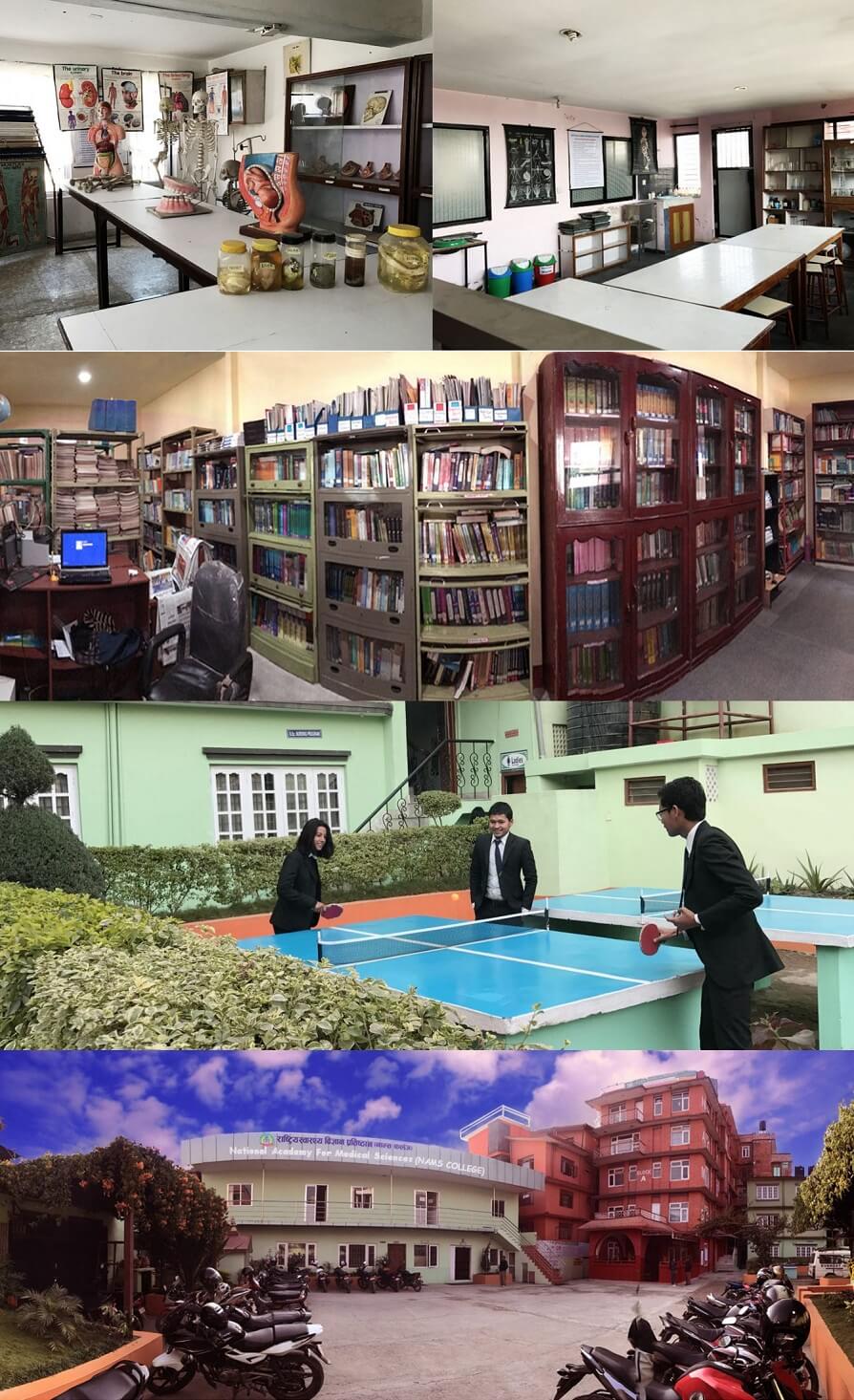
NAMS has a library and e-library to support academic study and reference work.
Its classrooms use multimedia teaching aids, while laboratories provide space for practical learning in relevant health science subjects. The college also has a Center for Teaching, Learning, and Evaluation.
Counseling and guidance sessions form part of the academic support available to students. A canteen is also available.
These resources support programs that require a combination of classroom instruction, laboratory work, clinical learning, community exposure, and field-based study.
NAMS maintains relationships with governmental, non-governmental, and community hospitals in connection with practical health education.
Clinical practicum and community-based learning form part of the academic approach used in its health programs. General Medicine includes both comprehensive clinical practicum and community field practicum, while Public Health incorporates multiple forms of field-based practice.
Nursing and pharmacy education also include practical or professional components relevant to their disciplines.
The college maintains relationships with education and health authorities, universities, CTEVT, professional councils, and hospitals associated with health education and practical training.
NAMS focuses on preparing health professionals with academic knowledge, technical ability, professional responsibility, and ethical awareness.
Its objectives include:
preparing health professionals with relevant knowledge and technical skills;
developing analytical, strategic planning, decision-making, and problem-solving abilities;
encouraging discipline, ethical conduct, and social responsibility;
preparing health workers capable of responding to public and community health needs; and
contributing trained human resources to Nepal's health sector.
The range of programs reflects these objectives across different areas of health practice. Public Health focuses on population and community health, Nursing on patient and community care, Pharmacy on medicines and pharmaceutical practice, and General Medicine on middle-level technical health services.
Completion of an academic program and professional licensing are separate requirements for regulated health professions.
After completing the relevant course, graduates must meet the licensing requirements of the professional council responsible for their discipline before entering professional practice.
Public Health and General Medicine graduates are associated with NHPC requirements, nursing graduates with Nepal Nursing Council requirements, and pharmacy graduates with Nepal Pharmacy Council requirements.
Students therefore need to complete the academic requirements of their university or CTEVT program and subsequently satisfy the applicable professional licensing requirements.
NAMS College has operated since 2001 with its academic activities concentrated on health science education. Its present program portfolio combines Purbanchal University bachelor programs with CTEVT diploma and PCL programs.
Students can study Public Health, Nursing, Pharmacy, or General Medicine at different academic levels. Each program follows its own curriculum, practical requirements, admission framework, and professional regulatory pathway.
For medical and nursing education governed through MEC, admission follows MECEE-BL and the prevailing MEC rules for the relevant academic intake. CTEVT programs follow the applicable CTEVT system. After graduation, professional council licensing requirements apply before entry into the respective regulated profession.