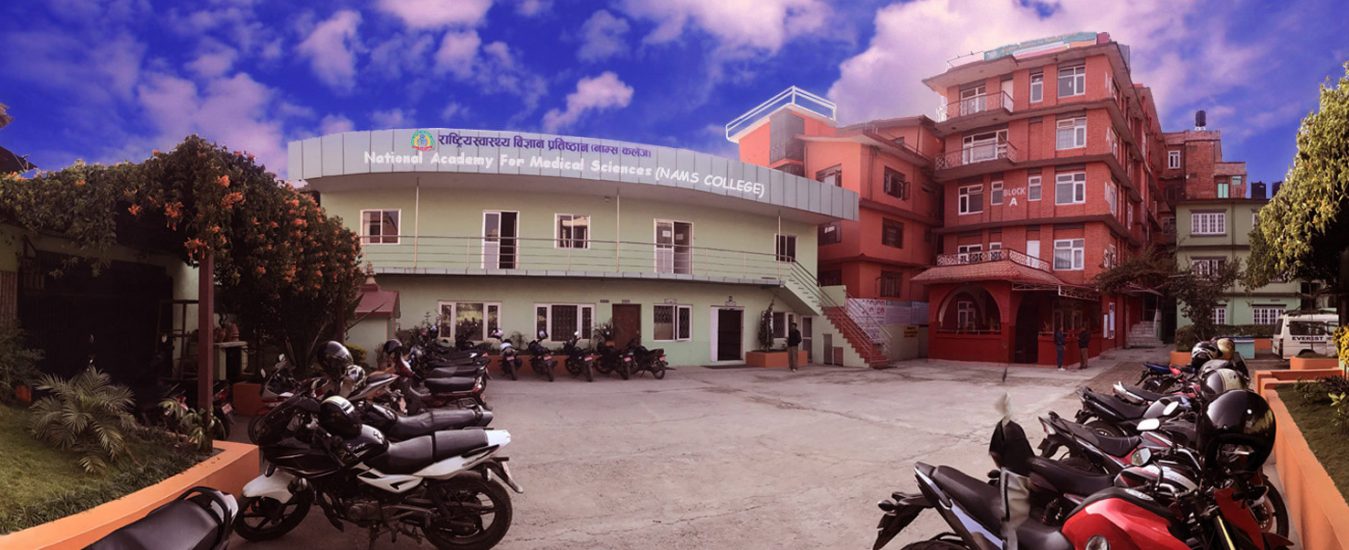
The Diploma in Pharmacy at NAMS College Kathmandu is a three-year diploma-level pharmacy program under the Council for Technical Education and Vocational Training (CTEVT). It follows a yearly academic system and prepares middle-level pharmacy professionals for work related to medicine dispensing, pharmacy services, pharmaceutical production, quality-related activities, and patient communication.
The curriculum combines basic sciences in the first year with pharmacy-specific subjects in the second and third years. The final year also includes comprehensive professional field practice in hospital, community, health facility, pharmaceutical industry, and regulatory settings.
The CTEVT Diploma in Pharmacy curriculum was revised for the second time in 2021.
Three-year Diploma in Pharmacy following the yearly system.
Operates under CTEVT.
Designed for middle-level pharmacy practice.
First year covers foundational and basic science subjects.
Second and third years concentrate on pharmaceutical sciences and pharmacy practice.
Includes laboratory work in major pharmaceutical subjects.
Third year includes hospital and clinical pharmacy, community pharmacy practice, and pharmacotherapeutics.
Includes eight weeks of comprehensive professional field practice.
Admission requires the applicable CTEVT entrance examination and merit-based selection.
Pharmacy graduates must meet the professional licensing requirements of the Nepal Pharmacy Council before entering professional practice.
| Particular | Details |
|---|---|
| Course | Diploma in Pharmacy |
| College | NAMS College Kathmandu |
| Academic Body | CTEVT |
| Level | Diploma |
| Duration | 3 years |
| Academic System | Yearly |
| Medium of Instruction | English or Nepali |
| Entrance | CTEVT entrance examination |
| Professional Council | Nepal Pharmacy Council |
Each academic year consists of 35 academic weeks or 210 working days, with 40 hours in an academic week excluding the examination period.
Applicants should have passed SEE or SLC.
For SEE applicants, the curriculum specifies a minimum GPA of 2.0 with C grade in Compulsory English, Mathematics, and Science. Admission also remains subject to the provisions issued through the CTEVT Office of the Controller of Examinations.
The entry requirements include SEE/SLC pass certificates and either a citizenship certificate or birth registration certificate. Candidates must also pass the entrance examination administered by CTEVT.
Admission follows the applicable CTEVT system for diploma-level health education.
Candidates who meet the academic and entry requirements must sit for the CTEVT entrance examination. Selection is made through a merit list among applicants who satisfy the required criteria.
Admission rules and intake arrangements are governed by the applicable CTEVT provisions for the relevant academic session.
The three-year structure moves from foundational education to pharmaceutical sciences and applied pharmacy practice.
| Year | Main Academic Focus |
|---|---|
| First Year | Basic sciences, languages, social studies, anatomy and physiology, mathematics and statistics |
| Second Year | Pharmaceutics, pharmacology, pharmaceutical chemistry, pharmacognosy, biochemistry and microbiology, pharmacotherapeutics, pharmaceutical management, public health pharmacy |
| Third Year | Advanced pharmaceutics, pharmacology and pharmaceutical chemistry, hospital and clinical pharmacy, community pharmacy practice, pharmacotherapeutics, professional field practice |
First-year study establishes the science and academic base needed for later pharmacy subjects. The curriculum includes English, Nepali, Social Studies, Anatomy and Physiology, Physics, Chemistry, Zoology, Botany, and Mathematics and Statistics. Several science subjects combine theory with practical work.
This stage introduces students to human biology, physical and chemical sciences, quantitative work, communication, and other foundational areas used in pharmaceutical education.
The second year shifts directly into pharmacy disciplines. Students study Pharmaceutics-I, Pharmacology-I, Pharmaceutical Chemistry-I, Pharmacognosy, Biochemistry and Microbiology, Pharmacotherapeutics-I, Pharmaceutical Management, and Public Health Pharmacy.
Practical components accompany Pharmaceutics-I, Pharmacology-I, Pharmaceutical Chemistry-I, Pharmacognosy, Biochemistry and Microbiology, and Public Health Pharmacy.
The year introduces medicine formulation, drug action, pharmaceutical chemistry, medicinal substances from natural sources, microbiological and biochemical concepts, therapeutic use of medicines, pharmacy management, and public health aspects of pharmacy.
Third-year study includes Pharmaceutics-II, Pharmacology-II, Pharmaceutical Chemistry-II, Hospital and Clinical Pharmacy, Pharmaceutical Jurisprudence and Community Pharmacy Practice, Pharmacotherapeutics-II, and Comprehensive Professional Field Practice.
Practical classes continue in the major pharmaceutical subjects. The year places greater emphasis on applying pharmaceutical knowledge in hospital, community, industry, and professional practice settings.
Comprehensive Professional Field Practice is included in the third year to connect academic learning with workplace pharmacy activities.
The field component runs for eight weeks at 40 hours per week. It is divided between hospital pharmacy practice and practice connected with health facilities, community pharmacies, pharmaceutical industries, or regulatory settings.
During this period, students work with areas such as prescription interpretation, dispensing and distribution, patient communication, medicine-related counseling, pharmaceutical manufacturing processes, quality assurance, regulatory functions, proper medicine use, and adverse drug reaction monitoring.
Diploma in Pharmacy uses classroom teaching alongside demonstrations, laboratory work, practical exercises, and workplace-based learning.
The curriculum supports printed and audio-visual materials, computer-based instruction, web-based learning, and other teaching resources alongside conventional classroom and laboratory methods.
At NAMS College, pharmacy education is also supported by laboratories, a library and e-library, multimedia-supported classrooms, counseling and guidance, and a Center for Teaching, Learning, and Evaluation.
Students need at least 90% attendance in each subject to appear in the respective final examination.
Assessment includes theory, practical work, internal assessment, final examinations, and practicum evaluation according to the nature of the subject.
Students must obtain at least 40% in theory and 50% in practical components. The required pass standard must be achieved separately in internal assessment and the yearly final examination for each subject.
The curriculum provides for back papers under CTEVT rules, with all subjects required to be completed within six years from the date of enrollment.
The course develops practical abilities related to dispensing medicines, reading prescriptions, communicating medicine-use information, working with pharmaceutical dosage forms, and supporting pharmacy services.
Students also gain exposure to pharmaceutical manufacturing, quality assurance, hospital and community pharmacy operations, medicine supply, pharmacotherapeutics, public health pharmacy, and regulatory functions through subject-specific practical work and field practice.
Diploma in Pharmacy graduates may explore pharmacy-related opportunities in hospital pharmacies, community pharmacies, clinics, pharmaceutical companies, pharmaceutical marketing, government-related services, and quality-control laboratories.
The CTEVT curriculum also identifies eligibility for positions equivalent to Non-gazetted First Class/Level 5 technical posts as prescribed by the Public Service Commission of Nepal and related agencies. Actual employment depends on recruitment requirements, professional registration or licensing, available positions, experience, and individual qualifications.
Diploma in Pharmacy is associated with the Nepal Pharmacy Council.
Completing the diploma and entering professional pharmacy practice are separate stages. Graduates must meet the applicable Nepal Pharmacy Council licensing requirements before entering the profession.
The curriculum also provides for registration with the relevant council in the grade permitted under the applicable council provisions.
The Diploma in Pharmacy is structured around the work performed by pharmacy assistants in public and private health institutions. Its academic objectives include safe medication use, prescription interpretation, hospital and community pharmacy services, pharmaceutical supply management, rational medicine use, medicine production and preparation, and quality assessment.
For students considering this course, the main academic commitment is three years of science-based study combined with laboratory and workplace practice, followed by the professional requirements applicable to pharmacy practice.