



The Bachelor of Pharmacy (B.Pharm) at NAMS College Kathmandu is a four-year bachelor-level pharmacy program affiliated with Purbanchal University. It follows an eight-semester system and combines pharmaceutical sciences with basic sciences, medical sciences, laboratory work, project work, and professional internship.
The course addresses pharmaceutical care, medicine distribution and control, hospital and community pharmacy, drug information, pharmaceutical manufacturing, public health, and clinical teamwork. Its academic structure moves from foundational chemistry and medical sciences into applied areas such as pharmacology, pharmaceutics, pharmaceutical technology, clinical pharmacy, and hospital pharmacy.
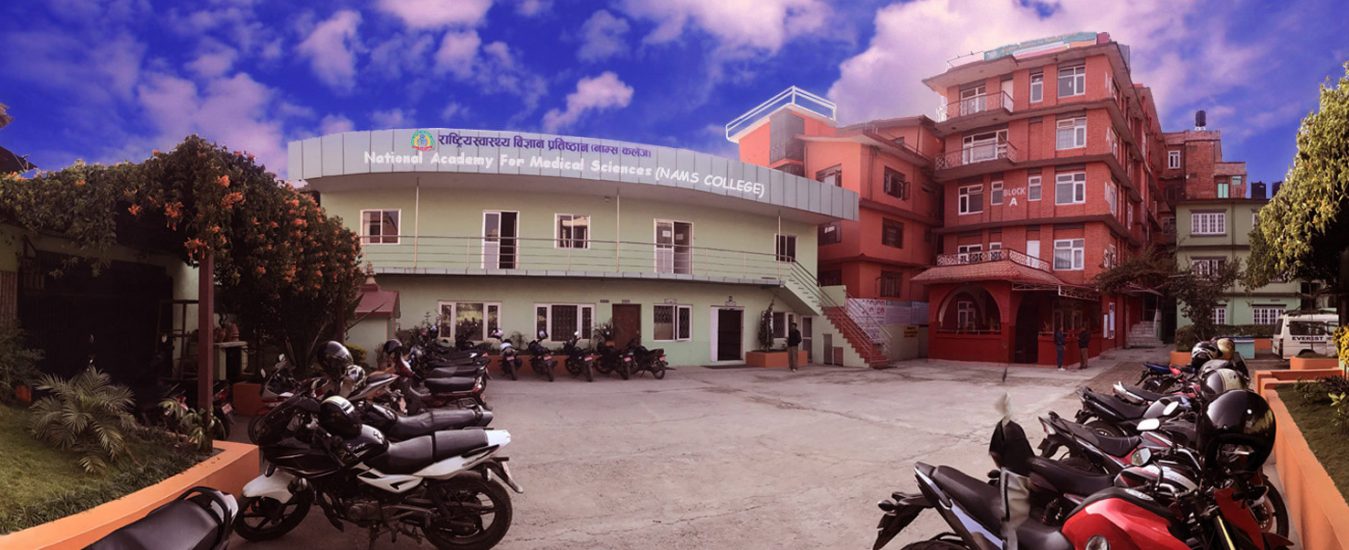
Four-year Bachelor of Pharmacy program divided into eight semesters.
Affiliated with Purbanchal University under the Faculty of Medical and Allied Sciences.
Total academic load of 168 credits.
Includes 122 theory credits and 32 practical credits.
Includes seminar, project work, and professional internship components.
Admission follows MECEE-BL and the prevailing Medical Education Commission framework.
Laboratory learning is integrated across pharmaceutical science subjects.
Eighth semester includes Hospital Pharmacy, Clinical Pharmacy, project work, and professional internship.
Graduates must meet Nepal Pharmacy Council licensing requirements before entering professional pharmacy practice.
| Particular | Details |
|---|---|
| Course | Bachelor of Pharmacy (B.Pharm) |
| College | NAMS College Kathmandu |
| Affiliation | Purbanchal University |
| Duration | 4 years |
| Academic System | 8 semesters |
| Total Credits | 168 |
| Admission | MECEE-BL |
| Professional Council | Nepal Pharmacy Council |
| Medium | English |
The 168-credit structure consists of 122 theory credits, 32 practical credits, 2 seminar credits, 6 project-work credits, and 6 professional-internship credits. Each semester has a minimum instructional period of 16 weeks.
The Purbanchal University B.Pharm structure recognizes several academic pathways for enrollment.
Students from a higher-secondary background must have completed 12 years of formal education, I.Sc., or equivalent study. The specified science combinations are Physics, Chemistry and Mathematics or Physics, Chemistry and Biology, with an average score of 50%. Requirements under a grading system follow the applicable admission criteria.
Diploma in Pharmacy graduates are eligible with an average score of 60%, while Certificate in Pharmacy graduates require an average of 50%. Registration with the Nepal Pharmacy Council is required for candidates entering through these pharmacy qualifications.
The curriculum also includes pathways for candidates with PCL in General Medicine (HA) or Certificate in Medical Laboratory Technology (CMLT), subject to the stated academic percentage, council registration, and equivalence conditions.
Applicants must also satisfy the eligibility and admission conditions in force for the relevant MECEE-BL intake.
Admission to B.Pharm follows the prevailing national medical education admission framework. Candidates are required to participate in MECEE-BL and complete admission according to the rules and procedures issued by the Medical Education Commission (MEC).
The applicable framework covers entrance and admission procedures, code of conduct, scholarship provisions, seat allocation, fee structure, and other admission requirements.
Seats are determined for the relevant academic intake and may change from one year to another. The same applies to fee arrangements, scholarship provisions, admission procedures, and related academic requirements governed through MEC decisions and the official admission calendar.
B.Pharm brings together three broad academic foundations: basic sciences, basic medical sciences, and pharmaceutical sciences.
Basic science study includes areas such as pharmaceutical chemistry, organic chemistry, physical chemistry, and mathematics. Basic medical sciences include Anatomy and Physiology, Biochemistry, Microbiology, and Pathophysiology.
The pharmaceutical science component covers areas including:
Pharmaceutical Chemistry and Instrumental Analysis
Pharmacognosy and Natural Product Chemistry
Pharmacology and Pharmacotherapeutics
Physical Pharmacy
Pharmaceutics and Dosage Form Design
Pharmaceutical Technology
Pharmaceutical Biotechnology
Public Health Pharmacy
Hospital Pharmacy
Clinical Pharmacy
Community Pharmacy
The fifth semester, for example, includes Medicinal Chemistry-I, Pharmaceutical Technology-I, Pharmaceutical Biotechnology, Pharmacology-II, Public Health Pharmacy, and Pathophysiology, along with related practical work and a seminar.
By the eighth semester, students study Hospital Pharmacy, Drug Delivery System, Instrumental Analysis, and Clinical Pharmacy while completing related laboratory work, project work, and professional internship.
Practical learning is a substantial part of the degree, accounting for 32 credits. Students carry out laboratory work under supervision in subjects where practical skills form part of the curriculum.
Project work is undertaken during the eighth semester. Students work in groups of up to three, review relevant literature, conduct research, prepare a project report under academic supervision, and defend their work.
The eighth semester also carries six credits of professional internship, alongside six credits of project work.
NAMS College also has laboratories, a library and e-library, multimedia-supported classrooms, counseling and guidance, and a Center for Teaching, Learning, and Evaluation within its academic environment.
A minimum of 80% attendance is required in both theory and practical classes.
Theory subjects include internal assessment, while practical assessment considers day-to-day performance, attendance, viva, laboratory records, and related work. Students must obtain at least 50% in theory and 60% in practical subjects separately to pass.
The final academic result is calculated through the cumulative grade point average system. The program allows a maximum period of seven years from admission to complete the B.Pharm degree.
The course develops learning related to pharmaceutical care, medicine distribution systems, community and hospital pharmacy, drug information, pharmaceutical production, rational use of medicines, and participation in clinical health teams.
Graduates may pursue work connected with pharmaceutical manufacturing, hospital or community pharmacy, quality-related functions, drug information, research, pharmaceutical services, academia, or regulatory work, depending on professional licensing, recruitment requirements, experience, and available positions.
Pharmacy is a regulated profession. After completing B.Pharm, graduates must pass the applicable professional licensing examination before entering professional practice.
The relevant professional body is the Nepal Pharmacy Council. Academic graduation and professional licensing therefore form separate stages of entering pharmacy practice.
B.Pharm seats, fees, scholarships, and admission arrangements are governed by the applicable MEC framework for the relevant intake.
Seat figures from an earlier academic year should not be treated as permanent because MEC seat determination may change from one admission cycle to another. The same principle applies to scholarship distribution and fee-related provisions.




.png)





