



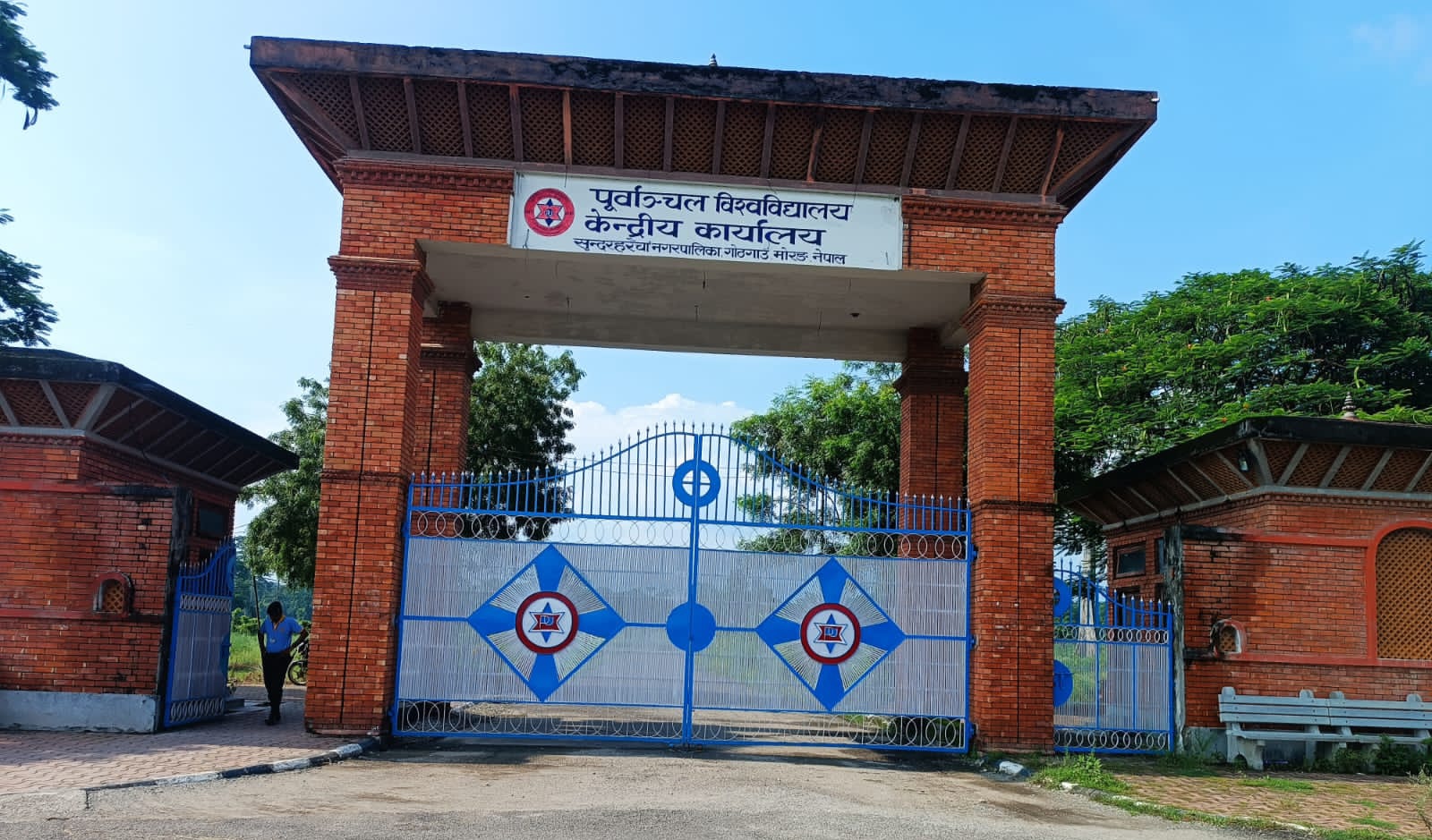
Purbanchal University (PU) is a public university in Nepal established in 1994 under the Purbanchal University Act, 2050 B.S. Its central office is located in Gothgaun, Morang, while the Office of Examination Management operates from Pushpalal Chowk, Biratnagar.
The university organizes its academic activities across seven faculty areas: Arts, Management, Science & Technology, Education, Law, Medical & Allied Sciences, and Engineering. Its academic scope includes undergraduate, postgraduate, and selected research-level programs delivered through university schools, campuses, departments, and institutions connected with PU.
Alongside teaching, the university's institutional structure covers examinations, research, curriculum development, academic administration, planning, library services, information technology, and other university functions.
| Field | Details |
|---|---|
| Official Name | Purbanchal University (पूर्वाञ्चल विश्वविद्यालय) |
| Abbreviation | PU |
| Institution Type | Public University |
| Establishment Year | 1994 |
| Legal Framework | Purbanchal University Act, 2050 B.S. |
| Central Office | Gothgaun, Morang, Nepal |
| Examination Office | Pushpalal Chowk, Biratnagar |
| Faculty Areas | 7 |
| Central Phone | +977-21-590832 (Ext. 8009) |
| Central Email | info@purbuniv.edu.np |
Purbanchal University was established by the Government of Nepal in 1994 as part of the expansion of higher education beyond the country's earlier university structure. One of its central purposes was to support a more decentralized approach to higher education and widen academic opportunities across different regions.
Its statutory foundation is the Purbanchal University Act, 2050 B.S. The Act provides the legal basis for the university's governance and institutional operation within Nepal's public higher education system.
From its early development, PU was intended to combine university education with professional, technical, research, and practical academic activities. Its objectives include running institutions for higher education, supporting teaching and research, strengthening the abilities of students and academic personnel, applying knowledge across disciplines, and responding to changing social and economic needs.
The university also developed a substantial physical base at Gothgaun in Morang. Land provided by the Government of Nepal became the site for administrative, academic, residential, library, environmental, and other university infrastructure.
Over time, PU's academic system expanded across a broad range of disciplines. Its present structure includes university-run academic units and institutions connected with PU programs, allowing the university to deliver courses in humanities, management, science, technology, education, law, health sciences, medicine, and engineering.
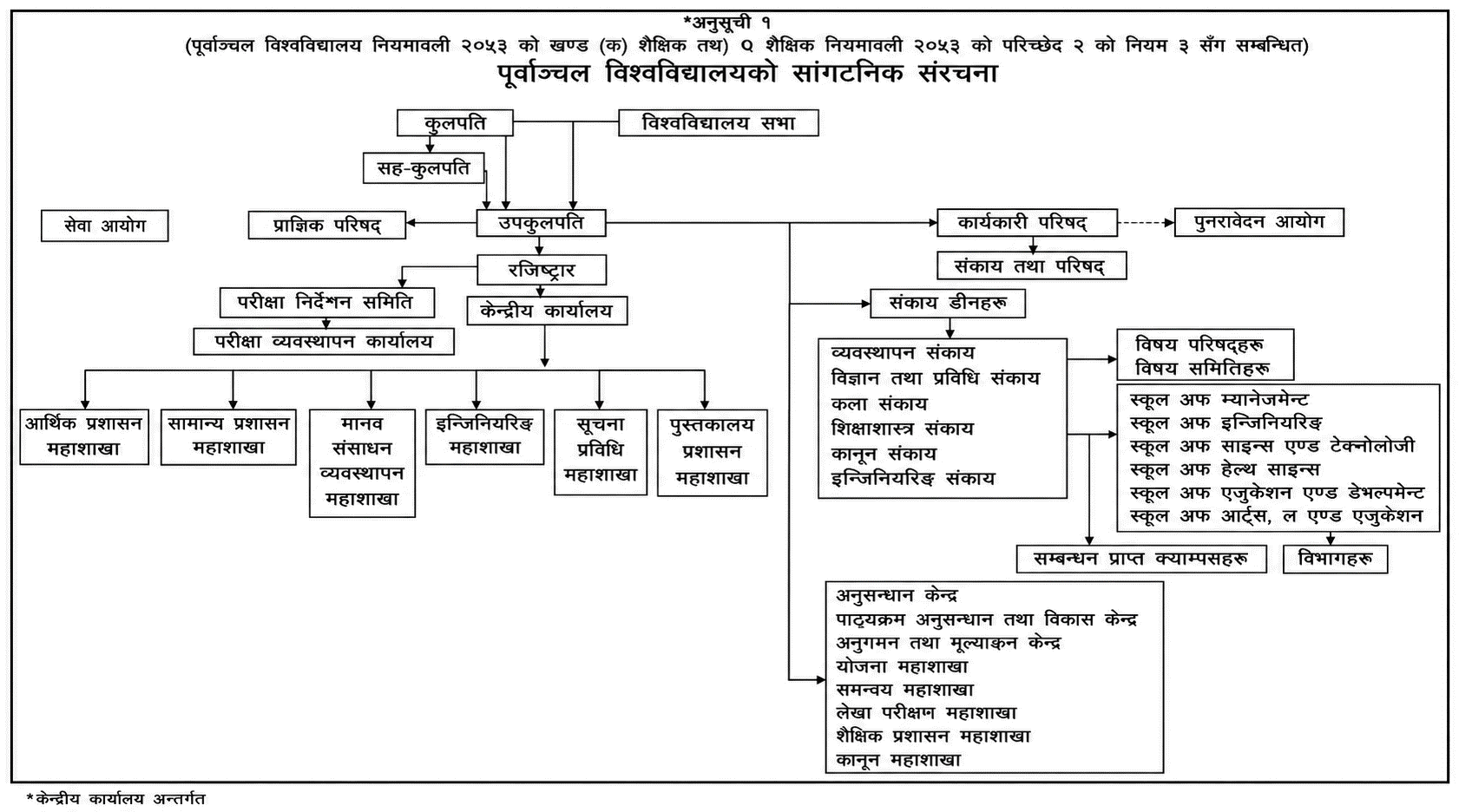
Purbanchal University operates as a public university under the Purbanchal University Act, 2050 B.S. Its governance framework includes statutory, academic, administrative, examination, and support bodies responsible for different areas of university operation.
The institutional structure includes the University Assembly, Academic Council, Executive Council, University Service Commission, faculties, faculty councils, subject councils, schools, academic departments, administrative divisions, research units, and the Office of Examination Management.
This structure separates major responsibilities within the university. Academic planning, examinations, financial administration, general administration, human resources, engineering administration, information technology, library administration, research, curriculum work, planning, monitoring, and coordination are handled through different institutional units.
The university also works through schools, campuses, departments, and affiliated institutions connected with specific academic programs.
Purbanchal University's central institutional office is located in Gothgaun, Morang. This location serves as the main university identity and is associated with central administration, campus development, academic infrastructure, and institutional planning.
The Office of Examination Management operates separately from Pushpalal Chowk, Biratnagar. It is responsible for examination-related administration, including schedules, examination forms, exam cards, results, notices, and related academic records.
The distinction between these two locations is important for students and other users of university services. General university administration and examination administration are handled through separate offices.
Students dealing with examination forms, schedules, exam cards, or results may need services associated with the Biratnagar examination office, while broader university matters may involve the central office or the relevant faculty, school, campus, or department.
Purbanchal University's stated vision focuses on developing the institution in support of Nepal's educational objectives and wider national development.
Its academic direction includes teaching, research, practical studies, professional education, and work related to social, economic, and sustainable development. The university has identified areas such as industry and technology, agriculture and forestry, environment, rural and cultural subsistence, and sustainable development within its broader academic priorities.
PU's objectives include:
Running professional and technical institutions for career-oriented higher education.
Supporting study, research, and teaching across different academic disciplines.
Contributing to the academic and personal development of students, teachers, and scholars.
Extending knowledge and supporting its practical application.
Mobilizing local, national, and international resources for academic development.
Improving the quality and effectiveness of academic programs.
Responding to changing social and economic needs through higher education.
Strengthening institutional practices within public and private higher education.
These objectives place the university's role beyond degree administration alone. Teaching, research, academic planning, institutional development, professional education, and practical application of knowledge form part of its wider mandate.
Purbanchal University's governance structure includes a number of statutory and academic bodies responsible for university-level administration and decision-making.
Key bodies and offices include:
University Assembly
Executive Council
Academic Council
University Service Commission
Faculty councils
Subject councils and committees
Schools and academic departments
Research and academic support units
Administrative divisions
Office of Examination Management
The Vice-Chancellor holds a central academic and executive role within the university structure, while the Registrar is associated with major administrative responsibilities. These offices work alongside the university's councils, faculties, commissions, divisions, and academic units.
Governance is also distributed through faculty deans, subject committees, schools, departments, research units, and administrative offices. This arrangement allows academic and administrative responsibilities to be managed through specialized parts of the university.
Purbanchal University currently organizes its academic activities under seven faculty areas:
Faculty of Arts
Faculty of Management
Faculty of Science & Technology
Faculty of Education
Faculty of Law
Faculty of Medical & Allied Sciences
Faculty of Engineering
Each faculty represents a broad academic division containing programs in related disciplines.
Courses may be delivered through university schools, campuses, departments, or institutions connected with PU. Program availability can therefore differ between institutions and academic cycles.
A program appearing within the university's academic structure does not mean that every institution connected with PU offers that program. Students need to consider the specific program and institution together when reviewing study options.
The Faculty of Arts covers study in humanities, communication, social sciences, social work, development-related fields, media, and other related disciplines.
Bachelor's-level programs within the university's arts listings include:
Bachelor of Arts
BA English with Honours
Bachelor of Social Work
Mass Communication and Journalism
Media Technology
Interior Design
Postgraduate study is also listed in areas such as English, sociology and anthropology, mass communication, social work, development studies, media technology, and development communication.
The faculty therefore brings together conventional humanities and social science education with applied fields involving media, communication, social work, and development studies.
Program delivery may vary across institutions connected with PU, so individual colleges or academic units may offer only selected programs from the wider university portfolio.
The Faculty of Management covers business, administration, hospitality, tourism, and related fields of study.
Bachelor's-level program listings include:
Bachelor of Business Administration (BBA)
Bachelor of Business Studies (BBS)
Bachelor of Hotel Management (BHM)
Travel and tourism-related study
Fashion design and management
Hospitality and catering management
At postgraduate and research levels, PU includes MBA programs, executive MBA formats, Master of Public Administration, tourism studies, hotel and hospitality management, MPhil in Management, and PhD in Management.
This academic range allows management education at PU to extend beyond business administration into public administration, tourism, hospitality, and related professional fields.
The exact availability of an individual program depends on the institution through which it is offered.
The Faculty of Science & Technology covers a diverse group of disciplines that includes computing, information technology, agriculture, biotechnology, food-related sciences, forestry, veterinary study, and other science-based programs.
Program listings include:
Bachelor of Computer Applications (BCA)
Bachelor of Information Technology (BIT)
BCA-IT
Agriculture
Biotechnology
Food Technology
Dairy Technology
Forestry
Veterinary Science and Animal Husbandry
Artificial Intelligence
Food, Nutrition and Dietetics
Postgraduate programs include MCA, MIT, Nutrition and Dietetics, Dairy Technology, Meat Technology, and Agri-Business Management.
Data Science, Cyber Security, and IoT also appear within the university's newer program area.
The breadth of the faculty reflects PU's involvement in both computing and applied sciences. Agriculture, food, nutrition, forestry, veterinary study, and biotechnology sit alongside information technology and computing disciplines within the wider science and technology structure.
Students considering one of these programs need to identify the particular institution offering it because the complete faculty portfolio is not necessarily available at a single campus or college.
The Faculty of Education includes Bachelor of Education and Master of Education programs. One-year B.Ed. formats also appear within the university's education program structure.
Education is maintained as a distinct faculty within PU rather than being combined administratively with other academic areas.
The faculty provides an academic base for university-level study connected with education and related areas. Program formats and availability may differ according to the institution and academic cycle.
Law is one of the seven faculty areas within the present academic structure of Purbanchal University.
Programs listed under law include:
LL.B.
BA LL.B.
LL.M.
Master's degree in Human Rights
Master's program in Conflict and International Humanitarian Law
The university's law portfolio therefore includes undergraduate and postgraduate legal education as well as specialized study related to human rights, conflict, and international humanitarian law.
Students considering law programs under PU need to review the particular program and institution because not every law course is necessarily offered through the same academic unit.
Medical and allied health education forms a separate faculty area at Purbanchal University.
Programs within this area include:
Post Basic Bachelor in Nursing (PBNS)
Bachelor in Pharmacy
Bachelor of Public Health (BPH)
B.Sc. Medical Laboratory Technology
B.Sc. Nursing
Master of Public Health (MPH)
M.Pharm.
MBBS
These programs cover medicine, nursing, pharmacy, public health, laboratory science, and related health disciplines.
Medical and allied health programs operate within academic and regulatory structures that differ from many general university courses. Admission arrangements can therefore depend on the particular program, applicable entrance procedures, institutional requirements, and the relevant academic cycle.
MBBS is included within Purbanchal University's medical academic structure.
The university received permission from the Government of Nepal to use Koshi Hospital in Biratnagar as a teaching hospital for the MBBS program. This arrangement is connected with a tripartite Memorandum of Understanding involving the Ministry of Health and Population, the Ministry of Education, Science and Technology, and Purbanchal University.
Use of a teaching hospital provides the institutional setting required for clinical components of medical education.
PU has also developed academic infrastructure for medical education at its Gothgaun site. The university's physical development includes a central academic building intended for medical education.
MBBS should therefore be understood as part of PU's current academic structure rather than as a future academic proposal.
The Faculty of Engineering covers undergraduate and postgraduate study across several engineering and built-environment disciplines.
Bachelor's-level programs include:
Computer Engineering
Civil Engineering
Electronics, Communication and Automation Engineering
Architecture
Geomatic Engineering
Biomedical Engineering
Electrical Engineering
Postgraduate programs include:
Electrical Power Engineering
Construction Management
Information System Engineering
Engineering Management
Earthquake Engineering
Urban Design and Conservation
PU's engineering portfolio therefore includes conventional branches such as civil, computer, and electrical engineering alongside specialized fields such as geomatics, biomedical engineering, earthquake engineering, and urban design.
Programs may be distributed across different academic institutions within the PU system. Students should consider the exact institution offering the intended engineering program rather than treating the university-wide list as a single-campus offering.
Purbanchal University's organizational structure includes a number of schools associated with different academic areas.
These include:
School of Education and Development
School of Arts, Law and Education
The wider structure also includes faculty deans, councils, subject committees, academic departments, affiliated campuses, administrative divisions, research centers, and academic support offices.
These units allow the university to divide responsibilities between broad faculty governance, subject-level academic work, institutional program delivery, administration, research, and student-related academic services.
Purbanchal University's academic system includes university-run academic units and colleges connected with PU programs.
A university-run school or campus operates within PU's own institutional structure. An affiliated institution operates separately while offering programs connected with the university under the applicable academic arrangements.
This distinction matters when students compare colleges. University affiliation alone does not indicate that every PU program is available at a particular institution.
A student considering a PU degree should identify:
The exact institution.
The specific PU program offered there.
The faculty under which the program falls.
The current academic intake.
The admission procedure applicable to that program.
This program-level approach is more useful than relying on a single university-wide count of institutions or programs.
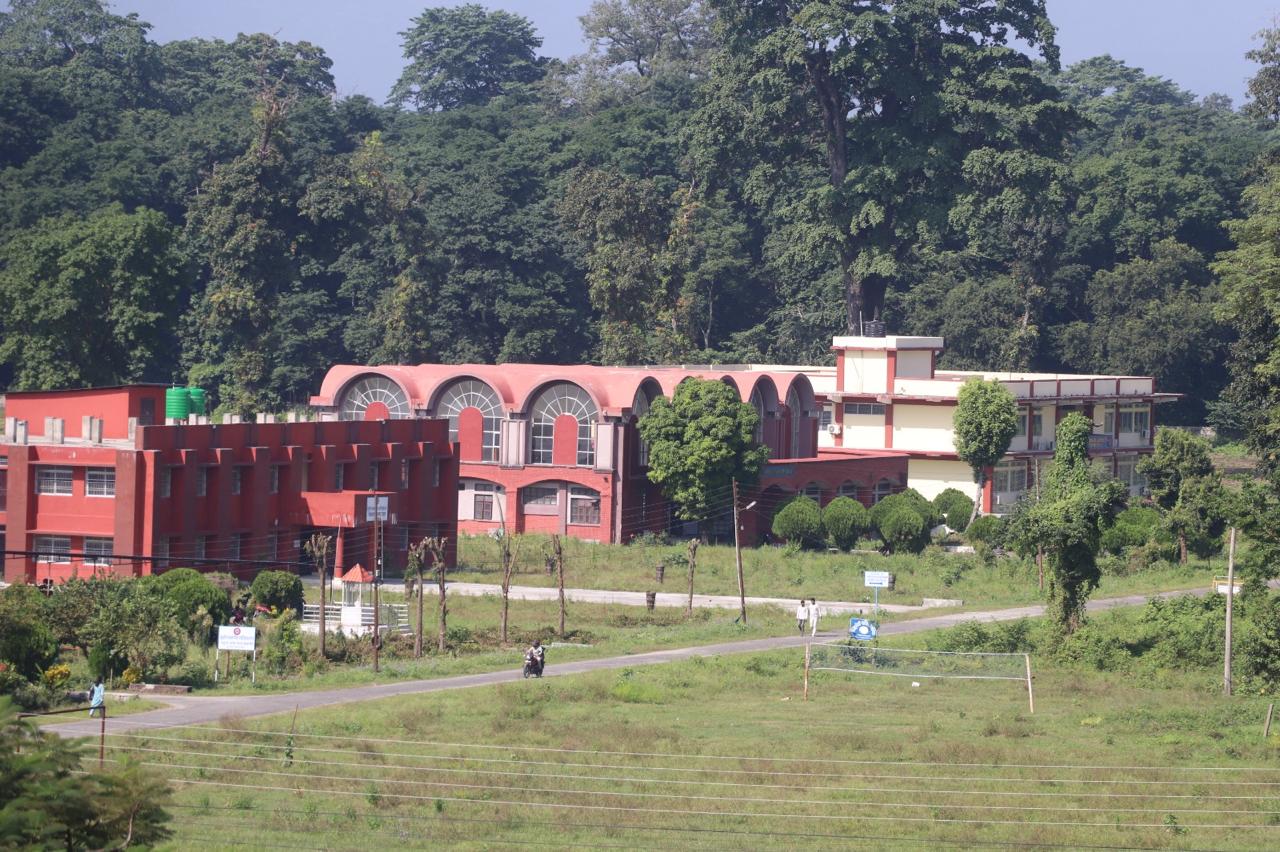
Purbanchal University's central campus is located at Gothgaun in Morang.
The university's campus occupies more than 545 hectares of land provided by the Government of Nepal. The site was planned not only for buildings but also for forestry, agriculture, agroforestry, environmental use, and physical infrastructure.
The historical land-use plan allocated:
50 percent for productive forest.
12.5 percent for higher-income farm activities, including medicinal herbs.
12.5 percent for agroforestry under an ecosystem-management approach.
25 percent for infrastructure and physical facilities.
This arrangement shows that the Gothgaun site was conceived as a broad university environment rather than a compact collection of academic buildings.
Its physical planning combined education, administration, residential facilities, environmental management, and land-based activities.
Infrastructure developed at the Gothgaun site includes university buildings and facilities used for academic, administrative, residential, and support purposes.
The earlier physical development phase included:
Administrative Building
Central Campus
Central Library
A-type staff quarters
B-type staff quarters
Boys' hostel
Girls' hostel
Continuing Education Centre
The university also developed a central academic building for medical education and included a Peace Research Center within its physical planning.
These facilities form part of the wider campus structure through which PU supports academic activities, administration, accommodation, library services, and other institutional functions.
A Central Library forms part of Purbanchal University's Gothgaun infrastructure. Library Administration also appears as a separate function within the university's administrative organization.
Other academic and institutional support units include:
Research Center
Curriculum Research and Development Center
Monitoring and Evaluation Center
Planning Division
Coordination Division
Internal Audit Division
Academic Administration Division
Law Division
Administrative responsibilities are further divided among financial administration, general administration, human resources management, engineering administration, information technology, and library administration.
This internal structure supports the university's academic work through planning, curriculum development, research, records, technology, finance, administration, monitoring, and institutional coordination.
Research is included within Purbanchal University's academic objectives and organizational structure.
The university's broader academic direction connects teaching and research with areas such as industry and technology, agriculture and forestry, environment, rural and cultural subsistence, and sustainable development.
A Research Center and Curriculum Research and Development Center form part of the academic support structure, while monitoring and planning units provide institutional support for wider university development.
Research is also included in PU's strategic priorities for the 2026–2030 period.
The presence of dedicated research and curriculum units gives research activity an institutional role alongside teaching, examinations, administration, and program management.
Purbanchal University has established academic relationships with national and international universities and academic institutions.
Its institutional information records more than 20 memoranda of understanding with national and international academic organizations. Jamia Millia Islamia and Banaras Hindu University are among the institutions identified in connection with these academic relationships.
Such agreements fit within the university's broader interest in academic cooperation and institutional links beyond Nepal.
Internationalization also forms part of PU's 2026–2030 strategic direction.
Purbanchal University has a five-year strategic plan covering 2026–2030.
The plan identifies several institutional priorities:
Master planning for the Gothgaun campus.
Financial sustainability.
Medical education.
Examination-system development.
Digital systems and EMIS.
Research and innovation.
Internationalization.
Performance monitoring through institutional indicators.
These priorities connect several long-standing areas of PU's development with its current institutional direction.
The Gothgaun master plan relates to the university's extensive physical campus. Medical education connects with MBBS and other health programs. Examination and digital systems address university administration, while research and internationalization focus on academic development and external relationships.
Financial sustainability and performance monitoring form another part of the strategy, reflecting the administrative requirements of operating a large public university with multiple faculties, academic units, and associated institutions.
The Office of Examination Management operates from Pushpalal Chowk, Biratnagar.
Its functions include examination-related services such as:
Examination schedules
Examination forms
Exam cards
Results
Examination notices
Program-related examination records
This office should not be confused with the university's central office in Gothgaun.
For students, the distinction helps identify the appropriate administrative channel. Examination matters may involve the Biratnagar office, while academic or institutional questions may involve a faculty, school, campus, department, or central university office.
Examination administration also forms part of the university's 2026–2030 strategic priorities, together with digital systems and EMIS.
Admission arrangements at Purbanchal University depend on the program, academic level, faculty, institution, and academic cycle.
PU offers programs across fields that follow different admission structures. Medical and allied health programs, for example, operate within regulated education systems, while other faculties may manage admissions through their respective academic units or associated institutions.
Students considering admission should identify several details together:
Exact program name.
Academic level.
Faculty.
Institution offering the program.
Current intake.
Applicable entrance process.
Eligibility conditions.
Seats available for the relevant cycle.
Fees and deadlines applicable to that intake.
These elements can change between admission cycles and should not be treated as permanent university-wide characteristics.
Purbanchal University's broad academic portfolio is distributed across different faculties, schools, campuses, departments, and affiliated institutions.
A student searching for BBA, BCA, engineering, law, nursing, public health, agriculture, MBBS, education, or another PU program should therefore look beyond the university name alone.
Three questions help clarify the actual study option:
Which institution offers the intended PU program?
Is that specific program active at the institution?
Is the institution accepting students for the current intake?
This is especially important in a university system where different institutions may offer different combinations of programs under the same university.
The academic relationship between the university, faculty, program, and institution is central to understanding how PU education is delivered.
Purbanchal University combines central university administration, academic faculties, schools, departments, examination management, research functions, and a wider network of institutions.
Its academic fields range from humanities and management to science, agriculture, computing, education, law, health sciences, medicine, and engineering.
The Gothgaun campus provides a substantial physical base for administration, teaching, library services, residential facilities, medical education, environmental land use, and institutional development.
The separate Office of Examination Management in Biratnagar handles examination-related services, while academic functions are distributed across faculties, schools, departments, campuses, and associated institutions.
The 2026–2030 strategy adds a current planning framework focused on the Gothgaun campus, medical education, examinations, digital administration, research, internationalization, financial sustainability, and institutional monitoring.
| Office | Details |
|---|---|
| Central Office | Gothgaun, Morang, Nepal |
| Examination Office | Pushpalal Chowk, Biratnagar |
| Central Phone | +977-21-590832 (Ext. 8009) |
| Central Email | info@purbuniv.edu.np |
Purbanchal University has operated since 1994 as a public university with its central base in Gothgaun, Morang. Its academic structure covers seven faculty areas and includes study in arts, management, science and technology, education, law, medical and allied sciences, and engineering.
Its institutional system combines university administration, academic faculties, schools, departments, research and curriculum units, examination management, and institutions connected with PU programs.
The Gothgaun campus provides the physical center for much of the university's administration and long-term campus development, while the separate examination office in Biratnagar handles major examination functions.
PU's current 2026–2030 strategy links its established academic role with priorities involving medical education, campus planning, digital administration, examination management, research, international cooperation, financial sustainability, and institutional performance.
For prospective students, understanding the relationship between the university, faculty, individual program, and institution is essential. PU's academic portfolio is broad, but program availability depends on the specific school, campus, college, or academic unit through which the course is delivered.
Purbanchal University was established in 1994. Its statutory framework is the Purbanchal University Act, 2050 B.S.
Yes. Purbanchal University is a public university in Nepal.
The central office is in Gothgaun, Morang, Nepal. The Office of Examination Management operates separately from Pushpalal Chowk, Biratnagar.
PU has seven faculty areas: Arts, Management, Science & Technology, Education, Law, Medical & Allied Sciences, and Engineering.
Yes. MBBS is included within the university's medical academic structure. PU also has an arrangement to use Koshi Hospital in Biratnagar as a teaching hospital for the MBBS program.
Management program listings include BBA, BBS, BHM, travel and tourism-related study, fashion design and management, hospitality and catering management, MBA programs, executive MBA formats, Master of Public Administration, tourism studies, hotel and hospitality management, MPhil in Management, and PhD in Management.
Bachelor's-level listings include computer engineering, civil engineering, electronics communication and automation engineering, architecture, geomatic engineering, biomedical engineering, and electrical engineering. Postgraduate listings include electrical power engineering, construction management, information system engineering, engineering management, earthquake engineering, and urban design and conservation.
Programs include BCA, BIT, BCA-IT, agriculture, biotechnology, food technology, dairy technology, forestry, veterinary science and animal husbandry, artificial intelligence, and food, nutrition and dietetics. Postgraduate study includes MCA, MIT, nutrition and dietetics, dairy technology, meat technology, and agri-business management.
Yes. Its central campus is located at Gothgaun, Morang, on more than 545 hectares of land.
The Office of Examination Management is located at Pushpalal Chowk, Biratnagar. It handles examination schedules, forms, exam cards, results, notices, and related examination administration.
No. Programs are distributed across different schools, campuses, colleges, faculties, and academic units. The university-wide program portfolio should not be treated as the program list of every institution connected with PU.
