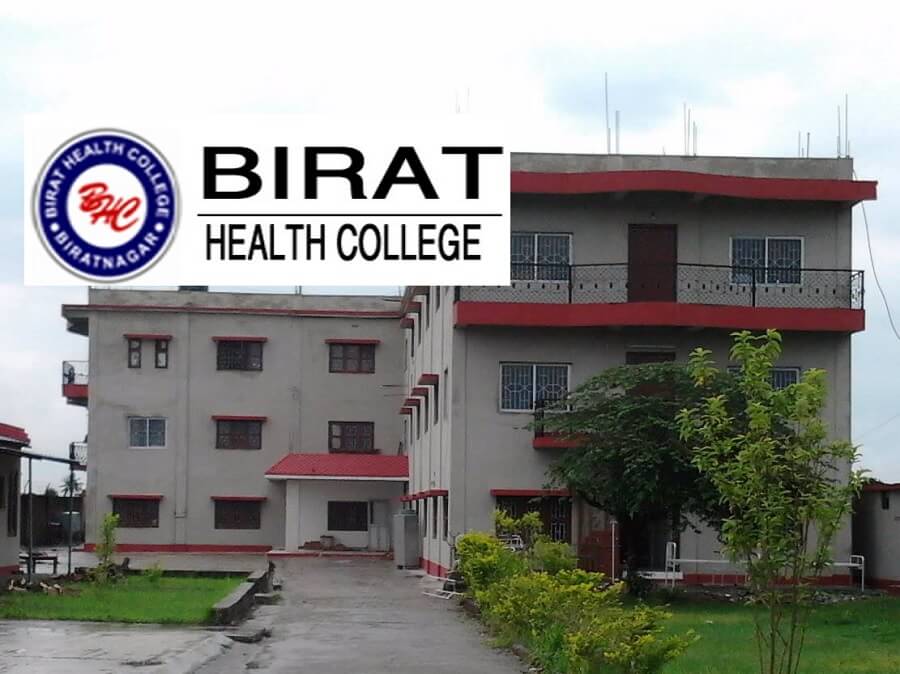
Birat Health College (BHC) is a health sciences college located in Biratnagar-4, Morang district, Koshi Province, Nepal. Established in 2004 AD (2061 BS), the college provides health education at bachelor, PCL, diploma, and certificate levels.
BHC was established by a group of academicians and health professionals with an academic focus on medical science and health technology. Its programs combine classroom study with laboratory work, practical instruction, clinical exposure, and community-based learning according to the requirements of individual health disciplines.
The college has academic affiliations with Purbanchal University and the Council for Technical Education and Vocational Training (CTEVT). Its current academic portfolio covers nursing, public health, general medicine, pharmacy, medical laboratory technology, and diagnostic radiography.
Established in 2004 AD (2061 BS) in Biratnagar-4, Morang, Koshi Province.
Offers health sciences education at bachelor, PCL, diploma, and certificate levels.
Bachelor-level programs are affiliated with Purbanchal University, while technical health programs are conducted under CTEVT.
Academic offerings include Post-Basic Bachelor of Nursing Science, BSc Nursing, Bachelor of Public Health, PCL in General Medicine, PCL Nursing, Diploma in Pharmacy, Certificate in Medical Laboratory Technology, and Certificate in Diagnostic Radiography.
Recognized by the Nepal Nursing Council, Nepal Pharmacy Council, and Nepal Health Professional Council for relevant professional disciplines.
Admission to PBNS, BSc Nursing, and BPH follows MECEE-BL and the prevailing rules of the Medical Education Commission.
Graduates of regulated health programs must meet the licensing requirements of the respective professional council before entering professional practice.
Teaching is supported by laboratories, a library, internet access, tutorial classes, and transportation for clinical, community, and field-based activities.
Practical learning forms an important part of the academic structure, with clinical practice, laboratory work, community exposure, field practice, and professional practicum varying by program.
Birat Health College is situated in Biratnagar-4, Morang, in Koshi Province. Its location places students in Biratnagar while the academic structure of its health programs includes clinical placements, community activities, field practice, laboratory work, and other forms of practical training.
Transportation support is available for activities such as clinical postings, community health programs, and field practice. This is particularly relevant to programs in which learning extends beyond regular classroom sessions.
BHC conducts bachelor-level programs under Purbanchal University and technical health programs under CTEVT. The college is also recognized by the Nepal Nursing Council, Nepal Health Professional Council (NHPC), and Nepal Pharmacy Council.
These academic and professional bodies have different roles. The university or technical education body governs the academic program, while the relevant professional council regulates professional requirements applicable to graduates in the respective health field.
BHC has a mix of university-level and technical health education programs.
| Program | Academic Body | Structure |
|---|---|---|
| Post-Basic Bachelor of Nursing Science (PBNS) | Purbanchal University | 3 years |
| Bachelor of Science in Nursing (BSc Nursing) | Purbanchal University | 4 years |
| Bachelor of Public Health (BPH) | Purbanchal University | 8 semesters |
| PCL in General Medicine (Health Assistant) | CTEVT | 3 academic years |
| PCL Nursing (Staff Nurse) | CTEVT | 3 years |
| Diploma in Pharmacy | CTEVT | 3 years |
| Certificate in Medical Laboratory Technology (CMLT) | CTEVT | Certificate-level health program |
| Certificate in Diagnostic Radiography | CTEVT | 3 academic years |
The Post-Basic Bachelor of Nursing Science curriculum under Purbanchal University runs for three years. It is structured for advanced nursing education and includes basic sciences alongside clinical, community, educational, research, and management components.
First-year study includes anatomy and physiology, pharmacology, pathophysiology, microbiology and parasitology, biochemistry, nutrition and dietetics, medical-surgical nursing, nursing concepts and theories, pediatric nursing, medical sociology and anthropology, and professional English.
The second year moves into midwifery, community health nursing, psychiatric nursing, educational science, epidemiology, geriatric nursing, and applied computer technology. Third-year study includes leadership and management, research and biostatistics in nursing, oncology nursing, and an elective area covering options such as community health nursing, midwifery, medical-surgical nursing, or psychiatric nursing.
The Bachelor of Science in Nursing curriculum is a four-year Purbanchal University program. Its first year establishes a base in anatomy and physiology, biochemistry, microbiology and parasitology, pathophysiology, pharmacology, nutrition and dietetics, foundations of nursing, and community health nursing.
Second-year study includes nursing concepts and theories, medical-surgical nursing, psychiatric nursing, community health nursing, medical sociology and anthropology, and geriatric nursing.
The third year covers pediatric nursing, midwifery, community health nursing, basic epidemiology, and gynaecology nursing. In the fourth year, students study research and biostatistics in nursing, educational science, leadership and management, and advanced medical-surgical nursing. Theory and practical components are incorporated across several major subjects.
The Bachelor of Public Health program follows an eight-semester curriculum under Purbanchal University. It begins with the scientific and professional foundations needed for later public health study.
Early semesters cover introduction to public health, anatomy, physiology and pathophysiology, public health microbiology, public health biochemistry, professional English, public health entomology and rodentology, pharmacology and toxicology, first aid and safety, foods and nutrition, and environmental health.
The curriculum then progresses into subjects such as public health core actions, epidemiology of communicable diseases, family health, applied public health nutrition, environmental and occupational health, demography, population studies and family planning, reproductive health and gender, and epidemiology of non-communicable diseases and mental health. Laboratory and field-based components are included alongside theory.
The PCL in General Medicine is a three-year, yearly-system CTEVT program designed for middle-level technical health education. Its academic scope combines general medicine with clinical, public health, community, diagnostic, and basic management competencies.
Course areas include medicine, gynaecology, surgery, orthopedics, physiotherapy, first aid, clinical pathology, clinical pharmacology and pharmacy, environmental health, health education, primary health care, family health, pediatrics, neonatology, psychiatry, dermatology, ENT, dentistry, ophthalmology, health management, epidemiology, and community diagnosis.
The curriculum also includes comprehensive clinical and community field practicum. This structure places substantial emphasis on applying clinical knowledge in supervised practical settings rather than limiting study to classroom instruction.
PCL Nursing follows a three-year yearly system under CTEVT. The curriculum develops nursing knowledge through theory, clinical practice, community health learning, and progressively specialized nursing subjects.
The course structure begins with fundamentals of nursing, community health nursing, anatomy and physiology, basic science applied to nursing, English, and Nepali. Later study covers medical and surgical nursing, geriatric nursing, behavioural science and mental health nursing, additional community health nursing, and social studies.
The third year concentrates on midwifery, gynaecological nursing, child health nursing, and leadership and management, with practical components accompanying the principal clinical subjects.
The Diploma in Pharmacy is a three-year yearly-system CTEVT program. Its curriculum combines pharmaceutical science with dispensing, clinical, community, management, and professional practice components.
Study areas include pharmaceutics, pharmacology, pharmaceutical chemistry, pharmacognosy, biochemistry and microbiology, pharmacotherapeutics, pharmaceutical management, and public health pharmacy.
Advanced sections include hospital and clinical pharmacy, pharmaceutical jurisprudence and community pharmacy practice, further pharmacotherapeutics, and comprehensive professional field practice. Practical components accompany several major pharmaceutical subjects.
The Certificate in Medical Laboratory Technology forms part of BHC's technical health education portfolio. Its subject area is medical laboratory technology, where practical laboratory work is central to the academic discipline.
The broader laboratory environment at BHC includes facilities used for scientific and health-related study, supporting hands-on learning across laboratory-oriented subjects.
The Certificate in Diagnostic Radiography follows a three-year yearly-system CTEVT curriculum. The first year concentrates on foundational subjects, while later stages shift toward radiography, imaging, clinical application, and practical work.
Second-year areas include radiographic technique, radiological procedure, radiographic imaging, basic radiation physics, radiological anatomy, first aid, and public health. Third-year study includes basic radiographic pathology, clinical practice and ethics, and radiography practical courses.
The curriculum is structured so that the final stage places greater weight on applying learned skills within hospitals, health institutions, and imaging settings.
Admission to PBNS, BSc Nursing, and BPH is based on MECEE-BL and follows the prevailing rules, guidelines, code of conduct, scholarship provisions, seat allocation system, fee structure, and admission procedures established by the Medical Education Commission (MEC), Nepal.
Seats, fees, scholarships, examination guidelines, admission procedures, and related provisions may change according to MEC decisions and the applicable MEC academic calendar. Applicants therefore need to follow the requirements issued for the relevant admission cycle rather than relying on figures or conditions from an earlier intake.
Academic completion and professional entry are separate stages in regulated health education. After completing the applicable course, graduates must pass the licensing examination of the respective professional council before entering the regulated profession.
Laboratory work is part of the academic environment at BHC. The facilities cover areas including physics, chemistry, botany, zoology, computer science, biochemistry, and parasitology. These spaces support practical exercises connected with the scientific and health subjects taught in the college.
The nature of BHC's programs also makes practical learning an important part of study. Nursing involves clinical practice, public health includes laboratory and field-based work, general medicine includes clinical and community practicum, pharmacy includes professional field practice, and diagnostic radiography includes extensive applied work.
The college library uses digital automation software and provides access to reference books, journals, and research papers. It serves regular study, reference work, assignments, examination preparation, and research-related academic activities.
Internet access is also available on campus, giving students an additional route to digital learning resources and online academic materials.
Transportation is provided for academic activities that take students outside the regular classroom environment. This includes clinical postings, community health programs, and field practice.
Such support is particularly relevant in health education because several BHC programs include community, hospital, laboratory, or field-based components within their academic structure.
BHC conducts tutorial classes for students who need additional academic guidance. These sessions are provided without an additional tutorial charge and are intended to support revision of course concepts and examination preparation.
This gives students a structured academic support option alongside their scheduled classes and practical sessions.
Sports activities at the college include football, basketball, volleyball, and athletics. The college also conducts sports-related activities and competitions as part of student life.
These activities sit alongside the college's academic focus on health sciences and provide students with opportunities to participate in organized physical and group activities outside regular coursework.
A recurring feature across BHC's programs is the movement from theoretical study into supervised practical application. Nursing programs include clinical practice; public health uses laboratory, field, and community-based work; general medicine includes comprehensive clinical and community practicums; pharmacy includes field practice; and diagnostic radiography moves into clinical and imaging practice.
This practical structure reflects the requirements of the individual curricula rather than a single common training format. Students therefore encounter different combinations of laboratories, clinical postings, community activities, practical classes, and field assignments depending on their program.
Birat Health College offers a concentrated range of health education programs in Biratnagar, with Purbanchal University bachelor programs alongside CTEVT technical health courses. Its academic environment is built around nursing, public health, general medicine, pharmacy, laboratory technology, and diagnostic radiography, supported by laboratory facilities, a library, tutorial classes, transportation for field activities, internet access, sports, and practical learning arrangements.



.png)