



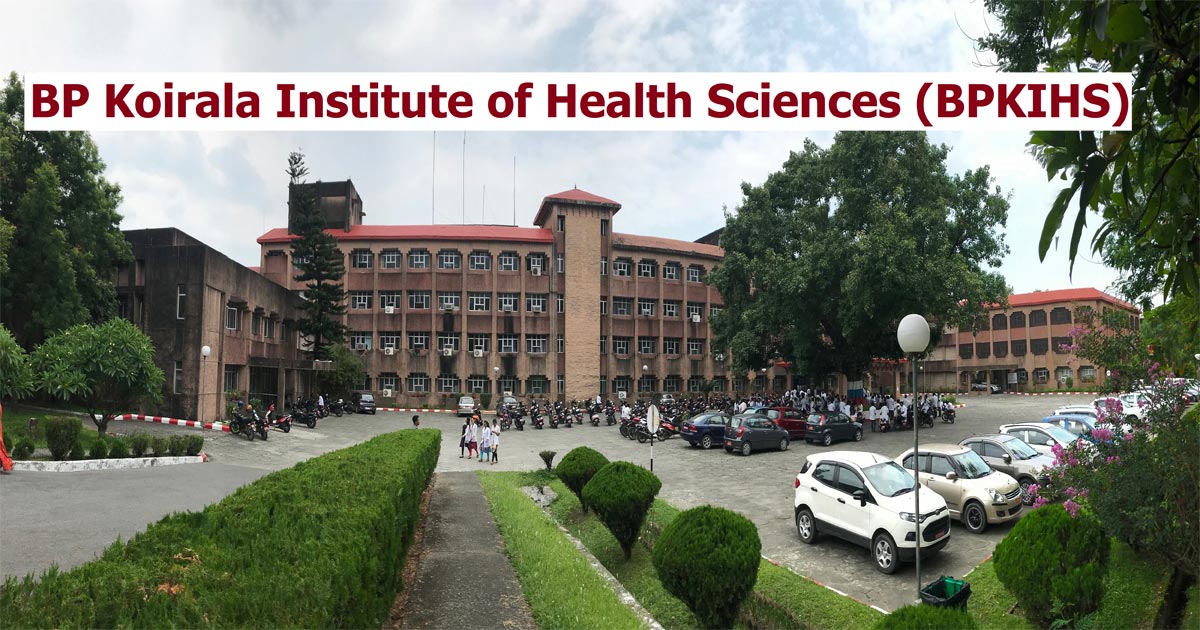
B.P. Koirala Institute of Health Sciences (BPKIHS) is a public, autonomous health-sciences institution in Dharan, Sunsari, Koshi Province, Nepal. It was established on 18 January 1993 under the B.P. Koirala Institute of Health Sciences Act, 2049. The law gives the institute a statutory role in health-science education, research, examinations and the awarding of health-related degrees and qualifications. BPKIHS states that it became an autonomous Health Sciences University on 28 October 1998.
The institution combines academic education with clinical services, community-based learning and research. Its academic structure covers medicine, dentistry, nursing, public health and allied health sciences, with study extending from undergraduate education to postgraduate, doctoral, super-specialty and fellowship levels.
BPKIHS also operates a central teaching hospital, maintains academic and clinical departments, supports community-based training through its public-health structure, and has institutional processes for research review and ethical clearance. These functions place academic teaching, patient care, community learning and research within the same institutional setting.
| Field | Information |
|---|---|
| Official name | B.P. Koirala Institute of Health Sciences |
| Acronym | BPKIHS |
| Location | Dharan, Sunsari, Koshi Province, Nepal |
| Established | 18 January 1993 |
| Legal basis | B.P. Koirala Institute of Health Sciences Act, 2049 |
| Institutional type | Public, autonomous/self-governing health-sciences institution |
| Institutional description | Autonomous Health Sciences University |
| Academic fields | Medicine, dentistry, nursing, public health and allied health sciences |
| Academic levels | Undergraduate, postgraduate, doctoral, super-specialty and fellowship |
| Teaching facility | Central Teaching Hospital |
| Official website | https://bpkihs.edu/ |
BPKIHS is a health-sciences institution established through a specific Act rather than as a conventional college operating only under an affiliating university.
The B.P. Koirala Institute of Health Sciences Act, 2049 establishes the institute and defines its institutional functions. Its legal framework provides authority for education, study, teaching, research, examinations and the awarding of qualifications in health-related fields.
This legal structure is important when describing BPKIHS. Labels such as "college" or "university" alone do not fully explain its position. BPKIHS is a statutory, self-governing institution with degree-awarding authority, while the institution itself uses the description "autonomous Health Sciences University."
The institute's academic work spans several branches of health education rather than medicine alone. Medical, dental, nursing, public-health and allied-health education operate within an institutional system that also includes clinical departments, a teaching hospital, research processes and community-based academic activities.
BPKIHS was established on 18 January 1993 in Dharan. The institution records an Indo-Nepal agreement for its collaborative development dated 10 March 1994 and states that it became an autonomous Health Sciences University on 28 October 1998.
The establishment of the institute through legislation gave it responsibilities extending beyond classroom instruction. Its statutory objectives connect health education with service and research, which helps explain the structure that developed around academic departments, clinical services and community-based education.
Dharan has remained the institutional base of BPKIHS. The location is specified in its legal and institutional records, placing the institute in Sunsari district of Koshi Province.
The historical development of BPKIHS is therefore closely tied to three functions:
education and training in health sciences;
health services through clinical and hospital activities; and
study and research in health-related fields.
These functions remain central to understanding the institution's academic identity.
BPKIHS derives its institutional authority from the B.P. Koirala Institute of Health Sciences Act, 2049.
The statutory framework establishes BPKIHS as a self-governing body and provides for academic activities such as teaching, research, examinations and the awarding of health-related qualifications.
This distinguishes BPKIHS from an institution whose academic programs depend entirely on affiliation with another university for degree authority.
The institute's legal status also explains why its academic structure includes several levels of health-professions education. Its functions extend across undergraduate, postgraduate and advanced study rather than being limited to a single professional program.
BPKIHS describes itself as an autonomous Health Sciences University from 28 October 1998. That institutional wording can be read alongside the Act, which provides the formal legal basis for its self-governing and degree-awarding functions.
BPKIHS organizes health-science education across medical, dental, nursing, public-health and allied-health areas.
Its academic structure includes undergraduate programs, postgraduate study and advanced academic pathways. MBBS, BDS, nursing and allied-health study at undergraduate level; MD/MS, MSc, MDS, MPH and nursing study at postgraduate level; and PhD, DM/MCh and fellowship study at advanced levels.
The structure reflects the multidisciplinary nature of health-professions education. A medical institution needs more than one academic department because professional education depends on basic sciences, clinical specialties, laboratory disciplines, public health, nursing, and related fields.
At BPKIHS, these areas are linked through academic departments and clinical services. Students in different programs therefore study within an institution whose work includes both academic and service functions.
BPKIHS academic programs are undergraduate degrees in medicine, dentistry, nursing, and allied health fields.
The undergraduate programs include:
Bachelor of Medicine and Bachelor of Surgery (MBBS)
Bachelor of Dental Surgery (BDS)
BSc Nursing
BSc Medical Imaging Technology (BSc MIT)
BSc Medical Laboratory Technology (BSc MLT)
Midwifery study
These programs represent different areas of health-professions education.
The MBBS program is the institute's undergraduate medical education pathway.
Medical education involves learning across basic medical sciences and clinical disciplines. Within BPKIHS, medical education is supported by academic departments and the teaching hospital, allowing the medical curriculum to operate within an institution that also provides clinical services.
The Bachelor of Dental Surgery program provides undergraduate education in dentistry.
Dental education at BPKIHS is supported by dental academic departments and related clinical disciplines. Dentistry forms a distinct academic component of the institution rather than being treated only as a subsection of general medical training.
Students comparing medical and dental education can also read MBBS vs BDS in Nepal for a broader comparison of the two study pathways.
BSc Nursing forms part of the nursing education structure at BPKIHS.
Nursing education operates alongside medical, dental and public-health education within the institute. Its placement within a health-sciences institution connects nursing study with clinical and interdisciplinary health-service environments.
For broader information about the field, students can read the Collegenp resource on BSc Nursing.
BPKIHS also includes undergraduate study in allied-health areas such as medical imaging technology and medical laboratory technology.
BSc Medical Imaging Technology focuses on the academic and technical field associated with medical imaging, while BSc Medical Laboratory Technology relates to laboratory sciences used in health-care settings.
These programs show that the academic scope of BPKIHS extends beyond medicine, dentistry and nursing into technical health-science disciplines.
Postgraduate education at BPKIHS covers clinical, basic-science, dental, nursing and public-health fields.
The main postgraduate program groups in BPKIHS academic information include:
MD/MS and other clinical postgraduate programs;
MSc programs in basic sciences and health-science fields;
MSc Nursing;
Master of Dental Surgery (MDS); and
Master of Public Health (MPH).
MD and MS programs provide postgraduate medical education across clinical disciplines.
These programs are connected with departments responsible for different areas of medical and surgical practice. The teaching hospital provides the clinical setting associated with postgraduate education in relevant specialties.
BPKIHS also provides MSc-level education in basic sciences and health-related academic areas.
Basic-science postgraduate education supports disciplines that underpin medical and health-professions teaching. These fields are part of the broader academic system needed for teaching, laboratory work and research.
The Master of Dental Surgery represents postgraduate education in dental specialties.
MDS study builds on undergraduate dental education and is situated within the institute's dental academic structure.
The Master of Public Health is part of BPKIHS's public-health education structure.
Public-health study differs from purely hospital-based clinical education because it also addresses population health, community settings, health systems and field-based learning. The School of Public Health and Community Medicine plays an important role in this area.
The academic structure of BPKIHS extends beyond undergraduate and conventional postgraduate education.
Institutional academic information includes:
PhD study;
DM programs;
MCh programs;
fellowship study;
short-term academic programs; and
continuing medical education.
PhD education represents the doctoral research component of the institute's academic work.
Doctoral study is closely linked with research, academic supervision and institutional research procedures. The existence of doctoral programs also reflects BPKIHS's role as a degree-awarding academic institution rather than solely a clinical training centre.
DM and MCh programs represent advanced medical and surgical study beyond standard postgraduate qualifications.
BPKIHS has super-specialty study in medical and surgical areas. These programs are part of the institute's advanced clinical academic structure.
Fellowship study provides another form of advanced professional and academic training within BPKIHS.
Fellowships sit alongside doctoral and super-specialty study within the broader group of advanced academic programs.
BPKIHS maintains a network of departments across medical, dental, nursing and public-health disciplines.
These departments support teaching, clinical work and related academic activities.
The departmental model allows different areas of health science to operate within their own subject structures while contributing to the wider academic system.
Basic-science departments support foundational health-science education. Clinical departments connect academic teaching with patient care. Dental departments support dental education and services, while nursing and public-health units address their respective professional and academic fields.
This arrangement is especially relevant in health education because students often move between different learning environments. Depending on the program, education may involve classrooms, laboratories, clinical departments, hospital units, community settings and research activities.
The School of Public Health and Community Medicine supports teaching and community-oriented health education at BPKIHS.
Its academic activities include undergraduate and postgraduate teaching and field-based learning. Institutional information describes community diagnosis work, residential postings and training in urban and rural health facilities.
Public-health education differs from education focused entirely on individual clinical care. It considers health at family, community and population levels and therefore requires learning beyond hospital wards and outpatient departments.
At BPKIHS, community-based activities connect students with health institutions and community settings outside the central teaching environment.
Community-based education forms part of the BPKIHS learning model.
The School of Public Health and Community Medicine describes field activities that place students in community settings and health facilities. These include community diagnosis activities, residential postings and supervised learning in urban and rural health environments.
BPKIHS also describes a teaching-district approach in which students receive learning opportunities within community health institutions under academic or specialist supervision.
This model adds a population and community dimension to health-professions education. Students are not exposed only to patients who reach a central hospital; community learning also provides contact with local health systems, public-health issues and health-service delivery outside tertiary clinical settings.
The nature of community work depends on the student's academic program and discipline, but community-based education remains an identifiable part of the institute's educational structure.
BPKIHS operates a central teaching hospital that serves both clinical and academic functions.
The hospital provides a setting for patient care while supporting clinical education for relevant health-professions programs. Institutional service information includes outpatient and inpatient care, operating-theatre services, intensive-care services and specialty clinics.
Service areas include:
outpatient services;
inpatient services;
operating theatres and procedural services;
intensive-care services;
cardiology;
ear, nose and throat services;
eye care;
psychiatry;
physiotherapy and rehabilitation; and
telemedicine.
The teaching hospital's academic role is particularly important for programs that require clinical education. Students in medical, dental, nursing and other relevant health programs can study within an institution where teaching departments and patient-care services operate together.
The hospital also supports postgraduate and advanced clinical education through departments associated with different specialties.
Clinical learning at BPKIHS is connected to the institute's hospital and departmental structure.
Health-professions education requires students to develop academic knowledge alongside supervised professional learning. The presence of a teaching hospital allows clinical subjects to be taught within the setting in which health services are delivered.
The learning environment therefore includes several connected components:
classroom-based academic teaching;
laboratory learning;
departmental teaching;
hospital-based clinical learning;
community-based education; and
research activities.
Not every program uses these components in the same way. Medical, dental, nursing, allied-health and public-health education have different academic requirements, but they operate within the same broader health-sciences institution.
Research is part of the statutory and academic mandate of BPKIHS.
The institution's research structure includes thesis-related work for postgraduate, doctoral, super-specialty and fellowship education. BPKIHS has also established procedures for the review and ethical clearance of research proposals.
Research within a health-sciences institution can involve clinical, laboratory, community, public-health and academic questions. Formal review procedures are especially important where research involves human participants, clinical information or health-related interventions.
The research component of BPKIHS therefore operates alongside teaching and health services rather than as a separate institutional activity.
BPKIHS uses an Institutional Review Committee (IRC) process for research review and ethical clearance.
The institute's thesis-protocol guidance requires research proposals covered by its academic procedures to pass through institutional review before thesis work begins.
Ethical review is an important part of health research because research involving people, health information or clinical activities requires safeguards beyond academic approval alone.
Within BPKIHS, the IRC process provides an institutional mechanism for examining research proposals before approved research proceeds.
For postgraduate and advanced students, this means research activity is connected with formal supervision, protocol preparation and ethical review rather than being treated only as an individual academic exercise.
BPKIHS maintains a Central Library as part of its academic infrastructure.
Institutional academic access to medical books, journals, and electronic resources.
A health-sciences library supports several forms of academic work. Undergraduate students need textbooks and reference material; postgraduate and doctoral students require journals and research literature; faculty members use academic resources for teaching and research.
The Central Library therefore supports the educational and research functions of the institute across multiple levels of study.
One of the defining features of BPKIHS is the presence of several health-professions disciplines within one institution.
Medicine, dentistry, nursing, public health, and allied health have different professional roles, but their academic work overlaps in areas such as basic sciences, patient care, disease prevention, community health, and research.
This shared institutional setting creates links between:
basic sciences and clinical medicine;
medical and surgical specialties;
dentistry and oral health;
nursing education and patient care;
laboratory and imaging sciences;
public health and community medicine; and
research and ethical review.
The result is an academic structure organized around health sciences as a broad field rather than around a single course.
BPKIHS is located in Dharan, Sunsari, Koshi Province, Nepal.
Dharan is the institute's statutory and institutional base. Its academic departments, central teaching hospital and administrative functions are centred there.
The location also connects with the institute's community-oriented academic work. While the central institution is based in Dharan, community learning includes activities conducted through health facilities and field settings beyond the main academic environment.
Official Website: https://bpkihs.edu/
BPKIHS combines several functions that are often discussed separately: degree education, clinical health services, community training and research.
Its structure can be understood through four connected areas.
The institute provides health-science education from undergraduate through postgraduate and advanced levels.
The central teaching hospital and clinical departments provide patient-care services while supporting clinical education.
The public-health and community-medicine structure takes parts of health education into community and field settings.
Research forms part of the institute's statutory role and includes institutional procedures for research proposals and ethical review.
Together, these functions explain why BPKIHS is described as a health-sciences institution rather than simply a medical college.
Students researching BPKIHS should first identify the academic field they intend to study.
The institute covers several distinct health-professions pathways. MBBS is a medical degree, BDS is focused on dentistry, nursing programs prepare students within the nursing discipline, public-health study addresses population and community health, and allied-health programs cover technical areas such as medical imaging and laboratory sciences.
Students interested in advanced education can also find postgraduate, doctoral, super-specialty and fellowship pathways within the BPKIHS academic structure.
Course selection should therefore begin with the student's intended profession and academic field rather than the institution's name alone.
Applicants seeking admission-specific information should use the official BPKIHS website and the relevant official admission authority because admission rules, application procedures and intake information are published separately from general institutional information.
B.P. Koirala Institute of Health Sciences is located in Dharan, Sunsari, Koshi Province, Nepal. Dharan is the institute's academic, administrative and hospital base.
BPKIHS was established on 18 January 1993 under the B.P. Koirala Institute of Health Sciences Act, 2049. The institution states that it became an autonomous Health Sciences University on 28 October 1998.
BPKIHS is a statutory, autonomous/self-governing health-sciences institution with authority to award health-related degrees and qualifications. The institution describes itself as an autonomous Health Sciences University.
BPKIHS provides education in medicine, dentistry, nursing, public health and allied health sciences. Its academic structure includes undergraduate, postgraduate, doctoral, super-specialty and fellowship study.
Institutional academic information includes MBBS, BDS, BSc Nursing, BSc Medical Imaging Technology, BSc Medical Laboratory Technology and midwifery study at undergraduate level.
BPKIHS academic information includes MD/MS, MSc programs, MSc Nursing, Master of Dental Surgery and Master of Public Health. Advanced academic study also includes PhD, DM/MCh and fellowship pathways.
Yes. BPKIHS operates a central teaching hospital with outpatient, inpatient, operating-theatre, intensive-care and specialty services. The hospital also supports clinical education in relevant programs.
Yes. The School of Public Health and Community Medicine describes field-based learning, community diagnosis, residential postings and training through urban and rural health settings as part of its academic activities.
Yes. Research is included in the institute's statutory and academic functions. BPKIHS also uses an Institutional Review Committee process for research review and ethical clearance under its thesis-related procedures.
The official website of B.P. Koirala Institute of Health Sciences is https://bpkihs.edu/.
